Location: Sankt Florian, 19km (12 miles) Southeast of Linz, Upper Austria Map
Tel. +43 (0)7224 8902 0
Official site
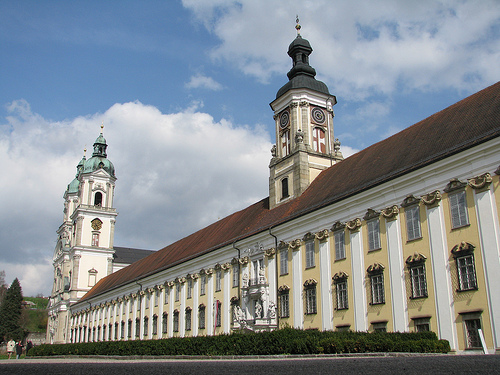
The Abbey of Saint Florian, commonly known as St. Florian Monastery or Stift Sankt Florian, is a historic Augustinian priory located in the town of Sankt Florian in the Linz-Land District of Upper Austria, approximately 14 kilometers southeast of Linz. As the largest Baroque monastery in Upper Austria and one of the oldest continuously operating Augustinian communities in the world, it exemplifies grandeur in ecclesiastical architecture and cultural heritage. Dedicated to Saint Florian—a 3rd-4th century Roman military commander martyred for his Christian faith and revered as the patron saint of firefighters—the abbey is built over his presumed grave. The site attracts visitors for its stunning Baroque aesthetics, musical legacy tied to composer Anton Bruckner, and serene atmosphere, often described as a hidden gem compared to more crowded sites like Melk Abbey.
Saint Florian and the earliest shrine
Florian served in the civil
administration of the Roman province of Noricum (roughly modern
Austria). During the Diocletianic persecution he publicly declared
himself a Christian. After refusing to sacrifice to the imperial gods he
was tortured and drowned in the Enns River with a millstone around his
neck. Tradition holds that a pious woman named Valeria recovered the
body and buried it on the spot where the abbey church now stands. A
spring that appeared during the translation of the relics is still
pointed out as the Floriansbrunnen.
Veneration began in the fourth
century. By the Carolingian era a small monastic cell existed “above the
saint’s grave.” The first written mention of a monastery dates to 819;
by 888 documents already call it a monasterium. The early community
followed the Aachen rule for canons rather than a strictly monastic
rule. The site suffered destruction during Avar and Hungarian raids,
then was rebuilt several times.
Augustinian refounding and
medieval growth (1071–1686)
In 1071 Bishop Altmann of Passau, a
leading figure of the Gregorian Reform, placed the house under the Rule
of St. Augustine. Secular canons became regular canons who took vows and
combined liturgical life with pastoral work. The first named provost,
Hartmann, took office that year. The community quickly became a regional
centre of learning and church administration. In the thirteenth century
the provost served as archdeacon of Lorch, giving the abbey influence
over much of what would become Upper Austria.
A Romanesque church of
the late eleventh century burned in 1235 and was immediately rebuilt.
The scriptorium produced the Giant Bible of St. Florian around
1140–1150, a major work of Romanesque illumination. A women’s community
existed alongside the canons until the fifteenth century. The hermit
Wilbirg, who died in 1289 with a reputation for holiness, is still
commemorated in the basilica. The abbey acquired parishes as far as the
Wachau and built a school that lasted until 1807. During the wars of
Matthias Corvinus in the 1470s–80s the canons moved valuables to the
nearby town of Enns for safety.
Baroque reconstruction
(1686–1751)
The present appearance dates almost entirely from the
late seventeenth and eighteenth centuries. After the Ottoman siege of
Vienna was lifted in 1683, Emperor Leopold I made a thanksgiving
pilgrimage to Florian’s tomb. Provost David Fuhrmann (1667–1689) seized
the moment and commissioned a complete rebuild. Work began in 1686 on
the church, using the medieval ground plan and some surviving walls.
The Milanese architect Carlo Antonio Carlone designed the basilica, his
masterpiece. It was the first church north of the Alps with a continuous
ceiling fresco cycle. Carlone completed the church and most of the
monumental west wing before his death in 1708. Jakob Prandtauer, already
famous for Melk Abbey, took over. He added the three-storey ceremonial
staircase, the grand west portal, the Marble Hall (Marmorsaal) of
1718–1724, and the summer refectory. After Prandtauer’s death in 1726
his designs were finished by Jakob Steinhuber. Johann Gotthard Hayberger
of Steyr built the library wing in 1744–1751. The entire complex was
essentially complete after 65 years of continuous work.
The result is
a vast rectangle 204 m long and 110 m wide with two inner courtyards.
The west façade stretches more than 200 m and is crowned by the twin
towers of the basilica. Interior decoration includes frescoes by
Bartolomeo Altomonte, stucco by Giovanni Battista Carlone and Franz
Josef Holzinger, and paintings by Johann Michael Rottmayr, Michael
Willmann and Andrea Celesti. The Marble Hall, intended for imperial
receptions, contains an apotheosis of Charles VI. The library hall, with
its towering shelves and Altomonte fresco of Virtue united with Science,
is one of the finest late-Baroque rooms in Austria.
Nineteenth
century to the present
Emperor Joseph II’s reforms in the 1780s
brought expropriation and the loss of some properties, but the community
recovered. In the nineteenth century the abbey became a centre of Upper
Austrian historical scholarship under canons such as Franz Xaver Pritz
and Jodok Stülz. The school was transferred to Linz in 1807; the canons
ran the Linz gymnasium until 1848.
Anton Bruckner arrived as a
choirboy in 1837 after his father’s death. He later served as organist
from 1848 (or 1850) to 1855 and returned throughout his life to play the
great organ built by Franz Xaver Krismann in 1770–1774. Bruckner is
buried in the crypt directly beneath that instrument, now called the
Bruckner Organ (103 stops, more than 7,300 pipes). The St. Florian Boys’
Choir, founded in 1071, continues the musical tradition.
In January
1941 the Gestapo seized the abbey and expelled the canons. From 1942 it
served as headquarters of the Reichsrundfunkgesellschaft. The community
lived at Pulgarn Abbey until they returned in 1945. The church was
raised to basilica minor in 1999. Today about two dozen canons serve 33
incorporated parishes. The complex also houses the Upper Austrian Fire
Brigade Museum, reflecting Florian’s patronage of firefighters. The
library holds roughly 150,000–160,000 volumes, including some 800
medieval manuscripts and nearly 1,000 incunabula. The Sankt Florian
Psalter, discovered here in 1827, is now in the National Library of
Poland.
The abbey remains a living religious house, a major cultural
archive, and one of the least crowded of Austria’s great Baroque
monasteries. Its history stretches from a fourth-century martyr’s grave
through Carolingian cell, medieval canonry, and imperial Baroque
palace-monastery to a working community that still sings the same hours
that have been heard on this hill for more than nine centuries.
St. Florian Abbey (Stift Sankt Florian) is one of Austria’s great
Baroque ensembles. Many visitors rank it with Melk and Klosterneuburg,
and some call it the country’s most complete example of High Baroque
monastic architecture because of its size, unified courtyard plan, and
dense ornament. The present complex rose between 1686 and about 1751 -
roughly 65 years - after Provost David Fuhrmann launched a full rebuild
following the 1683 victory over the Ottomans and Emperor Leopold I’s
thanksgiving pilgrimage to the tomb of Saint Florian. Three architects
shaped the work: Carlo Antonio Carlone of Como, who began the basilica
and west range; Jakob Prandtauer of Tyrol, who took over after Carlone’s
death in 1708 and designed the grand staircase and Marble Hall; and
Johann Gotthard Hayberger of Steyr, who built the library wing from
1744. Earlier Romanesque and Gothic fabric survives inside the later
skin: parts of the church walls and the south tower were retained and
wrapped in Baroque veneer rather than demolished.
The basilica
presents a three-storey west front with two towers about 80 meters high,
each crowned by a dome and lantern. Mighty white half-columns, broken
and winding entablatures, and tightly packed storeys force the viewer to
stand close, so the façade reads as a vertical wall of sculpture rather
than a distant silhouette. The inner courtyard is framed by three main
ranges. The west wing (1695-1708) holds the ceremonial staircase and a
three-storey portal. The south wing (1718-1724) is dominated by the
pavilion-like Marble Hall, the secular counterpart to the church. The
east wing (1744-1750) centers on the library. Plans for a twin theatre
and a formal French garden were never built, but the Summer Refectory
(1724/25-1730) was finished as an annex on the east side. Stucco
workers, fresco painters, sculptors, and cabinetmakers from Upper
Austria and northern Italy filled the rooms with illusionistic ceilings,
painted marble, gilded woodwork, and 18th-century furnishings that still
give the house its theatrical character.
The interiors are designed as a sequence of immersive rooms. The
Imperial Marble Hall, built for princely receptions, has pink marble
(partly real, partly scagliola painted to imitate stone), tall windows,
and a trompe-l’œil ceiling whose allegorical figures and architecture
appear to shift as the viewer walks. Throne-like seats and portraits of
Habsburg rulers underline its court function. Emperor Charles VI and
Prince Eugene of Savoy are commemorated here; the hall and the refectory
below were opened in 1732.
The library, a late-Baroque hall of
1744-1750, holds on the order of 130,000 to 160,000 volumes, among them
about a thousand medieval manuscripts and hundreds of incunabula.
Floor-to-ceiling wooden cases, a mezzanine gallery, and hidden doors
that open onto spiral stairs give the room the feel of a closed
scholarly world. The ceiling fresco by Bartolomeo Altomonte (figures)
and Antonio Tassi (illusionistic architecture) shows “the marriage of
virtue and science under the protection of religion.” One of the abbey’s
most famous finds, the Sankt Florian Psalter - a multilingual medieval
psalter in Latin, German, and Polish - was identified here in 1827 and
later moved to the National Library of Poland.
The Abbey Basilica,
raised to minor basilica status in 1999 and dedicated to Saints Florian
and Augustine, was the first church north of the Alps with continuous
ceiling frescoes covering the entire vault. Johann Anton Gumpp and
Johann Melchior Steidl painted scenes from Florian’s life and Marian
subjects; Bartolomeo Carlone supplied the white stucco. Side chapels
open like theatre boxes behind high arches. The Bruckner Organ, built by
Franz Xaver Krismann in 1770-1774 and later enlarged, is one of
Austria’s largest playable church organs: four manuals, 103 stops, and
more than 7,300 pipes (figures vary slightly by source between 7,343 and
7,386). Anton Bruckner, once a choirboy and later organist here
(1848-1855), is buried in a metal sarcophagus in the crypt directly
beneath the instrument so that, by his own wish, he might still “hear”
it.
The crypt also holds a 13th-century discovery of more than 6,000
Christian bones, stacked behind a grille and traditionally linked to
early pilgrims and Roman-period burials at the martyr’s grave. Nearby
stands the Sebastian Altar, whose panel paintings by Albrecht Altdorfer
belong to the Danube School and are among the abbey’s greatest
late-medieval treasures. The picture gallery shows 16th- and
17th-century works together with other late-medieval pieces. On the same
site, the Upper Austrian Fire Brigade Museum honors Saint Florian as
patron of firefighters.
St. Florian has been a working house of Augustinian Canons since
1071, making it one of the oldest continuously inhabited communities
following the Rule of Saint Augustine. Its boys’ choir, the St.
Florianer Sängerknaben, traces the same foundation date. The choir still
sings the liturgy and also tours, records, and appears in opera (often
as the Three Boys in The Magic Flute). A men’s chorus of former
choirboys was added in 1989. Anton Bruckner’s years as singer and
organist left a lasting mark on his symphonic writing; the abbey keeps
rooms with his piano, furniture, and early sketches.
The house once
served as an imperial stopping place. Its economy still rests on
farming, forestry, culture, and pilgrimage. Artifacts such as the Sankt
Florian Psalter recall a long tradition of multilingual scholarship.
After expropriation under the Gestapo in 1941, the canons returned after
1945 and restored monastic life. Today the abbey remains a living
monastery, a concert venue, and a place where martyrdom, faith, and
Baroque spectacle still meet under one roof.
Practical note for
visitors: the state rooms (library, Marble Hall, basilica, crypt) are
normally seen on guided tours. Public tours typically run daily from May
through October at 11:00, 13:00, and 15:00; group tours can be booked
year-round. Short live recitals on the Bruckner Organ are offered in
season (often mid-May to mid-October, daily except Tuesday and Saturday
at 14:30). Confirm current times and prices on the official site before
travel. The abbey sits in the town of Sankt Florian, a short trip south
of Linz in Upper Austria.
The list of prelates is largely based on the magnificent manuscript,
which was commissioned by Provost Johann Georg Wiesmayr in 1740 by the
Florian canon Johann Evangelist Pachl (1677–1744) and transferred to
parchment in decorative handwriting by the valet Karl Anselm Heiss.
Hartmann, officiated 1071-1099, first provost of the 1071 reformed
monastery
Isimbert, officiated 1099–1123
Dietmar I, officiated
1124–1152
Henry I, officiated 1153–1172
Engelbert I, officiated
1172–1202
Otto, officiated 1203-1213, from 1214 Bishop of Gurk
Altmann, officiated 1213–1223
Bernhard, officiated 1224–1240
Dietmar II, officiated 1240–1250
Arnold I, officiated 1250–1256
Sibito, officiated 1257–1258
Arnold II, officiated 1258–1271
Conrad, officiated 1272–1277
Ulschalk, officiated 1277–1283
Ulrich
von Patnanger (* in Enns), officiated 1283–1295
Einwik Weizlan (* in
Enns), officiated 1295–1313
Henry II of Marsbach, officiated
1314–1321
Wernher von Winkel, officiated 1322–1331
Henry III
Piber, officiated 1331–1350
John I, officiated 1350–1353
Weigand
Mosinger, officiated 1354–1372
Albert of Rana, officiated 1372–1381
Stephan Zainkgraben (Zeingraben), officiated 1382–1407
Jodok I
Pernschlag, officiated 1407–1417
Kaspar I Seisenecker, officiated
1417–1436
Lukas Fridensteiner von Maur, officiated 1436–1459,
received the pontificals from Pope Pius II Piccolomini (1458–1464), i.
H. that from this point on he was allowed to wear episcopal insignia and
perform episcopal official acts.
Johann II Stieger, officiated
1459–1467
Kaspar II Vorster, officiated 1467–1481
Peter II
Sieghartner, officiated 1481–1483
Leonhard Riesenschmied (* in
Lembach im Mühlkreis), officiated 1483-1508
Peter III Maurer (* in
St. Florian), officiated 1508-1545, resigned as provost
Florian Muth
(born 1491 in St. Florian), officiated 1545–1553
Siegmund
Pfaffenhofer (* in St. Florian), officiated 1553–1572
Georg I Freuter
(* in Coburg), officiated 1573–1598
Vitus (Veit) Widmann († January
20, 1612), officiated 1599–1612
Leopold I. Zehetner (* 1573 in St.
Florian; † September 30, 1646), officiated as provost 1612-1646
Mathias Gotter (* in Krummau), officiated as provost 1646-1666
David
Fuhrmann (* 1621 in Straubing; † October 6, 1689 in Linz), officiated
1667-1689, first Lateran abbot
Matthäus I von Weißenberg (* 1644 in
Steyr; † 1700 in St. Florian), officiated as provost 1689-1700
Franz
Klausius (Clausius) Kröll, officiated as provost 1700-1716
John III
Födermayr, who served as provost from 1716 to 1732, had Hohenbrunn
Palace built
Johann Georg II Wiesmayr (born April 4, 1695),
officiated as provost 1732–1755
Engelbert II Hofmann, officiated as
provost 1755–1766
Matthew II Gogl, officiated as provost 1766–1777
Leopold II Trulley, officiated as provost 1777–1793
Michael I.
Ziegler, officiated as provost 1793–1823
Michael II Arneth,
officiated as provost 1823–1854
Friedrich Mayer, officiated as
provost 1854-1858
Jodok II. Stülz, officiated as provost 1859-1872
Ferdinand Moser, officiated as provost 1872-1901
Josef Sailer,
officiated as provost 1901-1920, abbot general of the Austrian
Augustinian Canons Congregation 1907-1920
Vinzenz Hartl, officiated
as provost 1920-1944
Leopold Hager, officiated as provost 1944-1968,
resigned in 1968
Johannes Zauner, officiated as provost 1968-1977
Wilhelm Neuwirth, officiated as provost 1977-2005, 1987-2002 abbot
general of the Austrian Augustinian Canons' Congregation
Johannes
Holzinger (born April 12, 1951), has served as provost since 2005