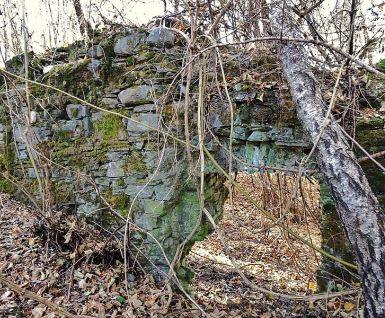
Location: Feldkirchen in Kärnten, Carinthia Map
Constructed: 12th century
Burgruine Dietrichstein, also known as Burg Dietrichstein or Dietrichstein Castle Ruins, is a medieval castle ruin located in the Glantal valley near Feldkirchen in Kärnten, in the Austrian state of Carinthia. Situated on a rocky outcrop at an elevation overlooking the Glan River, at coordinates approximately 46°43'34"N 14°7'45"E, the site served as a strategic fortification controlling the medieval trade route known as the Venedigerstraße, which connected Vienna to Venice via the Glantalstraße. Built in the early 12th century, with local traditions suggesting origins as far back as the 9th century, it is considered the ancestral seat of the noble von Dietrichstein family, who later rose to the status of imperial princes (Reichsfürsten). Today, the ruins represent a modest yet historically significant landmark, blending remnants of Romanesque and Gothic architecture amid a natural setting. The site is protected as a cultural monument and is distinct from the nearby Schloss Dietrichstein, a later Renaissance-era palace built around 1500 at the base of the hill, which now functions as a private residence and agricultural estate.
Legendary and Early Origins (9th–12th Centuries)
Local tradition
attributes the castle’s founding to the 9th century, when a knight named
Dietrich von Zeltschach (in the service of the Luitpolding Carinthian
dukes) supposedly built a stronghold known as “Dietrichs Stein” on the
site. The name “Dietrichstein” derives from this figure and the rocky
outcrop (“Stein”) on which the castle stands.
The first documented
mention appears in a deed from 1103, referring to a ministerial knight
named Dietrich associated with the castle. At this time, the site
belonged to the high nobility of Carinthia (Uradel) and was linked to
the Eppensteiner dukes of Carinthia. The early Dietrichstein family
members were ministeriales—hereditary administrative and military
officials serving the dukes.
In 1166, the Prince-Bishops of Bamberg
(Hochstift Bamberg) acquired the Dietrichstein estates, including the
nearby town of Feldkirchen. They enfeoffed the castle to a family of
Bamberg ministeriales who adopted the name “von Dietrichstein” from
their new seat. The family’s coat of arms featured a vintner’s knife
(Winzermesser), reflecting the importance of winegrowing in the region.
This branch did not own the castle outright as an allod but held it as a
fief.
14th-Century Destruction and Rebuilding
Around 1335, the
castle was destroyed during conflicts involving Margarethe Maultasch
(Margaret of Tyrol, Countess of Tyrol and Duchess of Carinthia). A local
legend (preserved in Carinthian folklore) attributes the destruction
directly to her forces, though historical accounts confirm the event
occurred amid regional power struggles. The castle was rebuilt before
1370, restoring its defensive capabilities.
By the mid-14th century,
the original ministerial line had become extinct. In the early 14th
century, the fief passed to Nikolaus I, another Carinthian ministerialis
from nearby Nussberg Castle (Burgruine Nussberg), whose descendants
continued to use the name “von Dietrichstein.”
Late 15th-Century
Siege and Final Destruction (1483–1491)
The castle reached its height
of strategic importance in the late 15th century as a key fortress
overlooking the Glan valley trade route. In 1483, during the Hungarian
campaigns under King Matthias Corvinus (who had occupied parts of
Austrian territory), the castle came under prolonged siege. Pankraz von
Dietrichstein (a prominent member of the family and later governor of
the region) defended the ancestral seat for six months before
surrendering on promises of safe conduct and preservation. The Hungarian
forces broke these promises and completely destroyed the castle. After
the Hungarians withdrew, the ruins were further systematically
dismantled (“geschleift”) in 1491, leaving the site desolate and
uninhabitable—contemporary accounts described it as “wüst, öd, und
unerbaut, zu einer Wohnung der Gespenster” (desolate, empty, unbuilt, a
dwelling for ghosts).
(Note: Some secondary English sources mention
Ottoman involvement in the 1483 destruction, but primary Carinthian and
Austrian accounts consistently attribute the siege and razing to
Matthias Corvinus’s Hungarian troops.)
The upper castle on the rocky
spur was never rebuilt as a fortress. Its layout included a steep
southwestern drop into the valley for natural defense, reinforced on the
northeast by two walls and three ditches. Surviving remnants today
include sections of the Romanesque ring wall (Bering) on the north side
(up to ~2 meters high), late Gothic masonry on the east, the faint
outline of the bergfried (keep), and a cistern in the former courtyard.
Post-Destruction: The Lower Schloss and Family Ascendancy (1500
Onward)
Around 1500, a new, smaller residential palace (Schloss
Dietrichstein) was constructed at the foot of the ruins, likely by
adapting a former economic building or outer ward of the original
castle. This lower structure served as the family’s continuing local
residence while the upper ruins were left as a picturesque (and
symbolic) reminder of their origins.
The Schloss changed hands
several times in subsequent centuries (passing through families such as
Mägerl, Mallentein, Lassacher von Weyersberg, Kulmer, Mandorf, and
Grotta). In 1838, it returned to the Princes of Dietrichstein. It was
remodeled in a late Neoclassical (classicist) style in 1840, resulting
in its current two-story, cube-shaped form with a roof turret, barrel
vaults, and stucco elements on the ground floor (including an embedded
2nd-century Roman grave relief). A barn with distinctive brick lattice
windows stands nearby, and the estate includes the Dietrichsteiner See
(a small lake). The palace was sold in 1932 and now functions as part of
an agricultural operation; it was restored in 1972–1973.
Meanwhile,
the House of Dietrichstein rose dramatically in status despite the loss
of their original fortress. They acquired additional estates (e.g.,
Hollenburg in 1514, Nikolsburg/Mikulov in Moravia in 1572), received
imperial elevations to Freiherr (baron), Graf (count) in 1612, and
finally Fürst (prince) in 1624. The main princely branch established its
primary seat at Nikolsburg in Moravia while retaining ties to Carinthia.
The family produced notable figures, including Cardinal Franz von
Dietrichstein (Prince-Bishop of Olomouc) and imperial diplomats. They
eventually held the sovereign Principality of Dietrichstein and the
Barony of Tarasp.
Modern Status and Legacy
Today, Burgruine
Dietrichstein consists of fragmentary, mostly overgrown ruins on private
land but accessible via local paths or viewpoints. It is listed as a
protected historic monument in Feldkirchen in Kärnten and features in
Austrian castle literature and regional tourism. The adjacent Schloss
Dietrichstein remains a private residential and agricultural property.
The site symbolizes the deep roots of one of Austria’s most illustrious
noble houses, whose name and coat of arms originated here in the
medieval Carinthian landscape.
Burgruine Dietrichstein exemplifies medieval defensive architecture
adapted to its rocky terrain. Positioned on a cliff above the Glan
valley, the castle's design prioritized security, with the southwest
side featuring a steep drop into the valley for natural defense, while
the northeast was fortified by two ramparts and three moats. The core
structure included a Romanesque ring wall (bering), preserved up to two
meters high on the north side, and late Gothic masonry on the east.
Until recent decades, the outlines of the bergfried (keep) and a cistern
were visible in the courtyard, highlighting its self-sufficient design.
The overall layout served as a hilltop castle (Höhenburg), controlling
the Glantalstraße and providing oversight of the surrounding market town
of Feldkirchen.
The family's coat of arms, featuring a winemaker's
knife, reflects the area's medieval viticulture, suggesting agricultural
integration into the castle's economy. Architectural remnants today are
limited, with stone walls and foundations outlining the original
defensive features, including a circular foundation and moat system
12-14 meters wide and up to 5 meters deep in places. The nearby Schloss
Dietrichstein, while not part of the ruins, incorporates Renaissance
elements like a two-story cubic design with a hipped roof, five-axis
facade, and embedded Roman-era artifacts such as a 2nd-century grave
relief.
Current State
As a burgruine (castle ruin), little remains
of the original structure beyond fragmented walls and masonry. The site
has decayed over centuries, with the bergfried and cistern no longer
distinctly outlined. It is privately owned but open to public viewing,
maintained as a protected historical monument. The ruins blend into the
natural landscape, with overgrown vegetation adding to their
atmospheric, ghostly allure as described in 19th-century accounts. No
major restorations have been undertaken to rebuild the castle,
preserving its authentic ruined state.
Significance
Burgruine Dietrichstein holds cultural and historical importance as the origins of the von Dietrichstein dynasty, a family that ascended to princely status within the Holy Roman Empire, influencing Austrian nobility. Its strategic role in guarding the Venedigerstraße underscores the economic vitality of medieval trade routes through the Alps, connecting northern Europe to Italy. The site's destruction events reflect broader conflicts involving the Habsburgs, Hungarians, and regional powers like Tyrol, providing insights into 14th- and 15th-century warfare and politics in Carinthia. As part of Carinthia's heritage, it contributes to the region's appeal for history enthusiasts, symbolizing the transition from fortified strongholds to peaceful ruins. The association with viticulture via the family crest highlights local agricultural history, while the nearby lake (Dietrichsteiner See) and palace add to the area's scenic and historical ensemble.
Visitor Information
Burgruine Dietrichstein is accessible year-round as a hiking destination, with no formal opening hours or admission fees, given its status as open ruins. Visitors can reach the site via trails from Feldkirchen in Kärnten (address: Dietrichstein 1, 9560), often starting near Schloss Dietrichstein at the base. A moderate hike uphill provides access, with paths suitable for various skill levels; one noted trail leads to the palace and extends toward the ruins. The area is ideal for outdoor activities, offering panoramic views of the Glantal valley. No guided tours or on-site facilities like restrooms or cafes are available, so visitors should prepare for a self-guided exploration. Respect private property boundaries, especially around the palace, which is not open to the public. For planning, check local tourism resources like visitcarinthia.at or alltrails.com for trail maps and reviews. Photography is permitted, but caution is advised on uneven terrain.