Location: Hohenems, Vorarlberg province Map
Constructed: 1343
Neu-Ems Castle (Burg Neu-Ems or Schloss Glopper) is a
well-preserved medieval hilltop fortress (Höhenburg) in Hohenems,
Vorarlberg, Austria, perched on a steep rocky spur in the Rüti area
above the Rhine Valley at about 666–680 meters above sea level.
It was built in 1343 by Ritter Ulrich I von Ems (with imperial
approval from Emperor Louis IV the Bavarian) as a more comfortable
residential fortress for his large family near the older, larger
Alt-Ems complex. It was destroyed in the Appenzell Wars (1407) and
rebuilt shortly afterward (around 1430), achieving much of its
current form then. Minor Gothic updates occurred around 1500, and it
received some Early Modern additions (e.g., a chapel in 1603).
The castle remains privately owned by the Waldburg-Zeil family
(since 1843) and has been renovated into a luxury private rental
venue while preserving its medieval character.
The castle is situated in the town of Hohenems, in Vorarlberg,
western Austria. It occupies a strategic position on a mountainside east
of the town center, within the mountain village of Emsreute. Perched on
a crest at an elevation of 666 meters (2,185 feet) above sea level, it
overlooks the Rhine Valley, providing panoramic views of the surrounding
landscape, including the Rhine River and distant alpine terrain. Its
coordinates are approximately 47.368333° N, 9.705556° E. This elevated
location not only offered defensive advantages in medieval times but
also contributes to its scenic appeal today.
Nearby landmarks include
the older Alt-Ems Castle (Burgruine Alt-Ems), a ruined fortress on the
adjacent Schlossberg mountain, which was the original seat of the Lords
of Ems. The two castles are historically linked, with Neu-Ems built as
an extension or alternative residence. Hohenems itself is a historic
town at about 433 meters elevation, known for its Renaissance palace and
cultural sites, lying near the borders with Switzerland and
Liechtenstein.
Origins and Construction (14th Century)
The castle was built in
1343 by Ritter Ulrich I von Ems (Knight Ulrich I of Ems, c. 1295–1357),
with approval from Emperor Louis IV the Bavarian (Ludwig der Bayer).
Ulrich I, a member of the noble Herren von Ems (Lords of Ems),
constructed it as a more comfortable residence for his large family amid
turbulent times. It was positioned near the much older and larger
Alt-Ems Castle (a major fortress complex on the Schlossberg, with roots
in the 12th century founded by the Guelphs/Welfs), which served as the
primary defensive stronghold.
The initial structure featured a
fortified octagonal residential tower. It provided a balance between
defensibility and livability compared to the more austere Alt-Ems.
15th Century: Destruction and Reconstruction
In 1407, during the
Appenzell Wars, the castle was destroyed after an eight-week siege by
Appenzell forces against the Ems castles. Ulrich V von Ems eventually
capitulated, and both Neu-Ems and Alt-Ems were razed.
Reconstruction
followed soon after. By 1430, it was rebuilt and extended under Hans
Ulrich I (d. 1449), founder of the Dornbirn Ems line. Emperor Sigismund
granted him rights to the "Newe Burg zu Emptz in der Ruti."
In 1456,
the castle was temporarily mortgaged and returned to Duke Sigmund of
Austria-Tyrol. By 1459, after the Ems-Dornbirn line ended, it reverted
to the main line of the Imperial Counts of Hohenems.
16th–17th
Centuries: Refurbishment and Cultural Significance
In 1603, Count
Kaspar von Hohenems (1573–1640) significantly refurbished the castle. He
added a chapel on the ground floor of the tower in honor of his parents,
Jakob Hannibal I von Hohenems and Hortensia Borromeo (sister of Saint
Charles Borromeo).
The chapel originally housed a notable Flemish
winged altar (c. 1515/1520) depicting scenes like the Birth of Christ,
Adoration of the Magi, and Jesus in the Temple. This altar was removed
in 1789 and has been in the Tyrolean State Museum (Ferdinandeum) in
Innsbruck since 1835. Only two lancet windows in the northern wall
remain from the original chapel.
The castle served as a secondary
residence and fortification for the Hohenems counts, who were
influential in the region.
18th–19th Centuries: Shifts in
Ownership
After the death of the last Count of Hohenems, Franz
Wilhelm III (d. 1759), the castle passed to the House of Lorraine (via
inheritance tied to Empress Maria Theresa) around 1765–1767.
It was
sold in 1834 to the former castellan Josef Peter. In 1842/1843, it came
into the possession of the Waldburg-Zeil family through Count Maximilian
Clemens of Waldburg-Zeil-Lustenau-Hohenems (1799–1868), who inherited it
via family lines connected to the Hohenems counts. The family has owned
it privately ever since.
During this period, it was managed by
castellans, such as Josef Waibel. In the late 19th/early 20th century, a
new roof was added to the tower (c. 1910), which defines its current
silhouette.
20th Century to Present
Notable residents included
Cardinal Achille Ratti (later Pope Pius XI), who stayed there in 1908
and 1911 while writing about St. Carlo Borromeo.
It was leased for
use as a restaurant and guesthouse at times in the early 20th century.
Danish Baron Paul von Reitzel-Nielsen wrote a detailed Chronicle of
Glopper (published later in 2016).
In the mid-20th century, it passed
within the Waldburg-Zeil family. In 2016–2018, Count Franz-Clemens
Waldburg-Zeil and his wife Stephanie undertook a major renovation,
converting it into a luxury 5-star private retreat/hotel ("Secret
Escape") while preserving its historic character. It remains privately
owned and inhabited by the family, not generally open to the public
(though the exterior can be viewed from hiking trails).
Overall Layout and Structure
The castle has a compact, cohesive
late-medieval design typical of Vorarlberg mountain fortifications,
emphasizing defense while providing noble residential space. It consists
of two main sections:
High Castle (Hochburg): The core fortified
residential area.
Outer Bailey (Vorburg): A lower, roughly square
defensive forecourt to the southwest.
These are connected by a
bridge over a rock-cut moat. The entire complex adapts tightly to the
irregular, steep terrain of the rocky crest, using natural drops for
defense.
The initial 1343 build centered on an elongated octagonal
residential tower (serving as a keep-like structure), a cistern, and an
encircling defensive wall around a courtyard. Post-1407 reconstruction
expanded this into the current layout with stronger bastions.
Key
defensive and architectural features include:
Robust local stone
masonry walls and foundations, thick and imposing.
Octagonal/rounded
tower elements and a prominent semicircular roundel (bulwark) for
enfilading fire.
Narrow slit windows (Schießscharten) and embrasures
on lower levels for archery and defense.
A rock-hewn well/cistern
integrated into the structure for siege resilience.
Steep rocky
slopes and natural barriers enhancing defensibility.
Wooden elements,
including access staircases, covered bridges/porches, and half-timbering
(Riegelbau) typical of the region on the palas.
The roofs are
hipped, with the tower featuring a distinctive dominating profile
(renewed around 1910).
High Castle (Hochburg)
This is the most
characteristic part: a small, closed upper castle with a keep-like
octagonal bastion attached to a three-story Palas (residential hall
building) of irregular rectangular footprint.
The Palas serves as
the main living quarters.
Access is via an elevated wooden staircase
leading to a protected porch/entrance (historically with drawbridge
elements at the Vorburg gate).
Lower stories are more fortified with
minimal openings; upper floors are more residential with larger windows.
Palas Interiors (Late Gothic Elements)
The Palas retains
significant late Gothic features from around 1500 (with some
17th-century work):
Ground floor hall: Ornate beamed ceiling
supported by a massive tie beam.
Upper floors (family quarters):
Profiled beamed ceilings, tracery friezes, and unified paneling
(Vertäfelungen). One notable beam features carved alliance coats of arms
(e.g., of Hans Ulrich I von Ems and his wife Adelheid von Ellerbach).
A picturesque wooden staircase connects floors.
Chapel
In
1603, Count Kaspar von Hohenems added a chapel on the ground floor of
the tower to honor his parents. It featured a notable Flemish winged
altar (c. 1515–1520, Antwerp master) with scenes of the Nativity,
Adoration of the Magi, and Presentation in the Temple (now in the
Tyrolean State Museum Ferdinandeum in Innsbruck). Only two lancet
windows (Spitzbogenfenster) in the northern wall survive today. The
chapel was used until 1789.
Visual Appearance
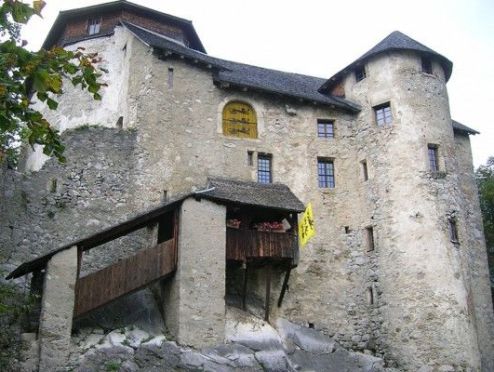
The castle
presents a formidable yet picturesque silhouette with its light-colored
stone walls, rounded towers, wooden balconies/structures, and dark roofs
contrasting against the forested hillside and Rhine Valley views. It has
a "stout, cylindrical towers and robust walls" look, blending military
strength with residential elegance.
Architectural Style and
Significance
It exemplifies late medieval/early Gothic Vorarlberg
castle architecture: compact, terrain-adapted, with a strong residential
component (uncommon for pure military keeps of the era). The "rare
closedness" (Geschlossenheit) of the small upper castle with its
integrated bergfried-like bastion and attached palas makes it
architecturally notable in the region.
It contrasts with the much
larger, ruined Alt-Ems (one of Austria's longest medieval castles) by
being a more intimate, preserved family seat.
Key Visiting Tip: Exterior Viewing Only
You cannot enter the
castle interiors as a regular visitor. Focus on exterior appreciation,
photography, and the surrounding landscape. Many visitors enjoy it as a
scenic highlight combined with nearby attractions like the Alt-Ems ruins
(a larger, ruined castle higher up the mountain).
How to Get
There
Location: Reutestraße 19, 6845 Hohenems, Vorarlberg (in the
mountain village area of Emsreute, east of central Hohenems).
By Car:
Easiest option. Drive up the winding roads from Hohenems town center
(about 10–15 minutes). Parking is limited near the castle; use
designated spots or park lower down and walk.
Public Transport: Train
or bus to Hohenems station, then taxi, local bus, or a steep uphill
walk/hike (30–60+ minutes depending on fitness).
Hiking: Popular to
combine with Alt-Ems ruins. Trails from Hohenems lead up; expect 40–60
minutes to the higher ruins and good views along the way.
Best time
to visit: Spring to autumn for pleasant weather and clear valley views.
Early morning or late afternoon for golden hour light and fewer people.
What to Expect and Tips
Views: Stunning panoramas over the Rhine
Valley, surrounding Alps, and Hohenems town. The elevated position is
one of the main draws.
Photography: Excellent opportunities from
paths and viewpoints around the castle. Respect private property—do not
trespass on grounds or gardens.
Duration: 30–90 minutes for exterior
viewing and photos. Pair it with Alt-Ems ruins or Hohenems town for a
half-day trip.
Accessibility: The area involves hills and uneven
paths; not ideal for those with severe mobility issues. Sturdy shoes
recommended for hikes.
Facilities: None at the castle itself (no
café, toilets, or ticket office for day visitors). Use amenities in
Hohenems town.
Weather: Vorarlberg can be rainy; check forecasts. The
exposed hilltop can be windy.
Crowds: Generally quiet compared to
major tourist castles, as it's off the main circuit.
Nearby
Attractions to Combine
Burg Alt-Ems Ruins — Much larger medieval
complex (one of Austria’s longest); great hike with even better views.
Hohenems town: Jewish Quarter, palaces, and cultural sites.
Rhine
Valley exploration, Lake Constance (Bodensee) area, or other Vorarlberg
castles.
Practical Advice
Respect Privacy: The owners live
there or host guests. Be courteous, stick to public paths, and avoid
noise or littering.
Events/Stays: If interested in experiencing the
interior, check rentacastle.at for exclusive rentals, events, or luxury
stays (high-end pricing).
Audio Guides: Apps like VoiceTour offer
info on the castle’s history for self-guided context while viewing from
outside.
Local Info: Visit the Hohenems tourist office or
vorarlberg.travel for maps and trail info.
Overall Verdict:
Neu-Ems / Glopper is ideal for lovers of authentic medieval atmosphere
and scenic hikes rather than guided castle tours. Its preserved exterior
and dramatic setting make it a rewarding, low-key stop in
Vorarlberg—especially when combined with the Alt-Ems ruins for a full
castle-hiking day.
Cultural Significance: The castle's winged altar in the Innsbruck
museum remains a key artifact, linking it to Renaissance art influences
from the Low Countries.
Strategic Role: Its proximity to Alt-Ems and
position above the Rhine Valley made it a vital stronghold in medieval
border disputes.
Modern Appeal: The 2016 renovation positions it as a
unique property for high-end living, with potential for use as a private
residence, event venue, or boutique retreat.
Accessibility: While
private, the surrounding area offers hiking opportunities, and the
castle's silhouette is a prominent feature in Hohenems' skyline.
Overall, Neu-Ems Castle embodies the enduring legacy of Austria's
medieval nobility, combining historical resilience with contemporary
luxury in one of Vorarlberg's most picturesque settings.