Location: Zadar County Map
Area: 95 km2 (36.7 sq mi)
Open: May- Sep: 6:30am- 8pm
Mar, Apr,
Oct: 7am- 7pm
Nov- Feb: 8am- 3pm Mon- Thu, 7am- 5pm Fri- Sun
Info:
Starigrad Paklenica, (023) 369 202, 369 155
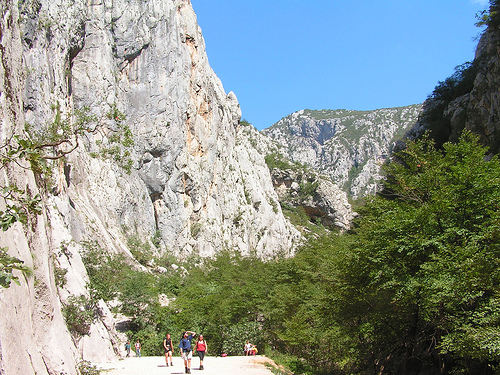
Paklenica National Park (Nacionalni park Paklenica), nestled in the southern reaches of Croatia's Velebit mountain range in Lika-Senj County, is a compact yet extraordinarily diverse protected area spanning 95 square kilometers. Proclaimed on October 19, 1949, it ranks among Croatia's oldest national parks, dedicated to safeguarding the dramatic karst landscapes, ancient forests, and torrent canyons that define this Adriatic hinterland. The park's name derives from "paklina," the resinous sap of the black pine (Pinus nigra), a tree emblematic of its rugged terrain. Encompassing elevations from near sea level at the coastal village of Starigrad-Paklenica to 1,757 meters at Vaganski Vrh—the highest peak in Velebit—the park serves as a gateway between the Mediterranean coast and the continental interior. Its twin canyons, Velika Paklenica (Great Paklenica) and Mala Paklenica (Small Paklenica), carve deep incisions into the limestone massif, creating a labyrinth of cliffs, caves, and waterfalls that attract hikers, climbers, and nature enthusiasts. As part of the larger Velebit Nature Park (established 1981) and recognized for its global ecological value, Paklenica offers a raw, immersive experience far removed from Croatia's crowded islands, blending solitude with adrenaline in a landscape where the Adriatic's salty breeze meets alpine chill. For a nation boasting eight national parks, Paklenica stands out as a climber's paradise and biodiversity hotspot, drawing over 100,000 visitors annually to its trails and summits.
Paklenica's human history mirrors the Velebit's role as a natural
barrier and refuge, with traces of habitation dating back to the
Paleolithic era (c. 20,000 BCE), when hunter-gatherers sought shelter in
its caves amid Ice Age fluctuations. Illyrian tribes dominated the
region by the Iron Age (c. 1000 BCE), using the canyons as defensive
strongholds and trade routes, followed by Roman colonization in the 1st
century CE, which left faint ruins near Starigrad (ancient Argyruntum).
Medieval shepherds and herders shaped the landscape from the 10th
century onward, constructing dry-stone walls and seasonal huts
(staništa) for transhumance, a practice that persisted until the
19th-century depopulation driven by phylloxera vine plagues and
emigration.
The park's modern conservation story began in the early
20th century, amid growing awareness of Velebit's ecological fragility.
Overexploitation of forests for Venetian shipbuilding and charcoal
production prompted protective measures, culminating in Paklenica's
declaration as a national park in 1949—the second in Croatia after
Plitvice Lakes. This act preserved the largest intact forest complex in
Dalmatia, threatened by logging. The park gained international stature
with Velebit's inclusion in UNESCO's Man and the Biosphere (MAB) Reserve
on February 10, 1978, recognizing its role in sustainable development.
Further accolades followed: integration into the EU's Natura 2000
network in 2014 for habitat protection, and UNESCO World Heritage
listing in 2017 as part of the "Ancient and Primeval Beech Forests of
the Carpathians and Other Regions of Europe," highlighting its relict
woodlands. During the 1991–1995 Croatian War of Independence, the park
served as a partisan hideout echo, but escaped major damage, with
post-war demining completed by 2000. Today, it embodies Croatia's
commitment to eco-tourism, with ongoing rewilding efforts enhancing its
historical narrative of resilience.
Paklenica's geology is a masterclass in karst dynamics, forged over
millions of years by the tectonic uplift of the Dinaric Alps during the
Alpine orogeny (c. 65 million years ago). Dominated by Cretaceous
limestones and dolomites, the park's terrain is a sculpted wonderland of
dissolution features, where acidic rainwater has etched deep canyons,
sinkholes (doline), and underground rivers. The star attractions are the
two parallel canyons: Velika Paklenica, stretching 14 kilometers with
walls soaring up to 700 meters, and the narrower Mala Paklenica, 12
kilometers long with steeper, more challenging gorges. These incisions,
formed by glacial melt and torrent erosion during the Pleistocene (c.
2.5 million–11,700 years ago), expose layered strata rich in marine
fossils from ancient Tethys Sea deposits.
The park boasts 115
speleological sites, including the iconic Manita Peć cave at 570 meters
elevation—a 175-meter-long show cave with vast chambers adorned by
stalactites, stalagmites, and flowstone draperies, formed over 80,000
years. Other highlights include the Bojinac plateau's jagged karst
towers and Vidakov Kuk's pinnacles, resembling a petrified forest of
limestone spires. Seismic activity along the Velebit fault adds to the
drama, with occasional rockfalls reshaping trails. This carbonate
bedrock not only fosters unique hydrology—intermittent streams like the
Paklenica River vanish into ponors (swallow holes)—but also provides
ideal conditions for climbing, with its grippy, fractured surfaces.
Paklenica's geology underscores the fragility of karst ecosystems,
vulnerable to climate change-induced droughts and erosion.
Paklenica pulses with life, its vertical stratification—from
coastal maquis to alpine meadows—creating a biodiversity hotspot
within the Mediterranean biome. Flora tallies over 1,000 vascular
plant species and subspecies, with 79 endemics adapted to the
karst's nutrient-poor soils. Dominant forests include primeval beech
(Fagus sylvatica) stands, UNESCO-listed for their post-glacial
purity, interspersed with black pine groves that give the park its
name. Rare blooms like the Croatian iris (Iris croatica) and
edelweiss (Leontopodium alpinum) dot higher elevations, while lower
canyons host Mediterranean shrubs such as sage and rosemary. Fungi
and lichens thrive in the humid gorges, contributing to soil
formation.
Fauna is equally rich: 236 bird species recorded, with
156 residents including golden eagles (Aquila chrysaetos), peregrine
falcons (Falco peregrinus), and the elusive Eurasian eagle-owl (Bubo
bubo). Mammals roam the wilds—brown bears (Ursus arctos) number
around 10–15 individuals, alongside chamois (Rupicapra rupicapra),
roe deer (Capreolus capreolus), and wild boars. Invertebrates
abound, with 42 ant species and endemic butterflies like the Apollo
(Parnassius apollo), while reptiles include the Dalmatian wall
lizard (Podarcis melisellensis) and venomous horned vipers (Vipera
ammodytes). Key features include seasonal waterfalls in Velika
Paklenica, underground streams, and biodiversity hotspots like the
Marasovići meadow, where orchids flourish. The park's isolation has
preserved relict species, making it a vital corridor in the Dinaric
Alps ecosystem.
Paklenica's 150–200 kilometers of marked trails cater to all levels,
from leisurely canyon strolls to multi-day alpine treks, emphasizing its
status as a hiker's haven. The flagship route is the Velika Paklenica
Canyon Trail (14 km round-trip, moderate, 4–6 hours), ascending from the
entrance through forested gorges to Manita Peć cave and the Paklenica
Mountain Hut (at 480 meters), with side paths to viewpoints like Anića
Luka. More challenging is the ascent to Vaganski Vrh (17 km, strenuous,
8–10 hours, 1,200m gain), rewarding with panoramic Adriatic vistas. Mala
Paklenica offers wilder, less-traveled paths (12 km, advanced, with
scrambling), ideal for solitude seekers.
Climbing is legendary: over
500 bolted routes on carbonate walls, graded 3 to 8b+, from short sport
climbs at Klanci to multi-pitch epics on Anića Kuk (350m face). Caving
tours explore Manita Peć (guided, 30 minutes, seasonal), while biking
and trail running utilize lower paths. Winter brings snowshoeing, though
avalanches pose risks. Activities promote eco-principles, with no
motorized access beyond entrances.
Paklenica embodies Croatia's natural patrimony, its UNESCO designations highlighting its role in global conservation amid climate threats like forest dieback. As a MAB Reserve, it models sustainable tourism, balancing 100,000 visitors with habitat protection through zoning (strict reserves in upper canyons). Culturally, it evokes Velebit's folklore—legends of outlaws (hajduci) hiding in caves—and inspires art, from Miroslav Krleža's novels to modern eco-films. For locals in Starigrad (pop. 1,800), it's an economic lifeline via guiding and lodging, fostering pride in Dalmatian heritage. Scientifically, it aids research on karst hydrology and endemic speciation, while rewilding (e.g., bear monitoring) counters biodiversity loss. In overtourism-plagued Croatia, Paklenica champions "deep nature" experiences, countering coastal crowds with introspective wilderness.
As of September 17, 2025, Paklenica remains fully operational under
the Public Institution Paklenica National Park, with no reported
disruptions from recent mild Adriatic storms or 2024 wildfires in nearby
regions. Entry fees are €10/adult (high season May–October),
€5/discounted, with multi-day passes available; climbing permits extra
(€3/day). Open year-round, though winter access limited by snow—check
np-paklenica.hr for alerts. The main entrance (Velika Paklenica)
features a visitor center with exhibits on geology and wildlife, plus a
national park camp for tents/RVs.
Access via Starigrad (45 km from
Zadar Airport, €20 bus), with parking €2/hour. Allow 1–3 days: day-hike
canyons, climb routes, or tour Manita Peć (€5, April–October). Spring
blooms wildflowers; autumn gilds forests, avoiding July–August heat
(30°C+). Trails are moderate-strenuous (elevations 500–1,200m); equip
with boots, water—bears rare but signage advises. Partial wheelchair
access at lower canyon; guided tours (€15, English) aid families.
TripAdvisor (4.7/5) praises "canyon majesty" and "climbing thrills,"
noting crowds at entrances—go early. Pair with Zadar's Roman ruins or
Velebit's northern parks for a Dinaric odyssey. Paklenica isn't
spectacle—it's immersion: scale a cliff, trace a fossil, or listen to
winds: here, Velebit's ancient heart beats wild.