Location: South Bohemian Region Map
Constructed: 12th century
Tel. 383 321 537
Open:
May- Oct: Tue- Sun
Official site
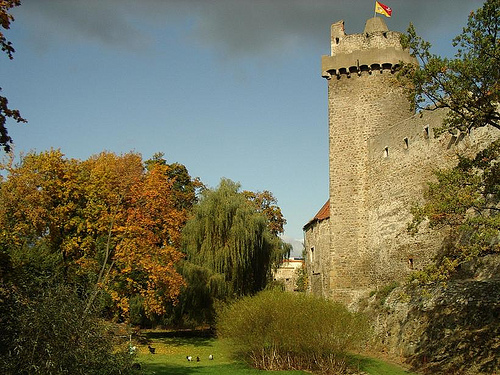
Strakonice Castle, situated in the town of Strakonice in South Bohemia, Czech Republic, is a medieval fortress built at the confluence of the Otava and Volyňka rivers. Founded in the early 13th century, it represents a unique blend of secular and ecclesiastical power, having been shared between the noble Bavor family and the Knights Hospitaller (Johannites) for centuries. Today, it stands as one of the oldest and largest preserved castle complexes in the country, designated a national cultural monument since 1995, and serves as a museum showcasing regional history, crafts, and artifacts.
The castle's origins date back to the first third of the 13th
century, when the noble Bavor family of Strakonice began construction on
a moated site along the Otava River, with the first written mention
appearing in 1235. In 1243, part of the castle was donated to the
Knights Hospitaller of the Order of Saint John (Johannites), who
established it as their main seat in the Czech lands. By 1402, the order
had acquired full ownership of the castle, town, and surrounding
estates.
During the Hussite Wars in 1420, Hussite commander Jan Žižka
occupied the town but failed to capture the castle. The Johannites
resided there for nearly 700 years, influencing its development.
Significant expansions occurred in the late Gothic period, followed by
Renaissance adjustments in the 16th century under Grand Prior Jan of
Rožmberk, transforming it into a representative residence. Baroque
elements were added in the 18th century by Grand Prior Ferdinand Leopold
Dubský of Třebomyslice. After the Thirty Years' War, the castle lost
much of its strategic importance but remained under the order's control
until modern times.
Strakonice Castle exemplifies a range of architectural styles from
Romanesque to Baroque, reflecting its long evolution. The oldest
preserved elements are Gothic structures from the 13th-14th centuries,
including the cylindrical Rumpál Tower, which served as a defensive
element, torture chamber, and prison. The Renaissance Jelenka Tower
features a wooden painted joist ceiling.
The Church of St. Procopius
(originally dedicated to St. Adalbert) is the castle's oldest part,
featuring Romanesque origins with a preserved window and profiled stone
jamb, later rebuilt in Baroque style with Rococo elements. It includes
cloisters and a capitular hall with rich fresco decorations, home to the
largest preserved cycle of mural paintings north of the Alps. The
northern wing, once a burgraviate, now houses Smidinger’s Library, while
the Baroque two-storey manor at the entrance represents the youngest
addition. The complex includes functional areas like an armoury, mill,
kitchen, bakery, blacksmith’s workshop, and brewery.
One of the castle's standout features is the Rumpál Tower, which offers panoramic views as a lookout point. The southern palace hosts historical and ethnographical expositions, including displays on pipes (bagpipes), 19th-century interiors, fez production, weapons, and motorcycles. The castle boasts the largest exposition of bagpipes and bagpiping in the Czech Republic. The Baroque prelature features a chateau gallery of contemporary art, with paintings, sculptures, pottery, porcelain, and jewelry. The unique Gothic wall paintings in the ambit and capitulary hall are particularly noteworthy.
Following extensive reconstruction between 2005 and 2010, Strakonice Castle is now a vibrant cultural site managed by the Museum of Central Otava Basin. It hosts events such as weddings, concerts, castle safaris, museum nights, night tours, and seasonal markets like Advent and Christmas markets in the courtyard. Visitors can enjoy tours, walks, and refreshments, with the site serving as a regional museum and gallery. For more details, contact the museum at Zámek 1, 386 01 Strakonice (tel: +420 380 422 608, email: informace@muzeum-strakonice.cz, website: www.muzeum-strakonice.cz).