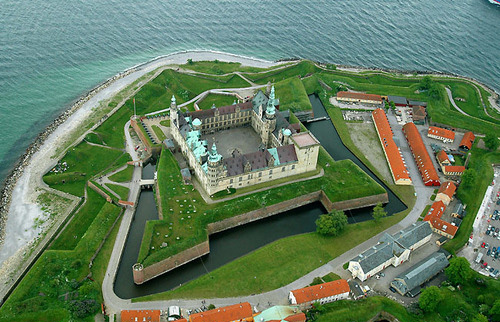
Kronborg sits on the northeastern tip of the island of Zealand
(Sjælland), directly on the Øresund Strait (the Sound) — the
narrowest point (about 4 km wide) between Denmark and Sweden. This
prime position allowed it to control maritime traffic between the
North Sea and the Baltic Sea for centuries.
From the 15th century
onward, Danish kings used the fortress to enforce Sound Dues (tolls
on passing ships), which brought immense wealth to the Danish crown.
The castle’s cannons could threaten any vessel attempting to evade
payment, and its location made it both a symbol of power and a vital
military stronghold.
Why Visit Kronborg?
Strategic location: Built on a peninsula
overlooking the Øresund strait between Denmark and Sweden, it controlled
shipping tolls for centuries.
Hamlet connection: Though Shakespeare
never visited, the castle’s reputation for intrigue made it the perfect
backdrop. Summer brings extra Shakespeare-themed events.
Highlights:
Grand halls (including one of Europe’s longest ballrooms), royal
apartments, gloomy casemates/dungeons with the statue of Holger Danske
(a legendary sleeping Viking hero), ramparts with panoramic views, and
cannons.
Atmosphere: It feels imposing yet walkable, with courtyards,
moats, and nearby beaches/harbor for a full day out.
A visit
typically takes 2–4 hours, depending on whether you join tours or
explore at your own pace.
Best Time to Visit
Summer
(June–August): Longest hours, best weather, and peak events (Shakespeare
performances, guided tours). Expect more crowds.
Shoulder seasons
(April–May, September–October): Fewer people, pleasant weather, still
good daylight.
Winter: Shorter hours, atmospheric (especially the
casemates), but colder and some areas may feel limited. Closed Mondays
in low season.
Current/2026 hours (check official site for exact
dates/holidays):
Peak (roughly March–October): Often daily
10:00–17:00 or 18:00.
Winter (Jan–March, Nov–Dec): Tue–Sun
11:00–16:00 (closed Mondays).
Ticket office generally opens with or
slightly before the castle.
Tickets and Prices (as of recent
data)
Adult: 150 DKK (online ~135 DKK).
Children (under 18): Free.
Discounts: Students/seniors often reduced; Copenhagen Card holders get
free entry.
Tickets are valid for a full year (except peak summer
special events in some cases).
Buy online in advance to save a bit
and skip lines, especially in summer.
Pro tip: Combine with the
nearby M/S Maritime Museum of Denmark (modern, underground design) for a
fuller experience.
How to Get There
From Copenhagen (easiest
day trip):
Train: Regional/coastal train (DSB Kystbanen) from
Copenhagen Central (København H), Nørreport, or Østerport to Helsingør
Station. Runs every 15–20 minutes, ~45 minutes. Then a pleasant 10–15
minute walk along the harbor with castle views.
Car: ~50 minutes via
E47. Parking at public lot north of the castle (Nordhavnsvej) — paid,
short walk.
Ferry: From Helsingborg, Sweden (short crossing) —
arrives right by the castle.
Accessibility: Limited for wheelchairs
(many stairs, no elevators). Accessible parking available inside
grounds. Service dogs welcome. Strollers must be parked outside.
What to See and Do (In-Depth)
Exterior & Ramparts — Walk the walls
for Øresund views and cannons. Great for photos, especially at golden
hour.
Courtyards & Moats — Free to wander parts of the grounds from
sunrise to sunset.
Interior:
Royal chambers and lavish
furnishings.
The massive ballroom (used for grand parties).
Casemates (dungeons) — dark, atmospheric underground passages.
Exhibits — History of the castle, Sound Tolls, military life, and Hamlet
connections.
Guided Tours (highly recommended):
Free or low-cost
daily tours in English/Danish.
Special “In Hamlet’s Footsteps” tours
(summer).
Shakespeare performances and family events in peak season.
Hamlet’s Wonderful World / Summer Events (2026): From late June to late
August, expect extra theater, actors in costume, and festivals. Book
ahead for popular shows.
Practical Visiting Tips
Arrive early
— Especially in summer — to beat crowds and enjoy better light.
What
to bring/wear: Comfortable shoes (lots of walking/stairs), layers for
wind by the sea, water/snacks. You can bring your own food to eat in the
Old Kitchens area.
Food: Café Sundtolden for drinks/snacks. Picnic
options available.
Facilities: Free cloakroom (no large bags inside),
gift shop, toilets.
Photography: Allowed in most areas; extra fees
may apply for professional/commercial shoots.
Dogs: Not allowed
inside (except service dogs).
Combine with Helsingør: Explore the
charming old town, harbor, museums, or take a quick ferry to Sweden for
the day.
Full day itinerary idea:
Morning train from
Copenhagen.
Explore castle (2–3 hours).
Lunch in town or picnic.
Maritime Museum or old town wander.
Evening train back.
Early History: Krogen Fortress (1420s)
The site’s history begins
in the early 15th century. In the 1420s, King Eric of Pomerania (Eric
VII) built a medieval fortress called Krogen (“the Hook”) on a sandy
promontory jutting into the sea. This was part of the Kalmar Union, when
Denmark, Norway, and Sweden were united under Danish rule.
Purpose:
To enforce Sound Dues (Øresundstolden), a lucrative toll on ships
passing through the strait into or out of the Baltic Sea. Denmark
claimed the Sound as internal waters. Paired with the fortress of Kärnan
in Helsingborg (on the Swedish side, then Danish territory), it gave
Denmark control over maritime traffic.
Structure: A square curtain
wall enclosing stone buildings for the royal residence, a banquet hall,
and likely a chapel. Remnants of these walls are still visible in
today’s castle.
Significance: Toll collection began around 1429 and
continued until 1857, funding royal projects and making the Danish crown
wealthy. An estimated 1.8 million ships paid dues over the centuries.
In the mid-16th century, King Christian III added bastions to modernize
the fortifications.
Renaissance Masterpiece: Frederick II’s
Kronborg (1574–1585)
King Frederick II transformed the outdated
Krogen into a magnificent symbol of Danish power and wealth.
Construction ran from 1574 to 1585 under Flemish architects Hans Hendrik
van Paesschen (initial phase) and Anthonis van Obbergen (later
expansions), with sculptural work by Gert van Groningen.
Key
Features:
Three coherent wings around a courtyard (expanding the
older structures).
Initially two storeys, later heightened to three,
with a grand ballroom over the chapel.
Sandstone cladding (from
Scania and Gotland) over red brick, copper roofs, golden spires, and
ornate sandstone decorations.
Strong fortifications with bastions,
ramparts, and casemates.
Lavish interiors: King’s and Queen’s
chambers, a massive Great Hall (62 x 12 meters, one of the largest in
Northern Europe), chapel (inaugurated 1582), and the Queen’s Gallery.
The castle served as both a royal residence and a formidable
fortress. Frederick II hosted grand banquets and theatrical performances
here. It projected royal authority above the nobility and demonstrated
Denmark’s dominance in the region.
The Great Fire and Rebuilding
(1629)
On the night of 24–25 September 1629, a fire—started by
careless workmen—destroyed much of the interior. Only the chapel’s
strong arches survived intact.
King Christian IV (Frederick II’s son)
immediately ordered a near-exact reconstruction, completed externally by
around 1639. He added Baroque elements like new portals, chimneypieces,
and ceiling paintings. The project was funded in part by doubling the
Sound Dues. While the exterior regained its splendor, the interior never
fully recovered its original opulence.
Swedish Siege and
Occupation (1658–1660)
During the Dano-Swedish War, Swedish forces
under Carl Gustaf Wrangel (and later King Charles X Gustav) besieged
Kronborg in 1658. After heavy bombardment, the castle surrendered on 6
September. The Swedes occupied it until 1660, plundering valuable
artworks, including a decorated fountain, Frederick II’s canopy, and
ceiling paintings.
Swedish royalty, including Queen Hedvig Eleonora,
stayed there during the occupation. The castle was returned to Denmark
under pressure from European powers after the war. This event exposed
vulnerabilities, leading to major fortifications upgrades.
Later
Military Role and Fortifications (Late 17th–20th Century)
Christian V
(1680s–1690): Added the advanced Crownwork (Kroneværket) and more
ramparts, making Kronborg one of Europe’s strongest fortresses.
From
1785, it primarily served as army barracks and a prison (including for
“honest” and “dishonest” convicts working on fortifications). Queen
Caroline Mathilde was briefly imprisoned here in 1772 after the
Struensee affair.
The castle ceased being a royal residence around
1690.
In the 19th–early 20th centuries, it remained a military site.
Swedish forces occupied parts during conflicts, but the army fully left
in 1923–1924.
Extensive restorations in the 1920s–1930s removed
military alterations and returned the castle closer to its Renaissance
appearance. It opened to the public.
Modern Era and Cultural
Significance
Kronborg has been a tourist attraction and cultural icon
for decades. Its UNESCO listing highlights its value as an outstanding
Renaissance castle and its role in Northern European history,
symbolizing power, commerce, and military strategy.
Hamlet
Connection: Shakespeare likely drew inspiration from the castle
(possibly via visiting actors or reports), setting his play there around
1600, though the story has older roots in Danish legend (Amleth). Annual
Hamlet performances occur in the courtyard.
Today, visitors explore
the royal apartments, Great Hall, chapel, casemates (dungeons), and
ramparts. The surrounding fortifications and views over the Øresund
underscore its strategic past.
The site began as Krogen, a medieval stronghold built in the 1420s by
King Eric VII (Eric of Pomerania) to control the Øresund strait and
collect the Sound Dues (tolls from ships entering the Baltic Sea). It
featured a curtain wall enclosing royal residence, ceremonial hall, and
chapel buildings.
In 1574–1585, King Frederick II radically
transformed the fortress into a magnificent Renaissance palace while
maintaining and enhancing its defensive role. Flemish architects Hans
Hendrik van Paesschen (initial fortifications and early work) and
Anthonis van Obbergen (later master builder) led the project, with
sculptural work by Gert van Groningen. The castle was rebuilt after a
devastating fire in 1629 under King Christian IV (led by Hans van
Steenwinckel the Younger), largely preserving the original Renaissance
exterior while incorporating some Baroque interior elements.
Overall Layout and Plan
Kronborg is a four-winged Renaissance castle
arranged around a spacious central courtyard, built on the footprint of
the earlier Krogen fortress. This quadrangular plan is typical of
Northern European Renaissance palaces but uniquely integrated with
advanced military fortifications.
Wings and Functions:
North Wing:
Royal apartments for the king, queen, and ladies-in-waiting, plus
chancellery offices.
South Wing: Features the grand Great Hall
(banqueting hall) on the upper level — one of the largest and most
exquisite in Northern Europe — above the chapel on the ground floor.
East Wing: Includes the Queen’s Gallery, a passageway allowing the queen
private access from her chambers to the ballroom.
West Wing:
Administrative offices and additional royal spaces.
The castle
sits on a promontory jutting into the Øresund, surrounded by moats, tall
ramparts, angular bastions (strengthened in the late 17th century under
Christian V), ravelins, and casemates for cannons. This creates a
powerful visual and strategic statement: a symbol of royal power, wealth
from tolls, and military dominance.
Exterior Architecture
The
exterior epitomizes Northern Renaissance style with Flemish and French
influences, blending defensive solidity with ornate elegance:
Materials: Originally red brick with sandstone details; from around
1580, fully clad in expensive sandstone from Scania (Skåne) and Gotland.
This creates bright, light-colored facades with distinctive horizontal
bands. Roofs are clad in copper (replacing earlier tiles), with gilded
spires and finials that glittered impressively.
Towers and Spires:
Multiple towers and pointed spires crown the structure, including the
prominent Trumpeter’s Tower (tallest) and Cannon Tower. These provide
dramatic vertical emphasis and practical vantage points. Wall walks
connect the towers.
Ornamentation: Rich, imaginative sandstone
carvings, gables, columns, and decorative elements. The facades are
balanced and symmetrical, with large windows that convey grandeur while
the lower levels remain fortified.
Defensive Features: Projecting
bastions, curtain walls, a moat, and gun emplacements. The design
reflects evolving artillery needs of the period — low, thick walls to
withstand cannon fire.
The overall effect is both imposing (as a
fortress guarding the narrowest part of the Øresund, only ~4 km wide)
and celebratory of royal prestige.
Interior Architecture and Key
Rooms
The interiors were originally lavish with paintings,
tapestries, and sculptures, though much was lost or altered after the
1629 fire and later uses. Restorations have aimed to recapture the
Renaissance character.
Courtyard: Open, surrounded by the four wings;
originally featured an ornate fountain (looted by Swedes in 1658).
Towers and spires rise dramatically around it.
Great Hall (Banqueting
Hall): Located in the south wing. Enormous (one of the largest in
Northern Europe), with high ceilings, large windows, and originally rich
decorations. Used for state functions, theater, and feasts.
Chapel:
In the southeast corner (south wing ground floor). The only part largely
spared by the 1629 fire. Retains original altar, gallery, pews, fine
wood carvings, and painted panels. Vaulted windows and Renaissance
detailing.
Royal Chambers: King’s and Queen’s apartments feature bay
windows, vaulted spaces, and views over the sound. Furnished with
17th-century Netherlandish pieces in restorations.
Other Features:
Painted ceilings (some Baroque additions post-fire), long galleries,
checkered floors in some halls, ornate chimneypieces, and grand
staircases. Many rooms have high, beamed or painted ceilings and large
leaded windows.
Architectural Significance
Kronborg
exemplifies the transition from medieval fortress to Renaissance palace,
showcasing how Danish royalty used architecture to project power and
cultural sophistication. Its integration of military engineering
(bastions, ramparts) with ornate residential design is masterful.
Influences from Dutch/Flemish Renaissance are clear in the stepped
gables, sandstone detailing, and symmetry.
It remains remarkably
intact despite fires, wars (including Swedish occupation in 1658), and
shifts to military use. Modern restorations respect 16th-century
techniques, preserving its authenticity as a UNESCO site.
Precise Location and Coordinates
Geographic coordinates:
Approximately 56°02′19″N 12°37′19″E.
It sits on the extreme
northeastern tip of the island of Zealand (Sjælland), Denmark’s largest
island, to the northeast of Helsingør’s historic town center.
Elevation: About 12 meters above sea level.
The castle is built on
Ørekrog (“the Hook” or sandy tongue/foreland), a small promontory of
land that juts out into the sea, enhancing its command over the
waterway.
The Øresund Strait (The Sound)
Kronborg’s geography
is inseparable from the Øresund (Öresund), the strait separating Denmark
(Zealand) from Sweden (Scania/Skåne province). Key features include:
Narrowest point: Only about 4 km (2.5 miles) wide directly between
Kronborg and the Swedish fortress of Kärnan in Helsingborg. This
chokepoint made it ideal for controlling maritime traffic between the
Baltic Sea (to the south) and the Kattegat/North Sea (to the north).
Overall dimensions: The strait stretches about 118 km long, with widths
varying from 4 km to 28 km.
Depth and hydrology: Maximum depth around
40 meters, but shallower areas (5–6 m in places) restrict larger
vessels. It features complex currents with a mix of brackish Baltic
water (surface) and saltier oceanic water (deeper layers). Salinity
varies significantly, influencing marine life. Tides are minimal;
currents and winds dominate water movement.
Historically, this narrow
passage was one of Europe’s most important maritime routes. Denmark
collected Sound Dues (tolls) from ships for over 400 years (1429–1857),
enforced by Kronborg’s cannons and paired with the opposite Swedish
shore fortress.
The castle’s position allowed Denmark (when it
controlled both shores) to monitor and tax nearly all shipping entering
or leaving the Baltic.
Terrain and Immediate Surroundings
Landform: The castle occupies a low, sandy foreland extending into the
Øresund. The site includes defensive earthworks, bastions, moats, and
ramparts typical of Renaissance fortifications, blending natural coastal
features with engineered defenses.
Coastal features: Rocky and sandy
shores, with beaches and harbors nearby. The area around Helsingør
includes a mix of urban development, green spaces, and waterfront.
Approach: From the town (east), visitors pass through moats and gates.
The castle is surrounded by fortifications, grassy ramparts, and water
on multiple sides, creating a peninsula-like setting.
Views:
Panoramic vistas across the Øresund to Sweden (visible on clear days).
The castle’s towers and battlements offer commanding overlooks of the
strait, shipping lanes, and coastline.
Regional Context in
Denmark
Zealand is part of Denmark’s eastern archipelago. The region
around Helsingør features:
Relatively flat to gently rolling terrain
typical of eastern Denmark.
Proximity to Copenhagen (about 45–60
minutes by car/train south).
Temperate oceanic climate with mild
summers, cool winters, and frequent maritime influence (wind, fog, and
occasional ice in severe winters affecting the strait).
Strategic
and Visual Geography
Aerial views highlight how Kronborg dominates
the narrow strait on a protruding headland, with the town of Helsingør,
harbors, and modern infrastructure (ferries, roads) integrated around
it. The fortifications extend outward, with bastions and moats creating
layered defenses.
The geography made Kronborg not just a residence
but a formidable coastal stronghold — its Renaissance architecture
(copper roofs, sandstone cladding) rises prominently against the sea and
sky, while its low-lying, fortified base merges with the coastal
landscape.
The office of Kronborg's commandant was established in 1582 by King
Frederik II, who wanted to secure Denmark's power in Øresund, and needed
a military person to manage Kronborg's business and manage customs.
The commander was responsible for operation and maintenance of the
castle, and was at the same time the highest officer and civil servant
at the royal castle. He was responsible for recruiting soldiers in North
Zealand and ensuring the fortress' supply of weapons.
The king
himself appointed the commanders partly from his own family and partly
from the country's noble families.
An unfortunate commander was
Poul Beenfeldt (1612-1676), who surrendered the castle to the Swedes
during the Second Carl Gustav War after only three weeks of siege.
Beenfeldt fled to Lybeck, and the enraged King Frederik III had both him
and his second-in-command sentenced to death in absentia. General Hans
Schack interceded for him and he was allowed to return to the country,
but lost his commission as an officer.
Eskild Andersen 1582 –
1597
Christian Albrecht Rantzau 1597 – 1603
Oluf Ebbesen Lunge
1603 – 1614
Henrik Lykke 1614 – 1641
Hans Ulrik Gyldenløve 1641 –
1645
Holger Vind 1645 – 1652
Otto Skade 1652 – 1 August 1658
Poul Beenfeldt 1 August 1658 – 6 July 1660
Eiler Holck 6 July 1660 –
16 March 1672
Carl Henrich von der Osten 16 March 1672 – 1 June 1675
Ulrik von Dewitz 1 June 1675 – 25 February 1676
Barthold von Bülow 25
February 1676 – 3 April 1676
Conrad Wichmann 3 April 1676 – 2 May
1676
Carl Henrich von der Osten 2 May 1676 – 12 July 1677
Hartvig
Asche Schack 12 July 1677 – 10 October 1678
Johan Didrik Wetberg 10
October 1678 – 10 October 1679
Carl Henrich von der Osten 10 October
1679 – 18 November 1685
Jacob Geveke 18 November 1685 – 8 September
1694
Hans Erasmus von der Pfordten 8 September 1694 – 22 December
1712
Michael Christopher von Schnitter 22 December 1712 – 30 July
1725
Hans Philip Pretorius 30 July 1725 – 24 December 1732
Ditlev
Revenfeld 24 December 1732 – 10 November 1742
Johan Frederik
Brockenhuus 10 November 1742 – 2 February 1748
Gustav Grüner 2
February 1748 – 17 March 1759
Johan Georg Moltke 17 March 1759 – 16
January 1765
Andreas Hauch 16 January 1765 – 6 December 1780
Carl
Johan Christian von Bessel 6 December 1780 – 4 August 1788
François
Jacques Xavier d'Aubert 4 August 1788 – 27 December 1793
Ezechias
Hinrich Stricker 27 December 1793 – 16 May 1811
Hans Ulrich Moritz
von Scheel 16 May 1811 – 1 February 1829
Frederik Ohlrogge 1 February
1829 – 1 February 1839
Gustav Joachim Michaelsen 1 February 1839 – 30
December 1839
Harald Rothe 30 December 1839 – 16 November 1848
Louis Paul Renouard 1 February 1849 – 1 February 1856
Niels Christian
Lunding 1 February 1856 – 1 October 1867
Johan Ditlev Harvest 1
October 1867 – 21 April 1868
Julius Theodor Hein 21 April 1868 – ?
Johan Cornelius Krieger 18?? – 18??
Sophus Wilhelm Vandall Pfaff 1886
– 1891
Hans Walter Harbou 1906 – 1911