Location: Narva Map
Constructed: 1346
Info: Puskini 12, 356 0184
Tel. (+372) 359 9230
www.narva.ee
Narva Museum
359 9245
Open: 10am- 6pm daily
www.narvamuuseum.ee
Location: Narva
Map
Constructed: 1346
Info: Puskini 12, 356 0184
Tel. (+372) 359 9230
www.narva.ee
Narva Museum
359 9245
Open: 10am- 6pm daily
www.narvamuuseum.ee
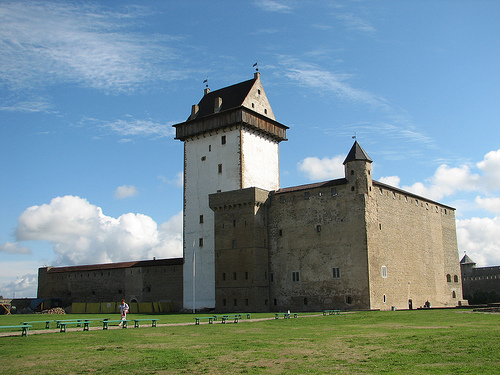
Narva Castle, also known as Hermann Castle (Estonian: Hermanni
linnus) or Narva Fortress, is a medieval stronghold in Narva,
northeastern Estonia, on the west bank of the Narva River, which
forms the modern border with Russia.
It stands directly opposite
the 15th-century Russian Ivangorod Fortress, creating one of the
most striking visual border symbols in Europe. The castle has a
history spanning over 770 years, shaped by Danish, German
(Teutonic/Livonian Order), Swedish, Russian, and later Estonian
control. It served as a border defense, administrative center, trade
protector, and military stronghold.
Getting There
From Tallinn: The most common way for visitors.
Train (Elron) takes about 2h 20–35 min and is comfortable; buses (Lux
Express or others) take ~3 hours. Both are affordable (€11–25 one way).
Within Narva: The castle is an easy walk from the train/bus station
(15–20 minutes). It’s located at Peetri plats 7, right by the river.
By car: Straightforward from Tallinn (about 2–2.5 hours). Parking is
available at Peetri Square near the castle.
Narva makes an
excellent (and very feasible) day trip from Tallinn, but staying
overnight lets you explore at a relaxed pace and enjoy the evening light
on the river.
Visiting the Castle & Museum
Opening Hours (as
of 2026): Generally 10:00 AM – 6:00 PM daily in summer (May–mid Sept);
shorter hours (Wed–Sun) in the off-season. Confirm on the official Narva
Museum site before your trip.
Tickets: Full adult ticket ~€16;
discounts for students/seniors (~€10); family ticket ~€32. The
grounds/courtyard areas are partially free to wander, but the museum and
tower require a ticket.
What to Expect Inside:
The Narva
Museum occupies much of the castle with modern, well-presented exhibits
on the city’s and castle’s history (medieval times through Soviet era).
Climb the Tall Hermann Tower for panoramic views over Narva, the river,
Kreenholm factory, and Ivangorod Fortress across the border. On clear
days, this is the highlight.
Restored halls, bastions, and
courtyards. Recent renovations have made previously inaccessible areas
open.
Handicraft workshops in the Northern Yard (seasonal) — great
for families or interactive fun.
Time Needed: Plan 2–3+ hours. You
can easily spend longer if you read all exhibits and enjoy the views.
Practical Visiting Tips
Best Time to Visit:
Summer
(May–September): Longest days, mild weather (15–25°C / 59–77°F),
everything open. Evenings offer beautiful golden light on the stone
walls.
Late afternoon or sunset for fewer crowds and dramatic photos.
Spring/autumn: Fewer tourists, pleasant for walking, but check weather
(can be rainy/windy).
Winter: Magical with snow, but colder and
shorter hours.
What to Wear/Bring:
Comfortable walking shoes —
lots of cobblestones, stairs (including the tower), and uneven surfaces.
Layers — river breeze can be chilly even in summer.
Camera or phone
with good zoom for border views.
Water and snacks (limited options
inside).
Accessibility: Some areas (especially the tower) involve
many stairs. Check with staff for limited mobility options.
Audio
Guides & Tours: Self-guided audio tours available (English), though some
visitors find them a bit confusing or stilted. Guided tours (book ahead)
are excellent for deeper context — highly recommended if you want
historical details.
Photography: The classic “Five Krooni View” (from
the promenade observation deck) lets you frame both castles perfectly.
Respect border sensitivities when photographing toward Russia.
Food &
Drink: Rondeel Restoran inside a former artillery tower of the castle
serves good food (try the Swedish pea soup). Other options nearby on the
promenade or in town.
Nearby Attractions to Combine
Narva
River Promenade: Lovely walk with sculptures, fountains, and the best
views of both fortresses.
Ivangorod Fortress: Visible across the
river — dramatic, especially at dusk.
Narva Bastions (e.g., Victoria
Bastion) and underground passages.
Kreenholm Manufacturing Complex
(historic textile factory).
Day extension to Narva-Jõesuu beach
resort (about 15–20 min north).
General Advice for Narva
Narva
has a unique Russian-Estonian border character (majority
Russian-speaking). It feels different from Tallinn — more industrial and
post-Soviet in parts, but the castle area is beautifully maintained.
It’s safe for tourists, but standard big-city awareness applies. Locals
and guides are often friendly and helpful.
Pro Tips:
Visit the
castle after 4 PM in summer for quieter exploration.
Combine with a
guided city tour for context.
If driving, explore the wider Ida-Viru
County (mining heritage, nature).
Early Danish Period (13th–14th Century)
The Kingdom of Denmark
conquered northern Estonia in the 13th century during the Northern
Crusades. Around 1256, they established a wooden border stronghold at
the intersection of the Narva River and an old trade route (linking the
Gulf of Finland to Novgorod and Pskov).
This site protected against
incursions from East Slavic principalities like Novgorod and Pskov. The
castle is first mentioned in writing in 1277. Under its protection, a
settlement grew, evolving into the town of Narva, which received Lübeck
city rights in the first half of the 14th century.
In the early 14th
century, following conflicts with Russian forces, the Danes replaced or
upgraded the wooden structure with stone fortifications. It began as a
compact castellum-style building with a predecessor to the later Hermann
Tower (about 40 meters tall on the northwestern corner).
In the 7th
decade of the 13th century (around the 1260s–1270s), it also served as a
residence for the Danish King's vice-regent.
Teutonic (Livonian
Order) Period (1346–Mid-16th Century)
In 1346, Denmark sold its
Estonian possessions, including Narva, to the Livonian branch of the
Teutonic Order (also called the Livonian Order). The Order owned it for
much of its medieval history and significantly expanded it.
During
the 14th–16th centuries, the castle gained its current general
appearance. Key developments included:
Strengthening into a powerful
convent-style fortress.
Construction of the iconic Tall Hermann Tower
(Pikk Hermann, 51 meters high), which became the castle's dominant
feature and a symbol of power. The Order named it after Hermann von
Salza or similar figures, though the exact origin ties to the Order's
traditions.
The castle guarded the northernmost defensive point
of Livonia and controlled vital trade routes. Its strategic location
made it a frequent target.
In 1492, Ivan III of Muscovy built
Ivangorod Fortress directly across the river as a direct counter to
Narva/Hermann Castle, escalating tensions.
Livonian War and
Shifting Control (1558–1581)
The Livonian War (1558–1583) brought
major upheaval. Russian forces under Ivan the Terrible captured Narva in
1558, turning it into a key trading port for Russian goods. The city
briefly flourished as a transshipment center.
In 1581, Swedish troops
under the Kingdom of Sweden conquered it. Subsequent Russian attempts to
retake it (1590–1595) failed.
Swedish Era (1581–1704/1721)
Sweden held Narva for over a century, during which the city became known
as the "baroque pearl of the Baltic." The castle and town saw
significant development:
Extensive fortifications, including a
powerful bastion system around the town (one of the strongest in
Northern Europe, designed by Erik Dahlberg in the late 17th century).
Rebuilding after a major fire in 1659, with only stone buildings allowed
in the center.
The castle served as a key defensive element in the
Swedish Empire's eastern border.
Great Northern War and Russian
Conquest (1700–1721)
The Battle of Narva on November 30, 1700, was a
pivotal early clash in the Great Northern War. Russian forces under Tsar
Peter I besieged the city, but a smaller Swedish army led by King
Charles XII decisively defeated them in a famous victory (aided by harsh
winter conditions).
However, Russia eventually prevailed. Narva fell
to Russian forces in 1704, and the Treaty of Nystad (1721) formally
ceded it to the Russian Empire. The castle's military importance
declined as borders and warfare evolved.
18th–19th Centuries:
Decline and Early Restoration
Under Russian rule, the castle lost
much of its strategic role but remained a landmark. In the mid-19th
century, it underwent one of the earliest restoration campaigns among
Estonian medieval castles, led by a Russian engineer.
20th
Century: Wars and Soviet Era
World War II caused severe damage,
especially in 1944 during intense fighting in the Narva region. The
castle was badly damaged, and the surrounding historic Old Town was
largely destroyed. Post-war Soviet authorities rebuilt parts of the city
in a typical Soviet style, and many original inhabitants were not
allowed to return; the population became predominantly Russian-speaking.
Major restorations occurred in the 1970s and 1980s, allowing the castle
to open as a museum.
Modern Era and Current Status
After
Estonia regained independence in 1991, the castle became a key cultural
site. Extensive reconstruction work from 2018–2020 (as part of the
"Opening of the Border Castle Discovery Centre" project) restored the
east wing and opened new areas to visitors. A new permanent exhibition
traces the castle's and city's history from the first Danish arrivals to
the present.
Today, it houses the Narva Museum, with exhibits on
military history, local heritage, weaponry, and more. The Tall Hermann
Tower offers panoramic views of Narva, the river, Kreenholm factory, and
Ivangorod Fortress. The complex spans about 3.2 hectares and is one of
Estonia's best-preserved and most diverse defensive structures.
Historical Development and Architectural Evolution
The castle
originated around 1256 under the Kingdom of Denmark as a border
stronghold (initially wooden) to control trade routes and defend against
Russian principalities. Stone fortifications began in the early 14th
century.
Danish Period (13th–mid-14th century): Started as a
small rectangular castellum-like structure (roughly 40m sides) with a
prominent tower at the northwestern corner — the precursor to the Tall
Hermann Tower. It featured thick perimeter walls, a courtyard,
residential quarters, and storage. The steep river cliffs provided
natural eastern defense, so the eastern wall may have been minimal or
absent initially. A western gate (later associated with the dansker) led
into the courtyard.
Livonian Order Period (after 1346): The Teutonic
Order’s Livonian branch purchased it and transformed it into a convent
house (a four-winged monastic-military complex typical of the Order).
They expanded it significantly into a compact quadrilateral upper ward
(main castle) with massive wings around a central courtyard and
cloisters. The Hermann Tower was heightened, and additional baileys
(forecourts) were added. Construction continued into the 15th–16th
centuries, adapting to evolving warfare (including early firearms).
Later Swedish, Russian, and modern Estonian phases involved
adaptations, restorations (notably 19th century and post-WWII in the
1960s–1980s), and some concrete interventions, but the core medieval
ground plan remains largely intact.
Overall Layout
The complex
includes:
Upper Ward (Main Convent House): The core
residential/defensive quadrilateral building.
Western Bailey (Outer
Courtyard): A large defended area for sheltering townspeople, with its
own fortifications.
Northern Bailey: Smaller area between the main
castle, town, and river.
Defensive Elements: Moats (including a wide
western moat), zwinger (inter-wall spaces), and later bastions/rondels.
The castle sits on limestone cliffs overlooking the river, enhancing its
defensibility.
Key Architectural Features
1. Tall Hermann
Tower (Pikk Hermann)
Dominant landmark: ~51 meters tall (one of the
tallest in the Baltics), with thick walls (up to 4m at base).
Located
at the northwestern corner.
Multi-story structure with a
reconstructed gabled roof, wooden external walkways, and viewing
platforms.
Served as a watchtower, defensive stronghold, and later
housed a chapel.
Offers panoramic views of Narva, the river, and
Ivangorod.
2. Four-Wing Convent House (Upper Ward)
Quadrilateral plan surrounding a central courtyard with cloisters
(partly vaulted).
West Wing: Earliest major addition; housed the
refectory (dining hall) on upper floors, dormitory below. Representative
spaces with vaulting.
North Wing: Likely private chambers for the
Order’s dignitaries (Advocatus/resident commander).
East Wing:
Included household/storage functions; connected to the prominent Dansker
Tower (a projecting sanitary tower with a deep well/shaft reaching the
river level for latrines/waste).
South Wing: Latest addition
(15th–early 16th century); more utilitarian.
Thick stone walls, arrow
slits (adapted for firearms in later phases), and limited decorative
elements — reflecting its primarily military/functional purpose.
3. Towers and Projecting Elements
Dansker Tower (East): Projecting
over the river cliff; functional for sanitation.
Smaller corner
towers, including an octagonal turret at the southwest.
Western
bailey corner towers (cylindrical/rondel-style) adapted for artillery.
4. Fortifications and Outer Works
Thick curtain walls with
battlements, wall-walks (parapets), and porches.
Moats and zwinger
(advanced lower wall ~4m out from the main wall).
Gates: Reinforced
with iron, drawbridges; later foregates and artillery adaptations.
Western bailey had semi-independent defenses, rare in the region.
5. Materials and Construction
Local limestone and stone masonry.
Vaulted interiors in key halls.
Adaptations for artillery in the
15th–16th centuries (e.g., gun ports, thickened walls).
Interior
and Current Use
The interior features restored chambers, exhibition
spaces (Narva Museum covers local and castle history), and accessible
levels in the tower. Original medieval room layouts are partially
obscured by restorations, but the overall convent-style organization
persists. Modern additions include staircases, floors, and facilities
while aiming to evoke the medieval character.
Visual Character
The castle presents as a massive, imposing beige/gray stone complex with
red-tiled roofs on restored sections, rising dramatically from the
riverbank. Its silhouette, dominated by the white-painted upper sections
of the Hermann Tower, contrasts with the water and the opposing Russian
fortress.