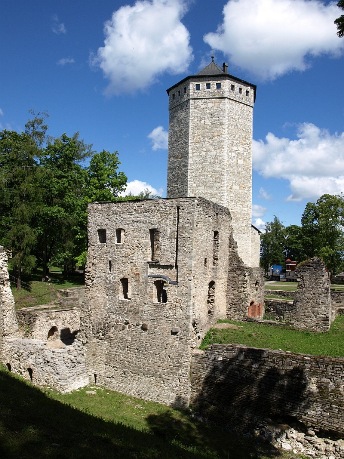
Location: Paide, Järva County
Map
Constructed: 30 September 1291 by Halt, master of the Livonian Order
Info: Parnu 6, 385 0400
www.paide.ee
Jarvamaa Museum
Lembitu 5
Tel. 385 1867
Open: Apr- Oct: 11am- 6pm Wed- Sun
Nov- Mar: 10am- 5pm Wed- Sun
www.jarva.ee/muuseum
Paide Castle (Paide ordulinnus or Paide Vallitorn) is a standout medieval site in central Estonia, located in the small town of Paide (about 100 km southeast of Tallinn). It's a rewarding stop for history enthusiasts, offering a mix of ruins, a modern interactive museum, and panoramic views.
What to Expect and See
The Castle Ruins and Grounds: Explore the
remains of the upper ward, outer bailey, moats, and walls on the hill.
The area is open year-round, free to wander, and offers a peaceful,
atmospheric setting with green spaces—ideal for photos and picnics.
The Main Tower (Vallitorn / Pikk Hermann): This octagonal,
~30-meter-high tower is the highlight. Inside is the Wittenstein Time
Center, an engaging "time machine" experience:
A lift takes you
through Estonian history floor by floor (medieval times to modern eras).
Exhibits include multimedia, sound & light effects, videos, and
artifacts.
The journey typically takes about 1 hour.
Climb to the
top for panoramic views of Paide's red rooftops, surrounding forests,
and countryside.
Additional Features: There's a restaurant in the
tower (traditional Estonian dishes) and a newer Activity Museum
(Tegevusmuuseum) focusing on 19th-century small-town life with
workshops.
The site feels well-maintained and less crowded than major
attractions like Tallinn's castles, giving it an intimate feel.
Practical Visiting Tips
Opening Hours (Wittenstein Time Center in the
Tower):
June 2 – August 31: Daily 10:00–18:00.
April 15 – June 1 &
September 1 – December 31: Wednesday–Sunday 10:00–18:00 (closed
Mondays/Tuesdays).
January 8 – April 14: Wednesday–Sunday 10:00–18:00
(advanced booking recommended).
The ruins and hill are accessible
24/7 year-round.
Tickets (as of recent data):
Adult: 12 €
Pensioner: 11 €
Student: 9 €
Family ticket (parents + children):
25 €
Preschoolers: Free
Museum Card (Estonian museums joint
ticket) accepted.
Combined ticket for Time Center + Activity Museum
available (~19 € adult).
Guided tours are offered in multiple
languages (Estonian, English, German, Russian, Finnish) — book ahead for
groups.
Duration: Allow 1.5–3 hours. Spend 45–60 minutes in the
tower/exhibits, plus time exploring ruins and enjoying views.
Best
Time to Visit:
Summer (June–August): Longest hours, pleasant
weather for outdoor exploration, and events like the Opinion Festival in
August on the hill.
Late spring/early autumn: Fewer crowds, nice
light for photos.
Avoid mid-winter if stairs or outdoor areas are
icy, though the indoor tower is manageable.
Accessibility and
Physical Considerations:
Steep stairs in the tower — wear comfortable
shoes with good grip.
The lift helps with some floors, but not all
areas are fully accessible.
The hill has some slopes; it's manageable
but not ideal for severe mobility issues.
How to Get There
By
Car: Easiest option. Paide is ~1–1.5 hours from Tallinn, Tartu, or Pärnu
via good roads (near Tallinn-Tartu highway). Free parking available
nearby.
By Bus: Regular services from Tallinn and other cities; the
stop is a short walk from the castle.
Address: Veski tn 11/1, Paide
(Vallimägi hill).
Pro Tips for Visitors
Combine with Other
Paide Sights: Visit the town square, Paide Church, Water Gate, Gunpowder
Tower, or nearby Endla Nature Reserve for a full day.
Photography:
Golden hour (sunrise/sunset) offers beautiful light on the tower and
ruins.
Food: Eat at the tower's restaurant for views and local fare,
or try nearby spots for Estonian classics.
Crowds: Generally quiet;
go early or on weekdays for a more personal experience.
Weather Prep:
Estonia's weather can change — bring layers and rain protection for
outdoor parts.
Language: Exhibits have English info; staff often
speak English.
For Families/Kids: Interactive elements and workshops
make it engaging; family tickets are good value.
Nearby Day Trip
Potential: Pair with other central Estonian spots or use as a stop en
route between Tallinn and Tartu.
Construction and Early Years (13th Century)
Construction of the
Paide Order Castle began in 1265 under the direction of Conrad von
Mandern (Konrad von Mandern), the Land Master of the Livonian Order (a
branch of the Teutonic Knights). It was established on the territory of
Alempois, right on the border with Danish-controlled Järva (Jerwen) to
circumvent restrictions in the Treaty of Stensby (1238), which limited
the Order’s building rights in certain areas.
The initial structure
centered on a massive octagonal main tower (keep), later known as Pikk
Hermann or Paide Vallitorn (Castle Tower), about 30 meters high with
walls up to 2.4–3 meters thick. Archaeological evidence suggests it may
not have been the absolute first building on the site, and temporary
wooden structures likely supported early operations. The location
offered natural defenses from swamps, forests, and the Pärnu River, and
there may have been a pre-existing ancient Estonian hillfort
(muinaslinnus) there.
By the early 14th century, the castle’s
military and economic importance led to its elevation to a commandry
(komtuur). The first recorded commander was Raimar Hahn (1314–1316). A
settlement grew around it, and Paide received town rights in 1291. The
castle served as the residence of the Järva Vogt (foogt) and later the
commander.
14th–15th Centuries: Expansion and Key Events
In
the 14th century, the castle was significantly expanded into a
convent-style fortress with a square upper ward. Only the northern and
eastern wings were fully developed, housing a chapel and chapter house
(possible refectory in the east). It was strengthened with thicker
walls, additional towers, and moats.
The Night of St. George’s
Uprising (1343) stands as one of the most dramatic episodes. On May 4,
1343, four Estonian leaders (known traditionally as kings: Vootele,
Murdja, Hundipea, and Meeme) and their servants met at the castle for
negotiations with the Order’s master Burchard von Dreileben and the
Bishop of Tallinn. The Order rejected their demands, then treacherously
murdered the envoys. This betrayal contributed to the broader
suppression of the uprising, after which northern Estonia came fully
under Teutonic Order control. The castle lost its strict border function
but retained high status—commanders of Paide were among the top
officials advising the Livonian Land Master.
Further rebuilding
occurred in the late 14th century. By the 15th century, the castle was
one of six major Teutonic centers in the region maintaining a full
complement of brethren. The tower’s image appeared on Paide’s coat of
arms as early as 1441.
Livonian War (16th Century): Repeated
Sieges and Destruction
The Livonian War (1558–1583) brought immense
turmoil. Paide’s strategic central location made it a frequent target as
Russia, Sweden, Poland-Lithuania, and others fought for control of
Livonia.
1558: Russian forces under Aleksei Basmanov besieged Paide
but failed to capture it.
1560: Another Russian siege was repelled by
commander Caspar von Oldenbockum.
1562: The castle passed to Polish
control, but Swedish forces under Klas Kristersson Horn soon captured
it.
1570–1571: Russians besieged it again without success.
1573:
Ivan the Terrible’s troops personally captured Paide. The assault was
brutal; nearly all inhabitants and defenders were killed. Commander Hans
Boije was reportedly impaled and roasted alive. Malyuta Skuratov (a
notorious oprichnik) led a heroic but fatal attack for the Russians.
Sweden recaptured it in 1581. In the 1580s, under Swedish rule, the
castle received modernizations, including outer bastions and earthworks
(around 1585, directed by master M. Peterni), adapting to gunpowder
artillery. These were among the last major fortifications.
Polish-Swedish War and Decline (17th Century)
Fighting continued
during the Polish–Swedish War (1600–1611):
In 1602, Polish forces
under Hetman Jan Zamoyski besieged and captured Weissenstein after a
long siege.
A major Battle of Paide occurred in 1604, where
Polish-Lithuanian forces under Jan Karol Chodkiewicz defeated the
Swedes.
Sweden regained control in 1608.
By 1636, the obsolete
and war-damaged castle was removed from fortress lists; parts of its
defenses were deliberately demolished. It gradually fell into ruin and
lost much of its military relevance.
Later History (18th–20th
Centuries)
The ruins persisted through Russian imperial rule. In the
late 19th century (1895–1897), restoration work under architect Wilhelm
Neumann focused on the central tower and western gate, and the hill was
landscaped.
During World War II, retreating Soviet forces blew up the
Vallitorn in 1941. It remained in ruins until Estonia’s regained
independence. The tower was fully reconstructed in 1990–1993 and now
houses the Wittenstein Time Centre (Ajakeskus Wittenstein), an
interactive museum on Estonian and local history. An Orthodox church
stood on the hill from 1862 until the mid-20th century.
Overall Layout and Structure
The castle followed a typical
conventual castle design for the Teutonic Order but was not a fully
regular four-winged structure. It consisted of:
An upper ward (inner
castle or hochburg) on a roughly square plan.
A fortified outer
bailey (vorburg) protecting it, particularly from the south and west.
Defensive elements including moats, curtain walls, gates, and multiple
towers.
The castle was strategically positioned near the Pärnu
River on the northeastern side of the emerging medieval town,
controlling key roads. It featured deep moats in the Middle Ages.
Key
components (based on historical plans and reconstructions):
Main
tower (Vallitorn / Tall Hermann): The dominant central keep, located in
the southwestern corner of the upper ward, connected to the curtain
walls.
Northern and eastern wings of the upper ward (the southern and
western sides were largely closed by simple curtains linked to the main
tower).
Outer bailey with auxiliary buildings attached to the walls.
Gates: Western gate (main entrance, preceded by a moat and gatehouse)
and northeastern gate (flanked by a four-sided tower with a longitudinal
passage).
Additional towers: A four-sided tower in the southeast
corner of the bailey; possibly one in the southwest. Later additions
included bastions for artillery.
Model/reconstruction views show
a compact, fortified complex with the tall central tower rising
prominently above the wings and walls.
The Main Tower (Vallitorn)
– Architectural Core
The octagonal Vallitorn (originally called the
"White Stone" tower) is the most iconic and best-preserved element. It
stands about 30 meters high with walls up to 2.4–3 meters thick, built
primarily of local high-quality white limestone (paekivi), which gave
the castle and town its German name Weißenstein.
Internal layout
(six main floors plus a fighting platform):
Lowest floor (partially
below ground): Likely a dungeon/prison. Accessed only via a hatch in the
vault above; a small peephole allowed monitoring without opening the
hatch.
Second floor: Original entrance (elevated ~10 meters above
ground for defense, reached via external stairs/ladder or wall walk).
Featured a brick hearth and barrel vault. Staircase within the walls led
to upper levels.
Floors: Alternating vaulting — barrel vaults on the
1st (ground), 2nd, and 4th floors; flat wooden ceilings on others. The
3rd had a wooden ceiling; 4th a domed-like vault.
Upper levels:
Served residential, storage, and defensive purposes.
Top:
Battlemented parapet with a fighting platform (later modified). Modern
reconstruction includes a conical roof, observation levels, wooden
machicolation-style balcony, and an elevator for visitors.
The
tower's octagonal shape (uncommon but effective for defense) provided
strong angles against projectiles. It served as the initial keep and
remained the symbolic and defensive heart throughout the castle's
history.
Exterior views of the restored tower show massive limestone
masonry, small defensive windows (arrow slits), and the prominent wooden
viewing balcony.
Upper Ward and Conventual Buildings
In the
14th century, the castle was expanded and partially converted into a
convent-type fortress (late Gothic influences). Only two main wings were
fully developed:
Northern wing: Likely housed a chapel (chancel
oriented east) and possibly a chapter house.
Eastern wing: Probably
contained the refectory (dining hall), potentially linked by a wall
passage to the northeastern gate tower (which may have served as a
dansker — latrine tower).
Ground floors of the wings were used for
utility/storage rooms. The courtyard was enclosed on other sides by
thick defensive curtains.
Defenses and Later Modifications
Walls: Thick limestone curtains, later heightened multiple times. Outer
bailey walls had attached utility buildings.
Moats and earthworks:
Deep ditches, especially around the western side.
15th–16th
centuries: Strengthened against firearms with added towers, enlarged
walls, and outer bastions (artillery adaptations during the Livonian War
era).
The castle changed hands repeatedly (Russian, Swedish, Polish
forces) and suffered damage, leading to its gradual ruin after the 17th
century.
Current State and Restoration
Today, much of the
castle lies in ruins, with visible foundations, wall remnants, moat
traces, and gate structures on Vallimägi. The Vallitorn was destroyed in
1941 (blown up by Soviet forces) and meticulously reconstructed in the
1990s (completed ~1993). It now houses the Wittenstein Time Centre
(Ajakeskus Wittenstein), a modern interactive museum with exhibits on
Estonian and local history, accessible via elevator.