Location: Maine- et- Loire Map
Tel. 02- 41 51 71 41
Constructed: 1101
Open: daily
Closed: Jan 1, Nov 1, Nov 11, Dec 25
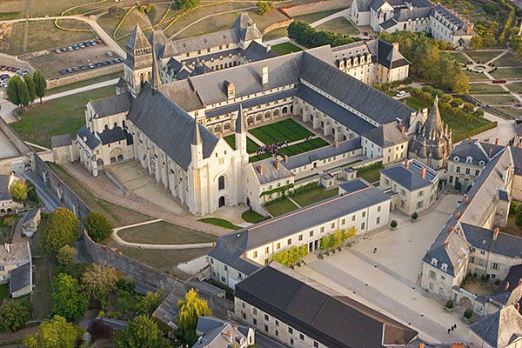
Abbaye Royale de Fontevraud also known as a Fontevraud Abbey or Fontevrault Abbey is situated near village of Fontevraud-l'Abbaye in Maine- et- Loire department of France. This Roman Catholic Monastery was found by Robert of Arbrissel (c. 1045–1116) in the years 1110- 1119. He also started an Order of Fontevrault around this time. Although he usually addressed under the title of "Blessed" he was never canonized due conflicting views of his life and alleged extreme ascetic life style.
Why Visit?
Historical significance: Burial place of key
Plantagenet figures like Eleanor of Aquitaine, Henry II, Richard the
Lionheart, and others. The polychrome recumbent effigies (gisants) are a
major highlight.
Architecture: Stunning Romanesque abbey church with
soaring pillars and domes, unique octagonal kitchens with multiple
chimneys, cloisters, chapter house, refectory, and dormitories.
Multi-layered history: From medieval powerhouse to prison (1804–1963) to
modern cultural venue.
Atmosphere: Peaceful, immersive site with
exhibitions, gardens, and events. Many visitors describe it as moving
and less crowded than major Loire châteaux.
A thorough visit
typically takes 2–3 hours (up to half a day if you linger or join
tours).
Practical Visiting Information (as of 2026)
Opening
hours: Generally 10:00 AM onward. Low season: often closed Tuesdays,
closes ~6 PM. Mid/high season: open daily until 7 PM or 8 PM. Always
check the official site (fontevraud.fr) as hours vary seasonally.
Tickets: Around €13 for adults (reduced ~€7.50 for
students/seniors/jobseekers). Free for under 18s and students under 25.
Guided tour supplement ~€5. Combined ticket with the Museum of Modern
Art available. Free entry on the last Sunday of certain months.
Guided tours: Available (1–1h15 duration); times vary—check at the
ticket office. Themed tours (e.g., on nuns or history) are offered
seasonally.
Buy tickets online in advance during peak season (summer)
to avoid lines.
Best Time to Visit
Spring (April–June) and
autumn (Sept–Oct): Ideal weather, beautiful surroundings, fewer crowds.
Summer: Longer hours, more events, but busier midday.
Avoid peak
crowds: Arrive at opening (10 AM) or late afternoon. Mornings or
end-of-day are recommended.
Weekdays are quieter than weekends.
Getting There & Parking
By car: ~15 min from Saumur, 55 min from
Tours, 1h10 from Angers. Easy day trip from Loire Valley bases.
Public transport: Bus line 1 from Saumur. Nearest train station: Saumur
(then bus/taxi).
Parking: Free parking available in the village
(e.g., Place du 8 Mai 1945 near the entrance). Ample spaces.
Biking:
Popular stop on Loire à Vélo routes.
Step-by-Step Visiting Tips
Start at the ticket office/courtyard: Pick up a map or audio guide (if
available). There's often an introductory exhibition.
Abbey Church
(Abbatiale): The highlight. Admire the Romanesque architecture, domes,
and the royal tombs with their painted effigies. Take time here—it's
atmospheric and photogenic.
Cloisters & monastic buildings: Wander
freely through the cloister, chapter house (with murals), refectory, and
dormitories. Look for prison-era remnants alongside medieval features.
Romanesque Kitchens: Unique 12th-century structure with 20+
chimneys—don't miss this architectural oddity.
Other areas: Courtyard
of the Écrou, bells, gardens, and modern art museum (if
interested—contemporary works in historic setting).
Take your time:
The site rewards slow exploration. Bring water; wear comfortable shoes
for uneven stone floors and outdoor areas.
Photography tip: Natural
light in the church is beautiful; early/late day enhances it. Respect
no-flash rules.
Amenities & Practical Tips
Food: On-site
options include the casual Terrasse Gourmande (local fast food) and a
more upscale restaurant (Fontevraud Le Restaurant). The village has
additional cafés and restaurants.
Accessibility: Generally good
(level paths, adapted services), but some areas like dormitories may
have stairs. Check official site for details.
What to bring:
Comfortable walking shoes, hat/sunscreen (outdoor parts), layers (stone
buildings can be cool), and a camera. Download the official app or map
if available.
Stay longer: Consider overnighting at Fontevraud
L'Hôtel (inside the former priory)—guests get after-hours access to roam
the empty abbey, a magical experience.
Nearby Attractions
Combine with Saumur (castle, mushroom caves), Montsoreau, Chinon, or
other Loire châteaux. The village itself is pretty with shops and
crafts.
Overall recommendation: Fontevraud is a must for
history/architecture lovers—deeper and more contemplative than many
tourist sites. Plan it as a focused half-day rather than rushing. Check
the official website (fontevraud.fr) for the latest details before your
trip, as events and hours change.
Founding and Early Years (1101–1110s)
The abbey was established by
Robert of Arbrissel (c. 1045–1116), an itinerant preacher and reformer.
After serving as Archpriest of Rennes and being driven out due to
clerical opposition, he lived as a hermit in the forest of Craon. His
ascetic lifestyle and powerful preaching attracted a diverse
following—including men, women, nobles, and even lepers.
Around 1100,
Robert settled in the valley of Fons Ebraldi (Fontevraud). Initially,
men and women lived together in a practice known as syneisaktism
(spiritual cohabitation), which was controversial and soon abandoned.
The community segregated by gender, with monks serving the nuns under
the overall rule of an abbess. This "double monastery" model was unusual
for the time.
Recognition: In 1106, the community gained approval
from the Bishop of Angers and Pope Paschal II.
Leadership: Robert
appointed Hersende of Champagne initially, followed by Petronilla of
Chemillé as the first abbess in 1115. Robert died in 1116/1117; by then,
the order had grown significantly (thousands of members across
priories).
Rule: Based on the Benedictine Rule, emphasizing
simplicity, silence, good works, and modest food/clothing. Early
abbesses were to be chosen from women with worldly experience (though
this was later changed).
The abbey quickly expanded, establishing
numerous dependent priories across France, England, and Spain—reaching
about 100 by the end of the 12th century.
Growth, Power, and the
Plantagenet Connection (12th–15th Centuries)
Fontevraud benefited
from patronage by the Counts of Anjou and especially the Plantagenet
dynasty. It became a royal necropolis and a favored retreat.
Architectural Development: Permanent Romanesque structures were built
from around 1110–1119. The abbey church, cloisters, and other buildings
reflect Romanesque and later Gothic styles. The famous Romanesque
kitchens (with multiple chimneys) are a standout feature.
Plantagenet
Ties: Henry II of England (Count of Anjou) and his wife Eleanor of
Aquitaine were major benefactors. Eleanor retired to Fontevraud in her
later years (around 1200) and died there in 1204. She commissioned
effigies and made it the burial place for her family.
Key Burials
(Plantagenet necropolis):
Henry II (d. 1189)
Eleanor of Aquitaine
(d. 1204)
Richard the Lionheart (d. 1199)
Isabella of Angoulême
(wife of King John, d. 1246)
Others including Joan (daughter of
Eleanor and Henry) and Raymond VII of Toulouse.
The painted stone
recumbent effigies (gisants) of Henry II, Eleanor, and Richard remain
among the most famous medieval sculptures in the abbey church. Eleanor
is depicted reading a book, symbolizing her intellect and influence.
The abbey housed nobles' daughters and maintained close ties with
royalty. It flourished as a spiritual center while wielding political
influence due to its location in the heart of Angevin territories.
Later Medieval to Early Modern Period
36 abbesses ruled from 1115
to 1792, nearly all of noble birth (many from Bourbon and other high
families). This feminine governance was exceptional.
Challenges:
Financial difficulties arose after the Plantagenet era waned. In 1247,
nuns were allowed to receive inheritances to sustain themselves.
Renovations: Under Bourbon abbesses (e.g., Renée de Bourbon in the late
15th/early 16th century), the abbey saw significant rebuilding and
enforcement of stricter rules.
By the 18th century, it continued as a
prestigious convent, even hosting daughters of Louis XV.
French
Revolution and Suppression (1789–1792)
The Revolution ended the
monastic era. Church property was nationalized in 1789. In 1792, the
remaining nuns and monks (about 200 people) were expelled. The site was
looted, and many religious artifacts were destroyed or dispersed. The
last abbess, Julie Sophie Charlotte de Pardaillan d'Antin, died in
poverty in Paris in 1797.
Prison Era (1804–1963)
Napoleon
transformed the abbey into a central house of detention (one of France's
harshest prisons) starting in 1804. It held up to 2,000 prisoners (men,
women, and children), requiring major modifications: dormitories,
workshops, and barracks were added. It gained a grim reputation,
comparable to Clairvaux. Political prisoners, including some French
Resistance members under Vichy, faced severe conditions.
The prison
operated until 1963, which helped preserve the buildings (as they were
adapted rather than demolished).
Modern Revival and Cultural Site
(1963–Present)
1963: Transferred to the French Ministry of Culture.
Restorations: Major work began, including on the church and kitchens
(led earlier by architect Lucien Magne). It was classified as a historic
monument in 1840.
1975 onward: Became the Centre Culturel de l'Ouest,
a cultural center hosting exhibitions, concerts, and events. Opened to
the public in 1985.
Today: A UNESCO World Heritage Site (as part of
the Loire Valley). It includes a hotel, Michelin-starred restaurant,
modern art museum (Cligman collection since 2021), and immersive
experiences. It blends medieval heritage with contemporary culture.
Fontevraud Abbey, also known as the "Monastic City", is considered
the largest monastic building in Europe. The extraordinary architectural
ensemble was built on an area of 14 hectares.
The conception as a
mixed monastery initially existed with priority given to women. Later,
two separate monasteries coexisted, then eventually four:
"Le
Grand-Moûtier" was intended for the nuns dedicated to prayer and for the
"Saint Benoît" hospital,
"La Madeleine" for the lay sisters dedicated
exclusively to the abbey,
"Saint-Lazare" for the nuns who cared for
lepers (lepers) and
"Saint Jean de l'Habit" for men, brothers and
priests who lived apart from the convent.
While the women were to
devote themselves exclusively to prayer within a strict enclosure, the
necessary work was left to the men; among them clerics and lay people
lived together without separation. Robert von Arbrissel, who rejected
the title of abbot, initially headed the entire community as Magister.
He always went barefoot and wore clothes made of coarse cloth. The
community of Fontevraud received a huge following from all walks of
life; Above all, rejected wives, prostitutes and even lepers sought
refuge with Robert of Arbrissel. From 1115 onwards and for seven
centuries, according to the will of the founder, 36 abbesses were to
succeed one another at the head of the order. The abbey was exempt, that
is, it was not subordinate to a bishop, but directly to the pope.
From the beginning, the monastery had a strong connection with the
House of Plantagenet, the Counts of Anjou: they particularly encouraged
this monastery and made it their royal burial place. Eleanor of
Aquitaine retired to this monastery in old age and is also buried there.
The monastery also houses the tombs of her second husband Henry II of
England, their son Richard the Lionheart and the wife of his youngest
son John, Isabella of Angoulême.
The monastery was dissolved
during the French Revolution. After the dissolution and sale of the
ecclesiastical property had been decided in August 1792, the last abbess
Julie-Gillette de Pardaillan d'Antin left the monastery on September 25,
1792.
The former monastery buildings have been largely preserved,
even though they have been rebuilt in different styles over the
centuries. The Romanesque kitchen building and the Renaissance-style
cloister from 1522 with the chapter house and the refectory are
particularly noteworthy.
The abbey church consists of a choir, a nave, a transept with a
crossing tower and a western façade with two smaller, non-accessible
towers. In the course of the restoration of the outer walls, the
Romanesque stone carvings, mainly consisting of capitals and friezes,
were replaced in particularly badly weathered places with new
constructions in the Romanesque style, without completely replacing the
old substance.
The current condition of the interior is also the
result of a thorough restoration. The church building was already
damaged during the French Revolution. Under Napoleon, the monastery
became a prison and, curiously enough, remained so until 1963. From
1821, four ceilings were drawn into the church and workshops and
dormitories were set up; these works led to the demolition of the domes
and the enlargement of the stained glass windows to the north, which was
reversed during the restoration.
Apart from the pointed transept
windows, the church belongs to the Romanesque period. The choir was
built between 1106 and 1117 under the direction of the Prioress
Hersendis of Champagne and consecrated in 1119 by Pope Calixtus II. In
its simplicity, it resembles Romanesque churches in the Loire region. It
houses the cenotaph of the monastery founder Robert von Arbrissel, whose
ascetic spirit shaped the building. The choir has a colonnade similar to
that of Notre Dame la Grande in Poitiers, but with a more pronounced
vertical division. There, the gallery has an indicated groined vault
with connections to the chapels, and the barrel and half-cupola of the
inner choir begin just above the arcade. At Fontrevaud the barrel vault
of the ambulatory overlies the crests of the chapel attachments and has
belt arches. In the inner choir there is a triforium and clerestory
above the arcade.
The barrel vaults of the transept are typical
of the Romanesque style of south-west France.
A basilical nave
would actually have fitted in with the basilical choir. Instead, a
single-nave nave was chosen, built from 1125, with a vault of four
pendentive cupolas. This type of construction can be found in several
churches in south-west France and is traced back to Byzantine models.
When the nave was completed in 1160, the development of style had
already progressed; Angers Cathedral, built from 1148 onwards, has a
similar floor plan with rib vaults instead of unstructured domes and is
therefore considered the first large building of the Angevin Gothic
style.
To absorb the lateral thrust, the walls are constructed of
two shells (here not in the sense of thermal insulation); Wall pillars
are placed in front of the window wall, which are broken through by a
walkway. This type of construction can also be found in Romanesque
basilicas in Normandy and in numerous early Gothic churches outside of
France. Each pilaster has paired double services or half-columns on
three sides. This pillar shape can be understood as a special variant of
the cross pillar. The capitals belong to the late Romanesque style of
south-western France, both in the choice of their subjects and in their
execution, as can be found for example in the Cathedral of Angoulême, as
well as St-Eutrope and the Abbaye aux Dames in Saintes.
Henry II of England and Eleanor of Aquitaine are buried in the
central part of the nave in front of the entrance to the chancel in the
upper row, including Richard the Lionheart and Isabella of Angoulême,
the wife of John the Landless, whose tomb was the only one carved out of
wood. The other three are tuff-calcareous sculptures carved around the
time they died, i.e. the beginning of the 13th century (between 1200 and
1256). They are among the earliest funerary sculptures in which the
deceased are depicted as recumbent, as Gisants.
This burial place
of the English royal family of the Plantagenets is one of the most
important in European history and stands in a line with that of the
Salian emperors in Speyer, the Hohenstaufen kings in the Capella
Palatina in Palermo, the French kings in St. Denis and the other English
kings in Westminster Abbey.
The grave figures are all depicted in
an idealized form. Eleanor of Aquitaine, for example, is not depicted as
an 82-year-old woman at the end of her life, but in the prime of her
life. In contrast to the white coolness of the church, the funerary
statues are still in the original intense colors. The interior of the
church used to have this colour. The statues are larger than life, their
originators are unknown. Efforts have been made to preserve the majestic
character of the figures in their tomb statues. They are crowned and lie
on a display bed, in accordance with royal funeral rites. The two kings
of this group of four are each dressed in a tunic and in their gloved
hands hold a sceptre, the symbol of royal power; at her side lies a
knight's sword.
Eleanor of Aquitaine was also depicted reading on
her deathbed. This underlines her legendary learning, one of the most
important women of the Middle Ages.
Romanesque cuisine
As a
rare exception, the kitchen building in the Romanesque style has
survived in Fontevraud. The floor plan of the building is an octagon –
like the baptisteries – and the vault of the kitchen has also become
eight-sided thanks to a sophisticated nesting of geometric figures. A
stone kitchen was built not only for reasons of fire protection, but
also for reasons of representation. The kitchen, located just behind the
refectory, with its capitals in the form of crowns, underlined the rank
of the whole monastery as a royal abbey.
Due to the nesting of
the building, niches are formed in the walls, which were used as
fireplaces. A look directly into the unusual and high vault shows a
rather complicated construction for a kitchen. Even in this apparently
purely functional building, attention was not only paid to clean
workmanship, but also to numerical symbols. In the high vaults there are
vents for the smoke from the fireplaces and for the vapors from the
prepared dishes. The roof is made of stone in the Angevin Romanesque
style and is shaped like a pine cone.
Hersendis of Champagne (first prioress) 1100 to 1 December 1114
Petronilla of Chemillé (first abbess) 18 October 1115 to 1150
1150–1154: Mathilde I of Anjou († 1154), widow of William Ætheling,
daughter of Count Fulk V of Anjou, aunt of the English king Henry II
1155-1180: Audeburge de Haute-Bruyere
1180-1189: Gilles/Gillette
1189–1194: Mathilde II of Flanders, daughter of Dietrich von Alsace,
Count of Flanders (House of Châtenois)
1194-1207: Mathilde III. from
Bohemia
1207–1208: Marie I of Champagne (de Bourgogne)
1208-1209:
Ala/Alix of Bourbon
1209-1218: Adele of Brittany
1218-1228: Berta
1228–1244: Adelheid (Adélaide) of Blois, daughter of Theobald V the Good
(Thibaut V le Bon), Count of Blois (House of Blois)
1244–1265: Mabile
de la Ferte (or de Blois)
1265-1276: Jeanne de Dreux (de Brenne)
1276–1284: Isabeau I Davoir
1284–1304: Marguerite I de Pocey
1304–1342: Eleanor of Brittany, † 1342, daughter of Duke John II of
Brittany (House of France-Dreux)
1342–1349: Isabella of Valois, †
November 11, 1349, daughter of Charles I, Count of Valois
1349-1353:
Theophanie de Chambon
1353-1373: Joan of Mangey
1373: Adélaïde de
Ventadour
1373–1393: Eléonore (Aliénor) II de Parthenay
1393-1431:
Blanche d'Harcourt
1431–1451: Marie II d'Harcourt
1433–1434:
Marguerite de Montmorency, † 1434 (see Montmorency lineage)
1451-1457: Marie III. de Beaussault, † 1461 (see Montmorency lineage)
1457–1475: Marie IV of Brittany
1477–1491: Anne of Orléans, † 1491,
daughter of Duke Charles of Orléans
1491–1534: Renée de Bourbon, †
1534, daughter of Jean VIII de Bourbon, comte de Vendôme and Isabelle de
Beauvau
1534-1575: Louise de Bourbon
1575-1611: Eleanor de Bourbon
1611-1637: Louise de Bourbon-Lavedan
1637–1670: Jeanne-Baptiste de
Bourbon, * February 22, 1608, † January 16, 1670, illegitimate daughter
of Henry IV (France)
1670-1704: Marie-Madeleine-Gabrielle de
Rochechouart-Mortemart (House of Rochechouart), a sister of
Françoise-Athénaïs de Rochechouart-Mortemart, Marquise de Montespan, who
temporarily lived at the monastery
1704–1742: Louise-Françoise de
Rochechouart (House of Rochechouart)
1742-1753: Louise-Claire de
Montmorin de Saint-Herem
1753-1765: Marie-Louise de Timbrone de
Valence
1765-1792: Julie-Gilette de Pardaillan d'Antin, daughter of
Louis de Pardaillan de Gondrin, 2nd Duc d'Antin (House of Pardaillan)