Location: Bas-Rhin département Map
Constructed:1246 and 1264 by by Eberhard d'Andlau
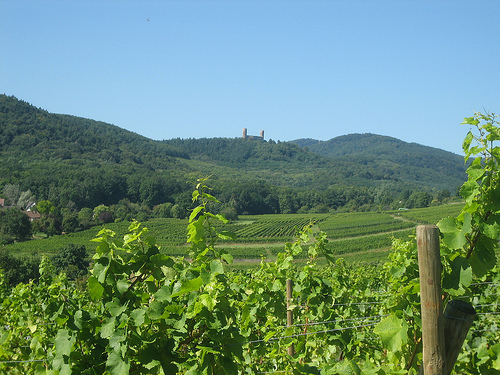
The Château d'Andlau, also known as Château de Haut-Andlau, is a medieval ruined castle situated in the commune of Andlau in the Bas-Rhin department of the Alsace region in northeastern France. Perched on a narrow granite outcrop at an altitude of approximately 451 meters (1,480 feet), it overlooks the valleys of Andlau and Kirneck, providing commanding views of the surrounding landscape, including the towns of Andlau and Barr to the north. Constructed primarily from local granite blocks excavated on-site, the castle's distinctive silhouette—featuring two prominent circular towers flanking a long residential building—makes it a striking example of 13th-century military architecture in the Vosges Mountains. Today, it stands as a protected historical monument and a popular tourist site, attracting visitors for its ruins, panoramic vistas, and cultural events.
Construction and Early History (13th Century)
The
castle's origins trace back to the mid-13th century, during a period
when the Alsace region was part of the Holy Roman Empire. It was built
between 1246 and 1264 by Eberhard d'Andlau (also referred to as Eberhard
von Andlau), a member of the noble Andlau family, who were knights and
lords under the empire's banner. The site was chosen for its strategic
defensive advantages: a steep mountainside to the east provided natural
protection, while a wide, rock-cut moat isolated the structure on other
sides. Unlike many contemporary castles in the Vosges, which were often
constructed from softer sandstone and featured a single tower or donjon,
Château d'Andlau was built in one cohesive phase using durable granite,
emphasizing a unique dual-tower design. This construction not only
served military purposes—controlling trade routes and valleys—but also
symbolized the Andlau family's power and influence in the region.
The
earliest documented mention of the castle appears in records from 1274,
highlighting its role as a fortified residence. The Andlau lords
maintained control over the castle for centuries, using it as a base for
administrative and defensive operations within the empire's feudal
system.
Medieval Period and Notable Events (14th–16th Centuries)
Throughout the medieval era, Château d'Andlau remained a key stronghold
for the Andlau family. One of the earliest recorded conflicts occurred
in May 1438, when troops from the nearby city of Obernai besieged the
castle. The incident stemmed from a dispute involving the castle's
bailiff, a squire who refused to pay a departure tax owed to Obernai.
Soldiers from the city launched a nighttime assault, stabbing the squire
and his wife, prompting a formal protest from the Andlau lords in a
letter decrying the violation. This event underscores the castle's
involvement in local feudal rivalries and urban-noble tensions.
By
the 16th century, modifications were made to the lower court, adapting
the structure to evolving needs, though the core upper castle remained
largely unchanged. The castle's robust design helped it withstand
various regional conflicts, but it faced greater threats in later
centuries.
Later History: Wars, Decline, and the French
Revolution (17th–18th Centuries)
The castle endured significant
turmoil during the Thirty Years' War (1618–1648), a devastating conflict
that ravaged much of Europe. It was occupied by Swedish troops and
forces from Strasbourg, but remarkably, it was relatively spared from
total destruction compared to other regional fortresses. However, in
1678, following Alsace's annexation to France under King Louis XIV, the
castle was pillaged by French troops led by Maréchal François de
Blanchefort de Créquy. This looting marked the beginning of its gradual
decline, as the structure fell into disrepair amid shifting political
landscapes.
The French Revolution (1789–1799) further sealed its
fate. Confiscated as national property (biens nationaux), the castle was
sold in 1796 to a private merchant who, starting in 1806, began
dismantling and selling its components—stones, timber, and other
materials—piece by piece. This commercial exploitation occurred with
little public opposition, leading to extensive ruin. During this period,
it briefly served as a residence for a gamekeeper employed by the Andlau
family, but the overall neglect accelerated its decay.
Modern
Times: Restoration and Preservation (19th Century–Present)
The
castle's salvation came in 1818 when Antoine-Henri d'Andlau, a
descendant of the original builders, repurchased the ruins to halt
further destruction. Initial repair work was undertaken in 1856 (or
1859, per some accounts) by his heirs, stabilizing key elements. It was
officially classified as a monument historique in 1926, granting it
legal protection. A major restoration campaign followed in 1927–1928,
spearheaded by the Club Vosgien (Vosges Club), which reinforced the
structure.
In 1998, a wall collapse prompted renewed efforts, leading
to the formation of the "Association des Amis du Château d'Andlau"
(Friends of Andlau Castle) in 2000. This volunteer group has since
conducted ongoing preservation, including guided tours for groups
(available by contacting info@chateaudandlau.com). The castle remains in
the Andlau family's ownership and is open to the public free of charge,
though visitors are advised to wear walking shoes due to the rugged
terrain. It now hosts seminars, summer events, and serves as a hiking
destination, with its towers offering magnificent views of the Alsace
Plain. Pets are allowed, and it's accessible about 4 km from the nearest
train station.
Overall Layout and Structure
The castle's design
closely follows the irregular shape of the granite outcrop on which it
is built, creating a compact and elongated layout that maximizes natural
defenses provided by the steep slopes and rocky terrain. It consists of
two main parts: the upper castle (or main keep) and a lower bailey. The
upper castle is a stretched, polygonal building measuring approximately
37 meters in length and 9 meters in width, forming the core of the
fortress. This main structure is flanked at both ends by circular
towers, connected by thick curtain walls, giving the castle a
distinctive "barbell" silhouette when viewed from above. The bailey,
located below the upper castle, originally housed auxiliary buildings
such as stables and industrial structures, accessible via a 16th-century
entrance gate that was added during modifications to accommodate
firearms. The entire site was once surrounded by moats and dense
forests, enhancing its isolation and defensibility.
Towers
One
of the most striking architectural features of Château d'Andlau is its
pair of massive, cylindrical towers, which project outward from the ends
of the main building. Each tower measures about 10 meters in diameter
with walls less than 2 meters thick, rising to a height that once
supported slate-capped spires (now lost to time). These towers are
taller and more robust than typical for the era, providing elevated
positions for surveillance and defense over the valley below. The
eastern tower is slightly larger and features narrow slit windows for
archers, while the western one includes remnants of internal chambers.
This dual-tower configuration is unique in Alsatian castles, which often
relied on a single central donjon, and reflects an innovative approach
to fortification that balanced residential comfort with military
strength.
Main Building and Residential Areas
The central
structure is a long, narrow main building divided into three levels,
serving both defensive and residential purposes. The ground level,
pierced by narrow arrow slits (archers) and later cannon ports, was
primarily for defense and storage. Above it, the middle and upper levels
housed living quarters, including a bright residential chamber
illuminated by multiple Gothic arched windows. These windows, set into
the thick granite walls, feature pointed arches typical of Gothic
architecture, allowing light into what were once grand halls and
chambers. Internally, the ruins reveal remnants of vaulted ceilings,
fireplaces, and staircases, suggesting divided rooms for nobility,
servants, and possibly a chapel. The polygonal shape of the building
adapts to the rock's contours, with walls up to several meters thick in
places, incorporating corbels and machicolations for dropping
projectiles on attackers.
Defensive Features
Château d'Andlau
exemplifies 13th-century military architecture with its emphasis on
passive and active defenses. The thick stone walls, constructed from
local granite blocks, provided robust protection against sieges. Arrow
slits and embrasures on the lower levels allowed for crossbow and later
artillery fire, while the elevated position on the outcrop made direct
assaults difficult. The moats, now partially filled, and the surrounding
forests acted as natural barriers. In the 16th century, adaptations
included reinforced gates and modifications for gunpowder weapons,
reflecting evolving warfare technology. The castle's design prioritized
height and visibility, with the towers offering panoramic views for
early warning.
Materials and Construction Techniques
The
entire structure is built from granite quarried directly from the
underlying outcrop, giving it a seamless integration with the landscape
and exceptional durability compared to sandstone castles in the area.
Blocks are roughly hewn and mortared, with finer ashlar stone used for
window frames and decorative elements. Gothic influences are evident in
the arched openings and pointed windows, blending Romanesque solidity
with emerging stylistic elegance. The construction exploited the site's
natural rock for foundations, reducing the need for extensive
excavation.
Current State and Preservation
Today, Château
d'Andlau exists as atmospheric ruins, with the towers and main walls
largely intact but roofs and interiors collapsed. Vegetation has
encroached, adding to its romantic, overgrown appeal. Restoration
efforts since the 19th century have stabilized key structures, making it
accessible via hiking trails for visitors interested in medieval
architecture. It remains a popular site for exploring Alsace's castle
heritage, offering insights into how architecture harmonized with nature
and defense needs.