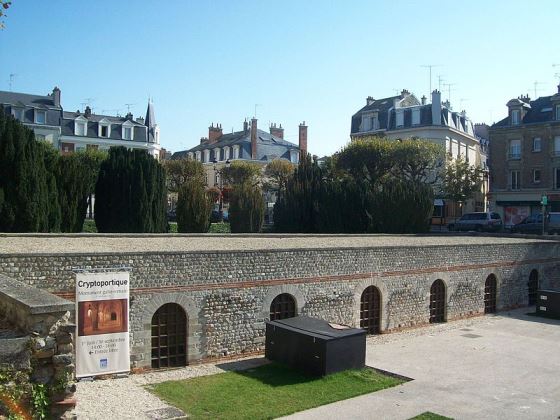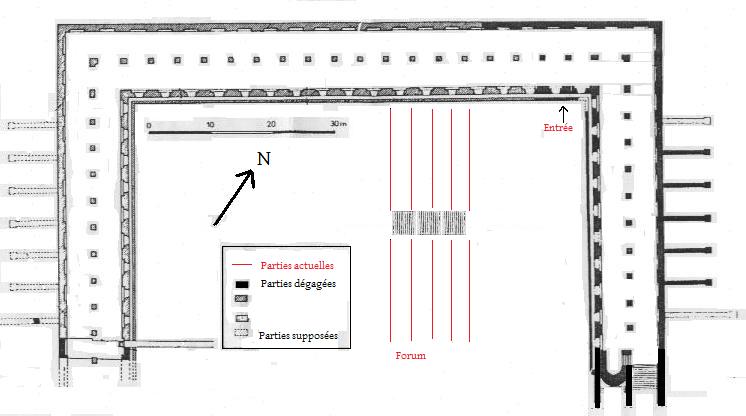
The cryptoporticus of Reims is an underground gallery, a horreum, in the shape of a U at the current place of the Place du Forum in the city center of Reims.
It was certainly the northern part of the Roman forum during
antiquity which must have been 65 m wide by 250 m long; it was built
around the year 100 and mostly ruined during the invasions of the
4th century; its entrance consisted of a monumental staircase (lower
right corner of the plan) and which turned at right angles and thus
passed above an altar for the statue of the emperor (lower right
corner, to the left of the staircase ).
The gallery is divided in
two by stone pillars which have notches serving to accommodate the
wooden structures which delimited boxes and whose stucco walls were
decorated with colored nets and stylized hangings.
The walls are
built in small apparatus and the vault is in semicircular tile
mortar. The north-east wall is blind but its opposite lets in light
through windows reaching level with the ground outside.
Above is
the current Place du Forum, an open-air theater (red on the map) and
is next to the Musée-hôtel Le Vergeur.
The Cryptoportique de Reims, also known as the Cryptoporticus, is a
well-preserved ancient Roman structure located beneath the Place du
Forum in the heart of Reims, France. This semi-subterranean vaulted
gallery represents a key remnant of the city's Gallo-Roman heritage,
offering insights into Roman engineering, urban planning, and daily life
in the province of Gallia Belgica. Originally part of the Roman city of
Durocortorum (the Latinized name for Reims, derived from the Gaulish
Durocorteron, meaning "round fortress"), the Cryptoportique was
integrated into the central forum, serving as both a functional and
structural element of the urban landscape. Reims, founded around 80 BC
by the Remi tribe of Gauls, allied with Julius Caesar during his
conquest of Gaul (58–51 BC) and grew into a major Roman center with a
population possibly reaching 30,000–100,000 at its peak. The site's
strategic location at the intersection of major Roman roads contributed
to its prosperity and the construction of monumental architecture like
the Cryptoportique.
Origins and Construction
Construction of
the Cryptoportique is dated primarily to the 3rd century AD, though some
sources suggest work began between the 1st and 2nd centuries, with
completion in the 3rd. This aligns with a period of urban expansion in
Durocortorum during the High Roman Empire, when the city was a hub for
trade, administration, and culture. The structure formed a U-shaped
complex enclosing three sides of the Roman forum, consisting of two
parallel galleries approximately 60 meters long connected by a
100-meter-long transverse passage. Built using robust stonework with
vaulted ceilings and arches, it exemplifies Roman engineering techniques
designed for durability and stability. The galleries were
semi-subterranean, with the roof serving as a walkway or portico above
ground, and featured rows of shops on the exterior. Unlike typical
enclosed cryptoporticus structures (underground vaulted passageways
found in other Roman sites like Pompeii or Arles), the Reims example was
atypically open on one side, possibly to facilitate access to the forum.
It also provided foundational support for overlying buildings, such as
temples or public edifices, reflecting the integrated nature of Roman
urban design.
The site's proximity to other Roman monuments, like the
3rd-century Porte de Mars triumphal arch (the widest surviving Roman
arch at 32 meters), underscores its role in the city's ceremonial core.
Recent archaeological findings nearby, including a 2nd–3rd-century
monumental complex with porticoed galleries, hypocaust-heated baths, and
painted plasters using rare pigments like Egyptian blue, suggest the
Cryptoportique was part of a broader elite or public architectural
ensemble, possibly a domus (wealthy residence) or spa facility.
Purpose and Function in Roman Times
The primary function of the
Cryptoportique was multifaceted. As a cryptoporticus, it served as a
cool, subterranean storage area for perishable goods like grain,
foodstuffs, and other items, leveraging its underground position for
temperature control. It also acted as a passageway for movement around
the forum, providing shade during hot summers and protection from the
elements. Additionally, it reinforced the structures above, distributing
weight and preventing subsidence in the chalky soil common to the
region. Excavations have revealed evidence of workshops, marketplaces,
and daily activities, with artifacts such as pottery, tools, and animal
bones indicating its role in commerce and urban life. The structure's
design, with barrel-vaulted ceilings and windows, allowed for
ventilation and light, making it a practical space for storage and
possibly even social gatherings.
In the broader context of
Gallo-Roman culture, the Cryptoportique highlights the Romanization of
Gaul, blending local traditions with imperial innovations. Reims'
alliance with Rome allowed for such developments, and the site provides
evidence of cultural exchange, including the adoption of Roman building
techniques by the indigenous Remi people.
Decline, Abandonment,
and Medieval Reuse
By the early 4th century, as the Roman Empire
faced invasions and economic shifts, the Cryptoportique and surrounding
forum began to decline. The city was captured by the Vandals in 406 AD
and sacked by Attila the Hun in 451 AD, leading to widespread
destruction. During the Middle Ages, many of the structure's stones were
quarried and reused in other buildings, a common practice of "recycling"
ancient materials that destroyed much of the overlying forum and parts
of the underground galleries. The site was gradually buried under layers
of debris, garbage, and new constructions, with only fragments surviving
as cellars or foundations in later buildings. This period of obscurity
lasted for centuries, as Reims evolved into a medieval center famous for
its cathedral and coronations of French kings.
Rediscovery and
Excavations
The Cryptoportique was rediscovered in the 19th century
during urban development. In 1830 (or 1840, per some accounts),
construction of a new market hall unearthed columns and sections of the
gallery. Rather than demolishing the remains, they were incorporated
into the market, though no full excavation occurred at the time. In
1922, the market was demolished for new buildings, prompting partial
digs, but efforts were limited by post-World War I reconstruction and
nearby homes. The site was classified as a historical monument in 1923,
and the square was renamed Place du Forum in 1932, signaling growing
interest in its Roman past.
Major excavations and restoration began
in the 1930s amid broader city rebuilding after World War I damage, but
comprehensive work took nearly five decades. By 1983, the eastern
gallery—the best-preserved section—was fully excavated and opened to the
public. Today, only this eastern arm, a right-angle corner, and a short
segment of the longer passage remain accessible, as much of the original
U-shape lies beneath modern structures. Artifacts from digs, including
objects from the forum, are displayed in an on-site museum space that
recounts the excavation history.
Modern Preservation and
Significance
The Cryptoportique is one of only a handful of
well-preserved cryptoporticus structures in the Roman world, making it
archaeologically significant for understanding Roman urbanism and
engineering. It is free to visit from mid-June to mid-October, with
self-guided access and occasional guided tours ("Les Samedis du Crypto")
in July and August lasting 90 minutes. The site now hosts art exhibits,
concerts, and cultural events in an open-air theater setting, where the
vaulted structure forms a scenic backdrop. Ongoing archaeological
interest persists, with hopes that future renovations in surrounding
buildings might reveal additional sections.
Beyond its historical
value, the Cryptoportique symbolizes Reims' enduring Roman legacy,
connecting visitors to the sensory world of ancient Durocortorum—its
bustling markets, innovative storage solutions, and architectural
prowess. It stands as a testament to the city's transformation from a
Gaulish stronghold to a Roman metropolis and, ultimately, a modern
cultural hub.
Discovery
In 1922, on the occasion of the desire to build the Central Halls of
Reims, the old covered halls built in 1840 in the market square were
razed. Vestiges being unearthed, the works were interrupted and the room
52 m and 5.70 m high, supported by a row of rectangular central pillars,
alcoves on each side; it appears that part of the structure is under
houses. But they have just been rebuilt after the destruction of the
First World War and we give up excavations in this part.
This
discovery explains, in part, the discovery of columns that had been
previously discovered and also the partial discovery during the
construction of the halls in 1840 by Saint-Saulieu, at that time there
was no decision to launch excavations.
Monument
It was listed in 1923, but was not highlighted, practically
abandoned, it only had a grassy terrace and an iron staircase, on May
27, 1932 the square was renamed Place du Forum.
Excavations are only
undertaken by passionate volunteers from the Champagne Archaeological
Society.
In 1982, safeguard work was carried out, consolidation of a
pillar that was sinking (65 cm), restoration of two partly collapsed
vaults which led to the opening to the public in 1983 of the eastern
part.
Uses
This monument highlights the place and importance of Reims in Roman times, it received 3,160 visitors in 2002 and serves as a stage for outdoor music events and indoor exhibitions.