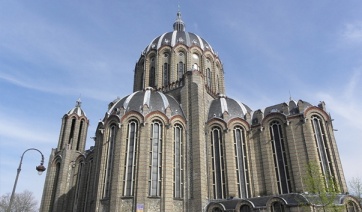
Location: 6 Place Sainte- Clotilde
Constructed: 1898
Basilica of Saint Clotilde is located in the central part of Reims. Church was built in 1898 in honor of the 1400th anniversary of baptism of King Clovis I by Bishop Saint Remi. Basilica of Saint Clotilde was named after his wife Queen Clotilde. According to a legend Clovis promised his Christian wife that in case of military victory he will baptize himself and his people, the Franks. According to legends Clotilde spent several nights praying for her husband. King Clovis did succeed in his endeavors and kept his word that he gave to his wife Clotilde. Basilica of Saint Clotilde was designed by a famous French architect Alfonso Gosse in the late neo- Byzantine architectural style. It is fairly unique type of church for Western Europe and its appearance certainly stand out comparing to other churches in Reims.
The Basilica of Saint Clotilde (Basilique Sainte-Clotilde) in Reims,
France, is a Catholic minor basilica dedicated to Saint Clotilde (c.
475–545), the Burgundian princess who became queen of the Franks as the
wife of King Clovis I. Clotilde played a pivotal role in the history of
France by influencing her husband's conversion to Christianity, which
culminated in Clovis's baptism around 496 AD in Reims by Saint Remigius
(Saint Remi). This event marked the beginning of Christianity's
dominance in Frankish territories and laid the foundation for France's
Christian monarchy. The basilica honors her legacy and serves as a
shrine to the saints of France, housing an extensive collection of
relics. Located in the Sainte-Anne neighborhood of Reims, it stands as a
testament to late 19th-century religious revivalism and national pride
in French Catholic heritage.
Inception and Purpose
The idea
for the basilica originated in the late 19th century under Cardinal
Benoît-Marie Langénieux (1824–1905), the Archbishop of Reims from 1874
to 1905. He envisioned it as a commemorative structure for the 1400th
anniversary of Clovis's baptism, an event central to French history and
tied to Reims, often called the "City of Coronations" due to its role in
royal baptisms and anointings. Beyond celebration, the basilica was
intended to become a national sanctuary for the saints of France, with
dioceses across the country contributing relics of historically
significant saints. Pope Leo XIII elevated it to the status of a minor
basilica, underscoring its importance within the Catholic Church. This
project reflected a broader wave of Catholic architectural endeavors in
France during the Third Republic, aiming to reinforce faith amid
secularizing trends.
Construction
Construction began in 1896
and was completed in 1905, under the direction of Alphonse Gosset
(1835–1914), a renowned architect from Reims who had gained
international recognition through competitions, including one in New
York. The basilica adopts a neo-Byzantine style, popular in the 19th
century and exemplified by structures like the Sacré-Cœur in Paris,
though Sainte-Clotilde is more modest in scale compared to Reims' larger
landmarks such as the Cathedral of Notre-Dame or the Basilica of
Saint-Remi. Its design draws inspiration from the Hagia Sophia in
Istanbul for its domed structure, as well as St. Peter's Basilica in
Rome and the Church of Saint-Augustin in Paris for overall proportions
and elements.
The layout follows a Greek cross plan, symbolizing
equality in all directions and emphasizing centrality, surmounted by a
prominent dome that represents the celestial vault. This Byzantine
influence is evident in the use of arches, mosaics, and a harmonious
blend of light and space, creating an atmosphere of spiritual elevation.
Notable Features
Inside, the basilica boasts several distinctive
elements that highlight its historical and religious themes. The
stained-glass windows depict key scenes such as the baptism of Clovis
and the life of Joan of Arc, integrating national heroes into the sacred
narrative. Tiling motifs include fleur-de-lys (symbolizing French
royalty) and doves (representing the Holy Spirit), adding layers of
symbolism. The dome's underside is painted to mimic a starry sky,
enhancing the ethereal quality. A separate circular baptistery near the
entrance, richly decorated, continues to be used for baptisms, echoing
the basilica's ties to Clovis's conversion.
The crypt is perhaps the
most unique feature, serving as a repository for over 2,000 relics from
more than 1,600 saints of France, housed in 120 to 403 reliquaries
(sources vary on the exact count). These were collected at Langénieux's
request and displayed in visible showcases, making it a pilgrimage site
for devotees. Other highlights include a Way of the Cross sculpted by
Eugène Auger, an altar, and a stone reputedly from Jerusalem's Via
Dolorosa.
Significant Events
Throughout its history, the
basilica has been a venue for major commemorations. In 1996, it hosted
events for the 1500th anniversary of Clovis's baptism, including a visit
by Pope John Paul II, which drew international attention and reaffirmed
its role in French Catholic identity. Unlike the nearby Reims Cathedral,
which suffered extensive damage from German shelling during World War I
(1914–1918) and some in World War II, Sainte-Clotilde appears to have
escaped major wartime destruction, likely due to its location and the
nature of the conflicts in the area.
A more recent and dramatic event
was a fire on April 18, 2012, sparked during roof repair work. The blaze
destroyed approximately 350 square meters of the roof and nearly the
entire northern half-dome, but the main structure, interior, and
precious relics in the crypt remained intact. Restoration efforts,
funded through donations and heritage initiatives, took several years,
with the basilica fully reopening in July 2016.
Current Status
Today, the Basilica of Saint Clotilde remains under the jurisdiction of
the Archdiocese of Reims and is managed by the Association of Friends of
the Relics of the Saints of France. It is open to the public seasonally:
on Sundays in July and August from 3:00 PM to 5:00 PM, and during
European Heritage Days on Sundays from 2:00 PM to 6:00 PM. The
surrounding area includes a public square (Square Rue de Verzy), added
in 1980, with recreational facilities like playgrounds, a ping-pong
table, a boules court, and a dog area, integrating the basilica into
community life. While not as famous as Reims' other UNESCO-listed sites,
it attracts visitors interested in French saintly history, architecture,
and quiet reflection, preserving a niche yet profound chapter of the
nation's past.
The Basilica of Saint Clotilde (Basilique Sainte-Clotilde) in Reims,
France, is a striking example of Neo-Byzantine architecture, constructed
in the late 19th and early 20th centuries. Dedicated to Saint Clotilde,
the wife of King Clovis I—the first Frankish king to convert to
Christianity—it serves as a shrine to France's Christian heritage. The
basilica was built to commemorate the 1,400th anniversary of Clovis's
baptism, which occurred around 496 AD in Reims. Designed by local
architect Alphonse Gosset, it draws inspiration from iconic structures
like Hagia Sophia in Istanbul, St. Peter's Basilica in Rome, and the
Church of Saint-Augustin in Paris. Though modest in scale compared to
Reims' more famous landmarks like the Cathedral of Notre-Dame or the
Basilica of Saint-Remi, it impresses with its harmonious design,
spiritual ambiance, and historical significance. The basilica suffered
damage from a fire in 2012 that affected 350 square meters of the roof
and the northeast half-dome, but it was restored and reopened in 2016.
Historical Context
Construction began in 1896 and was completed
in 1905, aligning with the Neo-Byzantine revival popular in 19th-century
France, as seen in buildings like the Sacré-Cœur Basilica in Paris. This
style sought to evoke the grandeur of Byzantine architecture from the
Eastern Roman Empire, emphasizing domes, mosaics, and symbolic
ornamentation. The project was initiated by Cardinal Benoît-Marie
Langénieux, the Archbishop of Reims, who gathered relics from dioceses
across France to enrich the basilica's crypt. Its location in the
Sainte-Anne district of Reims places it amid the city's rich
ecclesiastical history, near sites tied to Clovis's legacy. Today, it is
open daily from 8 AM to 7 PM with free entry, though visitors have noted
occasional closures and maintenance needs, such as loose floor tiles and
broken windows. Guided tours are available, particularly during summer
Sundays and European Heritage Days.
Architectural Style and Plan
The basilica exemplifies Neo-Byzantine architecture, characterized by
its centralized plan and emphasis on verticality and light. It follows a
Greek cross layout—a symmetrical cross with arms of equal length—topped
by a prominent central dome. This design creates a sense of balance and
unity, typical of Byzantine influences, where the dome symbolizes the
heavens. The overall structure is more restrained than its Gothic
counterparts in Reims, focusing on harmony rather than soaring height.
No specific dimensions are widely documented, but it is described as
modest in size, making it approachable yet majestic. Materials are not
explicitly detailed in sources, but the construction likely incorporates
stone typical of French ecclesiastical buildings of the era, with
possible use of brick or tile for decorative elements.
Exterior
Features
From the outside, the basilica presents an elegant and
imposing facade, best appreciated from a distance along the main road.
The central dome rises prominently, flanked by smaller semi-domes or
apses, evoking the domed silhouettes of Byzantine masterpieces. The
Greek cross plan is evident in the building's compact, cross-shaped
footprint, with arms extending from the central dome. The exterior
stonework is relatively simple, avoiding the intricate carvings of
Gothic styles, and instead relies on proportion and form for impact.
Entrances are modest, leading into the nave, with the baptistery
positioned nearby. Some observers note that while the distant view is
striking, closer inspection may reveal signs of wear, such as weathering
or minor disrepair.
Interior Features
Inside, the basilica
unfolds into a luminous and spiritually evocative space. The imposing
central nave, supported by the Greek cross structure, draws the eye
upward to the dome's underside, which features a ceiling symbolizing the
celestial vault—likely through painted or mosaic representations of
stars or divine motifs. Stained-glass windows flood the interior with
colored light, depicting key historical and religious scenes, including
Joan of Arc and the baptism of Clovis. The flooring includes decorative
tiling with motifs like fleur-de-lys (symbolizing French royalty) and
doves (representing peace and the Holy Spirit). Sculptures adorn the
space, enhancing the devotional atmosphere. A standout feature is the
baptistery, a circular, isolated chamber near the entrance, richly
decorated and dedicated to baptisms—tying back to the basilica's
commemorative purpose. The play of light through the windows and the
dome creates a serene, ethereal environment, emphasizing Byzantine
ideals of divine illumination.
The Crypt and Relics
One of the
basilica's most notable elements is its crypt, a subterranean space
housing an extraordinary collection of relics. Sources vary slightly on
numbers, but it contains between 120 and 403 reliquaries holding over
2,000 to 2,100 relics from 1,600 saints significant to French history.
These were collected from across France at the archbishop's request,
making the crypt a national treasure trove of Christian artifacts. The
crypt's design is functional yet reverent, with displays that invite
contemplation. Photography is often restricted here, preserving the
sacred atmosphere.
Overall Significance and Visitor Notes
The
Basilica of Saint Clotilde stands as a testament to France's royal and
religious past, blending architectural elegance with historical depth.
Its Neo-Byzantine style offers a contrast to the predominant Gothic
architecture in Reims, providing a unique perspective on ecclesiastical
design. While not as tourist-heavy as nearby sites, it rewards visitors
with its intimate scale and rich symbolism. For those planning a visit,
be mindful of potential maintenance issues, such as uneven flooring, and
check opening hours in advance. The basilica's location at Place
Sainte-Clotilde makes it easily accessible within Reims' historic
center.
Surroundings of the Sainte-Clotilde basilica
Access to the Sainte-Clotilde basilica is via avenue Sainte-Clotilde. Near the Sainte-Clotilde basilica, the square rue de Verzy, with an area of 4,430 m2, was laid out in 1980. It consists of a central clearing surrounded by tall trees. It has two play areas for children, a ping-pong table, a bowling green, and a canine area with a water point. The park is accessible by avenue Sainte-Clotilde and by rue de Verzy.