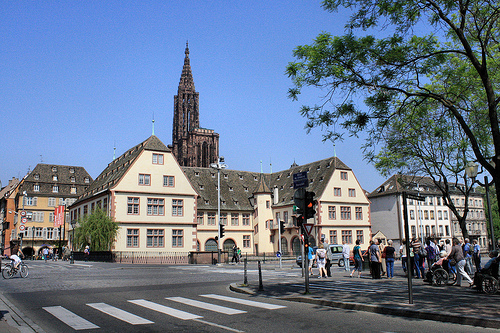
The Musée Historique de Strasbourg (Historical Museum of the City of Strasbourg) is one of the key museums in Strasbourg, France, dedicated to the city's rich and tumultuous history. It covers roughly nine centuries, from the Middle Ages to the post-World War II era and the founding of European institutions.
The Building: Former Grande Boucherie
The museum occupies a
significant Renaissance-era building: the Grande Boucherie (Great
Butcher's Hall or former slaughterhouse), constructed between 1587 and
1588 on the banks of the River Ill, near the Cathedral and Petite
France.
This structure served as the city's main butchery for over
three centuries (until 1899). Its architecture reflects Strasbourg's
prosperity during the period when it was a Free Imperial City in the
Holy Roman Empire. The building is classified as a Monument Historique
(protected since 1928).
After the butchery closed, the building was
repurposed. In the late 19th/early 20th century (during the German
period, 1871–1918), it briefly housed the Museum of Decorative Arts,
inaugurated by Kaiser Wilhelm II.
Founding and Early History of
the Museum (1919–1920)
The museum was formally founded in 1920,
shortly after World War I and the return of Alsace-Lorraine to France in
1918–1919. This timing was not coincidental: it reflected a desire to
reaffirm French identity in a border region with a complex Franco-German
history.
Under the direction of Hans Haug (director of Strasbourg's
museums), decorative arts collections were moved to the Palais Rohan,
freeing the Grande Boucherie for a new focus on Strasbourg's urban,
political, military, economic, and social history. An initial exhibition
emphasized the city's origins and military past as it "became French
again."
20th Century Development and Challenges
Throughout the
20th century, the museum accumulated a vast collection of around 200,000
objects, with only a fraction (about 1,650–1,700) displayed at any time.
Donations came from Strasbourg citizens and Alsace residents, including
military items, everyday objects, costumes, furniture, paintings, and
sculptures.
By the 1970s, it was described by its curator Jean-Pierre
Klein as an "Ali Baba's cave"—a somewhat chaotic mix of precious
artifacts, humble daily items, and historical relics.
The building
underwent major renovations. It closed for about 20 years before a
phased reopening:
June 30, 2007: First phase (ground floor or
main areas) under director Monique Fuchs, covering history from the
early Middle Ages to 1800.
November 16, 2013: Second phase (upper
floor), extending coverage to the Napoleonic era through the 20th
century and European institutions. The full museum reopened at the end
of 2013.
The 2013 renovation introduced a more modern, lively,
and interactive scenography with playful and digital elements to engage
visitors.
Collections and Permanent Exhibition
The museum
organizes Strasbourg's history into three main chronological chapters:
Free Imperial City of the Holy Roman Empire (1262–1681): Strasbourg as a
largely autonomous, prosperous Germanic city.
Royal then
Revolutionary City (1681–1800): Annexation by Louis XIV's France,
integration into the kingdom, and the impact of the French Revolution.
19th–20th Centuries and European Capital: Industrialization,
Franco-Prussian War, German annexation (1871–1918), World Wars,
liberation, and Strasbourg's role as a symbol of Franco-German
reconciliation and seat of European institutions (Council of Europe,
etc.).
Highlights include:
The star attraction: A massive 1727
plan-relief (relief map/model) of Strasbourg and its surroundings,
commissioned by Louis XV. It measures about 11.9m x 6m (nearly 80 m²) at
a 1:600 scale and served both military and educational purposes.
Military artifacts, weapons, uniforms (including Napoleonic items and
Leclerc's flag from the 1944 liberation).
Everyday life objects,
costumes, furniture, and archaeological finds.
Items related to key
figures like General Jean-Baptiste Kléber.
20th-century elements: A
1925 Mathis car (Strasbourg-made), fragments from the destroyed
synagogue, and donations from European institutions (e.g., a judicial
robe from the European Court of Human Rights).
The approach balances
"great history" with the lives of ordinary citizens.
Significance
and Role Today
The Musée Historique serves as an urban, civic, and
contemporary museum. It helps visitors understand Strasbourg's identity
as a border city that shifted between Germanic and French spheres
multiple times, while highlighting its role in European unity.
It is
part of the network of Strasbourg City Museums and holds the "Musée de
France" label. Annual visitors number around 50,000–60,000. It offers
guided tours, events, and interactive experiences.
Overall Form and Layout
The Grande Boucherie is a U-shaped
structure (often described as having three wings around a courtyard),
built in a utilitarian yet architecturally refined Renaissance style.
Ground floor: Originally open to the street on the north side for
butchers' stalls. The east and west wings featured vaulted spaces used
as cold stores.
Upper floors: The first floor hosted theatrical
performances and trade fairs. A spiral staircase in the courtyard (plus
former external staircases, now gone) provided access.
The building
sits near the Ill River in the Petite France / Grande Île area, close to
the Cathedral, blending into Strasbourg's historic urban fabric while
standing out with its scale and Renaissance features.
Exterior
Architecture
The façade reflects late Renaissance (or Northern
Renaissance) characteristics with Germanic/Alsatian influences:
Materials: Stone on the ground floor for durability (suitable for a
butchery), with upper levels in a mix of masonry and traditional
regional elements. The walls are typically rendered in light colors with
red sandstone or brick accents for trim, quoins, and window surrounds.
Windows: Large, regularly spaced mullioned windows on the upper floors,
typical of the period for light and ventilation. Dormer windows
punctuate the steep, hipped or gabled roof.
Roof: A prominent,
steep-pitched roof with dormers, covered in tiles (historically common
in the region).
Arches and Openings: Rounded arches on the ground
floor (some still visible as entrances), reflecting Renaissance symmetry
and classical influences.
Decorative Elements: Subtle ornamentation
including pilasters, cornices, and possibly original carvings or
inscriptions. The building emphasizes proportion, order, and
functionality over ornate excess, aligning with Strasbourg's pragmatic
Renaissance civic architecture.
The U-shape creates a courtyard that
adds depth and allows light into the interior spaces. From certain
angles (e.g., from the river or bridges), the full massing is visible,
showing its substantial footprint.
Interior Architecture
The
interiors were adapted for museum use but retain historic character:
Vaulting: The east and west ground-floor wings originally had impressive
vaulted ceilings for cold storage — sturdy, functional
Gothic-Renaissance hybrids common in utilitarian buildings of the era.
Spatial Organization: Multi-level layout (ground plus upper floors) with
spacious rooms suited for exhibitions. The 2013 renovation modernized
displays while preserving the building's historic bones, including
exposed beams, stone elements, and original floor plans where possible.
Staircases and Circulation: The central courtyard spiral staircase was a
key feature; modern adaptations ensure accessibility.
Atmosphere:
High ceilings, robust construction, and large windows create an airy yet
grounded feel. The museum now features engaging, interactive displays
across floors, with the massive 1727 Plan-relief (a ~80 m² scale model
of the city at 1:600) as a centerpiece, housed in a dedicated space that
highlights the building's scale.
Architectural Significance
The Grande Boucherie exemplifies Alsatian Renaissance architecture — a
blend of Italian Renaissance ideals (symmetry, proportion, classical
motifs) with local Germanic traditions (steep roofs, practical layouts,
half-timber influences in the region). It stands as one of the
best-preserved examples of late-16th-century civic utilitarian
architecture in Strasbourg. Classified as a historical monument, it
represents the city's prosperous period as a free imperial city with
strong guild influence (butchers were powerful).
Its conversion to a
museum preserves this heritage while adapting it for cultural use,
typical of many European historic buildings. The structure itself tells
a story of Strasbourg's evolution from medieval trade hub to modern
European city.
Collections
Overview of the Collections
The museum holds around 200,000
objects in total but displays only about 1,650 in its permanent
exhibition. These come largely from donations by Strasbourg citizens and
Alsatians, supplemented by archaeological finds, military items, and
contributions from European institutions.
Key categories include:
Military objects and uniforms: A notable collection of around 160
uniforms, weapons (muskets, cannons, armor), and related documents.
Paintings, drawings, graphic arts, and sculptures.
Everyday life
artifacts: Clothing, furniture, tools, toys, and household items that
illustrate social conditions across centuries.
Scale models and
architectural elements.
Archaeological pieces tracing early
settlement.
Modern items related to 19th–20th century events and
European integration (e.g., items from the Council of Europe and
European Court of Human Rights, including a judicial robe of former ECHR
President Jean-Paul Costa).
The visit is organized around three
major historical chapters:
Free City of the Holy Roman Empire
(1262–1681).
Revolutionary and Napoleonic period (1681–1800).
19th–20th centuries as a European capital, covering wars, occupations,
liberation, and post-WWII institutions.
Star Attraction: The
Plan-Relief of 1727
The undisputed centerpiece is the Plan-Relief de
Strasbourg (1727), a massive three-dimensional scale model commissioned
by Louis XV. It depicts the city and its immediate surroundings at a
scale of 1:600, covering about 72 m² (roughly 11m x 6–7m, composed of
multiple tables/sections). Made primarily of wood, paper, silk, and
metal, it offers an incredibly detailed "aerial photograph" of
18th-century Strasbourg, including fortifications, buildings, streets,
the cathedral, and surrounding countryside and rivers.
This model was
part of a French series of military relief plans for strategic defense.
It was later taken as war booty and eventually returned to Strasbourg.
Its level of detail and size make it one of the most impressive
surviving examples of its kind in Europe. Many visitors say seeing this
alone is worth the entry fee.
Other Notable Exhibits and Themes
Medieval to Early Modern Strasbourg: Archaeological fragments, religious
and civic artifacts, evidence of the city's importance as a printing
center (linked to Gutenberg), and its status as a prosperous free city.
Revolutionary Era: Items connected to figures like General Jean-Baptiste
Kléber (local hero, with personal effects, furniture, etc.), Rouget de
Lisle and the Marseillaise (including related paintings), and
revolutionary events. There are also references to local anecdotes like
the "Zurich millet pot" incident.
Military and Conflict History:
Extensive weaponry, uniforms, and artifacts from various conflicts,
including the Franco-Prussian War, WWI, WWII (liberation by Leclerc in
1944, with the flag of Koufra), and the Nazi occupation. Fragments from
the destroyed synagogue and items related to resistance or the only
concentration camp on French soil near Strasbourg are poignant.
Daily
Life and Social History: Costumes (civilian and military), furniture,
toys (from medieval to 20th century), vehicles (e.g., a 1925 Mathis
torpedo car, reflecting local industry; a 1820 turgotine public
transport carriage), and reconstructions that help visitors reflect on
living conditions.
European Dimension: Objects highlighting
Strasbourg’s role as the seat of European institutions.
The
museum uses digital interactives, games, and playful devices (over 9 of
each) to engage visitors, making complex history accessible. Audio
guides are available in French, German, and English.
Additional
Highlights
Paintings such as depictions of Rouget de Lisle singing
the Marseillaise.
Industrial and transport items (e.g., Mathis car).
Temporary loans and exhibitions often draw from the rich reserves.
The collections emphasize not just "great men" and grand events but
also ordinary citizens' lives, giving a well-rounded view of
Strasbourg’s turbulent yet resilient history as a crossroads city.
Practical Info (as of recent data)
Entry: Around €7.50 full
price, €3.50 reduced.
Focus: Highly recommended for understanding
Strasbourg’s unique identity. It pairs well with nearby sites like the
Musée de l’Œuvre Notre-Dame or the Cathedral.