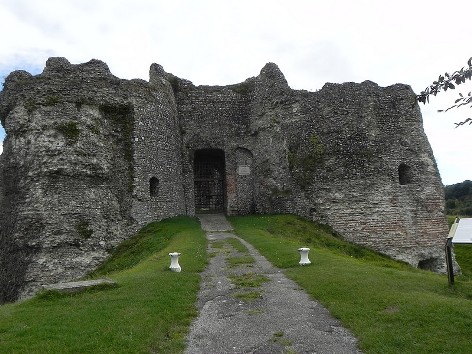
Location: Arques-la-Bataille, Seine-Maritime department, Haute-Normandie region Map
Constructed: 11th century by William of Talou
The Château d'Arques-la-Bataille is a ruined medieval castle located in the commune of Arques-la-Bataille in the Seine-Maritime department of Normandy, France. Situated on a narrow chalky spur overlooking the valleys of the Varenne, Béthune, and Eaulne rivers, which converge into the Arques River near the English Channel, the castle was strategically positioned to control key routes and waterways. Built primarily from local stone, it features a complex, elongated layout adapted to the terrain, including a prominent square keep, curtain walls flanked by round and square towers, and deep dry moats. The site has been a classified monument historique since 1875 and is owned by the French state, specifically the Regional Directorate of Cultural Affairs of Normandy. Today, the ruins are partially accessible to the public, with interior visits limited to events like European Heritage Days in September, offering insights into Norman feudal history and military architecture.
Origins and Early Construction (11th Century)
The castle's
history begins in the early 11th century, rooted in the feudal
dynamics of Normandy under Duke William II, later known as
William the Conqueror. Around 1040, William granted the land and
the County of Arques to his uncle, William of Talou (also known
as William d'Arques), who constructed the initial fortress—a
motte-and-bailey structure made of earth and wood, typical of
early Norman defenses. This early castle consisted of a keep on
a motte, surrounded by a palisade and ditch, designed to assert
control over the region.
However, tensions arose when William
d'Arques rebelled against his nephew in 1052-1053, allying with
French forces under King Henry I. The young Duke William
besieged the fortress, which was defended by the knight Gautier
Giffard. After a year-long siege marked by famine and failed
reinforcements, the defenders surrendered in 1053. William
d'Arques was exiled, and the Duke of Normandy retained direct
control of the site, marking the first of many sieges that would
define its history. Earlier records note an incident in 944 when
Count Arnoul I of Flanders dispersed the fortress guards,
indicating some form of fortification predated the 11th-century
structure.
Reconstruction and Anglo-Norman Period (12th
Century)
In 1123, during the reign of King Henry I Beauclerc
of England (grandson of William the Conqueror), the castle was
rebuilt in stone, transforming it from a wooden motte into a
more permanent fortification. This reconstruction introduced
Romanesque elements, including a massive square keep (20.2
meters per side, with walls up to 3.5 meters thick) divided into
four stories. The keep featured powerful buttresses, internal
halls, a bread oven, well, mill, cellars, apartments, and
guardrooms, with access via a western staircase. Surrounding it
was a wide curtain wall enclosing the site, flanked by about a
dozen round or square towers, enhancing its defensibility.
The castle's strategic importance continued during the Anarchy,
a civil war in England and Normandy. In 1145, amid conflict
between King Stephen of England and Geoffrey Plantagenet (Duke
of Normandy and husband of Empress Matilda), Geoffrey besieged
and captured Arques after forcing a surrender. Following Henry
II Plantagenet's accession in 1154, the castle remained under
Anglo-Norman control until the late 12th century.
Integration into France and the Capetian Period (Late 12th–13th
Centuries)
The late 12th century brought further turmoil.
After Henry II's death in 1189 and with Richard the Lionheart
imprisoned during the Third Crusade (1192-1194), King Philip II
Augustus of France conspired with Richard's brother, John
Lackland, to seize Norman territories. John was entrusted with
guarding Arques, but upon Richard's return, he besieged and
reclaimed the castle in 1195.
By 1202, Philip Augustus
attempted to capture Arques during his conquest of Normandy but
failed. It was only in 1204, after the fall of Rouen, that
Arques became the last Norman fortress to surrender to the
French crown, marking the end of Anglo-Norman dominance in the
region. From 1205 to 1211, Philip strengthened the defenses,
widening moats, reinforcing walls, and repairing a tower damaged
by siege engines. This period solidified Arques as a key French
stronghold.
The Hundred Years' War and Late Medieval
Period (14th–15th Centuries)
During the Hundred Years' War
(1337–1453), Château d'Arques-la-Bataille proved impregnable to
direct assaults but fell to English occupation following the
Treaty of Troyes in 1420. Its garrison fluctuated: in 1420, it
comprised four men-at-arms and 26 archers, reduced to 12 archers
by 1428, and expanded to 26 men-at-arms and 60 archers by 1429.
Notably, Joan of Arc was briefly imprisoned there in 1431 en
route to her trial and execution in Rouen.
In 1449, King
Charles VII of France recaptured the castle, restoring French
control. Another significant event occurred in 1472 during the
conflict between Charles the Bold (Duke of Burgundy) and Louis
XI of France, when Charles burned the town of Arques and
besieged the castle, which successfully resisted. Defensive
modifications continued, including a drawbridge entrance built
in 1367 by Charles V.
Renaissance Modifications and the
Wars of Religion (16th Century)
The 16th century saw
adaptations to emerging artillery technology under King Francis
I. A thick-walled bastion with four large brick-faced towers was
constructed at the northwest entrance (Porte de Dieppe),
featuring a triple-arch gate later adorned with a 1845
bas-relief of Henry IV. Deep dry moats (15-20 meters) and a
contrescarpe around the lower courtyard were added, enhancing
defenses against cannon fire.
During the French Wars of
Religion (1562–1598), the castle served as a refuge; in 1562,
the Duke of Bouillon sought shelter there after being expelled
from Dieppe. Its most famous role came during the Battle of
Arques on September 21, 1589, when King Henry IV, with just
7,000 men, defended the castle against 30,000 Catholic League
forces led by Charles, Duke of Mayenne. Fog initially obscured
artillery, but clearing skies allowed Henry's cannons to
decimate the enemy, forcing a retreat and securing a pivotal
victory that paved the way for Henry's coronation.
Decline and Abandonment (17th–18th Centuries)
After 1668, no
further repairs were made, leading to the castle's military
abandonment by 1688. In 1708, King Louis XIV declared it unfit
for service, initiating dismantling. Locals and nearby
Bernardine nuns used it as a stone quarry from 1753, with formal
authorization in 1771. During the French Revolution, it was
confiscated and sold as national property in 1793 for 8,300
livres to Louis Jean Félix Reine, a local resident who preserved
it by charging entry fees for visitors.
Modern
Preservation and World War II (19th–21st Centuries)
In the
19th century, preservation efforts intensified. In 1836,
historian Achille Deville and owners M. and Mme Reiset halted
further destruction. By 1860, parts were converted into a
museum. The French state acquired the site in 1875 for 60,000
gold francs, classifying it as a monument historique. Guided
tours and a small museum operated until 1939.
During World
War II, German forces occupied the castle, using it as a command
post, ammunition store, and anti-aircraft site. Upon their
retreat in 1944, they damaged the ruins with explosions.
Post-war, visits resumed but ceased in the late 1970s due to
safety concerns from falling stones. Restoration has been
ongoing, though the site remains mostly in ruins. Currently, it
is closed for general interior access but open for exterior
viewing via paths along the moat, serving as a testament to
Normandy's turbulent history.
Legacy and Architectural
Significance
Château d'Arques-la-Bataille's history reflects
broader shifts in European power, from Norman independence to
French integration, through wars and technological changes. Its
architecture evolved from a simple motte to a sophisticated
stone fortress, influencing later designs with features like
artillery bastions. As a symbol of resilience, it has inspired
artists like J.M.W. Turner and continues to attract historians
and tourists, underscoring its role in pivotal events like the
Battle of Arques.
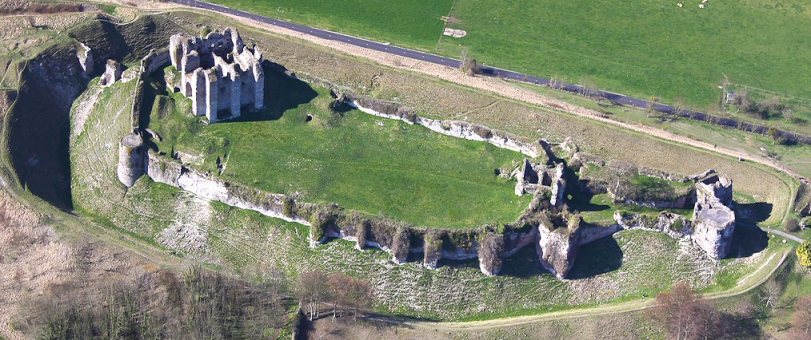
South Castle Gate and a collapsed part of the bridge that led to the original North Gate. Drawbridge is also missing.
Overall Layout and Structure
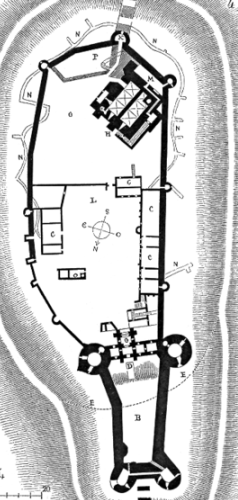
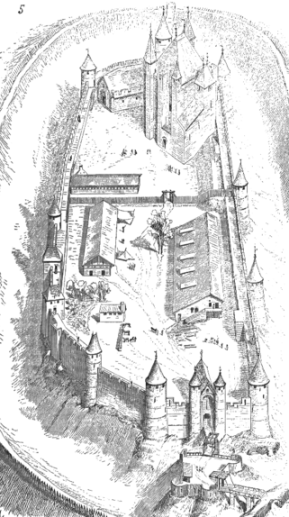
The castle follows a classic
motte-and-bailey layout adapted to the site's natural topography, with
the main structures aligned along the length of the rocky outcrop for
maximum defensibility. The core area is an ovoid stone enclosure
surrounding the keep on an artificial motte, encircled by deep ditches
that exploit the steep slopes dropping into the valley below. This
elongated design, stretching to follow the rock's contours, creates a
compact yet expansive fortress that was difficult to assault from
multiple sides. The layout includes an inner bailey with the keep at the
rear (highest point) and auxiliary buildings, protected by curtain walls
and an outer defensive belt added later. Access was limited to a single
drawbridge over the moat, emphasizing isolation and control.
Key
Architectural Features
Keep
The centerpiece is the rectangular
Norman-style keep, constructed around 1123 under Henry I of England,
measuring approximately 20 meters high with thick walls reinforced by
strong buttresses at the corners and midpoints. This dungeon, positioned
at the back of the site for added protection, features narrow slit
windows for archers and a flat roof likely once topped with battlements.
Internally, it was divided into multiple levels for storage, living
quarters, and defense, with remnants of vaulted ceilings and fireplaces
visible in the ruins.
Towers and Walls
High cylindrical towers
flank the walls, providing elevated vantage points for surveillance and
artillery. The curtain walls, built from layered stone, form an ovoid
enclosure with thicknesses up to several meters, incorporating collapsed
pillars and embrasures for crossbowmen. These walls follow the terrain's
irregularities, creating a jagged profile that enhanced defensive
angles.
Gates and Entrances
A gate building, added around
1123, served as the primary entrance, fortified with a portcullis and
drawbridge over the inner ditch. Later modifications included a
gatehouse with additional reinforcements for security.
Defensive
Features
The castle's architecture prioritizes defense through a
combination of natural and man-made elements. Deep ditches, including a
massive outer moat 20 meters wide and 15 meters deep dug in the 15th or
16th century, encircle the site, topped by high walls to deter
artillery. The elevated position on the promontory, with steep slopes
and broad pits splitting the valley, provided natural barriers, while
buttressed walls and towers allowed for enfilading fire. Adaptations for
firearms in the 16th century under Francis I included wider embrasures
and reinforced bastions.
Materials and Construction Techniques
Primarily built from local flint and stone (including "silver stones"
noted for their durability), the structures feature roughly hewn blocks
mortared together, with finer ashlar for key elements like buttresses.
Norman techniques emphasized solidity, with thick walls (up to 3-4
meters in places) and buttressing to withstand sieges. The design
integrates the natural rock foundation, reducing excavation needs and
enhancing stability.
Historical Modifications
11th Century:
Initial motte-and-bailey with basic keep and enclosure.
12th Century:
New rectangular keep with buttresses and gate building under Henry I.
15th-16th Centuries: Addition of outer moat and adaptations for cannons.
18th Century: Decommissioned in 1708, towers and walls dismantled for
materials.
19th Century: Converted to quarry, later museum
installation.
20th Century: WWII German modifications including
anti-aircraft positions; partial destruction in 1944.
Current
State and Preservation
Today, the castle exists as atmospheric ruins,
with the keep, walls, and ditches largely intact but overgrown with
vegetation. Paths allow exploration of the exterior and some interiors,
though access to unstable areas is restricted. Preservation efforts
since the 19th century have stabilized structures, making it a popular
site for historical tourism.