Location: Dordogne département Map
Constructed: 1183
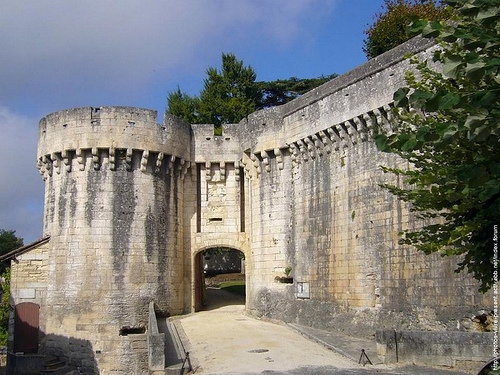
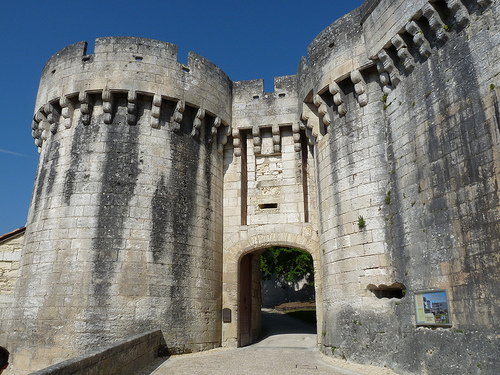
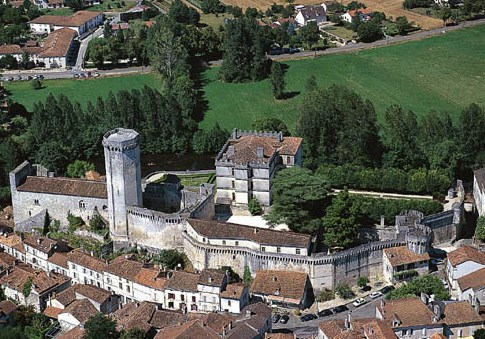
Château de Bourdeilles is a historic castle complex located in the commune of Bourdeilles in the Dordogne department of southwestern France, perched on a rocky spur overlooking the Dronne River. It uniquely combines two distinct structures: a 13th-century medieval fortress, emblematic of military architecture with its octagonal keep, and a 16th-century Renaissance palace, reflecting a shift toward luxury and artistic expression. The site has roots possibly dating back to the 9th century, though the current buildings span from the 13th to 16th centuries, and it has served roles in defense, residence, industry, and now tourism. Classified as a monument historique since 1919, the castle preserves much of its interior decoration, including a notable collection of 15th- to 19th-century furniture, and stands as a testament to eight centuries of regional history in Périgord.
Early History and Origins (9th-13th Centuries)
The site's
strategic position on a rocky outcrop suggests defensive use as
early as the 9th century, with possible fortifications existing
then, though no physical remnants survive from that era. The
earliest documented castle origins trace to the 12th century,
built atop the spur to overlook the Dronne River and control
surrounding trade routes. By the 13th century, the medieval
fortress was constructed, featuring a 35-meter-high octagonal
keep with 2.4-meter-thick walls, machicolations, crossbow slits,
and connected two-story buildings (of which only outer walls
remain today). This phase emphasized defense, with the keep
dominating the landscape and the entire complex enclosed by
fortified walls and round towers at the entrance. The
construction was initiated around 1283 by Geraud de Maulmont,
modeled after similar designs like Châlus Maulmont. Early
ownership tied it to local nobility, setting the stage for its
role in regional conflicts.
Medieval Period and Conflicts
(14th-15th Centuries)
During the 14th century, the oldest
surviving parts of the castle were solidified, reflecting its
evolution into a formidable stronghold amid the Hundred Years'
War (1337-1453). The castle changed hands multiple times between
French and English forces, prized for its strategic location. It
passed from the Kingdom of France to the English Crown before
being retaken in the late 14th century by the Breton knight
Bertrand du Guesclin, a key figure in French military history
who liberated it during campaigns against English occupation. At
the war's end, ownership was split: half to the Counts of
Périgord and half to the King of France. This arrangement held
until the early 15th century, when the counts used the castle as
a base for pillaging the countryside, prompting the French king
to intervene and confiscate their share. The period highlighted
the castle's military significance, with its thick walls and
elevated position proving effective in sieges and defenses.
Renaissance Era (16th Century)
The 16th century marked a
transformative phase, shifting from fortification to opulence
with the addition of the Renaissance palace adjacent to the
medieval fortress. François de Bourdeille, a descendant of the
original owners, repurchased the castle at the end of the 15th
century, and his family oversaw the new construction. The
palace, built toward the end of the century and inspired by
Italian palazzos, featured light-filled rooms, elaborate
decorations, and elements of the Second French Renaissance
style. Jacquett de Montbron, a notable female figure and
sister-in-law to the owner, supervised the project, infusing it
with artistic flair. Highlights include the 'Salon Doré' with
its painted ceiling, an armoury, dining room, and bedrooms, all
emphasizing comfort over defense. This era also saw the castle's
name linked to André de Bourdeille, who became Seneschal of
Périgord under King Henry II, adding prestige. The Renaissance
additions contrasted sharply with the medieval keep, symbolizing
the cultural shift in European architecture.
Later
History (17th-20th Centuries)
Following the Renaissance, the
castle changed hands several times in the 17th and 18th
centuries, serving non-military purposes such as a silkworm
factory and a site for manufacturing and storing saltpetre (used
in gunpowder production). It gradually fell into disrepair until
the Bourdeille family regained full ownership and held it until
1962. In the 20th century, benefactors Mr. Santiard and Mrs.
Bulteau undertook extensive restorations from the 1960s until
1972, installing a prestigious collection of antique furniture
from the 15th to 19th centuries, including the gilt Spanish
'Paradise Bed' of Charles V. Upon their deaths, the castle was
returned to the Dordogne department. It was listed as a monument
historique in 1919, preserving its architectural integrity. The
20th century also saw the addition of a labyrinth garden and
courtyard features, enhancing its cultural appeal.
Current Status
As of 2025, Château de Bourdeilles is owned by
the Dordogne department and operates as a public historical
site, open to visitors year-round (except January) with varying
hours: 10am-6pm generally, extended in summer. Admission is
approximately €8.80 for adults and €5.40 for children aged 5-12.
It attracts tourists for its dual architectural styles,
well-preserved interiors, furniture collection from the
Aquitaine region, and panoramic views from the keep. The site
hosts events like medieval festivals and serves as a cultural
landmark in Périgord Vert, emphasizing its role in blending
warfare heritage with Renaissance artistry.
Construction Materials and Overall Design
The château is
constructed predominantly from local limestone, which provides a light,
pale appearance to the structures and enhances their integration with
the natural rocky outcrop. The medieval sections feature thick, robust
walls—up to 2.5 meters (8.2 feet) in key areas—designed for durability
and defense, while the Renaissance palace employs finer stonework with
symmetrical facades and decorative elements. The overall layout is
linear, following the elongated rock platform: the medieval fortress
occupies the western end, with a courtyard enclosed by high fortified
walls, while the Renaissance palace adjoins it to the east, creating a
harmonious yet contrasting ensemble. Defensive features like ramparts
and towers blend with residential spaces, and the site is enclosed by a
surrounding wall with an entrance gate protected by two round towers.
This dual design reflects evolving purposes—from fortification to
luxurious habitation—spanning Gothic, medieval military, and Italian
Renaissance styles.
Layout and Key Structural Elements
The
château's layout exploits its elevated, defensible position on the rock
outcrop, monitoring routes between Périgueux and Angoulême. The medieval
castle forms the core, with a seigniorial lodge and octagonal keep at
the "prow" of the site, preceded by a courtyard bounded by fortified
walls. The Renaissance palace is positioned nearby, with
gardens—including a geometric maze-like parterre—separating and
connecting the two. Access is via a fortified entrance with round
towers, leading to internal courtyards and pathways. The complex
measures approximately 100-150 meters in length along the ridge, with
heights varying up to 35 meters at the keep. Key defensive elements
include crenellated walls and narrow windows for archers, while
residential areas feature larger openings and terraces for panoramic
views.
Medieval Fortress (13th-14th Centuries)
The medieval
section, dating primarily to the 13th century and built by Géraud de
Maulmont on older foundations (possibly from the 9th century),
exemplifies military architecture. At its heart is the octagonal keep
(donjon), constructed around 1280 and completed in the 14th century,
modeled after Châlus Maulmont. This imposing tower stands 35 meters (115
feet) tall with walls 2.5 meters thick, featuring multiple levels: a
ground floor for storage, upper floors with residential chambers, and a
panoramic terrace crowned with machicolations for defense. The keep is
connected to a two-story seigniorial lodge, of which only the outer
walls remain, forming a polygonal structure adapted to the rock. High
ramparts enclose the courtyard, with arrow slits and battlements for
protection. The design emphasizes impregnability, with steep approaches
and natural cliffs enhancing artificial fortifications.
Renaissance Palace (16th Century)
Constructed between 1588 and 1598
under Jacquette de Montbron, the Renaissance palace represents a
stylistic departure, influenced by Italian architecture through her
exposure at the court of Catherine de Médicis and treatises by
Sebastiano Serlio. This three-story building features a symmetrical
facade with crenellated parapets, mullioned windows, and a tiled roof,
blending defensive motifs with decorative elegance. The palace includes
grand halls, such as the Golden Salon (Salon doré) with painted murals,
and is adorned with classical elements like pilasters and pediments. Its
design is more residential, with spacious interiors for courtly life,
and it adjoins the medieval fortress without overpowering it. Gardens
with geometric hedges and pathways extend from the palace, adding to the
humanist aesthetic.
Interior Features and Furnishings
The
interiors showcase a rich collection of furnishings spanning Gothic,
Renaissance, and Baroque styles, many hand-carved from wood. The
medieval keep contains engraved gravures and functional spaces like a
chapel and living quarters with fireplaces. In the Renaissance palace,
highlights include the Golden Salon with elaborate paintings and
sculptures, reflecting Renaissance humanism. Other rooms house period
furniture, tapestries, and decorative arts, preserved to illustrate the
château's evolution from fortress to refined residence. Much of this
collection is among the finest in the region, with pieces from the 15th
to 17th centuries.
Restorations and Preservation
While
specific major restorations are not extensively documented, the château
has been maintained since its 1919 classification, with efforts to
stabilize structures and preserve interiors. Ownership by the
Bourdeilles family and ties to local abbeys have ensured continuity, and
modern interventions focus on tourism accessibility, including guided
tours and panoramic terraces.
Unique Aspects and Legacy
Château de Bourdeilles stands out for its seamless fusion of medieval
austerity and Renaissance splendor, symbolizing the transition in French
architecture. Unique features include the rare octagonal keep design,
Italian-inspired palace elements, and the strategic riverside location.
As a "crumbling yet majestic" site, it offers insights into feudal and
courtly life, attracting visitors for its historical depth and scenic
views.