Location: Saverne, Bas-Rhin département Map
Constructed: 1170
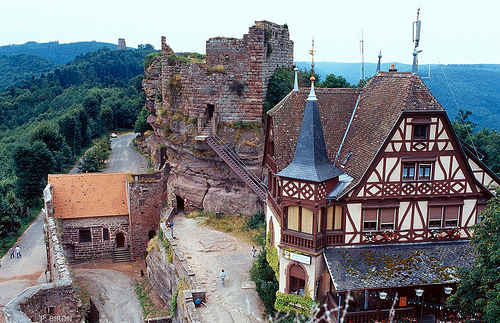
The Château de Haut-Barr, also known as Hohbarr or Burg Hohbarr, is a medieval castle ruin located above the town of Saverne in the Bas-Rhin department of Alsace, northeastern France. Perched on a sandstone outcrop at an elevation of 460-470 meters, it overlooks the Zorn Valley and the Plain of Alsace, earning the nickname "the eye of Alsace" since the Council of Constance in 1415 due to its panoramic views extending to the Vosges Mountains, the Black Forest, and even the spire of Strasbourg Cathedral on clear days. Constructed primarily from local sandstone, the castle spans three large rock formations connected by a footbridge known as the Pont du Diable (Devil's Bridge), creating a dramatic and strategic site. Originally built as a defensive stronghold by the bishops of Strasbourg, it exemplifies rock-integrated medieval architecture with features like a portcullis entrance, well tower, castral chapel, and artillery remnants. Classified as a monument historique since 1874, the ruins are now a popular tourist site maintained by the Castrum Borra association and owned by the city of Saverne, accessible via a short walk from a parking area on the D171 road.
Origins and Construction (12th Century)
The castle's origins trace
back to the 12th century, with the first structure built around 1100,
though some sources specify 1170 as the date of erection by the Bishop
of Strasbourg. Its primary purpose was to control and surveil the Zorn
Valley, a key passage between the Lorraine Plateau and the Alsace Plain,
as well as to monitor trade routes and potential invasions. The site was
chosen for its natural defensibility: three massive sandstone rocks,
separated by deep chasms, provided inherent protection. These rocks were
linked by the iconic Pont du Diable, a narrow footbridge spanning a
void, which became central to the castle's layout. Early construction
focused on basic fortifications, including walls adapted to the rugged
terrain and a central keep for residence and defense. The bishops of
Strasbourg, who held ecclesiastical and temporal power in the region as
part of the Holy Roman Empire, oversaw the initial build and subsequent
expansions, using the castle as a strategic outpost.
Medieval
Period and Expansions (13th–15th Centuries)
Throughout the medieval
era, Château de Haut-Barr underwent several expansions under the bishops
of Strasbourg, solidifying its role as a fortified residence. By the
14th century, it was transformed and restored, incorporating Romanesque
and Gothic elements such as arched gateways and defensive towers. The
castle's design exploited the natural rocks: the western rock housed the
main entrance with a portcullis, leading to a caretaker's lodge and well
tower; the central rock featured the castral chapel and lord's
residence; and the eastern rock included artillery tower vestiges. This
period saw the castle involved in regional power struggles within the
Holy Roman Empire, though specific conflicts from this time are less
documented. Its elevated position made it an ideal vantage point,
contributing to its "eye of Alsace" moniker during the Council of
Constance (1414–1418), where it symbolized surveillance over the region.
Renaissance Transformations and Later Conflicts (16th–18th
Centuries)
The 16th century marked a significant phase of
modernization under Bishop Jean de Manderscheid-Blankenheim, who
transformed and restored the castle in 1583, residing there frequently.
These works included reinforcements to adapt to artillery warfare, such
as the addition of gun ports and bastions, blending medieval defenses
with Renaissance aesthetics. The castle endured the turmoil of the
Thirty Years' War (1618–1648), after which the Peace of Westphalia
(1648) mandated its partial dismantling to prevent further military use,
reflecting the treaty's efforts to demilitarize the region.
However,
it was reactivated as a fortress at the onset of the War of the Spanish
Succession (1701–1714), occupied by soldiers to defend French interests
in Alsace. By around 1770, it was largely abandoned, though its vaulted
areas continued to be used until the French Revolution (1789–1799). In
1798, a Chappe telegraph—an early optical communication system—was
installed nearby, linking it to broader networks during the Napoleonic
era.
Decline and Modern Preservation (19th Century–Present)
Following its abandonment, the castle fell into ruin, overgrown and
neglected until the 19th century when romantic interest in medieval
sites spurred preservation efforts. It was classified as a monument
historique in 1874 by the French Ministry of Culture, granting legal
protection. The city of Saverne acquired the property in 1970,
initiating restoration projects to stabilize the structures and make
them accessible to the public.
Today, the ruins are open year-round,
with visitors able to explore the Devil's Bridge, chapel, and panoramic
terraces. Maintenance is handled by the volunteer association Castrum
Borra, which organizes events and guided tours. The site attracts hikers
and history enthusiasts, offering views that underscore its historical
surveillance role. While not fully restored, ongoing conservation
ensures the preservation of its sandstone features against erosion.
Notable Facts and Legends
One of the castle's most famous legends
surrounds the Pont du Diable: According to folklore, the bishop, facing
construction challenges over the chasm, made a pact with the devil to
build the bridge in one night in exchange for the soul of the first to
cross it. Upon completion, a stray dog was sent across, infuriating the
devil who stamped his foot, leaving a permanent mark on the rock. This
tale highlights the bridge's engineering marvel and adds a mystical
element to the site.
Architecturally, the castle's integration with
the natural rock formations sets it apart, with features like the well
tower for water supply during sieges and the chapel's preserved arches.
Its strategic importance through centuries of European conflicts
underscores Alsace's borderland history, making it a symbol of regional
resilience.
Overall Layout and Structure
The castle's unique layout is defined
by its adaptation to three narrow, elongated sandstone spurs or rocks,
which form a natural foundation and defensive barrier. These rocks are
connected by the iconic Pont du Diable (Devil's Bridge), a narrow stone
footbridge spanning a dramatic void between two of the spurs, adding
both functional access and a mythical element to the design. The
structure spans a rugged, elevated site, with the main entrance
featuring a portcullis that leads to the caretaker’s lodge and well
tower, providing controlled access to the inner areas. Key components
include the castral chapel, remnants of the artillery tower, and the
lord’s residence, all clustered on the rocks to maximize the site's
defensive potential. The layout emphasizes verticality and integration
with the terrain, creating a compact yet expansive fortress that
exploits the natural cliffs for protection. Surrounding forests and the
steep drop-offs enhance its isolation, making it a classic example of a
rock castle (rocher château) in the Vosges region.
Towers
The
castle features several towers that contribute to its defensive and
residential functions. The well tower, located near the entrance, served
as a vital water storage and access point, integrated into the main
pathway. The artillery tower, added or modified in the 16th century, now
exists only as vestiges but was designed to house firearms, reflecting
adaptations to evolving warfare. These towers are cylindrical or
semi-cylindrical in form, built directly from the sandstone bedrock,
with narrow slits for archers or cannons. Additionally, the site's
elevated spurs themselves act as natural "towers," providing high
vantage points for observation.
Keep
While not a traditional
single keep structure, the castle's core defensive element is embodied
in the lord’s residence and associated buildings on the central rock,
which functioned as a keep-like stronghold. This area includes remnants
of multi-level stone buildings with thick walls, designed for both
habitation and last-resort defense. The integration with the rock
formation provides inherent strength, with the Devil's Bridge serving as
a precarious access route to isolated sections.
Defensive
Features
Haut-Barr's architecture prioritizes defense through its
elevated, rocky position, which offers natural cliffs and steep
approaches as barriers against invaders. Key man-made elements include
the portcullis at the entrance for controlled access and the artillery
tower for ranged weaponry. Narrow slits in walls and towers allowed for
archery or cannon fire, while the Devil's Bridge created a chokepoint
that could be easily defended or destroyed. The site's isolation and
height made sieges difficult, emphasizing passive defense over elaborate
battlements.
Materials and Construction Techniques
The castle
is primarily constructed from local sandstone, quarried directly from
the site's spurs, which provides durability and seamless integration
with the natural rock. Walls and structures feature roughly hewn blocks
mortared together, with finer detailing in areas like the chapel's
arches. The Devil's Bridge exemplifies advanced medieval engineering,
built as a slender arch over a deep chasm, possibly using scaffolding or
cantilever methods, though legend attributes it to supernatural aid.
Construction exploited the rock's contours, minimizing excavation and
enhancing stability.
Historical Modifications
12th Century:
Initial construction as a surveillance fortress, including basic towers
and walls.
14th Century: Transformations and restorations, possibly
including chapel enhancements.
16th Century: Major renovations by
Bishop Jean de Manderscheid (1581–1586), adapting for firearms with
artillery tower and serving as a residence.
17th Century: Partial
dismantling after Thirty Years’ War (1649, per Peace of Westphalia).
18th Century: Temporary military use and restoration (1701, during War
of Spanish Succession); Chappe telegraph installed (1798); abandoned by
1770.
20th–21st Centuries: Acquired by Saverne in 1970; ongoing
preservation as a tourist site.
Current State and Preservation
As of 2025, Château de Haut-Barr remains an atmospheric ruin, freely
accessible to the public with vehicular access up to the gate. The site
includes a café-restaurant within the walls, popular for its scenic
terrace, and paths for hiking and exploration. Preservation efforts have
stabilized the structures, though the north rock may be inaccessible at
times for safety. The chapel, with its Romanesque nave and Gothic choir
featuring an oriel window, is a highlight, alongside the Devil's Bridge
and panoramic viewpoints. It attracts visitors for its historical
significance, architectural ingenuity, and natural beauty, serving as a
reminder of Alsace's medieval heritage.