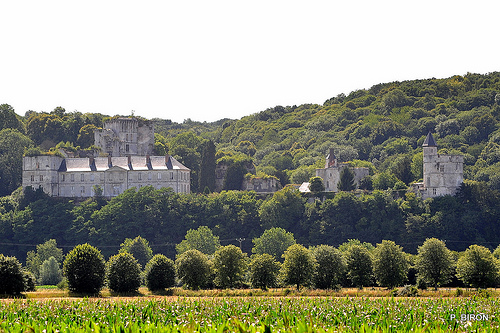
Location: Tancarville, Seine-Maritime departement Map
Constructed: 11th century
Château de Tancarville is located in Tancarville, Seine-Maritime departement in France. Château de Tancarville or Tancarville Castle was constructed in the 11th century on a cliff overlooking Seine River. Its original owner was Raoul, chamberlain of the Duke of Normandy. The castle was eventually turned into a private mansion as it became obsolete for military use. A splendid ballroom was constructed within its walls in 1468. During the French Revolution it was badly damaged and burned. In 1960's ruins of the former military stronghold were used for children summer camp.
Location
The ruins of the castle are located, on a triangular spur, on a chalky cliff overlooking the Seine, 1 kilometer south-east of the Saint-Michel church, in the commune of Tancarville, in the French department of Seine-Maritime. It protected the entrance to the Seine.
Origins and the Tancarville Family (11th–13th Centuries)
The
site’s strategic position on a triangular spur high above the Seine made
it ideal for defense and controlling river crossings. The castle
originated in the 11th century with the powerful Tancarville (or
Tankerville) family, of Viking/Norman descent tracing back to Tancredus
(Tancrède), a companion of Rollo around the time of the 911 Treaty of
Saint-Clair-sur-Epte.
Raoul I FitzGerald (or Raoul le Chamberlain, c.
1008–c. 1080), a key figure, served as chamberlain to Duke Robert I and
became a trusted guardian/educator to the young William the Bastard
(later William the Conqueror). He substantially fortified the castle
with thick walls (6–18 feet in places) and structures like the Tour
Carrée (Square Tower) and the Knights’ Chamber.
His son Guillaume I
de Tancarville (d. 1129) was the first to use the "de Tancarville" title
formally. He served as hereditary Chamberlain of Normandy and England, a
position of immense influence involving household management, finances,
and advising kings like Henry I. The family trained knights in chivalry
and jousting at the castle. Guillaume founded the Abbey of Saint-Georges
de Boscherville around 1112–1113.
Subsequent generations, including
Rabel de Tancarville and Guillaume II, maintained high status. The
castle featured a large motte, deep ditches, and strong defenses. It
became the seat of one of the most powerful lineages in the Pays de
Caux. The family held extensive fiefs in Normandy but fewer in England.
Later Medieval Period and Transitions (14th–15th Centuries)
In
1316, the last direct heiress Jeanne de Tancarville married Jean II de
Melun, bringing the title of Count of Tancarville to that family. In
1417, through marriage, it passed to the Harcourt family.
During the
Hundred Years' War, in 1418, Henry V of England conquered Normandy. The
English granted the title to John Grey, while the Harcourts retained
claims in France and recovered the castle after the English withdrawal.
A new ballroom was added around 1468 during Harcourt restoration.
Medieval remains today include parts of the 12th-century Square Tower, a
15th-century chapel, a large motte with a ruined 15th-century "Grosse
Tour," and reconstructed sections from the late 14th/early 15th
centuries.
Classical Rebuild and 18th Century
In the early
18th century, major transformation occurred. From 1709 to 1717, Louis
Henri de La Tour d’Auvergne, Count of Évreux, built a new
classical-style wing and château incorporating medieval remnants. This
elegant structure is what often appears prominent from a distance today.
Financier John Law briefly acquired it in 1718 but apparently never
resided there. The castle shifted from pure fortress to a more
residential aristocratic seat.
French Revolution and 19th Century
The French Revolution (1789 onward) devastated the site: it was looted,
sacked, partly burned, and abandoned, leading to significant decline.
A major restoration in the mid-19th century under the Comte de Lambertye
revived it as a habitable home. It was classified as a Monument
historique in 1862 (with further protections later).
20th Century
to Present: Decline and Preservation Efforts
In the 20th century,
uses included a children’s summer camp, restaurant, artisans’ workshops,
and even a junk shop. It served as a sanatorium until 1992 in some
accounts. From 1910–1939, it was rented by Fernand Prat and his wife
(sister of author Maurice Leblanc), hosting literary figures like
Colette, James Joyce, and Maurice Maeterlinck.
Ownership passed
through various hands. In 1805, the French state had donated it to the
Hospices de Le Havre at one point; later returns to private owners
occurred. It was listed as a historic site in 1951 and a monument in
1987.
By the late 20th/early 21st century, neglect set in. In 2013, a
group of professional footballers (including Rémi Gomis) bought it via
SCI Saqqara with plans to convert the 18th-century parts into luxury
apartments and restore sections, gaining tax benefits. Some roof and
tower work occurred, but progress stalled after associated companies
faced bankruptcy. As of the early 2020s, the site remains largely closed
to the public, in poor condition with risks of collapse, though visible
from afar (e.g., from the Tancarville Bridge area). Local associations
like the Amis du Château de Tancarville continue advocacy.
Overall Layout and Site
The castle occupies a triangular enclosure
(plan triangulaire) adapted to the natural topography of the cliff spur.
This shape maximizes defensibility with steep drops on multiple sides,
especially toward the Seine.
Enceinte (curtain walls): A large
triangular fortified perimeter with flanking towers. The south side
(facing the Seine) features a relatively simple curtain wall reinforced
by buttresses.
The complex includes medieval defensive elements
integrated with later residential buildings. Much of the medieval core
was damaged or repurposed during the 18th-century rebuild.
Medieval Architecture (11th–15th Centuries)
The earliest structures
date to the 11th century under Raoul de Tancarville (chamberlain to
William the Conqueror), with significant expansions in the 12th and 15th
centuries.
Square Tower (Tour Carrée): Built in the 12th century in
the southwest corner. This is one of the best-preserved early elements.
It stands about 20 meters high, divided into four levels, with
exceptionally thick walls (1.65 meters). It is served by a staircase
turret. This likely functioned as a donjon or strongpoint.
Tour de
l’Aigle (Eagle Tower): A prominent 15th-century defensive tower at the
northeastern point of the triangle. It is a large spur tower (en éperon)
rising three levels, marked by horizontal stone bands. Access is via a
small polygonal turret. It has romantic legends associated with it and
was used by Maurice Leblanc (Arsène Lupin author) for writing.
Châtelet d’Entrée: The entrance gatehouse with two twin (jumelles)
towers, typical of medieval fortifications for controlling access.
Other Towers:
Tour du Lion: A powerful, wide tower on the northern
front, used as a powder magazine.
Tour Coquessart: Hexagonal plan,
part of the access ramp defenses.
Vieille Tour (Old Tower):
Rectangular, 12th century, smaller and more ruined.
Donjon Ruins:
An almond-shaped (en amande) bastion at the end of a long ramp
(northwest), isolated and defended by additional turrets. Mostly ruins
remain.
Chapelle: A 12th-century (c. 1131) chapel integrated into the
seigneurial lodgings, located in front of the Vieille Tour.
Seigneurial Logis (Residential Quarters): Included the Knights’ Hall
(salle des chevaliers, c. 1410) with ogival (pointed) arches and
fireplace remnants; other halls with brick-and-stone alternating
facades; and connections to towers like the Tour de la Collecte. These
are now heavily ruined but show Gothic elements.
The medieval
design emphasized military strength: thick stone walls, multiple towers
for enfilading fire, and adaptation to the cliff for natural defense. It
evolved from a basic 11th-century fortress into a more sophisticated
15th-century stronghold under families like the Harcourts.
18th-Century Classical Wing ("Château Neuf")
In 1709–1717, under
Louis de La Tour d’Auvergne (Count of Évreux), a major classical-style
residential wing was added, leaning against the southern medieval
curtain wall (partially masking it).
Style: French classical (Louis
XIV/XV transition), characterized by symmetry, restraint, and proportion
rather than ornate Baroque excess.
Key Features: A large rectangular
building with an avant-corps (slightly projecting central pavilion)
topped by a triangular pediment (fronton triangulaire). This was the
main decorative element. The wing incorporated or abutted medieval
structures, creating a hybrid appearance.
It represented a shift from
fortress to aristocratic residence, common in the period as threats
diminished and comfort became prioritized.
Materials and
Construction
Medieval: Local stone (chalk/limestone from the cliffs),
thick masonry, some brick in later medieval phases.
Classical: Finer
ashlar stonework, more refined joinery.
The site’s chalk geology
influenced construction—stable for foundations but prone to erosion over
time.
Current State and Context
Today, the château is a mix of
imposing ruins and partial structures. The 18th-century wing and key
medieval towers (like the Square Tower and Eagle Tower) remain most
visible, while much of the enceinte and logis are in varying states of
decay. It is privately owned (SCI Saqqara) and closed to the public,
with past plans for luxury apartments that have faced challenges.
Visiting Tips (as of 2026)
Important: Do not expect interior
access, guided tours, or entry onto the grounds. Attempts to enter could
be dangerous and illegal.
Best Way to Experience It: View from public
roads, viewpoints in Tancarville-Haut (upper village), or spots along
the Seine. The cliffside location provides striking panoramas,
especially at golden hour or on clear days when the Seine sparkles
below.
Best Time to Visit: Spring (April–June) or early autumn
(September–October) for milder weather, fewer crowds, and good light for
photography. Avoid winter for shorter days and potential rain/mist that
can obscure views. Summer offers longer daylight but can be busier on
roads.
Duration: 30–90 minutes for photos and views; combine with
nearby stops for a half-day or full-day outing.
Photography & Views:
Bring a telephoto lens for details of towers and ruins. Drone use is
likely restricted. Look for vantage points near the Tancarville Bridge
(a major cable-stayed structure over the Seine) or from the riverbanks.
How to Get There
By Car (recommended): From Paris, ~170–200 km
(2–2.5 hours) via A13 toward Rouen/Le Havre, then local roads. From Le
Havre: ~30–40 minutes. From Rouen: ~45–60 minutes. Parking is available
in the village of Tancarville; walk or drive to viewpoints.
Public
Transport: Limited. Train to Le Havre or Yvetot, then bus/taxi. Not
ideal for a quick visit.
Nearby Airports: Le Havre or Rouen; Paris
airports for longer trips.
Practical Tips
Safety: Stay on
public paths/roads. The structure is unstable—respect closures.
Facilities: Very limited at the château itself (no tickets, shops, or
restrooms on-site). Use amenities in Tancarville village or nearby towns
like Lillebonne.
Accessibility: Uneven terrain and cliffs; not
suitable for mobility-impaired visitors seeking close access.
What to
Bring: Binoculars, camera, comfortable shoes for walking nearby paths,
weather-appropriate clothing (Normandy can be windy/rainy), and a picnic
for scenic spots.
Combine with Nearby Attractions:
Tancarville
Bridge and Seine views.
Marais Vernier wetlands and nature reserves
for birdwatching/hikes.
Étretat cliffs or Honfleur (charming port
town) ~30–60 minutes away.
D-Day sites or Rouen for a broader
Normandy itinerary.