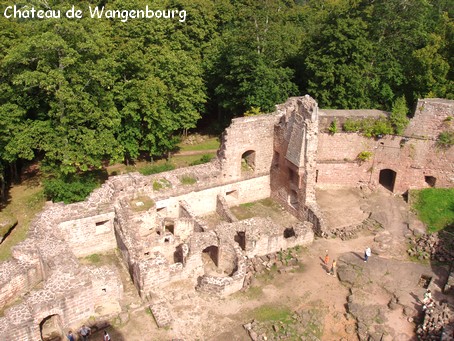
Location: 5 Rue du Château, Wangengbourg- Engenthal, Bas- Rhin department Map
Château de Wangenbourg is a medieval ruined castle located in the commune of Wangenbourg-Engenthal in the Bas-Rhin département of northeastern France, within the Alsace region. It sits on a rocky outcrop at approximately 480 meters in the Vosges Mountains, just east of the village of Wangenbourg, providing expansive views over the surrounding forested landscape and nearby settlements. Constructed primarily from local Vosges sandstone, the castle is a prime example of Alsatian medieval fortifications, designed to leverage the region's rugged terrain for defense.
Early Construction and Architectural Features
The castle's
origins date back to the 13th century, when it was built as a
polygonal enceinte—a vast, irregularly shaped fortified enclosure
typical of medieval defenses in the region. Key architectural
elements include an early 14th-century keep (donjon), which served
as the primary tower for defense and residence, and a chapel tower
for religious purposes. By the 16th century, two dwellings were
added, reflecting later modifications. The courtyard features the
base of an original keep and a filtering water tank, essential for
self-sufficiency during sieges. An eastern bailey (outer courtyard)
provided additional space for outbuildings and defenses.
Other
notable features include a spiral staircase tower for internal
access, a large Gothic-style residence, and a Renaissance chimney,
highlighting stylistic evolutions over time. The overall design
combines Romanesque and Gothic elements with later Renaissance
influences, making it a prime example of evolving medieval
architecture in Alsace.
Ownership and Feudal Conflicts
(13th–16th Centuries)
The castle was initially associated with
the Lords of Wangen, a noble family who held it as their seat. This
ownership persisted until the early 16th century, when political
upheavals intervened. In 1504, following the War of the Succession
of Bavaria, Holy Roman Emperor Maximilian I defeated Prince-Elector
Philipp and confiscated the castle from cousins Hans and Stephan von
Wangen as punishment for their allegiances. Maximilian granted it to
Count Tiestein, who in turn transferred it to Wilhelm III von
Hohnstein, the Archbishop of Strasbourg, in 1516.
Despite the
confiscation, a branch of the von Wangen family—Georg and
Hartmann—continued to occupy the castle. Between 1535 and 1550, they
undertook significant renovations, reconstructing the main logis
(living quarters) in the Renaissance style, which added ornate
elements like the aforementioned chimney and staircase tower. This
period marked a brief renaissance for the castle, blending its
medieval core with more comfortable, humanistic architectural
trends.
Disputes, Expulsions, and Decline (Late 16th–18th
Centuries)
Ownership disputes intensified in the late 16th
century. From 1578, the Archbishop of Strasbourg challenged the von
Wangens' claims, leading to the family's expulsion that year.
However, the von Wangens regained their rights in 1595, allowing
them to return. This back-and-forth reflected the broader religious
and political tensions in Alsace, caught between Catholic
archbishops and Protestant-leaning nobles amid the Reformation.
The castle's fortunes waned with the incorporation of Alsace into
France. In 1680, during the reign of Louis XIV, French troops
occupied the site as part of broader annexations following the
Treaty of Westphalia (1648) and subsequent conflicts. By 1702, the
castle had fallen into disrepair and was reported as ruins, likely
due to neglect, military damage, or abandonment during the wars of
the late 17th century, including the Nine Years' War (1688–1697).
Restoration Efforts (20th Century Onward)
After centuries of
ruin, restoration began in the early 20th century, driven by
historical preservation interests in France. Work resumed more
systematically in 1931, focusing on stabilizing the structures and
making the site accessible. A significant addition came in 1961 with
the construction of a footbridge to replace the original drawbridge,
improving safety for visitors. These efforts have preserved the
visible remnants, including the enceinte walls and interior building
bases, allowing the castle to serve as an educational and touristic
site today.
Significance and Legacy
The Château de
Wangenbourg encapsulates the feudal dynamics of medieval Alsace,
from noble family strongholds to imperial interventions and eventual
French integration. Its history mirrors the region's borderland
status, influenced by German emperors, French kings, and local
ecclesiastical powers. As a ruin, it attracts hikers, history
enthusiasts, and families, with its location near trails in the
Vosges offering both cultural and natural appeal. The site's
preservation underscores France's commitment to its medieval
heritage, ensuring that this once-mighty fortress continues to tell
its story through its stones.
The Château de Wangenbourg is a medieval ruined castle located in the
commune of Wangenbourg-Engenthal in the Bas-Rhin department of
northeastern France, perched at an altitude of about 480 meters in the
Vosges Mountains forest. Constructed primarily in the 13th century, it
exemplifies typical Alsatian castle architecture from the Middle Ages,
featuring a vast polygonal enceinte (enclosure wall) that surrounds the
site, with visible remnants of interior building foundations and various
defensive and residential elements.
Key architectural features
include a prominent keep (donjon) dating to the early 14th century,
which rises as a multi-story tower and culminates in a dungeon offering
panoramic 360-degree views of the surrounding landscape. Adjacent to
this is a chapel tower, also from the medieval period, along with two
dwellings reconstructed in the Renaissance style between 1535 and 1550,
showcasing more ornate elements like spiral staircase towers and large
Gothic residences. The layout incorporates a principal moat for defense,
a 17th-century access ramp leading to the lower court, and an eastern
bailey (outer courtyard). Inside the main courtyard, visitors can see
the base of an original keep, a filtration cistern for water management,
a kitchen oven, steam room, and even a tomb, highlighting the castle's
dual role as a fortress and noble residence.
The entrance
features a footbridge, added in 1961 during modern restorations to
replace the original drawbridge, along with the main gateway and ramps.
Specific residential sections, such as Hartmann de Wangen's and Georg de
Wangen's lodgings (logis), reflect later Renaissance influences with
their refined designs amid the otherwise rugged granite construction
typical of the region's castles. The site fell into disrepair by 1702
after periods of occupation and conflict, including confiscation in 1504
by Holy Roman Emperor Maximilian I and disputes over ownership in the
late 16th century, but restoration efforts began in the early 20th
century and continued in 1931, preserving it as a listed monument
historique since 1898.
Today, the ruins are accessible via a
short trail from a nearby parking area, making it a popular spot for
family visits, with opportunities to climb the tower for views, though
some areas like narrow steps may require caution.
Following the French occupation in 1680, the castle was largely abandoned, accelerating its decay. By the 18th century, it was no longer a noble residence, and natural elements like weathering and vegetation further degraded the structure. Today, Château de Wangenbourg is a protected historical monument, maintained by local authorities and heritage organizations. The ruins are open to the public, with stabilized walls and pathways ensuring safe access. Key surviving elements include parts of the keep, sections of the curtain walls, and the foundations of several outbuildings.
The castle is a popular destination for tourists and history enthusiasts visiting the Alsace region. Its location in the Vosges Mountains offers scenic hiking trails, and the site hosts occasional cultural events, such as medieval reenactments and guided tours. Informational plaques provide historical context for visitors, and the castle’s ruins are often highlighted in regional tourism campaigns for their picturesque setting and historical value.
Château de Wangenbourg is accessible year-round, with no admission fee for the ruins. Visitors can reach it via a short walk from parking areas near Wangenbourg village. The site is moderately accessible, with some uneven terrain and steps, which may pose challenges for those with mobility issues. Nearby amenities include local restaurants and accommodations in Wangenbourg-Engenthal, making it a convenient stop for those exploring Alsace’s castle route.
Since the 20th century, local heritage groups and the French government have undertaken stabilization efforts to prevent further deterioration. These include reinforcing the keep’s walls and clearing overgrowth to maintain the site’s integrity. Volunteers often assist in maintenance, and the castle is part of broader initiatives to preserve Alsace’s medieval heritage.