Location: Haegen, Bas- Rhin department Map
Château du Grand-Geroldseck, often referred to as Grand-Geroldseck Castle, is a medieval ruin perched in the Vosges mountains of eastern France, within the Alsace region. One of the oldest and largest castles in the area, it was built as a defensive stronghold with residential functions, overlooking the Zorn Valley. Its historical significance and evocative ruins make it a draw for hikers and history enthusiasts. Classified as a historical monument since 1898, it stands as a testament to the feudal era and the region’s complex past.
The castle is located in the commune of Haegen, Bas-Rhin department,
in the Grand Est region (formerly Alsace), at coordinates 48°43′08″N
7°19′56″E. Positioned on a rocky ridge at about 480 meters elevation, it
offers sweeping views of the Zorn Valley and the forested Northern
Vosges mountains, within the Parc naturel régional des Vosges du Nord.
Reaching the castle requires a hike, as no roads lead directly to it.
The most common starting point is Saverne, roughly 10 kilometers away.
From there, visitors take the D171 road to a parking area near Château
du Haut-Barr, another nearby castle. A marked trail, often indicated by
a red Saint Andrew’s cross, leads to Grand-Geroldseck in about 30-45
minutes of moderate hiking. The trail connects to a network linking
other castles, like Château du Petit-Geroldseck (500 meters away) and
Haut-Barr, making it part of a broader hiking circuit. The paths are
rated moderate, offering scenic views and access to multiple ruins.
The Château du Grand-Geroldseck, also known as Grand-Geroldseck
Castle, is a ruined medieval fortress located in the commune of Haegen
in the Bas-Rhin department of Alsace, France. Situated in the northern
Vosges Mountains, it overlooks the surrounding valleys and was
strategically positioned to protect regional territories. As one of the
oldest castles in the northern Vosges, it exemplifies early medieval
rock castles in the region, combining defensive and residential
functions on a rocky outcrop. Today, it stands as a stabilized ruin,
accessible via hiking trails from nearby sites like Château du
Haut-Barr, and is classified as a monument historique by the French
Ministry of Culture.
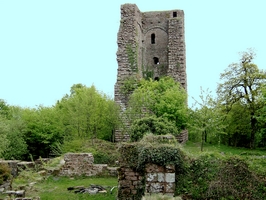
The ruins today feature remnants such as a
square keep with three-meter-thick walls faced in embossed stone, the
cellars of the lord's residence (known as the Knight's Room, a vaulted
space 22 meters long and 11 meters wide supported by ten massive
pillars, partly excavated into the rock), and a barbican entrance. These
elements highlight its evolution from a basic stronghold to a more
elaborate feudal residence.
Foundation and Early History (12th
Century)
The castle's origins date back to the early 12th century,
around 1120, making it one of the region's earliest fortifications. It
was constructed by the noble Geroldseck family (also spelled Geroltseck
or Geroldseck am Wasichen/ès-Vosges), a German-origin lineage that
served as avoués (advocates or bailiffs) for the powerful Marmoutier
Abbey near Strasbourg. The family's role was to protect the abbey's
extensive lands in Alsace from threats, including rival nobles and
invasions. The castle was built on a rocky platform to serve dual
purposes: as a defensive outpost and a seigneurial residence.
Alsace
at the time was part of the Holy Roman Empire, a border region with
fluid Franco-German influences. The Geroldseck family, documented as
early as the 11th century but prominently from the 12th, held
ministerial nobility status, acting as vassals to higher powers like the
bishops of Strasbourg and the abbey. The castle's foundation is tied to
the family's advocacy charter, with the first known member, Otto I von
Geroldseck (active around 1120–1126), witnessing documents related to
abbey exchanges and donations. His sons—Dietrich, Burchard I, and Otto
II—continued this role, with Otto II (active until 1155) also serving as
Marmoutier's advocate and appearing in charters from 1141 to 1155.
By
the mid-12th century, the family expanded its influence, with Otto III
(active until 1193) involved in disputes over Saverne and Burchard II
(active until 1172) maintaining ties to the abbey. The castle likely
started as a simple wooden or stone keep, evolving as the family's power
grew.
The Geroldseck Family and Medieval Development (13th–14th
Centuries)
The Geroldseck family, known as Herren von Geroldseck am
Wasichen (Lords of Geroldseck in the Vosges), played a central role in
the castle's history. They were not counts but noble lords with advocacy
rights, intermarrying with prominent Alsatian families like Lichtenberg,
Rappoltstein, and Ochsenstein. Key holdings included villages like
Weyersheim (shared ban rights in 1269), Herd (purchased in 1303),
Bergheim, and Otterswiller, alongside advocacies for abbeys like
Maurmunster.
Notable figures include:
Burchard III (died
1236/37), who witnessed charters on Dagsburg inheritance.
His sons:
Burchard IV (died 1256–1266), Siegmund (active until 1269, involved in
fief sales), and Heinrich (bishop of Strasbourg 1263–1273).
Burchard
V (active until 1323), who donated revenues and granted rights in
Bergheim.
Later members like Egon (died before 1346), who allied
against the Lichtenbergs in 1330, and his sons Hugo, Siegmund, Johann,
and Friedrich.
The castle underwent significant expansions in the
13th, 14th, and 15th centuries to adapt to changing warfare (e.g.,
artillery) and residential needs. This included reinforcing the keep,
adding the palas (lord's residence), and constructing defensive elements
like the barbican. By the 13th century, the family built the nearby
Château du Petit-Geroldseck (first mentioned 1349) as a co-owned fief of
the Bishopric of Metz, likely due to family growth and division of
holdings. In 1235, documents refer to "two lands of Gerolsec,"
indicating both castles' existence.
Significant events include the
1285 tournament account by trouvère Jacques Bretel mentioning Waleran de
Geroldseck's wife, Alice de Louppy-le-Château, and Waleran's death in
1289 during a Black Forest skirmish. The family also had ties to
Hohengeroldseck in Germany, though that was a separate branch.
Decline, Occupation, and Destruction (Late 14th–15th Centuries)
By
the late 14th century, the Geroldseck line in Alsace began to wane, with
deaths and property transfers. In 1390, part of the castle reverted to
the widow of Frédéric de Geroldseck. As family control weakened, it fell
into the hands of brigand knights (robber barons) who used it as a base
for raids, common in the fragmented Holy Roman Empire.
This led to
its destruction in a punitive expedition around 1471–1486. Sources vary
slightly on the date: some cite 1471 when it was razed as a den of
robber knights, others 1486 as the point of total ruin. The castle was
likely besieged or dismantled by regional authorities, such as the
Bishop of Strasbourg or allied nobles, to eliminate the threat.
Petit-Geroldseck was probably abandoned by then. The destruction marked
the end of its habitation, leaving it exposed to the elements for
centuries.
Post-Medieval Period and Modern Preservation (16th
Century–Present)
After destruction, the site was neglected amid
regional conflicts like the Thirty Years' War (1618–1648), which further
deteriorated ruins in Alsace, though Grand-Geroldseck was not a primary
target. It remained abandoned, with vegetation overgrowth accelerating
decay.
Interest revived in the 19th century: artist Désiré Monnier
sketched it in 1842, capturing its romantic ruin aesthetic. In 1898, it
was officially listed as a monument historique in the Mérimée database,
providing legal protection.
In the 20th and 21st centuries,
preservation efforts intensified. Organizations like Alsace Terre de
Châteaux Forts maintain the site. A 2018 crowdfunding campaign funded
repairs to the palas's curtain wall, addressing structural issues and
overgrowth. The ruins are now stabilized, preserving their authentic
medieval character for visitors, historians, and hikers.
The Château du Grand-Geroldseck, also known as Grand-Geroldseck
Castle, is a medieval ruin nestled in the Vosges Mountains within the
commune of Haegen in the Bas-Rhin department of Alsace, France. As one
of the oldest and largest castles in the northern Vosges region, it was
originally constructed in the early 12th century (around 1120-1141) by
the powerful Geroldseck family, who served as advocates (protectors) for
the nearby Marmoutier Abbey. The castle was designed to blend
residential comfort with robust defensive capabilities, perched on a
rocky platform overlooking the Zorn Valley to safeguard the family's
territories. It underwent significant modifications in the 13th, 14th,
and 15th centuries, incorporating elements of both Romanesque and Gothic
architecture, before falling into disrepair and being destroyed in 1471
during a punitive siege by the Duke of Lorraine and the Elector Palatine
to curb brigand activities. Further damage occurred in 1718 when
lightning struck the keep, creating a large breach, and restoration
efforts took place between 1863 and 1874. Today, it stands as a
classified monument historique since 1898, with ongoing preservation
work by the Association Pro Geroldseck to clear vegetation, secure
unstable areas, and halt further degradation.
Architecturally,
the castle's layout follows the irregular contours of its rocky outcrop,
forming an elongated, somewhat oval enclosure that adapts to the terrain
for optimal defense. The site measures approximately 100 meters in
length and 50 meters in width, making it one of the more expansive ruins
in Alsace. Entry was protected by a barbican—a fortified gateway added
in the 13th century to the east side—featuring a defensive outwork that
reinforced the main access point against assaults. The enclosure walls,
constructed from local sandstone, encircle the inner bailey and
incorporate remnants of various interior buildings, including storage
facilities and service structures.
At the heart of the defenses
stands the donjon, or keep, a prominent square tower positioned at the
eastern end near the entrance for strategic oversight. Built around 1200
in the Romanesque style, this isolated structure measures about 10
meters per side with walls nearly 3 meters thick, faced in rusticated
ashlar (pierres à bossages)—large, roughly hewn stones with protruding
bosses for added strength and aesthetic texture. The donjon originally
rose to multiple levels, with a partially preserved vaulted ceiling on
the upper floor, which is a rare surviving feature among Alsatian
castles of this era. It served as a last-resort refuge, symbol of
seigneurial power, and vantage point, visible from up to 20 kilometers
away.
Adjacent to the donjon is the palas, or grand seigneurial
lodge—a vast residential building that combined living quarters with
ceremonial spaces. Only the lower level and cellars remain, showcasing
Romanesque elements such as arched doorways and sturdy stonework, with
later Gothic additions like mullioned windows (fenêtres à meneaux) that
divided panes with vertical stone bars for light and ventilation. An
extension to the north of the palas, dating to the second half of the
13th century, likely expanded the living areas or added defensive
features. The cellars, dug into the rock, provided storage for
provisions and wine, with vaulted ceilings that have endured better than
the upper stories.
Other notable features include remnants of
curtain walls (murs de courtine) that connected the various structures,
some of which have partially collapsed and required recent emergency
stabilization. The castle's design emphasized verticality and
impregnability, with the rocky base serving as a natural barrier,
supplemented by man-made ditches or dry moats in vulnerable spots.
Materials primarily consisted of local Vosges sandstone (grès des
Vosges), prized for its durability and used in both rough and dressed
forms to create textured facades that deterred scaling.
In its
current ruined state, the Château du Grand-Geroldseck offers a poignant
glimpse into medieval fortification, with the imposing donjon as the
most intact element amid overgrown vegetation and scattered stonework.
Visitors can explore the site via hiking trails from nearby Château du
Haut-Barr, but caution is advised due to unstable walls and ongoing
conservation efforts. The ruins are free to access year-round, though
interpretive panels and volunteer-led initiatives by Pro Geroldseck
enhance understanding of its architectural evolution.
The castle remains a stabilized ruin, showing centuries of erosion. As a classified monument historique, it is protected by the French government, prohibiting unauthorized changes. In 2018, a crowdfunding campaign supported repairs to the palas’s curtain wall, addressing vegetation overgrowth and structural issues. No major reconstructions have occurred, preserving its authentic state. It is listed in the Mérimée database, and groups like Alsace Terre de Châteaux Forts advocate for its upkeep. Visitors are cautioned against climbing unstable walls for safety.
The castle is free to visit year-round, with spring and summer
offering the best conditions. No formal guided tours exist, but
interpretive panels may be available. It is part of Alsace’s “castle
route,” alongside sites like Haut-Barr and Lichtenberg. The nearby
Petit-Geroldseck provides a smaller contrast, while Saverne offers
museums and dining.
Occasional events, such as medieval music
festivals by groups like Festival Voix et Route Romane, highlight
its Romanesque heritage. The surrounding trails, rich in
biodiversity, attract hikers, but sturdy footwear is recommended for
uneven terrain, and visitors should monitor weather conditions in
the mountains.