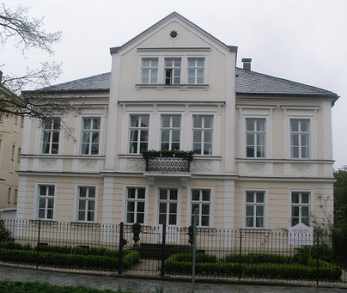
Location: Wahnfriedstraße 1
Tel. +49 921 5071444
Open: Sept -
June: 10- 12 am, 2- 5 pm daily
July/Aug: 10 am - 5 pm daily
The Jean-Paul-Museum, located at Wahnfriedstraße 1, 95444 Bayreuth, Germany, is a specialized literary museum dedicated to the life and work of Jean Paul (born Johann Paul Friedrich Richter, 1763–1825), one of Germany’s most significant poets and novelists, often referred to as the “Master of Bayreuth” alongside Richard Wagner. Housed in the former residence of Wagner’s daughter Eva and her husband Houston Stewart Chamberlain, the museum showcases the world’s most extensive private collection of Jean Paul artifacts, donated by Dr. Philipp Hausser, a descendant of Jean Paul’s landlords in Bayreuth. Established in 1980 and significantly redesigned in 2013 for Jean Paul’s 250th birthday, the museum offers an intimate exploration of the poet’s literary contributions, personal life, and connection to Bayreuth, where he lived from 1804 until his death.
Jean Paul in Bayreuth (1804–1825)
Jean Paul, born in Wunsiedel,
Upper Franconia, in 1763, was a prolific writer whose novels, such as
Hesperus (1795), Titan (1800–1803), and Flegeljahre (1804–1805), blended
romanticism, satire, and philosophical depth. Known for his vivid
natural descriptions, emotional nuance, and fantastical imagination, he
was one of the most widely read German authors of his time. In 1804,
Jean Paul settled in Bayreuth, where he lived until his death on
November 14, 1825, at age 62, from liver cirrhosis and near-blindness.
During this period, he changed residences seven times, finally settling
in 1813 at Friedrichstraße 5 (then Friedrichstraße 384), rented from
Jewish banker Joseph Isaak Schwabacher. This house, where he died, was
his most significant Bayreuth home, though the museum is located
elsewhere due to the original building’s private ownership.
Jean
Paul’s Bayreuth years were marked by prolific writing, social
engagement, and a love for local taverns, particularly the Rollwenzelei
inn, where he drank beer and wine with landlady Anna Dorothea
Rollwenzel. His works often featured Bayreuth and its surroundings,
embedding the city in his fantastical narratives. Despite his literary
fame, Jean Paul’s later years were marred by financial struggles and
health issues, though he remained active, planning a collected edition
of his works until his final days.
Museum’s Establishment (1980)
The Jean-Paul-Museum owes its existence to Dr. Philipp Hausser, a
Bayreuth physician and descendant of Joseph and Rosa Schwabacher, Jean
Paul’s landlords. Hausser amassed a remarkable collection of Jean Paul
artifacts from his youth, including autographs, first editions,
portraits, and personal items. This collection, considered the most
significant private Jean Paul archive, formed the museum’s foundation:
1980: The museum opened on the ground floor of the former
Chamberlain residence, under the direction of Dr. Manfred Eger, with
Hausser’s donation. The opening was attended by Jean Paul’s
great-great-granddaughters, Gertrud Lacroix-Förster and Adele Metzner.
1994: The city of Bayreuth expanded the museum, acquiring additional
manuscripts and documents to enrich the collection.
2013: For Jean
Paul’s 250th birthday (March 21, 2013), the museum was redesigned by Dr.
Frank Piontek and exhibition designer Florian Raff, under director Dr.
Sven Friedrich. The revamp modernized the presentation, making it more
pedagogical and visually engaging.
Historical Context
Habsburg
and Literary Connections: Jean Paul’s Bayreuth years coincided with the
Napoleonic era and the decline of the Holy Roman Empire, influencing his
satirical and humanistic writings. His friendships with figures like
Caroline von Flotow and Christian Otto tied him to regional nobility and
intellectual circles.
Chamberlain Controversy: The museum’s location
in Houston Stewart Chamberlain’s former home is significant.
Chamberlain, a Wagner son-in-law and ideologue whose writings influenced
National Socialism, contrasts sharply with Jean Paul’s humanistic
ideals. The museum’s presence is seen as a “symbolic salvation,”
reclaiming the space for Jean Paul’s humane legacy. Jean Paul himself
was misrepresented by Nazi propaganda as a “petty bourgeois” apologist,
a distortion the museum corrects through its focus on his universal
themes.
Bayreuth’s Cultural Landscape: Bayreuth, famous for Wagner’s
Festspielhaus and Margravial Opera House, also celebrates Jean Paul as a
local literary giant. The museum complements the Richard Wagner Museum
and Franz Liszt Museum, forming a “Museumsinsel” (Museum Island) at
Wahnfriedstraße.
Chamberlain House
The Jean-Paul-Museum occupies the ground floor
of the former residence of Eva Wagner and Houston Stewart Chamberlain,
adjacent to the Richard Wagner Museum (Haus Wahnfried). Built in the
19th century, the house is a modest yet elegant structure in Bayreuth’s
historic center:
Exterior: The building features a simple,
Historicist facade with clean lines, typical of Bayreuth’s bourgeois
architecture. Its proximity to Haus Wahnfried makes it easy to overlook,
as noted by visitors, but a sign clearly marks the Jean-Paul-Museum.
Interior: The museum spans three large rooms, covering approximately
100–150 square meters. The 2013 redesign introduced modern display
cases, neutral walls, and soft lighting to highlight the artifacts. The
layout is compact, with a chronological and thematic arrangement guiding
visitors through Jean Paul’s life and works.
Accessibility: The
ground-floor location ensures wheelchair access, with no stairs within
the exhibition space. Restrooms and a cloakroom are available via the
Wagner Museum’s facilities.
Architectural Significance
The
Chamberlain house’s historical association with Wagner’s family and its
controversial Nazi-era connections add complexity to the museum’s
setting. The 2013 redesign by Florian Raff balanced the building’s
19th-century character with contemporary museology, using minimalist
design to focus on the artifacts. The small scale fosters an intimate
experience, contrasting with larger museums like the Kunsthistorisches
in Vienna, but some visitors note the limited space can feel
restrictive.
The Jean-Paul-Museum houses the world’s most comprehensive collection
of Jean Paul-related artifacts, primarily from Dr. Philipp Hausser’s
donation, supplemented by city acquisitions and loans. The three-room
exhibition, redesigned in 2013, focuses on Jean Paul’s life, literary
output, and Bayreuth context, using autographs, first editions,
portraits, and personal items. Below are the key exhibits:
Room
1: Life and Bayreuth Years
Autographs and Letters: Original
manuscripts, including letters to friends like Christian Otto and
Caroline von Flotow, reveal Jean Paul’s wit and personal relationships.
A notable letter from September 3, 1793, expresses his affection for
Caroline.
Portraits: Contemporary paintings and sketches, including a
2019-acquired pastel of Caroline von Flotow and her brother Wilhelm, and
an oil portrait of Christian Otto, Jean Paul’s biographer and friend.
Personal Items:
Schnupftabakdose: A snuffbox from Jean Paul’s
possession, reflecting his daily habits.
Kachelofen: A tiled stove
from his Friedrichstraße apartment, evoking his domestic life.
Silver
Tafelservice: A silver table service gifted by Prussian Queen Luise for
Jean Paul’s engagement, donated by Adele Metzner in 2010.
Contextual
Displays: Panels detail Jean Paul’s seven Bayreuth residences, his
tavern visits (e.g., Rollwenzelei), and his death in 1825, with quotes
like “Wir wollen’s gehen lassen” from his final conversation.
Room 2: Literary Works
First Editions: Nearly all of Jean Paul’s
first editions, except the missing second volume of Grönländische
Prozesse. Highlights include Hesperus, Siebenkäs, and Flegeljahre,
showcasing his satirical and romantic style.
Manuscripts: Handwritten
drafts and sketches, some from Friedrich Kallenberg, a great-grandson
who donated items to the city’s Historisches Museum (now on permanent
loan).
Literary Circle: Books and documents from contemporaries like
Johann Wolfgang von Goethe and Friedrich Schiller, situating Jean Paul
in German Romanticism.
Interactive Elements: A touchscreen or audio
guide (available in German, English) offers excerpts from Jean Paul’s
works, explaining their “skurrile” (quirky) humor and philosophical
depth.
Room 3: Legacy and Bayreuth Context
Schreibsekretär: Jean
Paul’s writing desk, on loan from the Goethe-Nationalmuseum in Weimar
since 1999, is a centerpiece, symbolizing his creative process.
Memorabilia: Objects like prints, medals, and illustrations related to
Jean Paul’s reception, including his misrepresentation by Nazi ideology.
Bayreuth Connections: Exhibits on local figures like Anna Dorothea
Rollwenzel and Schwabacher, with maps showing Jean Paul’s haunts (e.g.,
Jean-Paul-Platz).
Cultural Impact: Displays on the Jean Paul
Kulturverein, which organizes exhibitions, concerts, and readings
inspired by Jean Paul’s humanism.
Additional Features
Audio
Guide: Included in admission, offering insights into Jean Paul’s life
and works, though some visitors find the narration monotone. Available
in English, but display texts lack translations.
2013 Redesign: The
revamped exhibition uses modern display techniques, with QR codes
linking to digital content and a focus on accessibility for younger
audiences.
Temporary Displays: Occasional exhibits highlight specific
works or anniversaries, such as Jean Paul’s correspondence or his
influence on later writers.
Critical Reception
Strengths:
Visitors praise the museum’s “literarisch wertvoll” (literary value) and
well-curated collection, noting it provides a “Schlüssel” (key) to
understanding Jean Paul’s complex writings. The personal items and first
editions are highlights.
Criticisms: The small size (two to three
rooms) and lack of English translations in display cases can limit
accessibility for international visitors. The audio guide’s delivery has
been criticized as unengaging, and some feel the museum’s location in
Chamberlain’s house, rather than Jean Paul’s actual home, is
incongruous.
Jean Paul’s Legacy
Jean Paul, alongside Goethe and Schiller, was a
titan of German literature, known for his imaginative prose, satirical
humor, and humanistic themes. His Bayreuth years produced works that
captured the region’s landscapes and spirit, making him a local icon.
The museum corrects historical misrepresentations, particularly the Nazi
era’s distortion of Jean Paul as a “kleinbürgerlicher” (petty bourgeois)
figure, emphasizing his universal appeal and empathy.
Bayreuth’s
Cultural Identity
Bayreuth is synonymous with Wagner’s operas, but
Jean Paul’s presence adds literary depth. The museum, part of the
“Museumsinsel” with the Wagner and Liszt museums, positions Bayreuth as
a hub of music and literature. The Jean Paul Kulturverein extends this
legacy through modern cultural events, such as readings and performances
at Friedrichstraße 5.
Chamberlain and Ethical Reflection
The
museum’s location in Chamberlain’s house is a poignant contrast.
Chamberlain’s racist ideologies, which influenced National Socialism,
clash with Jean Paul’s humanistic writings. The museum’s establishment
is seen as a reclamation of the space for enlightenment values, a
“victory of the humane over inhumane.” This narrative resonates in
Bayreuth, a city grappling with its Wagnerian and Nazi-era associations.
Literary Museum Network
As a member of the Arbeitsgemeinschaft
Literarischer Gesellschaften und Literaturmuseen (ALG) since 1986, the
Jean-Paul-Museum contributes to Germany’s literary heritage, alongside
institutions like the Goethe-Haus in Frankfurt. Its collection, enriched
by loans from Weimar and donations from descendants, is unmatched for
Jean Paul studies.
Critical Perspective
The museum excels for
literary enthusiasts, offering a “goldig” (charming) and “stilles”
(quiet) experience, but its niche focus and small size may underwhelm
casual visitors expecting a larger display. The lack of English
translations and limited interactivity (compared to Vienna’s Haus der
Musik) hinder accessibility. The Chamberlain house location, while
symbolically significant, frustrates some who prefer a site tied
directly to Jean Paul, such as Friedrichstraße 5, now privately owned.
Nonetheless, the museum’s 4-star Tripadvisor rating reflects its value
for those interested in German literature.