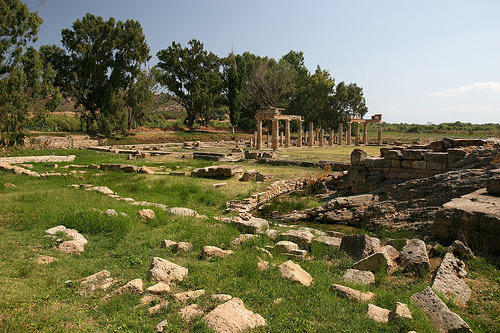
Location: 10 km (6 mi) Northeast of Markopoulo, Attica Map
Tel. 22990 27020
Site Open:
Open: 8:30am- 3pm Tue- Sun
Brauron is located 10 km (6 mi) Northeast of Markopoulo and 38
km East of Athens in the Attica region of Greece. Brauron site
once stood on the shores of the Aegean Sea, but the over time
the bay of the sea got silted and now the ancient cite is
situated inland.
Brauron Archaeological Site was
inhabited since Neolithic times. Local archaeological digs
revealed settlement dating back to circa 2000 BC. The city of
Brauron flourished during Middle Helladic and early Mycenaean
period (2000- 1600 BC). Over time Brauron Archaeological Site
became associated with the cult of Greek goddess of Artemis that
date back to the 8th century BC. Artemis was fought to help
pregnant women in childbirth. Before medical inventions this
process was very dangerous and often deadly to a woman and a
baby. The holiest place within the sanctuary was the sacred
spring of Artemis. Brauron site gave an ancient ritual a name of
Brauronia. It was held every four years. A long procession from
the Athens marched to Brauron. Young women aged 7 to 10 years
old "played the bear" for the Artemis. They were running,
dancing and serving the people. Their services became known as
arkteia from Greek word "arktos" or "bear". This was a sort of
act of passage into puberty, subsequent marriage and childbirth.
According to a legend Iphigeneia, daughter of Agamemnon and
Clytemnestra, brought the statue of Artemis and buried within
city limits. According to Greek legends the Persian invasion
caught the Greeks by surprise, so goddess reached down from
mount Olympus and took back her image in marble. Although many
historians agree that this legend is just a nice fairy. The
actual statue was carried off by the Persian armies to Susa
after they burned and destroyed much of the city in 480 BC.
Brauron Archaeological Site was subsequently rebuilt. The final
blow to Brauron Archaeological Site was dealt by a river
Erasinos that flood the region in the 3rd century BC forcing
many of its residents to flee to higher grounds. For the next
few centuries the site was a source of stones and marble. Only
in the 5th century AD Brauron Archaeological Site became
partially inhabited. A Christian basilica was added in the 6th
century just 500 meters (1/3 mile) West of the sanctuary site.
Currently Brauron archaeological site is still under ground.
According to insriptions and historian records the city still
has palaestra, gymnasium and other buildings still undiscovered.
Brauron Museum:
Open: 8:30am- 3pm Tue- Sun
Closed: Jan 1, Jan 6, Mar 25, Shrove Monday, Good Friday am, Easter Sunday, Easter Monday, May 1, Dec 25- 26
The Brauron Archaeological Site (also known as Vravrona or Brauron)
is an ancient sanctuary dedicated to Artemis, located about 38-40 km
east of central Athens in the Attica region, near the town of Markopoulo
Mesogeias. It's accessible via several transportation options, though
public transport can be limited and may require some walking (up to 1 km
from the nearest bus stop). Always check current schedules and routes
via official apps like OASA (Athens public transport) or Google Maps, as
details can change. Here's a breakdown of the main ways to get there
from Athens:
By Car (Recommended for Flexibility)
Renting a
car is the most straightforward option, allowing you to combine the
visit with nearby coastal areas or other sites.
Drive southeast from
Athens via the Attiki Odos highway (E94) toward the airport, then take
the exit toward Markopoulo and follow signs to Vravrona/Brauron.
The
drive typically takes 40-50 minutes, depending on traffic.
Parking is
available near the site.
By Public Bus
Take the Athens Metro
(Line 3, blue line) to Nomismatokopio station (from central Athens, this
takes about 20-30 minutes).
From there, catch bus line 304 toward
Porto Rafti or Markopoulo/Vravrona. The bus ride is approximately 45-60
minutes, and you'll get off at the Vravrona stop (near the
archaeological museum and site).
Alternative: From Ethniki Amyna
metro station (also Line 3), take bus 304 or 321 to Loutsa/Artemida,
then walk about 1 km to the site.
Buses run every 30-60 minutes, but
service is less frequent on weekends. Total time: 1-1.5 hours. Fare:
Around €1.20-€2 for the bus (metro ticket separate).
By Subway
and Taxi
Take the Metro Line 3 to Athens International Airport (about
40 minutes from Syntagma Square).
From the airport, hail a taxi or
use a ride-sharing app like Uber or Beat to the site (15-20 minutes,
costing €20-€30).
This hybrid option is convenient if you're flying
in or prefer not to drive.
By Taxi or Ride-Share Directly
From
central Athens (e.g., Syntagma Square), a taxi or Uber ride takes about
45-60 minutes and costs €40-€60, depending on traffic and time of day.
Agree on the fare in advance or use the meter.
Organized Tours
If you prefer a guided experience, join a day tour from Athens that
includes Brauron, often combined with the Temple of Artemis or nearby
wetlands. These can be booked via platforms like Viator or GetYourGuide,
with transport included (typically €50-€100 per person).
Prehistoric and Early Settlement (Neolithic to Bronze Age)
The
Brauron Archaeological Site, located in eastern Attica near modern-day
Artemida and approximately 38 km east of Athens, has evidence of human
habitation dating back to the Neolithic period. This early settlement
reflects the site's strategic position near the Aegean coast, providing
access to resources and trade routes. Archaeological findings suggest
continuous occupation from the Early Bronze Age, with prehistoric
remains indicating activity until a period of apparent abandonment
between the 12th and 9th centuries BCE. Mycenaean chamber tombs nearby
further point to Bronze Age use, potentially linking to early ritual or
burial practices, though direct connections to later cults remain
speculative. Unpublished data from excavations hint at site activity
resuming around the 10th century BCE, possibly with continuity from the
late Bronze Age through the Dark Ages.
Emergence of the Cult (8th
to 7th Centuries BCE)
By the 8th century BCE, Brauron rose to
prominence as a religious center with the establishment of the cult of
Artemis Brauronia, the goddess of hunting, nature, wilderness,
childbirth, and protector of women and children. Evidence of cult
activity from this era includes terracotta figurines found in votive
contexts, centered around a natural spring and cave-shrine later
associated with mythological figures like Iphigeneia. The site initially
may have functioned as a hero-shrine to Iphigeneia, with votive
offerings such as wooden and terracotta images of deities, statues of
children, jewelry, loom weights, and cosmetic items like combs and
mirrors. In the Archaic period, the principal deity appears to have been
a Potnia Theron (Mistress of Animals) figure before evolving into
Artemis the Huntress. The earliest stone structures were built in the
7th century BCE, marking the transition from rudimentary worship to more
formalized architecture.
Mythologically, Brauron is tied to the story
of Iphigeneia, daughter of Agamemnon. According to legend, she was
spared from sacrifice at Aulis by Artemis, who substituted a deer (or in
some variants, a bear), and transported her to Tauris. Iphigeneia later
returned to Brauron, bringing a sacred wooden statue (xoanon) of Artemis
and serving as her priestess until her death, with her tomb purportedly
at the site. However, modern archaeological analysis, such as by Gunnel
Ekroth, disputes direct evidence for Iphigeneia's burial, suggesting the
proposed site was likely a ritual dining hall instead. This myth
underscores the site's role in themes of sacrifice, substitution, and
divine protection, blending local folklore with broader Greek
narratives.
Classical Period Development (6th to 4th Centuries
BCE)
The 6th century BCE saw significant expansion, with the original
stone temple rebuilt and active worship of Artemis formalized. Athenian
tyrant Peisistratus (Pisistratus) introduced the cult to the Acropolis
in Athens around this time, establishing a counterpart sanctuary
(Brauronion) there, though primary rituals remained at Brauron. This
move may relate to Peisistratus' efforts to consolidate Attica's
boundaries, leveraging Artemis' associations with liminal spaces. By the
late 6th or early 5th century BCE, a stone structure was added to the
Acropolis sanctuary, aligning with broader Athenian building programs.
In the 5th century BCE, the site became firmly associated with Artemis,
evidenced by inscriptions like one on a mirror dedicating it "to Artemis
in Brauron." Architectural highlights include a Doric-style temple with
columns and foundations, a Π-shaped stoa for ritual gatherings and
accommodations, a small theater for festivals, and a stone bridge over
the Erasinos River to facilitate pilgrim access. The sanctuary's
proximity to water sources, which periodically flooded, preserved unique
artifacts like Attic wooden sculptures and painted works in mud
deposits.
Culturally, Brauron was a hub for female-centric rituals,
particularly the Brauronia festival held every five years. This involved
processions from Athens, where young girls aged 5 to 10, known as arktoi
("little bears"), dressed in saffron-colored robes (krokotoi) and
participated in games, dances, races, and sacrifices of goats. The
arkteia ritual symbolized a rite of passage, imitating bears to honor
Artemis and ensure healthy growth, marriage, and motherhood. It stemmed
from a myth where a sacred bear was killed after attacking a girl,
prompting Artemis to demand appeasement through these initiations.
Votive offerings peaked during this era, including clothing from mothers
post-childbirth, dolls, figurines, pottery, jewelry, and toys, with
artifacts like a statue of a girl hugging a rabbit symbolizing childhood
under Artemis' protection. The rituals were almost exclusively female,
drawing upper-class daughters from Athens and surrounding areas,
highlighting Greek women's roles in religion and Brauron's uniqueness as
a site where girls played central roles.
The site's significance
extended to themes of liminality, with Artemis embodying transitions
from girlhood to womanhood, wilderness to civilization, and life to
death. It also reflected broader Athenian identity, linking rural
sanctuaries to urban centers.
Decline and Abandonment (Post-4th
Century BCE)
Ritual activity continued into the 4th century BCE but
declined thereafter. The sanctuary was abandoned around 300 BCE,
possibly due to shifting religious practices, environmental factors like
flooding, or political changes in Hellenistic Greece. Later, a Chapel of
Saint George was built atop the ancient altar, indicating Christian
repurposing of the site.
Modern Excavations and Legacy
Systematic excavations began in 1948 under Greek archaeologist John
Papadimitriou, who uncovered much of the site's Classical structures
until his death in 1963. Challenges include unpublished notes from
Papadimitriou, held by his family, limiting full interpretation. Today,
the Archaeological Museum of Brauron displays key finds, such as marble
statues of young girls, figurines, and votives, offering insights into
ancient Greek femininity and religion. The site remains partially
excavated and open to visitors, serving as a vital window into Artemis
worship, initiation rites, and the interplay of myth and archaeology in
ancient Attica. Its female-focused rituals underscore underrepresented
aspects of Greek society, making Brauron a cornerstone for studies on
gender, childhood, and cult continuity in antiquity.
In 1945 the archaeologist Ioannis Papadimitriou made excavations in
the area. Excavations continued during the 1950s and 1960s and
uncovered most of the archaeological site. The most important sights
of the archeological site are the temple of Artemis, the P-shaped
portico, the sacred spring, the bridge over the Erasinos river, the
palaestra, the high school etc. The temple of Artemis is a small
temple in size, from which mainly its side is preserved. There is
doubt as to the shape of its façade, but it is believed to have been
six-column; The P-shaped portico surrounded a large courtyard on the
side of the temple. Around the gallery there were bases with small
statues. There was also a famous statue in the temple, which Xerxes
took and transported to Susa.
In 1961, two votive reliefs of
the classical period were unveiled in the temple of Brauronia
Artemis. One of them shows the goddess accepting the offer of votive
offerings from five men. Below the show begins a multi-line
inscription with a list of gifts to Artemis. This column, like
others, was used in the construction of the cobblestone road north
of the temple.
For years the church has been handed over to the mercy of the weather, with the result that even with a heavy rain it turns into a lake. These problems arise from the bureaucracy but also from the misunderstanding of the competent bodies to take responsibility for the care of such an important archaeological monument.
Today in the area of Vravrona there is a modern small seaside settlement. The current settlement of Vravrona has 41 inhabitants, according to the 2001 census. It has some taverns and other shops near the beach of Vravrona, which receives many visitors during the summer.
Vravrona and its coastal marine zone is a protected habitat of Natura 2000, with code GR3000004, with an area of 27.12 sq.km.