Location: Ionian Islands Map
Corfu, also known as Kerkyra in Greek, is the northernmost of the Ionian Islands in Greece, located in the Ionian Sea off the northwestern coast of the mainland. It is renowned for its stunning natural beauty, blending turquoise waters, lush greenery, and dramatic landscapes that have earned it the nickname "Emerald Isle." The island covers an area of about 610 square kilometers and has a population of around 101,600 residents as of recent estimates. Its strategic position has made it a crossroads of civilizations, resulting in a unique fusion of Greek, Venetian, French, and British influences that permeate its architecture, cuisine, and traditions. Positioned near Albania and separated by the narrow Strait of Corfu, the island's sickle-shaped form stretches approximately 64 kilometers long and up to 32 kilometers wide, offering a diverse terrain that attracts millions of tourists annually.
Corfu Old Town (Kerkyra) and Its Fortifications
The Old Town is
the island’s cultural and historical heart—a labyrinth of narrow
cobblestone streets (kantounia), pastel-colored multi-story
Venetian-style buildings draped in bougainvillea, arches, and hidden
squares. It sits at the entrance to the Adriatic Sea and was designed as
a formidable defensive ensemble.
Old Fortress (Palaio Frourio):
Built on a rocky promontory east of the town (originally Byzantine,
extensively rebuilt by the Venetians in the 14th–16th centuries and
later modified by the British), it is separated from the mainland by a
moat. The fortress features ramparts, towers, a small church, and a
lighthouse. It offers panoramic views over the sea, the town, and the
New Fortress. Inside, you can explore remnants of Venetian barracks and
British-era structures.
New Fortress (Neo Frourio): On the
western side overlooking the harbor and port, this massive Venetian
structure (built in the 16th–17th centuries) includes intricate tunnels,
galleries, and bastions. It was later enhanced under British rule.
Church of Agios Spyridon (Saint Spyridon): The spiritual centerpiece of
the Old Town (built 1589), this Venetian-style church houses the
mummified relics of Corfu’s patron saint (brought from Cyprus). The
saint is credited with miracles, including saving the island from
plague, famine, and Ottoman sieges (most famously in 1716). Its
distinctive red-domed bell tower dominates the skyline; religious
processions with the saint’s relics occur several times a year.
Spianada Square and Liston Promenade: Spianada is the largest square in
the Balkans, featuring manicured gardens, a bandstand, and a cricket
pitch (a legacy of British rule). Adjacent is the elegant Liston
arcade—French-inspired with cafes and shops—built in the early 19th
century for aristocratic strolling.
Palace of Sts. Michael and
George: A neoclassical British-era building now housing the Museum of
Asian Art, with exhibits from China, Japan, and beyond.
Royal
Palaces and Summer Residences
Corfu’s palaces reflect 19th-century
European royalty’s fascination with the island’s beauty and Greek
mythology.
Achilleion Palace (Gastouri, ~10 km south of Corfu Town):
This opulent neoclassical villa was built in 1890 for Empress Elisabeth
of Austria (“Sisi”) as a summer refuge after personal tragedies.
Designed in Pompeian and ancient Greek styles and dedicated to Achilles
(whom Sisi admired), it features marble columns, frescoes (including The
Triumph of Achilles), mosaics, and lush terraced gardens with
mythological statues. The most famous is Ernst Herter’s Dying Achilles.
Later owned by Kaiser Wilhelm II (who added his own Achilles statue), it
is now a museum with panoramic Ionian Sea views. It even appeared in the
James Bond film For Your Eyes Only.
Mon Repos Palace (near
Paleopolis, south of Corfu Town): A graceful neoclassical villa built in
the 1820s–1830s by British High Commissioner Frederick Adam as a summer
residence (set in a lush park with ancient ruins). It later became a
Greek royal summer home and was the birthplace of Prince Philip, Duke of
Edinburgh (in 1921). The surrounding park includes archaeological
remains of ancient Korkyra (temples of Artemis and Hera, Roman baths).
It now functions as an archaeological museum.
Byzantine Castles
and Hilltop Forts
Angelokastro (“Castle of the Angel”): Perched
dramatically on a 305–1,000-foot cliff on the northwest coast near
Paleokastritsa, this 13th–14th-century Byzantine acropolis and fortress
(built by Michael II Komnenos Doukas) was a key defensive stronghold
against pirates and Ottomans—it was never conquered. The ruins include
walls, a cistern, and a small church. A steep path leads to 360°
panoramic views of the Ionian Sea, Corfu’s interior, and (on clear days)
Albania and the Greek mainland.
Monasteries and Iconic Religious
Sites
Paleokastritsa Monastery (Moni Theotokou, northwest coast):
Founded around 1225 and dedicated to the Virgin Mary (Panagia), this
hilltop Orthodox monastery overlooks some of Corfu’s most dramatic
turquoise bays, cliffs, and coves. Rebuilt after destructions (e.g., by
Genoese in 1403 and Ottomans in 1537), the current 18th-century
buildings house a small museum with Byzantine icons and relics. A short
but steep climb rewards visitors with breathtaking views; the
surrounding area is legendary in Homer’s Odyssey (linked to Odysseus).
Vlacherna Monastery and Pontikonisi (Mouse Island, Kanoni
Peninsula): One of Corfu’s most photographed scenes. The 17th-century
whitewashed Vlacherna Monastery sits on a tiny islet connected by a
causeway to the mainland, near the airport (planes fly dramatically low
overhead). Just offshore is Pontikonisi (“Mouse Island”), a verdant
islet topped with a Byzantine chapel of Pantokrator—legend says it is
the petrified ship of Odysseus. Boat trips connect the sites; it’s an
iconic postcard view with turquoise waters and mountains in the
background.
Natural and Scenic Landmarks
Corfu’s west and
north coasts offer dramatic geology alongside beaches.
Paleokastritsa
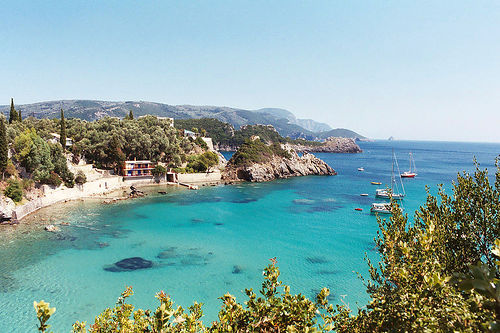
Bay and Beaches: Multiple horseshoe-shaped coves with crystal-clear
turquoise waters, pebble/sand beaches, and towering cliffs covered in
olive and cypress groves. Boat trips explore sea caves; the area is
ideal for swimming, snorkeling, or kayaking.
Cape Drastis (near
Peroulades, northwest coast): Striking white rock formations, sea
stacks, caves, and narrow sandy channels carved by erosion. Accessible
by boat or short hike; it creates a surreal, otherworldly seascape
perfect for photos and swimming in hidden coves.
Mount
Pantokrator: The island’s highest peak (~906 m). A winding road or hike
(from Old Perithia village) leads to a frescoed monastery and a cafe. On
clear days, views stretch across Corfu, to Albania, the mainland, and
even Italy.
Other highlights include Kassiopi Castle ruins
(northeast coast), Porto Timoni (twin beaches reachable by hike or
boat), and beaches like Myrtiotissa (praised by Lawrence Durrell as one
of the world’s most beautiful).
By Plane
Corfu has one international airport, Ioannis Kapodistrias
Airport (CFU), located about 2–3 km south of Corfu Town. It's
well-connected, with direct flights from various European destinations.
Upon arrival, you can take a short taxi ride (10–15 minutes, €10–15),
local bus (Blue Bus line 15, €1.20), or rent a car at the airport.
From Mainland Greece:
Athens (ATH) to CFU: Direct flights take
about 1 hour, with multiple daily departures (up to 33 weekly in peak
season) on airlines like Aegean Airlines, Sky Express, or Olympic Air.
Thessaloniki (SKG) to CFU: About 1 hour, with fewer but regular flights
on Aegean or Ryanair.
From Other Greek Islands: Limited options,
such as Lefkada (PVK) to CFU: As little as 18 minutes on select days,
but check availability as it's not daily.
From Europe: Direct flights
are abundant, especially in summer. Examples include:
UK (e.g.,
London, Manchester, Birmingham): 3–4 hours on easyJet, British Airways,
Ryanair, or Jet2.
Germany (e.g., Berlin, Munich, Frankfurt): 2–3
hours on Lufthansa, Eurowings, or Condor.
Italy (e.g., Milan, Bari,
Rome): 1–2 hours on Ryanair or ITA Airways.
France (e.g., Paris):
About 3 hours on Air France or Transavia.
Other countries: Direct
routes from Belgium (Brussels Airlines), Switzerland (Swiss), Austria,
Denmark, Finland, and more. In total, CFU serves direct flights from
around 96 airports across Europe.
Tips: Budget airlines like
Ryanair and easyJet offer cheap fares but charge for extras. Arrive at
departure airports 90 minutes early for domestic flights and 2–3 hours
for international. In winter (November–March), many routes are suspended
or reduced, so you may need to connect via Athens.
By Ferry
Ferries are a scenic and affordable option, especially if you're coming
from nearby areas or want to bring a vehicle. Corfu has two main ports:
Corfu Town (primary, handles most traffic) and Lefkimmi (smaller, in the
south, mainly for local routes). Services are operated by companies like
Kerkyra Lines, Kerkyra Seaways, Anek Lines, and others. Book via sites
like Ferryhopper for real-time availability.
From Mainland
Greece:
Igoumenitsa (nearest mainland port) to Corfu Town or
Lefkimmi: 50 minutes to 1.5 hours, with at least 16 daily crossings
year-round (more in summer). Fares start at €5 per person; vehicles
extra. Igoumenitsa is reachable by bus or car from Athens (5.5 hours) or
Thessaloniki (3.5 hours).
From Other Greek Islands:
Paxos
(Gaios) to Corfu: 1.5 hours, with 3 daily departures (e.g., 8 a.m.,
10:30 a.m., 6 p.m.) on Kamelia Lines. Buy tickets in advance at the port
or via email—no onboard sales.
Lefkada or Kefalonia: 5–6 hours from
Lefkada or 9–10 hours from Kefalonia, with seasonal services. Note:
Paxos is the only Ionian island with direct year-round ferry links to
Corfu.
From Italy (Seasonal, June–September):
Brindisi to
Corfu: About 6.5 hours, 3 weekly crossings.
Bari to Corfu: 8–10
hours, up to 6 weekly.
Ancona to Corfu: 18–19 hours, up to 5 weekly.
All allow vehicles; overnight sailings recommend cabins for comfort.
From Albania:
Sarandë to Corfu: 30 minutes to 1 hour 40 minutes,
up to 30 daily in summer (year-round but fewer in winter) on Finikas
Lines or Ionian Seaways.
Tips: Ferries can be delayed by weather,
so build in buffer time. If bringing a car, reserve space early. EU
citizens don't need passports for intra-Greece travel, but non-EU
visitors should carry ID. For island-hopping, combine with flights if
time is short.
Other Considerations
Combining Methods: Many
travelers fly into Athens or Thessaloniki and then take a short domestic
flight or ferry to Corfu for efficiency.
Once on Corfu: Use local
buses (Blue Buses for town, Green Buses for island-wide, €1–€2), taxis
(metered, but agree on fares), or rent a car/scooter for
flexibility—roads are winding but drivable. No Uber, but apps like Beat
work in some areas.
Best Time: Peak summer for options, but shoulder
seasons (May, October) for fewer crowds and milder weather.
Best Time to Visit
Shoulder seasons (May–June and
mid-September–October): Warm weather (swimmable sea), fewer crowds,
lower prices, and ideal conditions for hiking and exploring. These are
the top recommendations for most visitors.
Peak summer (July–August):
Hot, sunny, and lively with full services, but very busy in Corfu Town
and popular beaches. Expect higher prices and crowds.
Spring
(April–May) and Autumn (October–November): Great for outdoor activities,
wildflowers, and birdwatching; fewer tourists but some services may
close.
Winter: Mild but wetter with limited tourism infrastructure;
good for authentic local experiences.
Special events: Easter
celebrations are spectacular with processions, music, and traditions.
Carnival has a Venetian flair.
Getting Around
A rental car is
highly recommended for flexibility to reach remote beaches, villages,
and viewpoints—public transport is limited outside main routes and
requires walking from drop-offs.
Buses: Affordable Green (KTEL)
intercity buses and Blue city buses. Useful for town and some resorts,
but not ideal for full exploration.
Taxis/Transfers: Available but
pricier; pre-book airport transfers.
Boats: Day trips or rented small
boats (no license needed for some) for coastal exploration, especially
around Paleokastritsa or northeast coves. Great for avoiding crowds.
Driving tips: Drive on the right. Roads are often narrow, winding
(especially mountains), and scenic but can have poor markings. Use
caution, honk on blind curves, and watch for scooters. International
Driving Permit recommended (plus valid license). Speed limits: 50 km/h
urban, up to 90 km/h elsewhere. Seatbelts mandatory; alcohol limit
0.05%. Book cars in advance, especially in summer.
Pro tip: Fuel up
in towns; mountain roads demand low gears and attentive driving.
Top Attractions and Things to Do
Corfu Old Town (UNESCO): Venetian
alleys (Campiello), Liston promenade, Spianada Square, Old and New
Fortresses. Explore on foot; feel the Italian influence.
Paleokastritsa: Stunning cliffs, beaches, and monastery with boat trips
to caves and hidden coves.
Beaches:
Sandy/family-friendly:
Glyfada, Agios Georgios, Chalikounas (nature reserve with wildlife).
Dramatic: Porto Timoni (double bay, hike or boat), Canal d’Amour
(Sidari, legend of eternal love), Cape Drastis (rock formations).
Secluded: Rovinia, Myrtiotissa.
Castles & Palaces: Angelokastro
(panoramic views), Achilleion Palace (Sissi’s retreat, gardens).
Nature & Villages: Hike the Corfu Trail (200+ km), visit Old Perithia
(abandoned historic village), Mount Pantokrator, Lake Korission.
Traditional spots like Lakones (Bella Vista viewpoint) or Kassiopi.
Day trips: Boat to Paxos/Antipaxos (beaches), Albania, or Diapontia
islands (remote and unspoiled).
Suggested 7-day itinerary
outline:
Days 1–2: Corfu Town + nearby (Achilleion,
Kanoni/Pontikonisi).
Days 3–4: North/west (Paleokastritsa,
Angelokastro, Porto Timoni, Sidari).
Days 5–6: Beaches, hiking, or
boat day; east coast (Ipsos, Dassia).
Day 7: Relax or day trip.
Food and Drink
Corfu’s cuisine mixes Greek and Venetian
influences. Must-tries:
Pastitsada: Spicy beef or chicken stew with
pasta, cinnamon, and tomatoes.
Sofrito: Veal in white wine-garlic
sauce.
Bourdeto: Spicy fish stew (often scorpion fish).
Other:
Fish Bianco (garlicky), Nouboulo (local cured ham), Kumquat
liqueur/sweets, ginger beer (British influence), fresh olive oil, honey,
and mandoles (caramelized almonds).
Eat at traditional tavernas;
try local wines. Vegetarian options and fresh seafood abound. Budget:
Street food €4–8, meal €15–30+ per person.
Practical Tips
Currency: Euro (€). Cards widely accepted; carry cash for small
tavernas/beaches.
Language: Greek (official); English widely spoken
in tourist areas.
Costs (2026 approx.): Budget €100+/day
(hostel/bus), mid-range €200–300 (hotel/car/meals). Peak season higher.
Safety: Very safe overall; low violent crime. Watch for pickpockets in
Old Town, taxi overcharging, scooter rental scams, or sun/dehydration.
Party areas like Kavos have alcohol-related issues. Roads are the main
hazard.
Packing: Sunscreen, hat, comfortable shoes (for
cobblestones/hikes), swimsuit, light layers (evenings cooler), adapter
(EU plugs). Modest dress for monasteries/churches.
Sustainability:
Support local businesses, avoid single-use plastics, respect nature
reserves, and don’t overload infrastructure in peak season.
Health:
EU EHIC/insurance recommended. Tap water usually safe but bottled
common. Mosquitoes possible (green island).
Other: No major visa
issues for most (Schengen). Pharmacies well-stocked.
Hidden gems:
Patounis Soap Factory, quiet squares in Campiello, kitesurfing at
Chalikounas, or sunset at Bella Vista. Rent a boat for private coves.
Prehistoric and Mythological Origins
Corfu, known in ancient Greek
as Kerkyra or Korkyra, has roots deeply intertwined with Greek
mythology. The island's name derives from the nymph Korkyra, daughter of
the river god Asopos, who was abducted by Poseidon and brought to the
island, which he named after her. Their son, Phaiax, is said to have
given the inhabitants the name Phaeacians. Some scholars identify Corfu
as Scheria, the homeland of the Phaeacians in Homer's Odyssey, where
Odysseus received hospitality from King Alcinous, though archaeological
evidence for this is inconclusive. Other mythological associations
include it as Drepane in Apollonius of Rhodes' Argonautica, where Jason
and Medea married, and possibly as the hiding place of Cronus's sickle
or the home of the Taphians. The modern name "Corfu" comes from the
Byzantine Greek "Koryphō," meaning "city of the peaks," referring to the
twin hills of the Old Fortress. Prehistoric settlements date back to the
Paleolithic era, with evidence of human activity from around 1450–1200
BC, as indicated by Mycenaean Linear B tablets mentioning
"ko-ro-ku-ra-i-jo," likely referring to a man from Kerkyra.
Ancient Period
Inhabited by the Liburnians until the 8th century BC,
Corfu was colonized by the Corinthians around 730 BC, who founded the
city-state of Korkyra, with additional settlers from Eretria. Despite
its Corinthian origins, Korkyra quickly asserted independence, leading
to hostilities, including the first recorded Greek naval battle in 665
BC against Corinth. The tyrant Periander of Corinth briefly conquered
it, but it regained autonomy and focused on commerce. During the Persian
Wars in 480 BC, Corfu contributed the second-largest fleet (60 ships)
but played a minimal role. A dispute over Epidamnus in 435 BC sparked
the Battle of Sybota, which contributed to the outbreak of the
Peloponnesian War; Corfu allied with Athens, becoming one of Greece's
three major naval powers alongside Athens and Corinth, as noted by
Thucydides. It served as an Athenian base during the Sicilian Expedition
and faced internal oligarchic revolts in 427 BC and 425 BC, suppressed
with brutal reprisals. After withdrawing from the war around 410 BC, it
rejoined Athens in 375 BC and withstood a Spartan siege.
In the
Hellenistic era, Corfu endured sieges by Cassander (303 BC), brief
occupations by Cleonymus of Sparta and Agathocles of Syracuse, and
integration into the Epirotic alliance under Pyrrhus until 255 BC. It
gained independence after Alexander II of Epirus's death but was
captured by Illyrians in 229 BC following the Battle of Paxos, only to
be recovered by the Romans, who used it as a naval base until attaching
it to the province of Macedonia in 148 BC. In 31 BC, it supported
Octavian (later Augustus) against Mark Antony at the Battle of Actium.
Christianity arrived early, around 100 AD, via disciples of Saint Paul,
Jason and Sosipatrus, who converted the population; their relics were
housed in the old cathedral. Archaeological highlights include the
Temple of Artemis (c. 580 BC, the first fully Doric stone temple), the
Temple of Hera (c. 610 BC), and the Kardaki Temple (c. 500 BC, showing
Ionic influences).
Byzantine and Medieval Periods
In Late
Antiquity, Corfu was part of the Roman province of Epirus Vetus. It
suffered a devastating Ostrogothic raid in 551 AD, leading to the
relocation of the main settlement to the fortified site of Korypho. From
the 9th century, it belonged to the Byzantine theme of Cephallenia,
serving as a naval stronghold against western threats and a key link to
Byzantine possessions in southern Italy. Under the Macedonian dynasty
(867–1054), it enjoyed peace, with Archbishop Arsenios (canonized as a
saint) defending against Saracen raids in 933. Norman invasions
followed: occupied from 1081–1084 and recovered with Venetian help;
recaptured in 1147 by George of Antioch and reclaimed by Manuel I
Komnenos in 1149; taken again in 1185 by William II of Sicily and
regained by Isaac II Angelos.
Amid Byzantine fragmentation, Genoese
held it from 1197–1207 before Venetians expelled them. In 1214, it
passed to the Despotate of Epirus, then to Manfred of Sicily in 1259 as
a dowry, and later to the Angevin Kingdom of Albania under Charles of
Anjou. Around 1360, a Romani fiefdom was established with serfs.
Venetian control began in 1386, formalized in 1401, lasting until 1797.
As a Venetian possession, Corfu became a fortified bulwark against the
Ottoman Empire, repelling multiple sieges and earning a reputation as
one of Europe's most impregnable sites. Key Ottoman assaults included
1431 (repulsed), 1537 (25,000 troops landed, pillaged, and enslaved
20,000 but failed due to logistics and disease), 1571 (southeast landing
repelled, with Angelokastro holding firm), and 1573 (failed
counterattack). The most famous was the 1716 siege during the
Ottoman-Venetian War, where 33,000 Ottomans were defeated after 22 days
by 5,000 Venetians and 3,000 Corfiots under Count Johann Matthias von
der Schulenburg, aided by a naval victory in the Corfu Channel. The
success was mythically attributed to St. Spyridon, who allegedly caused
a storm and panic among the attackers. This event inspired Antonio
Vivaldi's oratorio Juditha triumphans. Venetian rule introduced
architectural influences, opera (with the Nobile Teatro di San Giacomo
di Corfù as the first Greek theater and opera house in 1733), and
cuisine like pastitsada. It also hosted the first modern Greek academy
in 1732 and sheltered Greek scholars and Italian Jews.
Modern
Period (19th Century)
Under the Treaty of Campo Formio in 1797, Corfu
was ceded to Revolutionary France as the département of Corcyre. French
forces were expelled in the 1798–99 siege by a Russo-Ottoman fleet under
Admiral Ushakov, leading to the Septinsular Republic (1800–1807) under
Ottoman suzerainty, the first self-governing Greek state in centuries.
It reverted to French control in 1807 under François-Xavier Donzelot,
but after Napoleon's defeat, the Treaty of Paris (1815) established it
as the capital of the British-protected United States of the Ionian
Islands. British rule brought infrastructure improvements like roads,
water systems, and the expansion of the Ionian Academy into the first
modern Greek university. Greek became the official language, and the
population grew to 66,000 by 1848. Notable figures include Ioannis
Kapodistrias, born in Corfu in 1776, who became the first governor of
independent Greece after the 1821 revolution.
In 1864, via the Treaty
of London and a plebiscite, Corfu was ceded to Greece as a gift to King
George I. An anti-Semitic pogrom in 1891, sparked by a blood libel
accusation, led to riots and the emigration of some Jews to Thessaloniki
or Ottoman lands. The Ionian School of music flourished, with Corfu as
its hub, producing composers like Nikolaos Mantzaros and Spyridon
Samaras, and hosting major operas at the Municipal Theatre until its
destruction in 1943.
20th Century and Contemporary Era
During
World War I, Corfu served as a refuge for the Serbian army and
government in 1916, with 150,000 soldiers arriving; many died from
disease and were buried at sea near Vido island, commemorated as the
"Blue Tomb." The 1923 Corfu Incident saw Italian bombardment and
occupation after a border dispute, resolved by the League of Nations in
Italy's favor.
In World War II, Italy occupied Corfu in April 1941
during the Greco-Italian War, administering it separately as part of
irredentist claims. Student protests in November 1941 marked early
resistance. After Italy's surrender in 1943, German forces took over,
bombarding the city on September 14, destroying much of the Old Town,
including the Jewish quarter (Evraiki), Ionian Academy, and Municipal
Theatre. Under Nazi rule, anti-Semitic laws were enforced; in June 1944,
about 1,900 Jews were deported to Auschwitz, with around 200 escaping
thanks to local aid. The island was liberated by British forces on
October 14, 1944. Post-war, the Corfu Channel Incident (1946) involved
Albanian mines damaging British ships, leading to the first case at the
International Court of Justice, ruling against Albania.
Reconstruction followed, with developments like electricity in the
1950s, radio in 1957, TV in the 1960s, and internet in 1995. Maria
Desylla Kapodistrias became Greece's first female mayor in 1956. The
Ionian University was founded in 1984. Tourism boomed, making Corfu a
popular destination with resorts, ferries, and an airport named after
Kapodistrias. The Old Town was designated a UNESCO World Heritage Site
in 2007. Cultural traditions persist, including Easter processions with
philharmonic bands, Carnival, and veneration of St. Spyridon. The
island's economy relies on tourism, olives, kumquats, and local products
like noumboulo salami and tzitzibira ginger beer. Notable sites include
the Achilleion Palace (built 1889 by Empress Elisabeth of Austria, later
used by Kaiser Wilhelm II), Mon Repos (birthplace of Prince Philip, Duke
of Edinburgh), and fortresses like Palaio Frourio and Angelokastro. As
of 2025, Corfu continues to blend its rich historical legacy with modern
life, hosting events like the 1994 EU summit and attracting visitors to
its Venetian-influenced architecture and natural beauty.
Size, Shape, and General Layout
The island covers approximately
592.9 km² (about 229 sq mi) and stretches roughly 64 km (40 mi) in
length. Its greatest width is around 32 km (20 mi) in the north,
tapering southward. Its distinctive sickle or scythe shape (from the
ancient Greek drepanē) has the concave side facing Albania; the main
town and natural harbor of Corfu sit roughly in the center of this
curve. The total coastline measures 217 km (135 mi) and is highly
indented with bays, coves, capes, cliffs, and beaches.
Topography
and Mountain Ranges
Corfu’s terrain is dramatically varied and
divided into three distinct zones by two prominent east-west limestone
mountain ranges:
Northern section: Mountainous and rugged.
Dominated by the Pantokrator range, which runs from Cape Falacro in the
east to Cape Psaromita in the west. Its highest peak, Mount Pantokrator
(Παντοκράτωρ, “the Almighty”), reaches 906 m (2,972 ft)—the island’s
summit. A secondary peak in this area is Stravoskiadi at 849 m (2,785
ft). Smaller hills (e.g., Troumpeta at ~600 m) and coastal plains fringe
the mountains.
Central section: Undulating hills and valleys. This
transitional zone includes the large, fertile Ropa Valley (formerly an
ancient lake bed, now ~2,500 acres of agricultural land and a golf
course).
Southern section: Low-lying and predominantly flat fertile
plains, ideal for agriculture.
The landscape shifts from steep,
forested slopes in the north to rolling hills and open plains in the
south, creating sweeping views from higher elevations.
Geology
and Soils
Corfu is built almost entirely of sedimentary
rocks—primarily limestone of various ages (including Pantokrator
limestones, Viglae limestones, and others), along with shale and
sandstone. The limestone creates a karstic landscape with caves,
sinkholes, and dramatic cliffs in places. The island lies near the
Kefalonia geological fault, making it prone to occasional earthquakes.
Abundant winter rainfall combined with the limestone-derived soils
produces exceptionally fertile ground, supporting dense vegetation even
on steeper slopes.
Coastline and Coastal Features
The 217 km
coastline is exceptionally varied:
Sandy beaches and dunes (e.g., the
long stretches at Agios Georgios and around the Korission Lagoon).
Pebble coves and dramatic rocky shores (e.g., Palaiokastritsa, Sidari
with its famous “Canal d’Amour” rock formations).
Cliffs and
headlands, especially on the west and north coasts.
Notable capes:
Drastis (north), Asprokavos and Lefkimmi (southeast), Megachoro (south).
Bays: Corfu Bay and Garitsa Bay dominate the eastern (leeward) side; the
western coast faces the open Ionian Sea with more exposed, scenic coves.
Small offshore islets include Vidos and Lazareto near the main
harbor, plus the Diapontian Islands (Othonoi, Erikoussa, Mathraki) to
the northwest.
Hydrology and Wetlands
Despite being an island,
Corfu is unusually well-watered for Greece. It has:
Several small
seasonal rivers and streams (e.g., Potamos, Sidari, Messonghi, Lefkimmi)
that often run dry in summer.
Two significant coastal lagoons:
Korission Lagoon (south) – a large protected wetland separated from the
sea by sand dunes; it is a vital nature reserve and RAMSAR site for
migratory birds.
Antinioti Lagoon (north) – a smaller but
ecologically rich wetland.
These wetlands, combined with the high
rainfall, create a lush environment that supports rich biodiversity.
Climate
Corfu has a classic hot-summer Mediterranean climate
(Köppen Csa), but it is notably wetter than most Greek islands,
especially in winter. This “extra” rainfall is the primary reason Corfu
is nicknamed the “greenest island in Greece.”
Summers
(June–September): Hot and dry, with daytime highs often 28–32 °C (record
42.8 °C).
Winters (December–February): Mild (daytime 13–15 °C) but
very rainy (record low –6 °C). Annual rainfall averages 1,111 mm, with
November and December being the wettest months (often >180 mm each).
There are about 122 rainy days per year.
Humidity is high year-round
(average ~71 %), and the island enjoys abundant sunshine (~2,546 hours
annually).
The combination of rain and mild temperatures produces
a verdant landscape dominated by olive groves, cypress trees, and
Mediterranean maquis.
Vegetation, Flora, and Ecosystems
Over
1,800 plant species have been recorded. The dominant natural vegetation
is high maquis (dense evergreen shrubs), with pockets of deciduous oak
and pine forests. However, the cultural landscape is defined by vast
olive groves (some centuries old) interspersed with cypress, fruit trees
(figs, citrus, kumquat), vines, and wild herbs. The island’s fertility
and rainfall allow for unusually dense greenery compared with drier
Greek islands. Protected areas such as the Korission Lagoon and
initiatives like the Corfu Butterfly Conservation help preserve habitats
for butterflies, dragonflies, birds, and reptiles.
Corfu's culture is a vibrant tapestry influenced by its occupiers,
evident in its dialect, which incorporates Italian words, and a small
Catholic community of Maltese-Italian descent. Music is central, with
the island being the cradle of the Ionian School of music; it hosts
three philharmonic orchestras (the Old, New, and Capodistria) that offer
free education and perform during festivals and parades. Theatrical
heritage includes the San Giacomo Theatre (1733), Greece's first opera
house, where the nation's initial Greek opera premiered.
Easter
celebrations are spectacular, featuring processions with epitaphs,
philharmonic bands playing funeral marches, and the "Early Resurrection"
tradition where clay pots are smashed from balconies in the Liston
square for good luck. Carnival draws from Venetian roots, with costumes
and grotesque figures. Cuisine reflects this blend: dishes like
pastitsada (spicy beef pasta), sofrito (veal in garlic sauce), and
bourdeto (spicy fish stew), alongside local products such as kumquat
liqueurs, olive oil, and noumboulo salami. The island pioneered modern
Greek education with the Ionian Academy (1824), now part of the Ionian
University.
Tourism dominates Corfu's economy, attracting visitors with its beaches, history, and luxury villas, particularly from the UK, Scandinavia, and Germany. Agriculture remains vital, producing olive oil from over 4 million trees, citrus fruits like kumquats and bergamots, wine from indigenous grapes such as Kakotrygis, and cheeses. Fishing and maritime activities support local livelihoods, while the island hosts events like the 1994 EU summit. Accessibility is enhanced by Ioannis Kapodistrias International Airport, ferries to the mainland and nearby islands, and roads like GR-24 and GR-25.