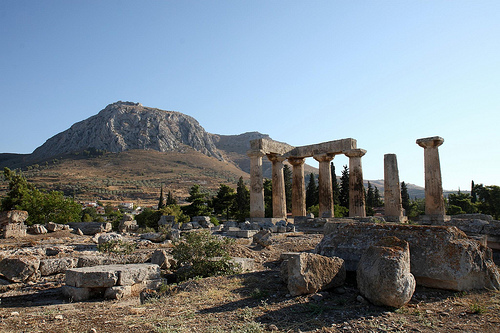
Location: 7 km (4 mi) South- west of modern Corinth Map
Tel. 27410 31207
Site/ Museum
Open: Apr- Oct: 8am- 7pm daily
Nov- Mar 8:30am- 3pm daily
Closed: Jan 1, 25 March, Good Friday,
Easter, 1 May, 25, 26 Dec
Corinth (Korinthos), in the Peloponnese region of Greece, stands
as one of the most historically significant cities in the ancient
world. Its strategic location on the narrow Isthmus of
Corinth—between the Gulf of Corinth (Ionian Sea) to the west and the
Saronic Gulf (Aegean Sea) to the east—made it a vital trade and
military hub for over 2,000 years. The city controlled two major
ports (Lechaion to the north and Kenchreai to the south) and
commanded the land route into the Peloponnese.
Today, Corinth’s
landmarks blend engineering feats, archaeological ruins spanning
Archaic Greek to Roman, Byzantine, Frankish, Venetian, and Ottoman
eras, and biblical ties (notably the Apostle Paul’s ministry around
50–52 AD). The primary sites are the Corinth Canal, the Ancient
Corinth archaeological site, and the Acrocorinth fortress. These can
easily be visited together in a day from Athens (about 1–1.5 hours
by car or bus).
1. Corinth Canal (Isthmus of Corinth)
The Corinth Canal is one
of Greece’s most iconic modern landmarks and an engineering marvel.
This 6.34 km (3.94 miles) artificial waterway slices straight
through the narrow isthmus at sea level, connecting the Gulf of
Corinth and the Saronic Gulf. It eliminates the need to sail around
the Peloponnese (a 400+ km detour).
History and construction:
Ancient leaders like Periander (7th century BC) and later Julius
Caesar envisioned it, but Nero began digging in 67 AD (using
thousands of slaves and prisoners). The project stalled until modern
Greece completed it between 1882 and 1893 using dynamite and manual
labor. It features sheer rock walls up to 90 meters (300 feet) high
in places and no locks—ships pass through via their own propulsion
or tugboats.
Significance and specs: At its narrowest, it
measures about 24.6 meters (81 feet) wide at the base and 8 meters
(26 feet) deep. Over 10,000 vessels (mostly tourist cruise ships,
yachts, and smaller cargo) traverse it annually. It’s more a
spectacle than a major commercial route today due to its dimensions
limiting large ships.
Visiting: Best views come from the bridges
(road and railway) or the observation platforms on either end. You
can also boat through it or bungee jump from the bridge for
adrenaline seekers. The canal’s dramatic cut through the limestone
cliffs is especially striking at sunset or from the air.
2.
Ancient Corinth (Archaia Korinthos) Archaeological Site
Just a
few kilometers southwest of modern Corinth lies the excavated heart
of the ancient city. This sprawling open-air museum (about 250,000
sq m of visible ruins) reveals layers from Neolithic times through
the Roman era. Corinth was one of Greece’s wealthiest and most
powerful city-states (population ~90,000 by 400 BC), known for
trade, pottery, bronze work, and a reputation for luxury and vice.
Romans destroyed it in 146 BC but Julius Caesar refounded it as a
colony in 44 BC.
Key highlights include:
Temple of Apollo
(c. 550 BC): The site’s most iconic and photogenic landmark. This
early Doric temple—one of the oldest and best-preserved Archaic
Greek temples on the mainland—originally had 38 monolithic limestone
columns (6 across the ends, 15 along the sides). Only 7 towering
columns (plus fragments of the stylobate and foundations) remain on
Temple Hill, but they dominate the skyline and offer stunning views
of the ruins and Acrocorinth behind them. Dedicated to Apollo (god
of light, music, and prophecy), it symbolized the city’s prosperity.
Peirene Fountain: One of ancient Greece’s most famous springs
and Corinth’s primary water source for centuries. Mythologically
linked to the nymph Peirene (who wept tears forming the spring after
Artemis accidentally killed her son) or Pegasus (who struck the rock
with his hoof, creating the fountain where Bellerophon tamed him).
The structure evolved from a simple 6th-century BC grotto with
underground tunnels into a grand Roman complex with marble-clad
chambers, reservoirs, and a triconch (three-niched) courtyard. Water
still flows from Acrocorinth’s upper spring. It’s exceptionally
well-preserved and was a social hub.
Bema (Bema of St. Paul): A
large raised stone platform in the center of the Roman Forum
(agora). This was the public rostrum where officials addressed
crowds or held trials. In ~52 AD, the Apostle Paul stood here before
proconsul Gallio after Jewish leaders accused him of illegal
teaching (Acts 18:12–17). Gallio dismissed the case, allowing Paul
to continue his ministry (he lived in Corinth ~18 months and wrote
letters to the Corinthians). The bema later became a Byzantine
church. It’s a powerful site for biblical history enthusiasts.
Other notable ruins: Lechaion Road (paved Roman street lined with
shops leading to the northern port); Glauke Fountain; South Stoa
(massive 4th-century BC portico); Temple E (possibly dedicated to
Octavia); theater and odeon; shops, baths, and a triumphal arch. The
site vividly shows the transition from Greek to Roman urban
planning.
Archaeological Museum of Ancient Corinth: On-site
museum (built 1932) displaying artifacts like statues, pottery,
mosaics, inscriptions, and coins from the excavations (ongoing since
1896 by the American School of Classical Studies). It contextualizes
the ruins beautifully.
The site is open daily (combined
ticket with Acrocorinth ~€15 as of recent data); allow 1–2 hours to
explore.
3. Acrocorinth (Akrokorinthos) Fortress
Rising
dramatically 575 meters (1,886 feet) directly above Ancient Corinth
is this monolithic rock acropolis—the “upper Corinth” and one of
Greece’s most impressive fortresses. It served as the city’s citadel
and a key defensive stronghold for millennia (“one of the Fetters of
Greece” alongside other Macedonian-held forts).
History and
fortifications: Occupied continuously from Archaic times to the
early 19th century. First fortified in the Mycenaean/Classical
period; expanded under Byzantines, Franks (after the Fourth
Crusade), Venetians, and Ottomans. The perimeter walls exceed 3 km,
with three successive lines of defense, gates, towers, a moat, and
internal structures. It controlled the isthmus and was besieged
multiple times.
What to see inside: Ruins of the Temple of
Aphrodite (5th–4th century BC, once famous for sacred prostitution
with up to 1,000 priestesses); Upper Peirene spring (Ano Peirene);
Byzantine churches and cisterns; Frankish/Venetian towers; Ottoman
mosques and houses; and panoramic 360° views of the Corinthian Gulf,
Saronic Gulf, mountains (Parnassus, Helicon), and the ancient city
below. The highest peak offers breathtaking vistas—especially at
sunrise/sunset.
Other nearby or minor landmarks include the
modern town’s neoclassical buildings (e.g., the 1908 Courthouse),
statues of Pegasus (symbol of Corinth), and smaller sites like the
Sanctuary of Hera or Diolkos (ancient ship-hauling track), but the
canal, Ancient Corinth, and Acrocorinth are the must-sees.
The Corinth Archaeological Site, also known as Ancient Corinth,
is located in the village of Archaia Korinthos in the Peloponnese
region of Greece, about 90 km (56 miles) west of Athens. It's one of
the most significant ancient sites in the country, featuring ruins
like the Temple of Apollo and remnants of a Roman forum. Below, I'll
outline the main ways to reach it, assuming a starting point from
Athens (the most common origin for visitors). If you're coming from
elsewhere, such as Patras (120 km east), adjust accordingly by
highway or public transport.
By Car
This is the most
flexible option. From Athens, take the E94/A8 highway (Olympia Odos)
west toward Corinth/Patras. The drive takes about 1 hour in light
traffic.
Exit at the sign for Archaia Korinthos (Ancient
Corinth). There's free parking near the site entrance.
Toll roads
apply (around €3-5 one way from Athens). Use a GPS app like Google
Maps or Waze for real-time directions.
If renting a car, major
companies like Hertz or Avis are available at Athens International
Airport (ATH) or downtown.
By Train
Take the suburban
train (Proastiakos) from Athens (Larissa Station or Athens Airport)
to Corinth Station (Kiato line). The journey is about 1 hour and
costs €8-12.
Trains run frequently (every 1-2 hours). Book via
the Hellenic Train website or app.
From Corinth Station (also
called New Corinth Station), you'll need a short transfer to the
site:
Taxi: 10-15 minutes, about €10.
Local bus: Line 1 or
similar from the station to Archaia Korinthos village (18 minutes,
€1-3). Buses are less frequent, so confirm via KTEL Corinthia.
By Bus
Intercity buses (KTEL) depart from Athens' Kifissos
Bus Station to Corinth Bus Station (Isthmus Station). The trip takes
1-1.5 hours and costs €8-10.
Buses run every 30-60 minutes. Check
schedules on the KTEL Corinthia website.
From Corinth Bus
Station, take a taxi (10-15 minutes, €10) or a local bus to the
site.
By Guided Tour or Private Transfer
For convenience,
join a day tour from Athens, which often includes transport, a
guide, and stops at nearby sites like the Corinth Canal or
Acrocorinth. Options via platforms like GetYourGuide or Viator start
at €50-100 per person, with pickup from central Athens hotels.
Private taxi or transfer services (e.g., via Uber or Welcome
Pickups) from Athens cost €100-150 one way for up to 4 people.
Additional Tips
From Athens Airport (ATH): Direct trains or
buses to Corinth are available, adding 20-30 minutes to the journey.
Site Details: Open daily 8 AM-8 PM in summer (shorter in winter);
entry €8 (free for EU students). Wear comfortable shoes for uneven
terrain.
Public Transport Apps: Use OASA (for Athens) or Rome2Rio
for multi-modal planning.
If driving from the north (e.g.,
Patras), take the E65 highway east and exit at Archaia Korinthos.
Key Attractions
1. Ancient Corinth Archaeological Site & Museum
The main draw features Roman-era ruins (with some Greek foundations) at
the base of Acrocorinth. Highlights include:
Temple of Apollo
(550 BC): Iconic with 7 surviving Doric columns.
Roman Agora/Forum,
Bema (platform where Paul was reportedly tried), Peirene Fountain,
shops, and other structures.
Archaeological Museum: Excellent
collection of mosaics, sculptures, pottery, and artifacts (including
recovered stolen items from a 1990 heist).
Visiting tips: Allow
1.5-2+ hours. Wear comfortable shoes and a hat; sites are exposed.
Signage is good, but an audio guide or guidebook enhances the
experience. Combine with the museum.
Hours & Fees (as of recent info;
confirm on-site or via Greek Ministry of Culture): Generally 8 AM–8 PM
(or later in peak summer) April–October; shorter in winter (closes ~3
PM, Tuesdays often closed). Ticket ~€15 (includes site + museum);
reduced for some categories; free on select days (e.g., first Sunday
Nov–Mar).
2. Acrocorinth (Akrokorinthos)
The ancient
acropolis/fortress crowns a steep hill (about 530-575m elevation) above
the site. Layers include Greek, Roman, Byzantine, Frankish, Venetian,
and Ottoman fortifications, churches, mosques, a Frankish tower, and
remnants of the Temple of Aphrodite. Panoramic views over the isthmus,
sea, and countryside are stunning.
Visiting tips: Steep, rocky
paths—wear sturdy shoes and bring water. Allow 1-2 hours (hike or short
drive up). Less crowded than the lower site; great for photos and
history. Free or low fee; open similar daylight hours.
3. Corinth
Canal
This dramatic 6.4 km engineering feat (completed 1893) cuts
through the isthmus, with sheer rock walls up to 80m high. Nero
attempted it in the 1st century AD. Watch ships pass (or bungee jump for
thrill-seekers). Views from bridges or edges are impressive.
Visiting
tips: Stop briefly en route; best from the road or lookout points.
Nearby submersible bridges and Isthmia area add context.
Other
Nearby Sites
Loutraki: Beach town with hot springs, casinos, and
resorts (good for relaxation).
Isthmia: Ancient sanctuary of Poseidon
and stadium for the Isthmian Games.
Beaches: Kalamia or others for
swimming.
Further afield (easy combine): Mycenae, Nafplio, or
Epidaurus.
Best Time to Visit
Spring (April–June) and fall
(September–October): Mild weather (comfortable for hiking ruins), fewer
crowds, lower prices. Summers are hot (can exceed 35°C/95°F) and busier.
Winters are cooler/wetter but quieter and good for dedicated history
fans. Avoid peak July–August heat/crowds if possible.
Practical
Tips
Duration: 4-6 hours for main sites as a day trip; 1-2 nights for
relaxed pace + beach/nearby exploration.
What to Bring: Sunscreen,
hat, water, sturdy shoes. Ruins involve uneven ground and sun exposure.
Accessibility: Sites are partially accessible but involve
hills/steps—check ahead.
Safety: Generally very safe for tourists.
Standard precautions (watch belongings in crowds).
Money & Language:
Euros; cards widely accepted. English common in tourist areas.
Food:
Fresh seafood, Greek tavernas (try local Corinthian raisins, olives,
wine). In Ancient Corinth: simple spots like taverna near the site.
Modern Corinth or Loutraki for waterfront dining. Avoid tourist traps
right at the canal.
Accommodations: Modern Corinth has limited
standout hotels—consider Loutraki resorts (e.g., with pools/beach) or
stays near Ancient Corinth for atmosphere. Book ahead in season.
The Corinth Archaeological Site, located in the northeastern
Peloponnese region of Greece, encompasses the ruins of Ancient
Corinth, a city that played a pivotal role in Greek, Roman, and
later histories due to its strategic position controlling the
Isthmus of Corinth. This narrow land bridge connected the
Peloponnese to mainland Greece, facilitating trade between the
Corinthian Gulf to the west and the Saronic Gulf to the east via
ports at Lechaion and Kenchreai. The site's history spans from
Neolithic times around 6500 BC to the modern era, marked by periods
of prosperity, destruction, and rebuilding. Key features include the
Temple of Apollo, the Acrocorinth acropolis, forums, theaters, and
fortifications, excavated primarily by the American School of
Classical Studies at Athens since 1896. The site reveals layers of
occupation, from prehistoric settlements to Byzantine and Ottoman
structures, highlighting Corinth's evolution as a commercial,
religious, and military hub.
Prehistoric and Mythical Origins
Evidence of human activity at Corinth dates back to the Neolithic
period around 6000–6500 BC, with pottery and settlements indicating
early habitation. During the Early Bronze Age (circa 3000–2000 BC),
the area served as a trade center, though population density
fluctuated, with sparse remains in the Middle Helladic phase. By the
Mycenaean period (circa 1600–1100 BC), coastal sites near Lechaion
facilitated trade across the Corinthian Gulf, but the main urban
center at Corinth proper emerged around 1000–900 BC with Dorian
settlers. Mythologically, the city was known as Ephyra, founded by
Corinthos (a descendant of Zeus) or the goddess Ephyra (daughter of
Oceanus). Legends attribute its kingship to Sisyphus, son of Aeolus,
who tricked gods like Zeus and was punished eternally in the
underworld. Other myths link Corinth to Jason and Medea, the Trojan
War under Agamemnon, and Bellerophon's capture of Pegasus at the
Peirene spring. The Acrocorinth, a monolithic rock rising 579
meters, served as the ancient acropolis and was mythically awarded
to Helios by Briareus in a dispute with Poseidon.
Archaic and
Classical Periods (8th–4th Centuries BC)
By the 8th century BC,
Corinth was ruled by the aristocratic Bacchiadae clan, unifying
scattered communities into a cohesive state with a population of at
least 5,000 by 730 BC. They established colonies like Corcyra
(Corfu) and Syracuse, fostering trade. In 657 BC, Cypselus overthrew
the Bacchiadae as tyrant (658–628 BC), building temples to Apollo
and Poseidon and expanding colonies to Italy, Sicily, and Egypt. His
son Periander (627–587 BC), one of the Seven Wise Men of Greece,
minted the first Corinthian coins ("colts"), attempted an Isthmus
canal (abandoning it for the Diolkos ship-hauling ramp), and peaked
Corinth's wealth through Mediterranean trade, black-figure pottery
exports, and the Isthmian Games honoring Poseidon (founded by
Sisyphus, with celery or pine wreaths as prizes). Tyranny ended in
581 BC with Periander's nephew's assassination, leading to
oligarchic rule and the Temple of Apollo's construction around
550–540 BC (Doric style, with seven standing columns today).
In
the classical era, Corinth allied with Sparta against Argos and
Athens, mediating disputes and developing the trireme warship. It
participated in the Persian Wars (480–479 BC), sending forces to
Thermopylae, Salamis, and Plataea. Rivalry with Athens escalated in
the Peloponnesian War (431–404 BC), sparked by conflicts over
Epidamnus and Corcyra; Corinth aided Syracuse against Athens in 415
BC. The Corinthian War (395–387 BC) saw Corinth ally against Sparta,
weakening the city. By the 4th century BC, it rejoined the
Peloponnesian League but fell under Macedonian influence after
Philip II's victory at Chaeronea in 338 BC, hosting the League of
Corinth.
Hellenistic Period (338–146 BC)
Under Macedonian
control (338–243 BC), Corinth was garrisoned by figures like Ptolemy
I and Demetrius Poliorcetes. In 243 BC, Aratus captured Acrocorinth
for the Achaean League, making Corinth its capital by 224 BC. The
city opposed Roman expansion, leading to the Battle of Corinth in
146 BC, where Roman consul Lucius Mummius sacked the city after its
defeat, burning structures, killing males, and enslaving women and
children. This marked the end of independent Greek Corinth, with the
site largely abandoned for a century as Roman ager publicus (public
land), though some rural habitation persisted.
Roman Period
(146 BC–AD 395)
Julius Caesar refounded Corinth in 44 BC as
Colonia Laus Iulia Corinthiensis, imposing a Roman grid plan over
Greek ruins, with a forum, basilicas, temples, and an amphitheater.
It became Achaia's capital, with a diverse population of 50,000 by
the 1st century AD. Apostle Paul visited in AD 49–50, staying 18
months, founding the church, and writing epistles (First and Second
Corinthians) amid trials under proconsul Gallio. Nero initiated a
canal in AD 67 (unfinished), and Vespasian refounded it as Colonia
Iulia Flavia Augusta Corinthiensis post-earthquake in the 70s AD.
Patrons like Herodes Atticus funded buildings in the 2nd century AD.
Earthquakes in AD 365 and 375 caused damage, followed by Alaric's
Visigothic sack in AD 395.
Byzantine, Frankish, Venetian, and
Ottoman Periods (AD 395–1832)
Rebuilt smaller under Justinian I
(AD 527–565), Corinth included the Hexamilion wall across the
Isthmus and churches. An earthquake in AD 521 and plague in AD 542
devastated it; it became the theme of Hellas' capital around AD 800,
recovering with a silk industry in the 9th–12th centuries. Sacked by
Normans in 1147, it fell to Franks after the Fourth Crusade in 1210,
becoming part of the Principality of Achaea. Byzantines recaptured
it in 1403, restoring the Hexamilion in 1415, but Ottomans conquered
in 1458, renaming it Gördüs. Venetians held it 1687–1715 during the
Morean War. Earthquakes in 1858, 1928, and 1930 damaged the area,
leading to modern Corinth's relocation 3 km northeast.
Modern
Period and Archaeological Excavations
Liberated in 1832 during
the Greek War of Independence, Corinth was briefly considered for
Greece's capital. The Corinth Canal was completed in 1893.
Excavations began in 1892 by the Greek Archaeological Society, but
systematic work started in 1896 by the American School of Classical
Studies, uncovering Neolithic to Ottoman layers. Key digs include
the Sanctuary of Demeter and Kore, Asklepieion, forums, and the
Archaeological Museum (built 1932, expanded 1951) housing artifacts
like sculptures and inscriptions. The site today includes the Temple
of Apollo, theater (capacity 15,000–18,000), agora, Roman forum,
baths, Peirene Fountain, city walls (5th century BC with long walls
added in 4th century), and Acrocorinth's fortifications
(Byzantine-era walls 3 km long).