Tel. 22650 82312
Site Open:
Open: Apr- Oct 8am- 7:30pm daily
Nov- Mar 8:30am- 3pm
Museum:
Apr- Oct 7:30am- 6:45pm
Nov- Mar
8:30- 3pm
Delphi, Greece, is one of the most profound archaeological sites
in the ancient world—a Pan-Hellenic sanctuary dedicated
primarily to the god Apollo, revered as the omphalos (navel or
center) of the Earth. Perched on the southwestern slopes of
Mount Parnassus in Phocis, Central Greece, it lies between the
dramatic Phaidriades (Shining Rocks) cliffs, offering sweeping
views over the Pleistos River valley, olive groves, and the Gulf
of Corinth. Inscribed as a UNESCO World Heritage Site in 1987,
Delphi embodies a unique harmony between monumental architecture
and its sacred natural landscape.
The site’s influence peaked
in the 6th century BCE as the religious, political, and cultural
heart of ancient Greece. Pilgrims, city-states, kings, and
athletes from across the Mediterranean sought the Oracle of
Delphi’s prophecies, consulted on matters from personal fate to
wars and colonization. Mythologically, Zeus released two eagles
from opposite ends of the world; they met above Delphi, marking
it as the cosmic center. The sanctuary hosted the Pythian Games
(second only to the Olympics) every four years, featuring
athletic, musical, and poetic contests in honor of Apollo.
Habitation dates to Mycenaean times (c. 1500–1100 BCE), with the
oracle emerging around the 8th century BCE. Multiple rebuilds
occurred due to earthquakes, fires, and landslides; the visible
ruins largely date to the 4th century BCE or earlier.
Excavations began in the 19th century, revealing a layered
history of chthonic (earth-based) cults evolving into Olympian
worship.
Visitors today explore two main sanctuaries—the
larger Sanctuary of Apollo and the smaller Sanctuary of Athena
Pronaia—along with supporting structures, all integrated into
the mountainside. The experience begins near the modern
entrance, with the Castalian Spring just east of the main site.
Castalian Spring
This sacred spring, nestled in the ravine between
the Phaidriades Rocks, was the first stop for all pilgrims. Its waters
purified visitors, athletes in the Pythian Games, and especially the
Pythia (the oracle priestess) and priests before rituals. Myth links it
to Apollo slaying the serpent Python, who guarded an earlier earth
oracle. Two fountain structures survive: an Archaic (6th-century BCE)
marble-lined basin with benches and lion-head spouts, and a later Roman
(1st-century BCE) version higher up with seven bronze spouts, a paved
courtyard, and rock-cut niches for votive offerings (one later converted
to a Christian shrine). The spring still flows, underscoring its
enduring sanctity.
Sanctuary of Apollo: The Sacred Way and
Treasuries
The main sanctuary is entered via the Sacred Way, a
winding processional path lined with treasuries, monuments, and statues
donated by Greek city-states. These small temple-like buildings stored
lavish votive offerings (gold, silver, sculptures) as thanks to Apollo.
The most iconic and best-preserved is the Treasury of the Athenians (c.
490 BCE, rebuilt in modern times). Built in pure Doric style from Parian
marble after the Battle of Marathon, it housed Athenian dedications and
symbolized the city’s power and piety. Its metopes depict heroic myths
(Theseus, Heracles). Other treasuries (e.g., Siphnian, with elaborate
Ionic friezes now in the museum) lined the path, turning the ascent into
a display of wealth and rivalry.
Supporting the temple terrace is the
remarkable Polygonal Wall (6th century BCE), a massive retaining
structure of irregularly fitted limestone blocks inscribed with
thousands of manumission records (freeing of slaves), highlighting
Delphi’s role in social and legal matters.
Temple of Apollo
At
the heart of the sanctuary stands the Temple of Apollo, the spiritual
and architectural focal point. Several temples occupied this spot; the
visible ruins are from the 4th-century BCE Doric peripteral structure (6
columns wide by 15 deep), rebuilt after an earthquake around 373 BCE by
architects like Spintharus of Corinth. It measured about 60m x 23m, with
a stylobate on three steps, a ramped entrance, and an inner cella
(chamber) leading to the restricted adyton—the oracle’s inner sanctum
where the Pythia sat on a tripod, inhaling vapors (possibly from a
geological fissure) to enter a trance and deliver prophecies (often in
ambiguous verse, interpreted by priests).
The temple housed the
Omphalos stone (a carved navel marking the world’s center; an ancient
copy is in the museum). It was the site of major rituals, sacrifices at
the adjacent altar, and the transition from earlier Gaia/Python cults to
Apollo’s dominion. Today, only the platform, foundations, and a few
re-erected columns remain, but the setting against the mountains is
awe-inspiring.
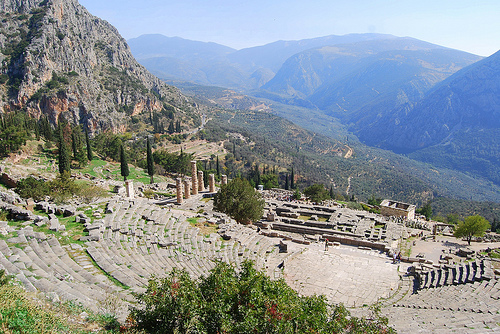
Above the temple sits the Ancient Theatre of Delphi
(4th century BCE, with later Hellenistic and Roman modifications).
Carved into the hillside, it seats about 5,000 in a horseshoe-shaped
cavea (seating area) divided by a diazoma walkway into lower (theatron,
27–28 rows in 7 wedges) and upper sections. The circular orchestra
(performance area) hosted musical and dramatic contests during the
Pythian Games, with exceptional acoustics and panoramic views.
Higher
still is the Stadium (c. 5th–4th century BCE, later enlarged), where
athletic events (races, wrestling, chariot races) took place before up
to 6,500–7,000 spectators. It features a starting line with grooves for
runners and was central to the games’ pan-Hellenic prestige.
Sanctuary of Athena Pronaia
About 1 km east (the first sight for
pilgrims approaching from the east), this smaller sanctuary honors
Athena as “guardian before the temple” (Pronaia). It includes remains of
three temples to Athena and, most famously, the Tholos (c. 380–360 BCE).
This circular masterpiece—possibly designed by Theodorus of
Phocis—features 20 outer Doric columns around a platform, with 10 inner
Corinthian columns supporting a conical roof. Its metopes depicted
Amazonomachy and Centauromachy scenes (fragments in the museum). The
function remains debated (hero shrine, treasury, or symbolic structure),
but its elegant proportions and innovative design make it one of
Delphi’s most photographed and symbolic monuments.
Archaeological
Museum of Delphi
No visit is complete without the adjacent museum,
which houses thousands of artifacts excavated from the site. Highlights
include:
The Charioteer of Delphi (c. 478–470 BCE): A life-sized
bronze masterpiece in Severe style, depicting a victorious charioteer
from a dedication by the tyrant Polyzalos of Gela. Its inlaid eyes,
copper lips, and serene expression capture human dignity and motion.
The Sphinx of Naxos (c. 560 BCE): A towering marble guardian once atop a
tall column.
Kleobis and Biton (or the Argive Twins, c. 580 BCE):
Monumental Archaic kouroi statues.
Friezes from the Siphnian and
Athenian Treasuries (mythological battles).
The Omphalos stone,
chryselephantine (gold-and-ivory) statues, tripods, and inscriptions
(including hymns to Apollo with musical notation).
Best Time to Visit
Shoulder seasons (April–early June and
September–October): Ideal. Mild weather (pleasant for walking uphill),
wildflowers in spring, fewer crowds than peak summer, and golden autumn
light. These periods balance comfort and accessibility.
Summer
(June–August): Hot, sunny, and busy with tour groups. Visit early
morning or late afternoon to avoid heat and crowds. Long daylight hours
are a plus, but little shade on-site.
Winter (November–March):
Quieter and cooler (possible snow at higher elevations), good for
mountain vibes or nearby skiing in Parnassus. Shorter hours and
potential closures on holidays.
Tip: Avoid major Greek holidays
(e.g., Easter, Christmas, May 1) when the site may close or have reduced
hours.
Getting There
Delphi lies about 180–185 km northwest of
Athens (2.5–3 hours).
By car (most flexible, especially for
overnights): Easy drive via E75 highway. Scenic once you leave the main
road; allow extra time for stops like Hosios Loukas Monastery. Tolls
apply; mountain roads near Delphi are narrower.
By bus (KTEL):
Affordable (~€16–17 one-way, ~3 hours) from Athens Liosion Station
(Terminal B). 4–5 daily services; book ahead in peak season. Drop-off
near the village/site.
Guided day tour from Athens: Popular and
hassle-free (~€45–80 including transport/guide). Good for first-timers
but limits time on-site.
Other: Private transfer or combine with
nearby spots like Arachova (10 km away, charming mountain town).
Pro tip: Rent a car if staying overnight for flexibility (e.g., visiting
the Tholos or hiking).
Opening Hours and Tickets (as of 2026)
Site & Museum: Combined ticket covers both.
Summer (April 1–Oct 31):
Generally 8:00–20:00 (last entry ~19:30–19:40); hours shorten gradually
in Sept/Oct.
Winter (Nov 1–March 31): 8:30–15:30 (last entry
earlier).
Prices: ~€20 full (summer combined); reduced €10 or €6
in winter. Free for EU students/under-25s, certain days (e.g., first
Sunday Nov–March, March 6, etc.). Buy online in advance via official
Hellenic Ministry site or GetYourGuide to skip queues.
Closed on
major holidays; check official sources (e.g., odysseus.culture.gr) for
updates.
Allocate 3–4 hours minimum: 1.5–2.5 hours for the site,
1–1.5 for the museum.
Visiting the Archaeological Site
Enter
and follow the Sacred Way uphill (steep, uneven paths—wear sturdy
shoes).
Highlights:
Treasuries (e.g., well-preserved Athenian
Treasury).
Temple of Apollo (core of the sanctuary; ruins from 4th c.
BC).
Ancient Theatre (4th c. BC, great views).
Stadium (at the
top; seated ~6,500 for Pythian Games).
Castalian Spring (sacred water
source).
Sanctuary of Athena Pronaia (Tholos ~800m east—short drive
or walk; often quieter).
Tips:
Go early (at opening) or late
afternoon to beat tour buses (they peak ~11:00–14:00).
Little
shade—bring hat, sunscreen, water (fountain at entrance). Refill
bottles.
No toilets inside the main site—use facilities at the museum
or entrance.
Informative signs; audio guides or a live guide enhance
the experience (myths, history, Oracle context).
Delphi
Archaeological Museum
Located next to the site—don't skip it.
Excellent collection of artifacts in context.
Must-sees:
Bronze
Charioteer of Delphi (masterpiece, ~470 BC).
Sphinx of Naxos.
Kouroi statues (Kleobis and Biton).
Friezes, Omphalos stone,
gold/ivory items.
Tip: Visit after the site (or during hottest part
of day). Air-conditioned, great for deeper understanding with
models/reconstructions.
Where to Stay and Eat
Stay in Delphi
village for convenience (walk to site) or Arachova for charm/mountain
feel. Aim for Gulf of Corinth views. Options: Pan Hotel or Fedriades
(affordable, good breakfasts).
Eat: Traditional tavernas with views.
Try Taverna Vakhos (reservations recommended; great vegetarian options,
baklava). Local specialties: grilled meats, fresh salads, beans.
Overnight recommendation: Spend 1–2 nights to explore relaxed, catch
sunset/sunrise, and avoid day-trip rush. Perfect base for hikes (e.g.,
Corycian Cave).
Practical Tips
What to wear/bring: Comfortable
walking shoes (uphill terrain), sun protection, layers (mountain weather
changes), reusable water bottle. Modest clothing for any monastery
stops.
Accessibility: Some paths are steep/uneven; limited for
mobility issues (check for ramps/lifts at museum).
Crowd avoidance:
Early/late visits or shoulder seasons. Late afternoon can be magical
with softer light.
Nearby: Arachova (shopping, food), Hosios Loukas
Monastery, olive groves, hiking on Parnassus.
Photography: Best light
early morning or late day; panoramic views from theatre/stadium.
Health/Safety: Stay hydrated; watch for slippery stones when wet.
Standard tourist precautions.
Mythological Origins
Greek mythology ties Delphi’s sanctity to
deep prehistoric roots. Legend holds that Zeus released two eagles from
opposite ends of the Earth; they met above Delphi, confirming it as the
world’s center. The site was originally an oracle of Gaia (Earth
goddess), guarded by the serpent-dragon Python (sent by Hera to thwart
Apollo’s mother Leto). Apollo, god of light, music, prophecy, and order,
slew Python with his arrows, claimed the shrine, and atoned for the
killing by serving eight years in exile. He then returned in the form of
a dolphin (delphis), guiding Cretan priests to the site via the port of
Kirrha (modern Itea). This dolphin legend gave Delphi its name. The
oracle passed from Gaia/Themis to Apollo, symbolizing the shift from
chthonic (earth-bound) to Olympian (celestial) cults. The omphalos
stone, housed in the Temple of Apollo, marked the spot; a goatherd
reportedly discovered the prophetic vapors rising from a chasm.
These
myths (recounted in the 7th-century BC Homeric Hymn to Apollo and later
by Aeschylus and Euripides) were ritually reenacted in festivals like
the Septeria and Pythian Games.
Prehistoric and Early Settlement
(Neolithic to 8th Century BC)
Archaeological evidence shows human
activity from the Neolithic period (~7000 BCE onward), with significant
Mycenaean occupation (1600–1100 BC). A small settlement existed on the
slopes, with traces of early worship possibly linked to Gaia (female
figurines and ritual vessels). The site likely began as a modest
sanctuary to Earth deities near natural gas-emitting fissures.
Apollo’s cult was established peacefully between the 11th–9th centuries
BC during the Greek “Dark Ages,” supplanting earlier Gaia worship. By
~860–800 BC, Delphi emerged as a recognized cult center. Dedications
(pottery, bronze tripods) surged in the late 8th century BC, coinciding
with the oracle’s growing fame. Cretan priests (per myth) administered
it under Phocian control from nearby Kirrha. The first attested
structures appeared in the 7th century BC, including an early temple
attributed (in legend) to architects Trophonios and Agamedes.
Archaic Rise and Golden Age (8th–5th Centuries BC)
Delphi’s
transformation into a Pan-Hellenic sanctuary accelerated in the Archaic
period. The Oracle—embodied by the Pythia, a local woman over 50 who
entered a trance on a tripod in the temple’s adyton (inner sanctum),
possibly inhaling ethylene vapors from fissures—gained unparalleled
prestige. Priests interpreted her utterances as Apollo’s will.
The
First Sacred War (~595–585 BC) proved pivotal: the Amphictyonic League
(a religious-political alliance of central Greek tribes) destroyed
Kirrha for taxing pilgrims, freeing access and consolidating control
over the sanctuary. The Pythian Games were reorganized in 582 BC
(initially every 8–9 years, later every 4), second only to the Olympics.
These featured musical contests (lyre, flute, singing), later athletic
events, chariot races, and even painting/dance—winners received laurel
wreaths.
City-states built lavish treasuries along the Sacred Way to
house votive offerings (tripods, statues, war spoils). Famous examples
include the Athenian Treasury (post-Marathon, ~490 BC), Siphnian, and
others from Sicyon, Thebes, and Massalia. The Temple of Apollo was
rebuilt multiple times (e.g., after a 548 BC fire, funded by the exiled
Alcmaeonids of Athens). Delphi advised on colonization (hundreds of
Greek cities sought its guidance) and state affairs, amassing wealth and
influence.
Classical Peak and Sacred Wars (5th–4th Centuries BC)
Delphi reached its zenith between the 6th and 4th centuries BC as the
“religious center and symbol of unity of the ancient Greek world.”
Rulers like Croesus of Lydia and leaders from Athens, Sparta, and beyond
consulted the Oracle before wars, treaties, or major decisions. It
influenced the Persian Wars (e.g., advice to Athens in 480 BC) and
Peloponnesian conflicts.
Further Sacred Wars erupted: the Second
(449–448 BC) saw Phocians briefly control the site amid broader Greek
rivalries; the Third (356–346 BC) involved Phocian plundering, ended by
Philip II of Macedon’s intervention, shifting power dynamics. Despite
earthquakes (e.g., 373 BC damaging the temple), monuments flourished:
the 4th-century BC Doric Temple of Apollo (the visible ruins today),
Theater (seating ~4,500), Stadium, and the Tholos at the nearby
Sanctuary of Athena Pronaia. The Castalian Spring provided sacred water.
Hellenistic, Roman, and Late Antiquity (4th Century BC–4th Century
AD)
Macedonian, then Aetolian and Roman influence followed. Gauls
attacked in 279 BC but were repelled (with alleged divine intervention
via earthquake and panic). Rome captured Delphi in 191 BC; it was sacked
by Sulla (86 BC) and Nero (66 AD, who also performed in the Games). Yet
the Oracle and Pythian Games persisted under emperors like Hadrian, who
granted privileges. By the 4th century AD, Delphi was formally a city.
Christianity’s rise doomed the pagan site. Emperor Theodosius I banned
pagan practices (~391–394 AD), closing temples and ending the Games
(last attested ~424 AD). The Oracle’s final recorded prophecy lamented
Apollo’s departure. The site gradually declined, suffering landslides
and neglect.
Rediscovery and Modern Era
By Byzantine and
Ottoman times, a village (Kastri) overlaid the buried ruins. Systematic
excavations began in 1892 by the French School at Athens (“Grande
Fouille,” 1892–1900s), revealing the sanctuary’s layout after removing
the village. Earlier probes occurred in the 1880s. The site has yielded
thousands of artifacts now in the Delphi Archaeological Museum.
Today, Delphi remains a UNESCO World Heritage Site under criteria
emphasizing its artistic mastery, historical influence, testimony to
Greek religion/civilization, architectural ensemble, and association
with the omphalos belief. It draws millions of visitors annually, its
ruins evoking the profound spiritual and political role it played for
over 1,000 years.
Location and Regional Context
Delphi lies in the regional unit of
Phocis (Fokida) in Central Greece (Sterea Ellada), on the southwestern
slopes of Mount Parnassus. Precise coordinates for the ancient sacred
precinct are approximately 38°28′56″N 22°30′05″E, while the modern town
of Delphi (adjacent to the site) sits at roughly 38°28′47″N 22°29′38″E.
The site is about 180 km (112 miles) northwest of Athens and roughly 10
km (6 miles) inland from the Gulf of Corinth (ancient Krisaean Gulf or
Gulf of Itea). It occupies terraces on a steep rocky hill at an
elevation of around 500–650 meters (1,600–2,130 ft) above the valley
floor, with the modern settlement at approximately 550–630 m
(1,800–2,070 ft).
The broader area forms part of Parnassos National
Park (established 1938), a protected landscape extending across Phocis
and neighboring Boeotia, with strict building prohibitions on the slopes
and olive groves to preserve the historic setting.
Topography and
Key Landforms
Delphi sits on the steep lower slopes of Mount
Parnassus, a limestone spur of the Pindus Mountains rising to 2,457 m
(8,061 ft). The sacred precinct nestles dramatically between two
towering limestone cliffs called the Phaidriades (or Phaedriades,
"Shining Rocks"), which frame the site like natural sentinels.
A
sheer scarp drops about 500 m (1,600 ft) from the site to the valley
floor below. The ancient sanctuary was built on artificial terraces
supported by massive retaining walls (including the famous polygonal
wall), allowing structures to cling to the mountainside. The Sacred Way
winds uphill through the precinct, with higher features like the theater
and stadium positioned even further up the slope against the mountain.
To the south lies the Pleistos River Valley (also called the Krisaean
plain or Delphic landscape), a relatively recent tectonic rift valley
that serves as a natural east-west corridor. The Pleistos River flows
westward through this valley—passing south of Delphi—between Mount
Parnassus (to the north) and the mountains of the Desfina
Peninsula/Kirphis (to the south). It eventually empties into the Gulf of
Itea near the ancient port of Kirra (modern Itea area).
This valley
is renowned for its vast, high-quality olive groves (the Amfissa olive
grove, one of the largest continuous groves in Greece, covering
thousands of hectares with millions of Conservolia/Amfissa olive trees).
The silver-green sea of olives creates a striking contrast with the
rocky slopes above and the blue gulf beyond.
The road accessing
Delphi follows the northern slope of the Pleistos pass, providing an
easy historic route across central Greece. A spur of Parnassus narrows
the valley nearby, where ancient Krisa once stood.
Geology and
Environmental Features
Geologically, Delphi lies in a tectonically
active zone on the periphery of the major Corinth Rift fault system. The
area experiences frequent earthquakes, landslides, soil erosion, and
sedimentation—challenges noted since antiquity. The bedrock consists
primarily of Jurassic-Cretaceous limestones from the Parnassus Massif. A
famous cleft in the rocks (associated with the oracle) once emitted
vapors, possibly from hydrocarbon sources.
The Castalian Spring
emerges in a ravine between the Phaidriades rocks, feeding two ancient
monumental fountains (Archaic and Roman). This sacred water source added
to the site's mystical character.
Vegetation and Landscape
Character
The valley floor is dominated by productive olive groves,
among Greece's finest. Higher slopes and mountains feature pine trees,
plane trees, cypresses, and other forest species, transitioning to firs
and alpine meadows at greater elevations. The combination of rocky
cliffs, terraced ruins, olive sea, and distant sea views creates an
exceptionally scenic and "romantic" landscape that has inspired visitors
for millennia.
Climate
Delphi has a Mediterranean climate
(Köppen Csa) modified by its elevation and mountain setting: hot, dry
summers (July highs around 29°C/85°F) and cooler, wetter winters (with
possible snow on Parnassus). Annual precipitation is moderate (~660 mm /
26 inches), with wettest months in autumn/winter. The mountain influence
brings more rainfall and cooler temperatures than coastal lowlands, and
the oracle's consultations were traditionally suspended in winter due to
colder conditions.
Strategic and Visual Impact
The geography
made Delphi naturally fortified and strategically positioned along
ancient routes. The dramatic setting—cliffs above, fertile valley below,
and Gulf of Corinth in the distance—enhanced its spiritual aura and made
it a visually unforgettable "center of the world."