Location: island of Rhodes, Dodecanese Map
Tel: (22440) 31258 (info)
Tel: (22440) 31258 (info)
Open: Sep-May: Tue-Sun 8:30am - 2:40pm
Jun-Aug: daily 8:30am - 6pm
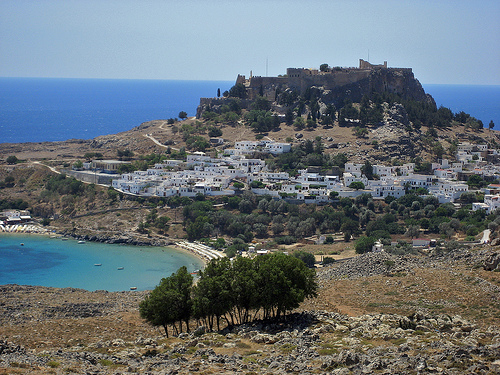
The Lindos Archaeological Site, located on the island of Rhodes
in Greece, is one of the most impressive ancient citadels in the
Aegean region. Perched on a dramatic 116-meter-high rocky cliff
overlooking the sea, it combines natural fortification with layers
of historical architecture spanning from the Bronze Age to the
medieval period. The site is dominated by the Acropolis of Lindos,
which served as a religious sanctuary, defensive stronghold, and
trading hub. Today, it attracts visitors for its stunning panoramic
views of the surrounding harbors, coastline, and the charming
whitewashed village below, blending archaeological wonders with
scenic beauty.
The acropolis offers a glimpse into millennia of
human activity, reflecting influences from the Dorians, Greeks,
Romans, Byzantines, Knights of St. John, and Ottomans. Its strategic
eastern position on Rhodes made it a vital crossroads for
Mediterranean trade and culture.
The Lindos Archaeological Site, centered on the Acropolis of Lindos
on the eastern coast of Rhodes (Dodecanese islands, Greece), ranks among
Greece’s most spectacular and historically layered ancient sites. It
crowns a sheer 116-meter (381-foot) natural rocky cliff that dominates
the picturesque whitewashed village of Lindos below and offers panoramic
views over the Aegean Sea, including St. Paul’s Bay. The acropolis spans
roughly 8,400 square meters and functioned as both a major Pan-Hellenic
sanctuary to the goddess Athena Lindia and a strategic fortress across
millennia.
Human activity here dates back to the Neolithic and Bronze
Ages, but the sanctuary proper emerged in the Geometric period (9th
century BCE). Lindos, one of Rhodes’ three original Dorian city-states
(founded ~10th century BCE), grew into a prosperous trading hub. The
tyrant Kleoboulos (one of the Seven Sages of Greece) revived and
monumentalized the cult in the 6th century BCE. After a major fire in
342 BCE, the site underwent grand Hellenistic rebuilding in the late
4th–3rd centuries BCE. It later served as a Byzantine stronghold, a
Knights Hospitaller (Knights of St. John) fortress from the early 14th
century, and an Ottoman garrison until the 19th century. Danish
excavations (1902–1914) and later Italian and Greek restorations
revealed its multi-period treasures.
The site blends ancient Greek,
Hellenistic, Roman, Byzantine, and medieval Crusader architecture, all
unified by its dramatic clifftop setting. Below is a detailed breakdown
of its primary landmarks, encountered roughly in the order visitors
approach them (via a steep path or donkey ride from the village).
1. Rock-Carved Trireme (Warship) Relief
At the base of the grand
staircase leading up the acropolis, a large rock-cut relief depicts the
stern of a Rhodian triemiolia (a fast three-banked warship) with its
aphlaston (curved stern ornament), captain’s seat shaped like a bird’s
wing, and traces of original red pigment. Carved around 180 BCE by the
sculptor Pythokritos son of Timocharis, it served as a votive monument
honoring naval victories, with a bronze statue of the honoree
(Hagesandros son of Mikion) once mounted on a base in front. A small
naiskos (shrine) with a female figure stands behind it. This relief
vividly illustrates Rhodes’ maritime supremacy in the Hellenistic era
and acts as a dramatic “welcome” to the sanctuary.
2. Propylaea
(Sanctuary Gateways) and Monumental Staircase
Dating to the 4th
century BCE (post-fire reconstruction), the Propylaea form the
ceremonial entrance to the upper sanctuary. A wide, monumental staircase
ascends to a wall pierced by five door openings, fronted by a D-shaped
stoa (covered colonnade). These gateways, built in the Doric order,
created a theatrical processional approach, channeling pilgrims upward
toward the temple. They exemplify late Classical/Hellenistic sacred
architecture and were part of the major reorganization that gave the
acropolis its terraced, stage-like appearance.
3. Hellenistic
Stoa (Colonnaded Walkway)
Constructed around the late 3rd century BCE
(with terrace extensions in the 1st century BCE), this enormous
pi-shaped (Π) Doric stoa stretches approximately 87–89 meters long and
originally featured 42 columns. Its two symmetrical roofed wings flank
the central staircase, creating shaded walkways and a grand forecourt.
Beneath the terrace lie 14 vaults and two complexes of cisterns (total
capacity ~300 cubic meters) for collecting rainwater. Partially restored
(columns and entablature re-erected in the 1930s–1940s and later
refined), it served as a public, multifunctional space for gatherings,
offerings, and shelter while enhancing the site’s monumental scale. It
represents a hallmark of Hellenistic public architecture and influenced
later designs across the Mediterranean.
4. Temple of Athena
Lindia
The crowning glory and spiritual heart of the acropolis sits
at the highest point. Originally built in the mid-6th century BCE under
Kleoboulos (likely on an even earlier site possibly linked to a cave
cult), the temple was destroyed by fire in 342 BCE and rebuilt around
300 BCE as a small Doric amphiprostyle temple (roughly 7.75 × 21.65
meters or ~22 × 8 meters overall). It featured a pronaos (front porch),
cella (inner chamber with a low parapet, offerings table, and base for
the cult statue of Athena), and opisthodomos (rear chamber). Constructed
of local poros sandstone originally stuccoed white, only portions of the
west and east walls, crepis (stepped platform), and column bases survive
in situ, with significant modern restoration of the colonnades.
This
was a major Pan-Hellenic shrine attracting votive offerings from across
the Mediterranean (documented in the famous Lindian Chronicle, a 99 BCE
inscription listing mythical and historical dedications, including from
figures like Danaus and Alexander the Great). Athena Lindia embodied
both warrior and protector aspects. The temple’s continuity of
worship—from possible pre-Hellenic roots through Greek, Roman, and later
periods—makes it uniquely significant.
5. Byzantine Church of
Saint John (Ayios Ioannis)
Built in the 12th–13th century CE
(possibly over a 6th-century basilica), this Greek Orthodox church
stands near the temple precinct. It follows a cross-in-square plan with
three aisles divided by pillars, three eastern apses (central one
projecting), and a narthex. Under the Knights it served as part of the
headquarters complex; the Ottomans later converted it to a mosque
(mihrab traces remain). Excavations dismantled some elements to recover
inscriptions. It testifies to the Christianization of the ancient
sanctuary and the site’s enduring religious role.
6. Medieval
Fortress and Fortifications (Knights of St. John Castle)
Overlaying
ancient Greek and Byzantine walls, the massive medieval castle dates
primarily to the early 14th century (constructed shortly before 1317
under the Knights Hospitaller) and was reinforced through the 15th
century. It includes imposing stone walls, towers (notably at the
southwest corner), machicolations, and bastions added under Grand
Masters like Pierre d’Aubusson. The Knights built their headquarters
adjacent to the church. Earlier Hellenistic fortifications (rectangular
towers) and Ottoman additions are also visible. The natural cliff
provided formidable defense, making Lindos one of Rhodes’ strongest
strongholds. The ruins blend seamlessly with the ancient sanctuary,
creating the iconic clifftop silhouette seen today.
Additional
Notable Features
Ancient Theatre: Carved into the western slope below
the acropolis (4th century BCE), this rock-hewn theatre seated
1,800–2,000 spectators. It featured a circular orchestra, stage
building, and cavea divided into cunei (wedge-shaped sections). It
hosted Dionysian festivals, dramas, music, and athletic events
(including the Sminthia).
Other elements: Include a Roman-era Ionic
Stoa of Psithyros (2nd century CE, oracular shrine), a votive
semicircular exedra (~180 BCE), rock inscriptions at the nearby
Boukopion sacrificial site, possible traces of a Roman temple to Emperor
Diocletian, and extensive cisterns/water systems.
The entire
acropolis offers not just individual monuments but a living palimpsest
of Greek religious life, naval power, medieval warfare, and cultural
continuity. Its breathtaking setting—ancient columns against the sea and
sky—makes it one of Rhodes’ (and Greece’s) most visited and photogenic
archaeological treasures.
Getting to Lindos Village from Rhodes International Airport (RHO)
The airport is about 55 km north of Lindos. Here are the main options:
Public Bus: There's no direct service. First, take a bus from the
airport to Rhodes Town's central bus station (about 30-40 minutes,
€2.50). Then transfer to a KTEL Rodou bus to Lindos (1 hour 45 minutes,
€5-8, with departures roughly every 1-2 hours depending on the season).
Total journey: around 3 hours, cost €7-11.
Taxi: Direct ride takes
50-60 minutes and costs €75-81 during daytime (higher at night or with
surcharges). Taxis are available 24/7 outside arrivals.
Shuttle or
Shared Transfer: Affordable options like shared shuttles cost around €10
and take 2 hours; speedy shuttles are about €18 for 1 hour 50 minutes.
Book in advance via services like HolidayTaxis or Airparks.
Rental
Car: Rent at the airport and drive south via the E95 coastal road
(well-maintained, 50-60 minutes). Major companies like Hertz or Avis are
available; expect €30-50/day plus fuel. Parking is available in lots
outside Lindos village.
Private Transfer or Tour: Pre-booked private
minivans or coaches cost €80-100+ for groups and take 55 minutes.
Getting to Lindos Village from Rhodes Town
Public Bus: KTEL Rodou
buses run from the central station (near Mandraki Harbor) to Lindos,
taking 1 hour 45 minutes with 1-2 stops. Fare: €5-8 one way (€11
return). Schedules vary by season—check KTEL's website or app for
real-time info.
Taxi: 50-60 minutes, costing around €70 one way (more
for return or peak times).
Rental Car or Driving: Follow the E95
south (47-50 km, 50 minutes). Scenic route with good roads.
Organized
Day Trip: Many tours from Rhodes Town include bus transport, guided
visits, and return (e.g., via GetYourGuide, €20-40/person including
entry).
Boat: In summer, excursion boats depart from Mandraki Harbor
to Lindos Bay (1-1.5 hours, €20-30), offering sea views but
weather-dependent.
Getting to the Archaeological Site from Lindos
Village
Lindos village is compact and partly pedestrian-only, so
vehicles can't reach the site entrance. Park in public lots on the
outskirts (free or low-cost), then:
Walk 5-10 minutes from the
main square through narrow alleys to the base of the acropolis.
Climb
approximately 300 uneven stone steps (varying heights, some without
railings, with steep drops in places). The ascent takes 15-20 minutes
and can be challenging in heat—wear sturdy shoes and bring water.
Donkey rides are offered from the village center to the top (15 minutes,
€5-10), but they're often discouraged due to animal welfare concerns.
Additional Tips
Entrance Fees (as of 2025): €20 for adults over
25; free for minors under 25 and certain groups (e.g., EU students with
ID). Reduced rates may apply for seniors or disabled visitors—check the
official Hellenic Heritage site. Buy timed-entry tickets online in
advance via hhticket.gr to skip lines, especially in peak season
(summer).
Best Time: Visit early morning or late afternoon to avoid
crowds and midday heat (site open 8 AM-5 PM, varies seasonally).
Accessibility: The steps make it difficult for those with mobility
issues; no elevators or ramps.
Always confirm schedules and prices
via official sources like KTEL Rodou or Rhodes tourism sites, as they
can change. If driving, use GPS apps like Google Maps for real-time
traffic.
Practical Visiting Information (2026)
Opening Hours (subject to
minor changes; check officially closer to your trip):
April–August:
Daily 08:00–20:00 (last entry ~19:30).
September: Gradually shortens
(e.g., 08:00–19:30 early month, down to 08:00–19:00 later).
October:
08:00–18:00 or earlier.
Winter (Nov–Mar): 08:30–15:10, Tuesday
closed.
Tickets: €20 adults (reduced €10 for seniors 65+; free
for EU under 25, children, and certain categories). Timed-entry slots
are mandatory since 2024—buy in advance to avoid queues.
Official
site: hhticket.gr (select date and slot).
Alternatives: GetYourGuide
or similar for bundles with audio guides. On-site sales possible but
risky in peak season.
Duration: 1–3 hours on site (average ~2 hours).
Add time for the climb and village.
Accessibility: No wheelchair
access due to steep, uneven rocky paths and steps. Not suitable for
those with serious mobility issues.
Best Time to Visit
To
avoid crowds and heat: Early morning (arrive at opening, ideally before
9 AM) or late afternoon/evening (sunset slots if available). Cruise
ships and tours peak mid-morning to early afternoon.
Overall season:
Shoulder months (May–June or September–early October) offer pleasant
weather, warm sea, and fewer people. Peak summer (July–August) is hot
(30°C+/86°F+), crowded, and intense on the exposed site. Spring/fall
provide good light and milder conditions.
Sunset visits (later slots)
can be magical but confirm last entry.
Getting There and the
Climb
Lindos sits on Rhodes’ east coast, ~47–60 km/1 hour drive from
Rhodes Town.
By car (recommended for flexibility): Park in paid lots
outside the pedestrian village (€5–7/day). Prefer spots near St. Paul’s
Bay for easier village access. Traffic and parking fill quickly.
Bus:
KTEL public buses from Rhodes Town.
Tours/Boat: Common day trips;
boats arrive at nearby bays.
From the village to the Acropolis:
Steep 15–30 minute uphill walk on paths and steps (some cobblestone,
slippery when wet, limited/no guardrails). Wear sturdy, non-slip shoes.
Donkey rides are available but strongly discouraged for animal welfare
reasons—walk instead. Approach from the north side if possible to avoid
peak village crowds.
What to See and Experience
Entrance area:
Rock-carved relief of a Rhodian warship (trireme, ~190 BC) and ancient
cisterns.
Lower levels: Byzantine church remnants, commandant’s
house, medieval fortifications.
Main highlights: Grand staircase to
Hellenistic stoa (long colonnade), propylaea, and the iconic Doric
Temple of Athena Lindia at the summit (with offering table and cult
statue base).
Views: Panoramic vistas over the Aegean, village,
Lindos Beach, and heart-shaped St. Paul’s Bay (where the Apostle Paul
reportedly landed). The open, windswept layout makes the setting as
memorable as the ruins.
Move at your own pace, pause for photos
and scenery, and note how layers of history (ancient Greek, Roman,
Byzantine, medieval) overlap. Audio guides or a live guide enhance
context significantly.
Essential Visiting Tips
What to
bring/wear: Comfortable walking shoes, hat, sunscreen, sunglasses,
reusable water bottle (refills may be limited; buy in village). Light
layers for wind at the top. No shade on site—protect against sun/heat.
Health & safety: Stay hydrated; watch children and those with balance
issues near drops/edges. Slippery rocks possible. Take breaks.
Photography: Best light in morning or golden hour. Capture the temple
against the sea and village views from multiple angles.
With
kids/families: Feasible but supervise closely; strollers impractical.
Early visit best.
Combine with: Village exploration (whitewashed
alleys, Panagia Church with frescoes, captain’s houses with pebble
mosaics), beach time at Lindos Beach or St. Paul’s Bay, or a boat trip.
A full day (5–7+ hours) works well.
Etiquette: Respect
barriers/restoration areas. No touching fragile stones. Quiet enjoyment
appreciated.
Crowd avoidance: Pre-book timed tickets; visit off-peak
hours/days. Avoid cruise ship peak times if possible.
Other: Site is
exposed—check weather. Free admission on certain days (e.g., European
Heritage Days) but expect bigger crowds.
Prehistoric and Early History (Neolithic to Geometric
Period)
Evidence of human presence at Lindos dates back to the
Neolithic period around 4,000 years ago, with sporadic occupation
continuing into the Bronze Age (circa 4th to 2nd millennia BCE). The
site's strategic cliffside location, offering natural defenses and views
of surrounding harbors, likely attracted early settlers. Mythologically,
Lindos is tied to Danaus, the son of the Egyptian king, who is said to
have founded the settlement while fleeing with his daughters,
establishing a cult to Athena. By the 11th to 10th century BCE, Dorian
Greeks, led by the mythical King Tlepolemus of Rhodes (a descendant of
Heracles), formally founded the city as part of the Dorian Hexapolis—a
league of six Dorian cities. The name "Lindos" may derive from the Greek
word for marshland, reflecting the area's terrain. During the Geometric
period (circa 9th century BCE), a sanctuary dedicated to Athena Lindia
was established on the Acropolis, possibly replacing an earlier
Mycenaean cult of a pre-Hellenic fertility goddess associated with
nature. This early temple laid the foundation for the site's religious
significance.
Classical Period (8th to 5th Century BCE)
By the
8th century BCE, Lindos had evolved into a prosperous trading center,
leveraging its position between mainland Greece, Phoenicia, and the
Middle East to facilitate commerce and cultural exchanges. The Acropolis
was fortified with massive stone-and-earth walls, towers, and artillery
like catapults, supported by a naval fleet that protected trade routes.
In the 7th century BCE, these defenses proved crucial against Persian
incursions. The mid-6th century BCE marked a pivotal era under the
tyrant Cleobulus, one of the Seven Sages of Greece, who built the first
fortified enceinte (perimeter wall) and a stone temple to Athena at the
site's highest point. This Doric temple, accessible via a staircase, was
enclosed by a peribolos (sacred enclosure). During the 5th century BCE
Peloponnesian War, the Acropolis withstood Athenian invasions, aiding
Spartan control until naval battles resolved the conflict. However,
Lindos' prominence began to wane after the founding of the city of
Rhodes in 408 BCE, which unified the island's power.
Hellenistic
and Roman Periods (4th Century BCE to 4th Century CE)
A devastating
fire in 392 BCE damaged the temple, prompting reconstruction around 300
BCE in Doric style as part of a grand Hellenistic redesign. The Temple
of Athena Lindia, measuring about 22x8 meters with a pronaos (porch),
cella (main chamber), and opisthodomos (rear room), featured a statue of
the goddess and an offering table. In the early 3rd century BCE,
monumental propylaea (gateway) with a staircase and five-door openings
were added, followed by a large Doric stoa (portico) around 200 BCE,
87-89 meters long with 42 columns and projecting wings, creating a
terraced, theatrical layout.
A Hellenistic wall with towers encircled
the site, repaired in the 2nd century CE. Around 180 BCE, a rock-cut
relief of a Rhodian trireme (warship) was carved at the staircase base
by sculptor Pythokritos, commemorating a naval victory and featuring a
statue of General Hagesander. In the 1st century BCE, the stoa terrace
was extended with vaults and cisterns.
Under Roman rule, the
Acropolis remained a trading and military hub, with emperors like Julius
Caesar and Augustus visiting the temple for offerings. A small Roman
temple, possibly dedicated to Diocletian around 300 CE, was added, along
with repairs by priest P. Aelius Hagetor in the 2nd century CE. The site
also included the Boukopion, a sacrificial area with inscriptions, and
remnants of an ancient theater for 1,800 spectators carved into the
hillside.
Byzantine and Medieval Periods (5th to 15th Century CE)
During the Byzantine era, the Acropolis flourished as a trading port,
with religious sites like the Church of the Virgin Mary (associated with
miracles) attracting pilgrims, alongside libraries and schools. A
possible 6th-century basilica preceded the 12th-13th century Church of
St. John, a cross-in-square structure with apses, which was later
converted to a mosque under Ottoman rule. The site housed a garrison
commander's residence.
In the medieval period, the Knights of St.
John (also known as the Knights Hospitaller) captured the Acropolis in
1307 CE and built a fortress on Byzantine foundations before 1317 CE,
under Grand Masters like Foulques de Villaret, Antoine Fluvian, and
Pierre d'Aubusson. This castle included pentagonal and round towers, a
chapel, and cannons, serving as a base against invasions until the 16th
century. Ramparts were reinforced around 1474 CE per Grand Master
Orsisi's decree.
Ottoman Period (16th to 19th Century CE)
In
1522 CE, Ottoman Sultan Suleiman the Magnificent seized the Acropolis
after a siege, turning it into a military base with mosques, minarets,
and workshops for pottery and textiles. Bastions were added in the
16th-17th centuries, but the period saw economic decline due to
restricted trade. A Turkish garrison remained until 1844 CE.
Modern Excavations and Preservation (20th Century to Present)
Liberated from Ottoman rule in 1912, the site saw excavations by the
Danish Carlsberg Institute from 1900-1914 (directed by Karl Frederik
Kinch and Christian Blinkenberg), uncovering foundations to bedrock.
During Italian occupation (1912-1945), restorations using concrete
damaged some evidence, including staircase rebuilding and stoa column
re-erection. After Rhodes joined Greece in 1948, the Hellenic
Archaeological Service continued work under the Ministry of Culture,
focusing on restoration and protection with Greek and international
archaeologists. Designated a UNESCO World Heritage Site in 1988, it now
attracts visitors who access it on foot or by donkey, preserving its
ruins for tourism and study.
The Lindos Acropolis symbolizes the evolution of Mediterranean civilizations, from Dorian religious cults to Rhodian naval power, Hellenistic architectural innovation, Roman imperial tributes, Byzantine Christianity, Crusader defenses, and Ottoman adaptations. As a center of Athena worship, it influenced regional trade and pilgrimage, with its layered fortifications highlighting intercultural exchanges. Today, it stands as a testament to ancient Greek heritage, drawing scholars and tourists to explore its panoramic views and enduring legacy.
Excavations have unearthed a wealth of artifacts, including pottery,
inscriptions, and architectural fragments that illuminate Lindos' role
in ancient trade and religion. The Danish expeditions cleared down to
bedrock, revealing stratified layers from Geometric to Roman periods.
Inscriptions, such as those on the Hellenistic walls mentioning repairs
funded by the priest P. Aelius Hagetor, provide insights into civic
life.
Findings from the temple precinct include votive offerings to
Athena, emphasizing the site's sanctity. The trireme relief and
associated statues underscore military achievements. Ongoing work aims
to mitigate damage from past restorations and protect against
environmental threats, with digital mapping and conservation enhancing
understanding of the site's evolution.
Lindos embodies the fusion of myth, philosophy, and history in Greek
culture. As a Dorian foundation and part of the Hexapolis, it symbolized
early Hellenic unity. The Temple of Athena Lindia was a pan-Hellenic
pilgrimage site, attracting visitors like Alexander the Great and later
Romans. Its memory as a "repository of memory" persists through
phenomenological interpretations, where the site's layout evokes layered
historical narratives.
In modern times, Lindos gained pop culture
fame as a filming location for The Guns of Navarone (1961), adding to
its allure. It represents resilience, having withstood invasions and
time, and serves as a UNESCO-recognized cultural heritage site on
Rhodes.
Beyond architecture, the site's natural features are remarkable. The
cliff-top position affords breathtaking 360-degree views, including St.
Paul's Bay, believed to be where the apostle landed. The Mediterranean
climate, with mild winters and hot summers (average 22°C annually),
makes it Greece's warmest area, influencing preservation challenges like
erosion.
The ancient theater, though partially ruined, could seat
thousands, indicating vibrant public life. The site's integration of
rock-cut elements, like the trireme relief, showcases innovative use of
the landscape.