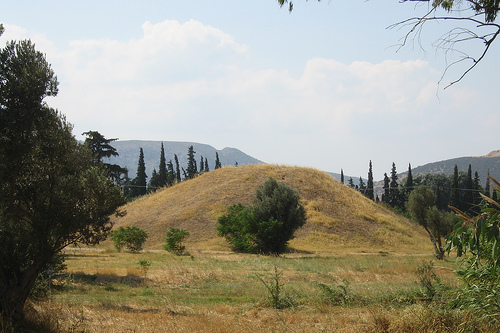
Location: Attica Map
Battle site: 490 BC
Museum:
Tel. (22940) 55155
Closed: Mondays
The Marathon Archaeological Site, located in the northeastern
region of Attica, Greece, approximately 42 kilometers from Athens,
encompasses a vast area around the modern town of Marathon. This
site is renowned not only for its association with the historic
Battle of Marathon in 490 BCE but also for its rich archaeological
layers spanning from the Neolithic period through to the Roman era.
The plain of Marathon, framed by mountains and the sea, served as a
strategic and cultural hub in ancient times, yielding evidence of
human activity dating back to the Stone Age. Today, the site
includes burial mounds, sanctuaries, prehistoric cemeteries, and a
dedicated museum, all set within a protected park that allows
visitors to explore the remnants of ancient Greek history.
The
site's global significance stems primarily from the Battle of
Marathon, a pivotal event during the first Persian invasion of
Greece. In this clash, an outnumbered force of about 11,000 Athenian
and Plataean hoplites defeated a Persian army estimated at 25,000
infantry and 1,000 cavalry, with reserves from their fleet. The
victory halted Persian expansion into Greece, ushering in the
Classical era and inspiring cultural advancements in Athens. It also
gave rise to the modern marathon race, commemorating the legendary
run of the messenger Pheidippides (or Philippides) from the
battlefield to Athens to announce the triumph—a distance of roughly
42 kilometers.
Beyond the battle, Marathon reveals a continuum of
occupation: Early Bronze Age settlements, Mycenaean tombs, and later
Roman structures highlight its enduring importance as a deme
(administrative district) in ancient Attica.
The Marathon Archaeological Site, located in the northeastern Attica
region of Greece, encompasses a vast plain and surrounding areas that
have been inhabited since prehistoric times. While globally famous for
the Battle of Marathon in 490 BC, where Athenian and Plataean forces
decisively defeated the invading Persians, the site's history reveals a
continuous human presence from the Neolithic era through the Bronze Age,
Classical period, Hellenistic times, and into the Roman Empire. Key
features include burial tumuli, sanctuaries, settlements, and the
Archaeological Museum of Marathon, which houses artifacts illustrating
this rich timeline. The landscape, framed by mountains and the sea,
supported early agriculture, trade, and later became a symbol of
democratic resilience against tyranny.
Prehistoric Periods
(Neolithic to Early Helladic)
Human activity at Marathon dates back
to the Neolithic Age, around 6000-3200 BC, with evidence of settlements
at Nea Makri (ancient Probalinthus) featuring huts and finely crafted
pottery, including black matt vases decorated with linear patterns,
triangles, lozenges, and zigzags. Traces of huts on the plain and
foundations near Kotroni hill were uncovered during modern
infrastructure works, such as the Marathon highway for the Olympics. By
the late Neolithic (3700-3200 BC), inhabitants shifted to peripheral
areas, including the Cave of Pan in the Oinoe ravine—a natural cavern
with chambers and stalactites resembling goats, later dedicated to the
god Pan in Classical times. Artifacts from the cave and the Tsepi site
include stone hoes, intact pithoid storage jars containing beads and
stones, and fruit bowls with incised or impressed decorations.
The
Early Helladic period (c. 3200-2000 BC) marked a surge in organized
communities, with lakeside dwellings at Schinias featuring reinforced
two-room structures against flooding, and settlements at Plasi and
Tsepi. The Tsepi cemetery, one of the site's highlights, contained at
least 65 family graves—rectangular pits with stone masonry, enclosures,
and thresholds—holding storage jars, frying-pan vessels with incised
Cycladic motifs like spirals and suns, stylized marble figurines
(trapezoidal torsos evolving to more detailed forms), bone pigment
graters, jewelry, and early copper/bronze tools. These findings indicate
strong Cycladic influences, maritime trade, and a hierarchical society
with central authority. Excavations at Tsepi in 1968 by Spyridon
Marinatos revealed this extensive cemetery, underscoring Marathon's role
in early Aegean networks.
Bronze Age Developments (Middle
Helladic to Mycenaean)
During the Middle Helladic period (c.
2000-1600 BC), Marathon saw the construction of tumuli at Vranas, with
seven mounds up to 15 meters in diameter. These included a central
chief's tomb surrounded by family cist graves, filled with plain pottery
imitating metal vessels, such as kantharoi and amphorae with upright
handles and fluted designs. Arrowheads of obsidian, pyrite, and copper,
along with spindle whorls and bronze items, point to a warrior-elite
society. The Vrana tumuli form a rare 'tumulus cemetery,' unusually
well-preserved with stone periboloi (enclosures) and mantles, containing
diverse grave types like pits, built chamber tombs, and multi-roomed
structures, plus ritual features such as an "altar-like" installation
between mounds. Artifacts include abundant skeletal remains, pottery, a
complete horse skeleton, bronze weapons, stone tools, and jewelry,
highlighting social complexity.
The Mycenaean period (c. 1600-1100
BC) represented a peak, with a "royal" tholos tomb at Arnos featuring a
7-meter-diameter chamber and a 25-meter dromos (entrance passage) with a
gateway. It housed pit graves covered in bones and charcoal, suggesting
hero cults, along with a gold cup and sacrificed horses from a chariot
burial—indicating elite status and centralized power. A Mycenaean dam at
Koraki hill managed floods for agriculture, tying into mythological
narratives like Heracles draining lakes and taming the "Marathon bull"
(the river Haradros). Sanctuaries and springs, such as Makaria, link to
these legends. Excavations in 1933-35 by Georgios Sotiriadis uncovered
the tholos, with horse burials found in 1958 by Ioannis Papadimitriou.
Classical Period and the Battle of Marathon
Marathon formed part
of the ancient Tetrapolis (four villages: Probalinthus, Marathon,
Tricorynthus, Oinoe), sharing the plain with common sanctuaries to
Heracles (near the Greek camp site) and Dionysus (near Plasi). The deme
system involved scattered farmlands, family grave enclosures, and
communal gatherings at sanctuaries and gymnasia.
The site's defining
event was the Battle of Marathon in 490 BC (on the 16th of Boedromion),
a pivotal clash in the Greco-Persian Wars. Persian forces, numbering
around 25,000 infantry and 600 ships under Datis and Artaphernes, landed
at Schinias beach, camping possibly at Mesosporitissa or Tricorynthus,
guided by the exiled Athenian tyrant Hippias. The Athenians (9,000
hoplites) and Plataeans (1,000) marched via Vranas, camping near the
Heracleion sanctuary at Valaria. After a stalemate, Miltiades launched a
surprise attack, extending flanks to envelop the Persians despite a
weakened center. The Greek phalanx charged 1,500 meters, breaking enemy
lines and pursuing them to the sea and marsh, resulting in 6,400 Persian
deaths and 192 Athenian losses (though figures are debated). The victory
halted Persian expansion, bolstered Athenian democracy, and symbolized
freedom over autocracy, inspiring later Western ideals.
Monuments
include the Tumulus (Soros) of the Athenians—a 9-meter-high,
50-meter-diameter mound housing cremated remains in an ash layer, with
an offerings ditch containing black-figure lekythoi, heirloom vases
(e.g., a Corinthian amphora from 580/70 BC), and arrowheads confirming
the battlefield. A smaller Plataean tumulus nearby holds 10 graves. A
marble trophy column (10 meters high with Ionic capital and Nike statue)
was erected at Mesosporitissa, with fragments preserved. Votive
offerings, such as Miltiades' dedications at Olympia and Delphi, further
commemorated the triumph.
Hellenistic and Roman Eras
Post-battle, the site saw continued use, with Geometric to Hellenistic
graves yielding simple funeral gifts, reliefs depicting daily life
(e.g., Pasimache's pyxis from the 4th century BC), and inscriptions for
athletic contests like the Heracleia games. In the Roman period (2nd
century AD), the wealthy sophist Herodes Atticus built an estate at
Brexiza, including the Sanctuary of the Egyptian Gods—enclosed by walls
with pylons mimicking Egyptian temples, central pyramid, courtyards, and
a bathhouse. Statues syncretized Greek and Egyptian deities:
Osiris/Serapis, Isis-Demeter (with wheat sheaf), Isis-Aphrodite (with
roses), reflecting Middle Platonic philosophy of unified divinity. Other
Roman structures include the Gate of Concord (Homonoia) and the Pythion
fountain.
Excavations and Discoveries
Modern excavations began
in the 19th century: William Leake and Eduard Bursian identified the
Athenian Tumulus in the 1830s, Heinrich Schliemann probed it in 1884,
and Valerios Staïs fully excavated it in 1890-91, revealing bones,
vases, and the offerings ditch. In the 20th century, Dimitrios
Theocharis and Maria Pantelidou excavated the Neolithic settlement at
Nea Makri (1955-77) and the Cave of Pan (1958); Spyridon Marinatos
uncovered the Tsepi cemetery (1968) and Vranas tumuli (1969-70); Eugene
Vanderpool found the trophy in 1966. Recent digs include the Sanctuary
by Iphigenia Dekoulakou (1999-2005) and Roman baths by Xenia Arapogianni
(1988). The Prehistoric Tumuli of Marathon Project (2015-18) analyzed
the Vranas site for publication.
The Archaeological Museum of
Marathon and Modern Significance
Opened in 1975 at Vranas, the museum
preserves artifacts from Neolithic figurines and vases to Mycenaean gold
cups, Classical grave offerings, battle-related items (trophy fragments,
arrowheads), and Roman statues from the Sanctuary. Its six galleries
cover prehistoric burials (e.g., Tumuli of Varnas shelter), the Cave of
Pan, Early Helladic finds, Geometric-Classical tombs, Herodes Atticus
portraits, Sanctuary statues, and the 'Trophy Room.' Renovations
post-2004 Olympics have enhanced its role as a cultural gateway.
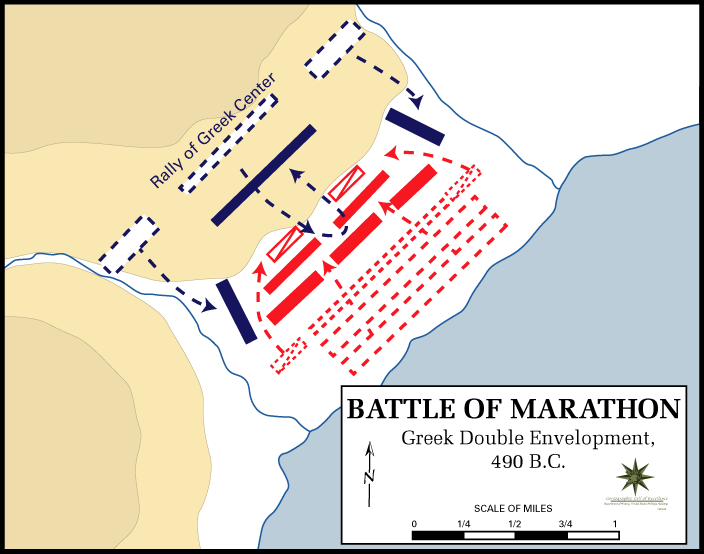
The Tumuli (Burial Mounds)
The most iconic elements are the two
tumuli commemorating the battle's fallen. The Athenian Tumulus, known as
the "Soros," is a hemispherical mound about 12 meters (40 feet) tall and
50 meters in diameter, dominating the plain. Excavated in 1884 by
Dimitrios Philios and further in 1890-1891 by Valerios Stais, it
revealed a thick layer of ash, charred bones, and pottery shards,
confirming it as the collective cremation site for 192 Athenians. The
mound was built over a pit filled with the remains, a rare revival of
archaic burial practices in 5th-century BCE Greece, where war dead were
typically interred in cemeteries like Kerameikos.
Nearby, the smaller
Plataean Tumulus, about 3 meters (10 feet) tall, contains inhumed
(non-cremated) bodies of the 11 Plataeans. Identified and excavated in
1970 by Spyridon Marinatos, it features multiple burials in a similar
pit style. These mounds, now in a landscaped park, symbolize Greek
resilience and are accompanied by a modern replica of the original
victory trophy—a marble column erected by the Athenians. Fragments of
the original are displayed in the museum.
Prehistoric Sites
Marathon's earlier layers include the Tsepi cemetery (Early Bronze Age),
with rectangular stone-built graves containing multiple inhumations,
marble figurines, and Cycladic-style pottery. At Vrana, three Middle
Helladic tumuli feature horseshoe-shaped graves with single burials
under stone coverings, sheltered today in a protective building near the
museum. A Mycenaean tholos tomb (15th-14th century BCE) at Vrana
includes a dromos (entrance passage) and chamber, with evidence of horse
burials from a funeral cortege.
At Plasi, an Early Helladic fortified
settlement and Middle Helladic structures, including a pottery kiln and
graves, indicate early organized communities. Ongoing excavations at an
Early Helladic cemetery further enrich the prehistoric narrative.
Sanctuaries and Other Structures
Several sanctuaries dot the
landscape. The Herakleion, dedicated to Herakles, and a temenos (sacred
precinct) for Athena reflect classical worship. The Sanctuary of the
Egyptian Gods, built in the 2nd century CE by Herodes Atticus within his
villa estate, features a propylon (gateway), temple, and bath complex.
Originally walled with Egyptian-style pylons and a central pyramid, it
housed syncretic statues of gods like Osiris-Serapis and goddesses
embodying Isis-Demeter, Isis-Aphrodite, and other forms, symbolizing
Middle Platonic ideas of divine unity. Replicas stand on-site today,
with originals in the museum. Nearby ruins include parts of Herodes'
villa at Mandra tis Grias.
The Archaeological Museum of Marathon
Housed in a modern facility near the tumuli, the museum showcases
artifacts from the region across six galleries, spanning Neolithic to
Late Roman times. Gallery I features Neolithic items from the Cave of
Pan; Gallery II displays Early Helladic, Mycenaean, and prehistoric
tumuli finds; Gallery III covers Geometric to Classical tomb artifacts;
Gallery IV presents portraits of Herodes Atticus and his wife Regilla;
Gallery V holds original statues from the Egyptian Sanctuary; and
Gallery VI, the Trophy Room, exhibits battle trophies and grave
offerings from the Athenian and Plataean tumuli. The museum grounds
include an in-situ Middle Bronze Age cemetery under a shelter, allowing
views of the ancient burial structures.
Excavations have uncovered pottery, figurines, weapons, and
architectural remains that illustrate Marathon's evolution. Prehistoric
pottery links to Cycladic and Mycenaean influences, while battle-related
finds include ash layers with bones and offerings. The site's syncretic
Roman elements underscore cultural exchanges in the ancient
Mediterranean.
Marathon's enduring legacy lies in its embodiment of
heroism, innovation, and continuity. As a UNESCO-recognized cultural
landscape in spirit, it attracts historians, tourists, and runners, with
events like the Athens Classic Marathon tracing the ancient path. The
site's preservation in a park ensures accessibility, though visitors
should note seasonal hours and combine it with nearby beaches for a full
experience.
By Public Bus (Most Affordable Option)
Public buses operated by
KTEL Attikis are the primary budget-friendly way to reach Marathon.
There are two main access points in Athens for these buses:
From
Pedion tou Areos (Mavromateion Street):
This is the main departure
point for direct buses to Marathon.
How to get to the bus stop: Take
Metro Line 1 (Green Line) to Victoria station (about 5-10 minutes from
Syntagma), then walk 5-10 minutes north along Areos Park to Mavromateion
Street.
Bus route: Direct to Marathon (often via Nea Makri or along
the coast).
Frequency: Buses run approximately every 30-60 minutes
from early morning (around 5:30 AM) to late evening (around 10 PM) on
weekdays. Weekends have reduced service.
Duration: 1-1.5 hours,
depending on traffic.
Cost: €3-7 one-way (pay in cash or with a
ticket from the kiosk).
Notes: The bus drops you in central Marathon;
from there, it's a short walk (1-2 km) or local taxi to the
archaeological site and museum. Look for buses labeled "Marathon" or ask
the driver.
From Doukissis Plakentias Station (Alternative
Route):
Take Metro Line 3 (Blue Line) from central Athens (e.g.,
Syntagma) to Doukissis Plakentias (end of the line for some trains).
Duration for metro: About 20 minutes.
Cost for metro: €2 (or included
in a day pass).
At the station, exit and head to the adjacent KTEL
Attikis bus terminal (on the right side).
Bus route: Transfer to a
bus heading to Marathon (may be via Rafina or Nea Makri; confirm with
staff).
Frequency: Similar to above, every 30-60 minutes.
Total
duration: 1-1.5 hours including the metro.
Cost: €3-7 for the bus
segment.
Notes: This is convenient if you're already on the Blue Line
(e.g., coming from the airport). Buses are air-conditioned and have
luggage storage.
For the latest schedules, check the KTEL Attikis
website (ktelattikis.gr) or call +30 210 880 8000. Tickets are bought on
board or at the station.
By Car (Most Flexible Option)
Rent a
car from Athens (available at the airport or city center via companies
like Hertz or Sixt).
Route: Head northeast via the Attiki Odos
(A6/E94) highway or the national road (EO Athens-Lamia). Follow signs
for Rafina/Marathon.
Duration: 40-60 minutes, depending on traffic.
Distance: About 42 km.
Cost: Fuel ~€5-10; tolls ~€3; rental starts at
€30/day.
Notes: Parking is available near the site and museum. GPS
apps like Google Maps work well in Greece—search for "Archaeological
Museum of Marathon" or "Tumulus of Marathon." Driving allows stops at
nearby spots like Marathon Lake. Be aware of Athens' traffic and road
signs in Greek/English.
By Taxi or Ride-Share
Hail a yellow
taxi in Athens or use apps like Uber, Bolt, or Free Now.
Route:
Direct from anywhere in Athens to the site.
Duration: 40-60 minutes.
Cost: €40-60 one-way (metered; airport surcharges may apply if starting
there).
Notes: Taxis are plentiful, but confirm the destination (show
"Αρχαιολογικό Μουσείο Μαραθώνα" in Greek). For groups, this can be
cost-effective. Avoid unlicensed taxis.
By Train (Limited Option)
There's no direct train to Marathon. The closest is the Proastiakos
suburban rail to Pallini or Doukissis Plakentias, then transfer to a bus
or taxi (adds 20-30 minutes and €10-20).
Not recommended unless
you're already on the rail line.
Other Tips
From Athens
International Airport: Take the X93 bus to central Athens (€5, 1 hour),
then connect via metro/bus, or opt for a direct taxi (€50-70, 30-45
minutes).
Organized Tours: If you prefer guided access, book a day
tour from Athens via platforms like GetYourGuide or Viator (includes
transport, entry, and a guide; €50-100/person).
Site Details: Entry
to the tumulus is free; museum ticket ~€3. Open daily except Mondays
(check for holidays). Wear comfortable shoes for walking.
Best Time:
Visit early to avoid heat/crowds. Public transport is reliable but can
be crowded in summer.