Location: Heemskerk
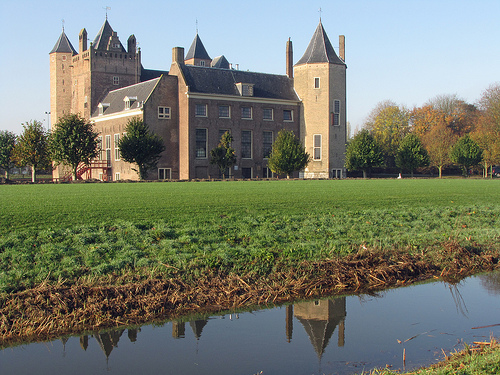
Castle Assumburg, also known as Slot Assumburg, is a historic castle located in the eastern part of Heemskerk, North Holland, Netherlands. Situated at coordinates 52°30′19″N 4°41′06″E, it stands as a striking example of a "wings castle" – a structure with four wings enclosing an inner courtyard. Despite its medieval appearance, complete with towers, moats, and crenellations, the castle was never designed for serious defense; its thin walls (about 50 cm thick) make it more of a luxurious noble residence than a fortress. The name "Assumburg" derives from the nearby hamlet of Assum, between Heemskerk and Uitgeest. Today, it serves as a youth hostel and event venue, surrounded by restored baroque gardens that enhance its fairy-tale-like charm.
Origins and Early History (13th–14th Centuries)
The site's history
dates back to the second half of the 13th century, when a residential
tower or fortified house stood on the grounds. This early structure,
likely a simple wooden or brick tower with a moat and a flattened motte
(hill), served as a noble dwelling rather than a full castle.
Archaeological excavations have uncovered Kloostermoppen (large medieval
bricks) and pottery shards, confirming its existence. A 2021 geophysical
survey using electromagnetic conductivity techniques revealed a
predecessor just north of the current castle: a round bailey about 12
meters in diameter, encircled by a moat, with a 9.5-meter brick tower
inside. By the late 14th century, this tower had fallen into disuse, and
the land was converted into an orchard between 1399 and 1446.
In the
13th and 14th centuries, the property was associated with the Van Velsen
family, referred to as "Williaems Woninghe van Velsen." Ownership was
split: in 1322, Jan van Rietwijk (son of Willem van Rietwijk van Velsen)
held half, mortgaged to him, while the other half belonged to Barthout
van Assendelft, a relative. On May 17, 1328, Jan sold his share to
Barthoud van Assendelft. Barthoud (I) dedicated the entire Assumburg to
Jan I van Polanen on June 5, 1335, and died around 1345. His son Dirk
(I) inherited it but died childless, passing it to brother Gerrit (II)
in 1348. Gerrit married Stevina van Haarlem, merging the Van Haerlem
coat of arms into the Van Assendelft lineage. This marked the beginning
of the Van Assendelft family's long dominance over the estate.
Construction and Architectural Features (15th Century)
The current
castle's foundations were laid in the 15th century, around 1450–1486,
under the direction of Nicolaas van Assendelft and his wife Aleid van
Kijfhoek, who inherited the land in 1486. It replaced the earlier
orchard and tower site, incorporating some remnants like two square
towers and parts of the ring wall. The design features four wings around
a central courtyard, where justice was historically administered. A
bridge connects the castle to a forecourt, which includes an orangery
(restored around 1965). Architecturally, it blends late Gothic elements
with foursquare motifs and is classified under Classicism influences.
Notably, the 1546 renovation (sometimes dated to the broader
15th-century rebuild) gave it its present form, imitating a medieval
stronghold but with decorative rather than functional defenses. The
crenellations and towers were added for aesthetic appeal, reflecting a
shift from fortified castles to status symbols for nobility. Contrary to
some myths, it was not built using materials from the demolished Oud
Haerlem Castle. The structure's vulnerability – thin walls unsuitable
for sieges – underscores its role as a noble residence rather than a
military outpost.
Ownership Changes (15th–19th Centuries)
The
Van Assendelft family inhabited and expanded the castle for generations.
Barthoud (II), eldest son of Gerrit (II), was exiled by Duke William VI,
allowing brother Dirk (II) to occupy it in 1413 and lease it out in
1421. The line continued until Gerrit (VIII) van Assendelft (1567–1617),
the last male heir, who died unmarried. His sister Anna (II), married to
Gerrit van Renesse van der Aa, inherited it in 1618 and passed it to the
Van Renesse family upon her death in 1626. They resided there until
1669, when it was sold to Amsterdam merchant Johannes Wuijtiers
(1629–1674).
In 1694, Wuijtiers sold it to banker Jean Deutz
(1655–1719) and his wife Maria Boreel (1634–1702). The Deutz family,
prominent Amsterdam merchants, owned it until 1867. Jean Deutz
modernized the interiors and created elaborate French-style gardens. The
last Deutz resident was Jacob Maarten Deutz van Assendelft, who died
there in 1858; his widow Josina Johanna Willink died in 1867, marking
the end of private noble occupancy.
Renovations and Modifications
Major renovations occurred in 1610 under Gerrit V van Assendelft,
updating the structure. The Deutz era (1708–1719) brought significant
enhancements: modernization of the house, geometric baroque gardens, a
park, deer enclosure, and water features like ponds and fountains. By
the 19th century, the castle fell into disrepair after 1867, with the
gardens subdivided and auctioned by 1912.
Restoration began after the
1911 donation to the state. In the 20th century, the Government
Buildings Agency oversaw full restoration by around 1980. The orangery
was rebuilt circa 1965. From 2009–2011, the 18th-century gardens were
recreated based on a 1729 copper engraving, featuring beech hedges,
parterres de broderies, a rose garden, vegetable and herb plots, a
sunken bowl with a marble statue ("Sabine Puppetry" by Elisabeth
Stienstra), a bell-shaped pond with fountains, and an amphitheater. In
2017–2018, painting and structural work connected the forecourt to a
visitor center, making it publicly accessible. Wall repairs were
completed in 2020.
Significant Events
Throughout its history,
Assumburg witnessed key transitions. It served as a protective
stronghold against West Frisians in its early days and hosted noble
families during the Dutch Golden Age. In 1881, it briefly functioned as
a cholera hospital, and later as a school. Post-1867 auctions dispersed
its furnishings, with paneling, chimneys, and doors relocated to
Marquette Castle in 1906.
During World War II, German forces camped
there. After liberation, it temporarily housed about 30 political
prisoners. In 2003, the adjacent Assumburg nature and recreation park
was established. The castle opens limitedly during Heritage Days, and
since 2011, its gardens have been public. On January 15, 2016, ownership
transferred from the government to the National Monuments Organization
(Monumentenbezit).
Modern History and Current Use
After
falling into ruin by 1911, the castle was symbolically sold to the Dutch
state for one guilder, with a mandate for preservation. Restoration
efforts culminated in its opening as a youth hostel on July 15, 1933,
initially for unemployed youth aiding the work – a suggestion from the
National Office for the Preservation of Monuments. Operated by Stayokay,
it now accommodates overnight stays, meetings, parties, and weddings.
The castle itself is not generally open to the public, but the baroque
gardens are accessible daily, especially from May to September, and are
wheelchair-friendly.
Architectural Style and Overall Structure
Architecturally, Castle
Assumburg embodies a blend of late medieval and Classicist influences,
often classified under Classicism with notable Late Gothic elements. It
is not a true fortress but an imitation of a medieval castle, commonly
referred to as a "wings castle" (vleugelkasteel) or "coulissen castle"
in Dutch terminology. This design prioritizes aesthetic appeal and
residential comfort over defense, as evidenced by its notably thin
walls—incapable of withstanding a prolonged siege. The structure
radiates an imposing facade, but this is more for show, reflecting the
transition from fortified strongholds to elegant country estates in the
late Middle Ages and Renaissance periods.
The castle's layout
consists of four wings arranged symmetrically around a central inner
courtyard, creating an enclosed, introspective space typical of
Classicist designs. This courtyard, historically used for administering
local justice (known as a vierschaar or square court), is accessed via a
bridge connecting the main building to a forecourt. The forecourt
includes an orangery—a greenhouse-like structure restored around
1965—and has been enhanced with passages and a visitor center extension
in 2015 and 2018, restoring symmetry and public accessibility. Materials
primarily include medieval bricks known as Kloostermoppen (monastery
bricks), with archaeological finds from the site also revealing pottery
shards from earlier periods, underscoring the castle's layered history.
Key surviving medieval elements date to the 15th century, including two
square towers positioned at the corners and portions of the original
ring wall that once encircled the structure. These towers, robust and
angular, provide a nod to the castle's defensive origins, though their
integration into the overall design emphasizes verticality and grandeur
rather than fortification. The ring wall, partially preserved, adds to
the enclosed feel but lacks the thickness or battlements of true
military architecture. Alterations in the 17th and 18th centuries,
particularly under the Deutz family, obscured much of the medieval core,
introducing smoother facades and interior modernizations aligned with
Baroque tastes.
Interior Features and Layout
Internally, the
castle's four wings create a harmonious, residential flow around the
central courtyard. A standout feature is the Late Gothic gallery, which
incorporates a foursquare (vierschaar) design—a raised platform or
enclosed space used for judicial proceedings, reflecting the castle's
historical role in local governance. This gallery, with its arched
openings and intricate stonework, exemplifies the Late Gothic style's
emphasis on vertical lines and decorative tracery, contrasting with the
broader Classicist symmetry of the overall building. While much of the
original interior paneling and furnishings were transferred to nearby
Marquette Castle after 1867, the spaces retain a sense of historical
authenticity through exposed brickwork and restored elements. The wings
house various rooms adapted for modern use as a youth hostel, including
dormitories, common areas, and event spaces, all while preserving
accessibility (the castle is wheelchair-friendly). Defensive interior
aspects are minimal, with no evidence of arrow slits or heavy
portcullises, further highlighting its residential rather than
militaristic purpose.
Gardens and Surrounding Landscape
The
castle's gardens are a highlight of its architecture, embodying Baroque
symmetry and geometric precision. Originally designed in the French
style by the Deutz family between 1708 and 1719, the garden was
recreated in 2011 based on a 1729 copper engraving by landscape
architect Nico Brantjes. It features a large formal area divided into
four parterres de broderies (intricate patterns of boxwood hedges), two
beds for annual flowering plants, a sunken bowl hosting the marble
sculpture "Sabine Puppetry" by Dutch artist Elisabeth Stienstra
(inspired by Giambologna's Rape of the Sabine Women), a bell-shaped
courtyard pond with fountains, and an amphitheater for gatherings.
Enclosed by tall beech hedges, the garden emphasizes axial views and
balanced proportions, with water features adding reflective tranquility.
Adjacent areas include a fruit orchard, rose garden (rosarium), and a
vegetable and herb garden showcasing heirloom varieties, promoting
historical agricultural practices. The surrounding park, which had
largely vanished by the 19th century due to subdivision, was revitalized
in 2003 as a nature and recreation area. A deer park from the Deutz era
has been lost, but the overall landscape integrates seamlessly with the
castle, enhancing its picturesque setting. The garden is publicly
accessible during daylight hours, particularly in summer, and serves as
a venue for events.
Unique Elements and Modern Adaptations
What sets Castle Assumburg apart is its deceptive grandeur: an
"imitation" castle that blends medieval remnants with later stylistic
overlays, creating a hybrid that feels both timeless and approachable.
Unique archaeological insights, such as the 2021 discovery of the
predecessor site, add layers to its narrative, while modern additions
like the 2015 visitor center (designed by lab03 to restore forecourt
symmetry on the site of former stables) blend contemporary wood and
glass elements with the historic context without overwhelming it. The
castle's transformation from noble estate to public hostel exemplifies
adaptive reuse, balancing preservation with functionality. Today, it
stands as a testament to Dutch architectural evolution, where defensive
pretense gives way to elegant living and communal spaces.