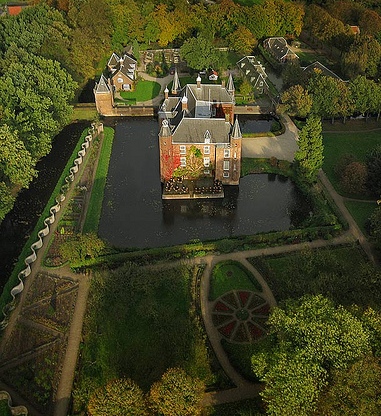
Location: Tournooiveld 1, Oud- Zuilen, Vechtstreek Map
Constructed: current castle is constructed in 1525
Tel. 030 244
0255
Open:
15 Mar- 15 May & 15 Sept- 15 Nov: Sat & Sun (groups by
appoint)
15 May- 15 Sept: Tue- Thu, Sat & Sun
Closed: 15 Nov- 15
Mar
The Castle of Zuylen, usually Slot Zuylen, is a castle in
Ald-Zuilen, on the river Fecht in the municipality of Stichtske
Fecht, in the province of Utrecht, near the city of Utrecht. The
castle was built in the 13th century.
In the 13th century,
Mr. Van Sulens, ancestor of the Van Zuylen van Nijevelt family, had
a tower built, which was expanded with a large room in the 14th
century. In the beginning of the 15th century, when the layer Van
Zuylen had no male heirs, it was given to the hands of Van Borssele,
a family of high nobility from Zeeland. Frank van Borselen inherited
it in 1422, but did not benefit much from it: in that year, as part
of the Tierderijen van Hoeken and Kabbeljauwen, the Hoeksken took
the castle.
Between 1510 and 1522 Mr. Willem van Rennenberg
had the castle restored. The owner of the castle gets a permanent
seat in the council of the Principality of Utrecht. His descendants,
including George van Lalaing and the house of Egmont, became the
owner until 1610, when the castle was sold to a rich merchant from
Amsterdam, Jasper Quinget. Six years later, he sold the castle to
his colleague Adam van Lockhorst.
Origins and Early History (13th-15th Century)
Slot Zuylen, also
known as Zuylen Castle, is situated in the village of Oud-Zuilen near
Utrecht, Netherlands, along the picturesque river Vecht. Its history
traces back to approximately 1250, when Steven van Zuylen constructed a
simple keep—a square residential tower fortified with walls measuring
2.70 meters in thickness. This structure served as a defensive
stronghold typical of medieval architecture in the region. The
foundations of this original keep were uncovered during later
restorations and remain visible today in the castle's terrace.
By the
early 15th century, ownership had passed to Frank van Borssele, the
fourth husband of Jacoba van Beijeren (also known as Jacqueline of
Bavaria). This period coincided with the turbulent Hook and Cod wars, a
series of civil conflicts in the County of Holland between factions
supporting decentralized power (the "Cod" faction) and centralized
Burgundian authority (the "Hook" faction). Van Borssele aligned with the
Burgundians, which made the castle a target. In 1422, inhabitants of
Utrecht, seeking greater autonomy for their city, demolished the tower.
The site lay in ruins for nearly a century, reflecting the instability
of the era.
Rebuilding and Transition to Noble Residence
(16th-17th Century)
Reconstruction began around 1510–1525 under Count
Willem van Rennenberg, who erected a new castle on the existing ruins.
This rebuild incorporated a guardhouse and transformed the site into a
more habitable structure, which was subsequently recognized as a
"knights' house" by the States of Utrecht—a designation that affirmed
its status among noble estates. The new design retained some defensive
elements but shifted toward residential use, adapting to the changing
needs of the time as warfare evolved and noble life became more focused
on comfort and prestige.
In the early 17th century, the castle came
under the ownership of Adam van Lockhorst, who used it as a summer
residence to underscore his aristocratic standing. Upon his death, it
was inherited by his four-year-old granddaughter, Anna Elisabeth van
Reede. To preserve the family's holdings, she married her cousin,
Hendrik Jacob van Tuyll van Serooskerken, in 1665. This union marked the
beginning of the Van Tuyll van Serooskerken family's long tenure, which
lasted from 1668 until 1952. The family resided there continuously,
embedding the castle deeply into their lineage and local history.
The
castle escaped destruction during the disastrous French invasion of 1672
(known as the "Rampjaar" or Disaster Year in Dutch history), largely due
to the Van Tuyll van Serooskerken family's influential connections,
which likely included diplomatic ties that protected their property amid
widespread looting and occupation.
Major Renovation and
Enlightenment Era (18th Century)
For nearly two centuries after the
rebuild, the castle saw little alteration. However, in 1752, Diederik
Jacob van Tuyll van Serooskerken initiated a significant renovation
under the direction of architect Jacob Marot. Inspired by contemporary
French fashions, the project converted the medieval fortress into an
elegant country house. Key changes included demolishing the outer
defensive wall, filling in the moat, reshaping the layout into a U-form
with a central square courtyard, adding a symmetrical left wing,
creating a ground-floor entrance hall with grand marble staircases
leading to the bel-etage (principal floor), and installing a gallery to
facilitate movement between rooms without traversing them directly.
These modifications emphasized symmetry, light, and livability, aligning
with Rococo and neoclassical trends. No substantial architectural
updates have occurred since, preserving the castle's 18th-century
character.
This era also produced the castle's most renowned
resident: Isabelle Agneta Elisabeth van Tuyll van Serooskerken, better
known as Belle van Zuylen (1740–1805). Born in the castle as the eldest
child of Diederik Jacob van Zuylen and Helena Jacoba de Vicq, Belle was
an Enlightenment intellectual, writer, composer, and feminist ahead of
her time. From childhood, she rebelled against the constraints of
nobility, which expected women to prioritize marriage, motherhood, and
obedience. She pursued studies at the University of Utrecht, took
private mathematics lessons, and wrote poetry, often in French—her
preferred language after a formative year in Geneva learning from
Voltaire and Rousseau's influences.
Belle's life was marked by
intellectual pursuits and scandals. In 1763, she anonymously published
her satirical novel Le Noble, critiquing aristocratic hypocrisies; her
father suppressed it by buying and burning copies, straining family
relations. She famously declared, "Je n’ai aucun talent pour la
soumission" (I have no talent for subservience). Romantic entanglements
included a forbidden affair with the married Swiss officer David-Louis
Constant d’Hermanches and a courtship with Scottish writer James
Boswell, whose 1764 marriage proposal was vetoed by her father. Belle
viewed the castle as a "gilded cage"—a luxurious prison stifling her
independence—yet it was also a creative sanctuary where she penned
letters on freedom and marriage from her bedroom overlooking the Vecht.
Her beauty and intellect were captured in portraits, including a 1766
pastel by Maurice Quentin de La Tour and a marble bust by Jean-Antoine
Houdon. To escape her confines, she married Swiss nobleman
Charles-Emanuel de Charrière in 1771, relocating to his château in
Colombier, Switzerland. As Madame de Charrière, she produced novels,
plays, poetry, and music, and later had a passionate but unrequited
romance with Benjamin Constant. She died on December 27, 1805, in
Colombier, leaving a legacy as one of Europe's early feminist voices.
19th-20th Century: Social Role and World War II
Throughout the
19th and 20th centuries, successive generations of the Van Tuyll van
Serooskerken family maintained an active presence in local society.
Barons often served as mayors, employers, or community leaders in Zuilen
village, while baronesses were renowned for charitable work. In 1900,
villagers celebrated the return of a new lord after nearly two decades
of absence, highlighting the castle's enduring ties to the community.
During World War II, under the ownership of Lucile Agnes Baroness van
Tuyll van Serooskerken (also known as Baroness van Lynde), the castle
provided refuge for individuals in hiding from Nazi occupation forces.
This act of resistance is commemorated in exhibitions, such as the 2020
"Baroness in Wartime" display. Tragically, nearby in 1943, British
airman Sgt. Richard Huke perished in a parachute malfunction just 200
meters from the castle.
Modern Era: Museum and Preservation
(1950s-Present)
By 1951–1952, escalating maintenance costs prompted
the last residents to transfer the castle, its gardens, and furnishings
to the Slot Zuylen Foundation. This shift preserved the estate and
opened it to the public as a museum over 70 years ago (as of 2026).
Today, it showcases nearly 300 years of noble residential culture,
including a portrait gallery with over 200 paintings from the 15th to
20th centuries by artists like Paulus Moreelse, Gerard van Honthorst,
and Nicolaas Maes. The collection also features extensive glassware,
silver, porcelain, and a masterpiece tapestry by 17th-century weaver
Maximiliaan van der Gucht.
The former carriage house now operates as
a museum café, serving local and organic fare, including produce from
the castle's gardens. Slot Zuylen stands as a testament to Dutch
history, blending medieval roots with Enlightenment ideals and modern
cultural heritage.
Exterior Architecture
The castle's current exterior presents a
U-shaped plan, a hallmark of the 1752 renovation that demolished the
outer defensive wall and filled in part of the moat to create an
open square courtyard. This layout enhances accessibility and
aesthetic balance, with the addition of a left wing to achieve
perfect symmetry—a key neoclassical principle. The facade is
constructed primarily of red brick, accented by white stone details
around windows and doorways, giving it a restrained yet stately
appearance. Pointed turrets rise from the corners, remnants of its
medieval heritage, adding a touch of Gothic verticality to the
otherwise horizontal, balanced composition.
The main entrance was
relocated to the center of the facade during the 18th-century
rebuild, flanked by pilasters and topped by a pediment, emphasizing
grandeur and welcoming visitors rather than repelling invaders. A
gallery was added along the front, allowing independent access to
rooms without passing through enfilades (a series of aligned
interiors), which improved privacy and flow. The overall silhouette
is compact yet imposing, with steeply pitched roofs covered in
traditional Dutch tiles and dormer windows that punctuate the
roofline for light and ventilation.
Interior Architecture and
Decorations
Internally, Slot Zuylen reflects its transition from
fortress to refined home, with a layout centered around a grand
entrance hall on the ground floor leading to the piano nobile (main
floor) via twin marble staircases—a symmetrical feature introduced
in 1752 for dramatic effect. The U-shaped plan encloses the
courtyard, with wings housing residential and service areas. Rooms
are arranged for both functionality and display, featuring high
ceilings, large sash windows for natural light, and ornate
plasterwork ceilings with neoclassical motifs like garlands and
medallions.
Notable interiors include period-furnished salons and
bedrooms that showcase Dutch Baroque and Rococo influences. The
castle preserves much of its original inventory, including furniture
from the 17th and 18th centuries, such as carved oak cabinets,
upholstered armchairs, and writing desks. Artworks adorn the walls,
including paintings by Utrecht master Gerard van Honthorst, known
for his chiaroscuro style, and a massive room-filling tapestry woven
by Delft carpet maker Maximiliaan van der Gught, depicting elaborate
scenes in rich colors. Other treasures include rare glassware,
Chinese porcelain displayed in cabinets, and family portraits that
highlight the castle's noble lineage. The library and drawing rooms
feature built-in bookcases and fireplaces with intricate mantels,
evoking the intellectual pursuits of residents like the
Enlightenment writer Belle van Zuylen, who lived here in the 18th
century.
Gardens and Landscape Features
The surrounding
gardens, partially redesigned around 1840 by landscape architect
J.D. Zocher Jr., complement the castle's architecture with romantic
English-style elements. Winding paths, manicured lawns, and mature
trees frame the building, while the remaining moat adds a
picturesque water element. A standout feature is the 120-meter-long
serpentine wall (or "snake wall"), a crinkle-crankle structure built
to support fruit trees by creating warm microclimates through its
undulating brick design. This wall is one of the longest and
best-preserved examples in the Netherlands, illustrating innovative
18th-century horticultural architecture.
The castle has a tapestry by the Delft tapestry weaver Maximiliaan
van der Gught.
The oldest known furniture made by Gerrit Rietveld
dates from 1906 and was intended for the gatehouse.
The 18th century
serpent wall ends at the level of the gatehouse in a bulwark with
shooting slits. This defense element is considered a folly.
The TROS
children's series Koning Bolo was filmed in Slot Zuylen.