Via Santa Margherita 1, ☎ +39 055 219 416,
info@museocasadidante.it
Full price €4, reduced price €2.
1
October-31 March: Tue-Sun 10am-5pm; 1 April-30 September Mon-Sun
10am-6pm
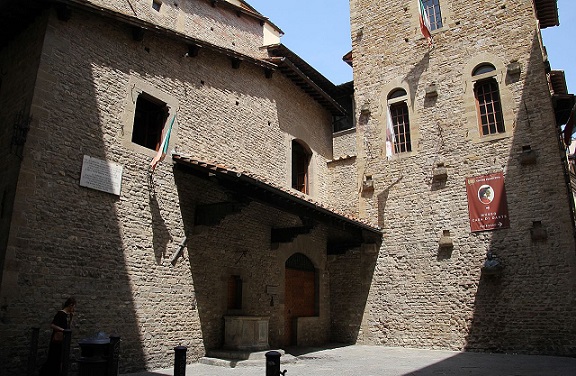
Dante’s House, known as the Casa di Dante or Museo Casa di Dante, is a historic site and museum in Florence, Italy, located at Via Santa Margherita 1, in the heart of the city’s medieval quarter. While not the actual residence of Dante Alighieri (1265–1321), the renowned poet and author of The Divine Comedy, the site is closely associated with his life and legacy, situated in the area where the Alighieri family lived. The museum, housed in a reconstructed medieval building, serves as a cultural and educational hub dedicated to Dante’s life, works, and the historical context of 13th- and 14th-century Florence.
What to Expect Inside
The visit typically lasts 30–60 minutes and
unfolds across three floors, each focusing on a phase of Dante's life
and the medieval context of 13th–14th century Florence:
Ground/First Floor: Covers Dante's youth, his baptism in the "beautiful
San Giovanni" (the Baptistery), family background, and early public life
in Florence. You'll see documents, models of medieval Florence, and
details on the city's politics, guilds, and social structure. Highlights
include a reconstruction of a medieval bedroom (spartan furniture
evoking daily life) and displays on battles like Campaldino, where Dante
fought as a young man (with weapon reproductions and a battle model).
Second Floor: Focuses on Dante's political career (he served as a prior
of Florence), his exile in 1301 after factional conflicts (Guelphs vs.
Ghibellines), and the pain of banishment. Maps, documents, and exhibits
illustrate the turbulent politics that shaped his worldview and led to
The Divine Comedy.
Third Floor: Dedicated to The Divine Comedy
(Inferno, Purgatorio, Paradiso). This is often the most engaging part,
with manuscripts, iconography, artistic reproductions spanning
centuries, immersive projections, and VR elements that let you "journey"
through the three realms. It also explores Dante's broader cultural
legacy and influence on art and literature.
The museum emphasizes
not just the poet but the man, warrior, politician, and lover of
Florence. Content is available in Italian and English. Many visitors
describe it as educational and tech-forward, though some note it feels
more like a multimedia center than a historic house with original
artifacts. It's particularly rewarding for literature fans, history
buffs, or those interested in medieval Florence, but it may feel light
on "wow" factor for casual tourists.
Practical Visiting Tips
Opening Hours (as of 2026):
Summer (April 1 – October 31): Daily
10:00 AM – 6:00 PM (last entry 5:30 PM).
Winter (November 1 – March
31): Tuesday–Friday 10:00 AM – 5:00 PM; Saturday–Sunday 10:00 AM – 6:00
PM. Closed Mondays.
Closed on December 24–25. Special openings or
closures may apply during holidays or events—check the official site
closer to your visit.
Tickets:
Full price: €8.
Reduced: €5
(children 7–18, teachers, groups, etc.).
Free: Children under 7,
people with disabilities (and companion), Firenze Card holders.
Tickets are sold at the entrance (no advance online purchase needed for
individuals). Groups of more than 6 require reservation. Last entry is
30 minutes before closing.
Reservations: Not required for
individuals on weekdays, but required on weekends (and for groups). Book
via email (prenotazioni@museocasadidante.it) or phone (+39 055 219 416)
during opening hours. This helps manage capacity and avoid
disappointment during busy periods.
Accessibility: Partially
accessible for wheelchairs/strollers (some limitations due to the
historic building's layout—stairs and narrow spaces). Contact the museum
in advance if needed.
Best Time to Visit:
Go early in the day
(right at opening) to avoid crowds, especially in peak season
(April–October).
Weekdays are quieter than weekends.
Shoulder
seasons (March–April or October–November) offer milder weather and fewer
tourists overall in Florence.
Allocate 45–60 minutes; it's small
enough to combine with nearby sights without fatigue.
Pro Tips:
Consider a guided tour (about 1 hour, €60 per group plus entry fees) if
you want deeper context—the multimedia can feel dry without explanation.
These bring Dante's exile, politics, and poetry to life.
The Firenze
Card provides free entry and direct access.
Photography is generally
allowed (check rules inside).
It's compact and family-friendly in
parts (interactive elements appeal to kids), but older children or
adults with literary interest will get the most out of it.
If you're
short on time or on a budget, prioritize if you're a Dante fan; some
visitors find it skippable or overpriced relative to the experience.
Location and Getting There
The museum sits in a charming medieval
tangle of narrow streets between the Duomo (about 5–7 minutes walk) and
Piazza della Signoria/Palazzo Vecchio (similar distance). It's easy to
reach on foot from most central areas—no public transport needed.
Address: Via Santa Margherita 1, 50122 Firenze.
Nearby Dante-Related
Spots (perfect for a self-guided walking itinerary):
Chiesa di
Santa Margherita dei Cerchi ("Dante's Church"): Right next door. Tiny
11th-century chapel where Dante supposedly first saw Beatrice (his muse)
and later married Gemma Donati. It has a claimed tomb of Beatrice and
feels atmospheric—worth a quick peek (hours can be irregular).
A
marble plaque/map on nearby Via Dante Alighieri showing the medieval
neighborhood.
Bust of Dante in the small courtyard outside the
museum.
Extend to the Baptistery (where Dante was baptized), Badia
Fiorentina, or Santa Croce (with Dante's cenotaph/memorial).
This
area lets you walk in Dante's footsteps through the same narrow lanes he
knew.
Combining with Your Florence Itinerary
Dante's House
pairs well with a half-day medieval Florence focus:
Morning:
Duomo complex → Dante's House & Church → Lunch in the area (try nearby
spots for lampredotto or simple Tuscan fare).
Afternoon: Palazzo
Vecchio (political context) or Uffizi (artistic legacy).
It's an
excellent low-key contrast to blockbuster sites like the Uffizi or
Accademia—more intimate and contextual. If you're into literature or
history, it enriches your understanding of Florence as the cradle of the
Renaissance and Italian identity.
Dante's House (Casa di Dante or Museo Casa di Dante) in Florence is a
museum dedicated to the life, works, and historical context of the poet
Dante Alighieri (1265–1321). It stands in the heart of medieval Florence
at Via Santa Margherita 1, in the ancient San Martino al Vescovo
district near the Torre della Castagna, the Badia Fiorentina, and the
Church of Santa Margherita de' Cerchi (traditionally linked to Dante's
first sighting of his muse Beatrice Portinari).
The site evokes 13th-
and 14th-century Florence through its stone-built medieval-style
structures, small piazza with a well, and a bronze bust of Dante by
Augusto Rivalta on the facade. However, it is not the literal original
house where Dante was born or lived; it is a thoughtful
early-20th-century reconstruction on (or incorporating elements of) the
traditionally identified location of the Alighieri family properties.
The museum focuses on education and immersion rather than housing
original Dante artifacts, offering a window into the poet's world
through exhibits, reconstructions, and multimedia.
The Site in
Dante's Lifetime (13th Century)
Dante Alighieri was born in Florence
in late May or early June 1265, under the sign of Gemini, in the parish
of San Martino al Vescovo. The Alighieri family (a minor noble Guelph
lineage) owned several houses in this densely built-up area between the
Church of San Martino, Piazza dei Donati, and the Torre della
Castagna—one of Florence's best-preserved medieval towers. Contemporary
documents, including tax rolls and property records from the early
1300s, place the family homes here. One key piece of evidence is a
recorded lawsuit by the prior of San Martino al Vescovo against the
Alighieri family over fig tree roots damaging the church garden wall.
Dante himself referenced his birthplace in relation to the Badia
Fiorentina and San Martino parish. The family properties were typical of
the era: stone or mixed-material townhouses in a city of towers,
factional strife (Guelphs vs. Ghibellines), and bustling commerce. Dante
grew up amid these surroundings, was baptized in the Baptistery of San
Giovanni, fought at the Battle of Campaldino (1289) as a young man, and
entered public life as a prior in the turbulent politics of the late
13th century before his exile in 1302.
After Dante's Death:
Ownership Changes and Decay (14th–19th Centuries)
Dante died in exile
in Ravenna in 1321. His brother Francesco Alighieri sold a portion of
the family house to the Mardolli family in 1332. Dante's children (who
had also been affected by the family's political banishment) retained
the rest briefly but soon left Florence. Over the following centuries,
successive owners expanded, renovated, and repurposed the
buildings—turning parts into storerooms, shops, and residences. The
structures were repeatedly altered, losing much of their original
medieval character, and eventually fell into neglect and decay.
Popular tradition, however, kept the memory alive, consistently
identifying the cluster of humble houses as "Dante's house." In 1436,
humanist Leonardo Bruni (in his Life of Dante) described showing Dante's
great-grandson Leonardo Alighieri (who had settled in Verona) the
ancestral houses and sharing details the family had forgotten.
19th-Century Rediscovery: Florence as Italy's Capital (1865–1871)
The
modern story of the site as a cultural landmark began in 1865, when
Florence temporarily became the capital of the newly unified Kingdom of
Italy (ratified by law in December 1864). In preparation for the 600th
anniversary of Dante's birth (celebrated with great national fervor in
May–June 1865), the Florence City Council resolved on February 4, 1865,
to purchase and restore the house as a priority—a symbol of Italian
cultural unity and the "sacred" legacy of the "Supreme Poet."
A
commission (including lawyer Emilio Frullani, historian Luigi Passerini,
professor Gaetano Bianchi, and architect Mariano Falcini) conducted
exhaustive research in 1866–1868. They examined tax rolls, property
records from the 1300s onward, archaeological surveys, and historic maps
(at 1:140 scale). Their March 1868 report confirmed the site's location
and recommended buying and restoring the properties "to their original
state." Negotiations began, but when the capital moved to Rome in 1871,
funding and momentum evaporated, and the project was shelved.
Early 20th-Century Reconstruction (1911)
In 1911, the city finally
initiated "recovery and reconstruction" under architect Giuseppe
Castellucci. Corner houses deemed non-original were demolished to create
the small, picturesque piazza that fronts the museum today. The project
incorporated surviving medieval fabric, notably one of the two towers of
the neighboring Giuochi family (extinct around 1300 and adjacent to the
Alighieri properties). The restored building features characteristic
medieval elements: stone filaretto masonry, "becco di cicogna" arches,
and putlog holes (buche pontaie). It was designed to evoke a noble
13th/14th-century Florentine residence while adapting the space for
public use.
Establishment and Early Years as a Museum
(1960s–1990s)
Since the 1950s, the Unione Fiorentina (a cultural
association founded in Florence in 1949) had advocated for a dedicated
Dante museum in the city. In 1960, anticipating the 700th anniversary of
Dante's birth, they secured permission to create one inside the
reconstructed premises (then used for municipal offices). The museum
officially opened to the public in May 1965, with support from the City
of Florence, Cassa di Risparmio di Firenze, tourism bodies, industrial
associations, the Ministry of Public Education, and scholars like
Francesco Mazzoni. It was arranged on three floors corresponding to key
phases of Dante's life: his youth and Florentine context; his exile and
political struggles; and his literary legacy, especially the Divine
Comedy.
Exhibits included documents on 13th-century Florence,
reconstructions (such as a typical medieval bedroom), portraits, first
editions, and displays on Guelph-Ghibelline conflicts, the Battle of
Campaldino, and Dante's exile. Some sources note a reopening or refresh
on June 1, 1994.
Modern Era and Renovation (2020–Present)
On
June 24, 2020 (timed near the 700th anniversary of Dante's death in
2021), the museum underwent a complete technological and multimedia
overhaul, designed by ETT S.p.A. The new setup transformed it into an
immersive experience with interactive hotspots, backlit timelines
linking Dante's life to Florentine and European events, video mapping,
virtual reality, and multisensory rooms. A highlight is Room 7's
immersive show L’Amor che move il sole e l’altre stelle ("Love that
moves the sun and other stars"), featuring actor Francesco Pannofino
reciting original Divine Comedy verses while visitors "journey" through
Inferno, Purgatorio, and Paradiso.
Today, the museum offers guided
tours, school workshops (in-person and online), a virtual 3D tour, and
rotating activities. It attracts tens of thousands of visitors annually
and emphasizes Dante as soldier, politician, poet, and father of the
Italian language, set against the backdrop of medieval Florence.
Authenticity and Cultural Significance
While the museum building
faithfully recreates the medieval atmosphere and stands on the
historically documented site of the Alighieri family neighborhood
(supported by archival evidence and tradition), scholars and sources
consistently note that the exact original house no longer survives—it
was likely demolished or heavily altered long ago, possibly in nearby
Piazza San Martino. The current structure prominently incorporates the
Giuochi tower and other medieval remnants chosen during the 1911
project. It remains a powerful site of memory and pilgrimage, blending
history, legend, and education.
Medieval Florentine noble residences were often case-torri
(tower-houses): tall, compact, stone-built structures serving defensive,
status, and residential purposes amid factional strife (Guelphs vs.
Ghibellines). The Alighieri homes, documented from the early 1300s via
tax rolls and a notable lawsuit over a fig tree damaging a neighboring
church wall, were typical of this. Over centuries, the properties were
expanded, subdivided, repurposed (as shops, storerooms), and altered,
losing their original form.
In the 1860s, as Florence briefly became
Italy's capital, the city prioritized preserving Dante's legacy. A
commission (including architect Mariano Falcini) conducted archival
research, archaeological surveys, and produced geometric plans (scale
1:140). Economic and political shifts delayed action until 1911, when
the Comune commissioned reconstruction. Architect Giuseppe Castellucci
(after Falcini's earlier surveys and death) led the project: corner
buildings were demolished to create a small piazzetta in front, and
"extraneous" later additions were removed. The result is a somewhat
arbitrary "medievalizing" revival—critics note it interprets rather than
strictly restores, prioritizing evocative 13th–14th-century Florentine
style over precise authenticity. Later interventions (2002–2004 by
engineer Giancarlo De Renzis) focused on modern infrastructure.
The
building was listed as national artistic heritage in 1901 and opened as
a museum in 1965 (700th anniversary of Dante's birth), with major
multimedia refurbishments around 2020.
Exterior Architecture and
Materials
The structure presents as a robust, multi-story casa-torre
complex with a rugged, fortified medieval aesthetic typical of
pre-Renaissance Florence:
Masonry and Stonework: Regular courses
of squared stone blocks (filaretto or ashlar-like stone cladding, likely
pietra forte—the strong local sandstone common in Florentine towers).
The ground floor retains prominent traditional stone facing. The
truncated corner tower features distinctive horizontal rows of stone,
visible buche pontaie (putlog holes for scaffolding beams), and
corbelled elements (sometimes described as "becco di cicogna" or
stork's-beak-like brackets).
Facade and Openings: Narrow, arched or
rectangular windows (some with simple stone frames or iron grilles),
evoking defensive minimalism. A large ground-floor arch (possibly a
former portone or loggia opening) is now buffered/closed. The main
entrance has a prominent portone d'ingresso (portal) with a protective
canopy (tettoia). Roofs use traditional terracotta tiles.
Corner
Tower and Piazzetta: The torre scapitozzata anchors the corner, giving a
vertical, imposing silhouette amid narrow streets. A small square
(created in 1911) fronts the building, enhancing its picturesque quality
with a bronze bust of Dante by sculptor Augusto Rivalta (placed 1965 on
a mensola/bracket) and a lapide (plaque) with Dante verses. A
non-original stone wellhead adds medieval flavor.
Overall Scale and
Integration: Compact, 3–4 stories tall, seamlessly embedded in the
historic fabric. It blends with surrounding medieval remnants (e.g.,
nearby Giuochi tower traces) while standing out as a deliberate homage.
Interior Layout and Architectural Features
The museum occupies
three primary floors (sometimes described as four levels including
ground), organized thematically around Dante's life rather than as
preserved domestic spaces. The historic shell retains medieval
character—thick stone walls, beamed or vaulted ceilings in places, and
adapted openings—but interiors have been heavily adapted for exhibition
use (with 2020 updates adding touchscreens, VR, video mapping, and
immersive rooms).
Ground/Entrance Level: Often serves as entry
with some stone-clad remnants and a large arch feature; leads into
introductory spaces on medieval Florence.
Upper Floors: Multi-room
layout with a reconstructed "typical medieval master bedroom" (Room 6)
featuring period-like furnishings, slits in doors for varied visitor
heights, and halls for exhibits. Ceilings may show fresco traces or
original timber elements in restored areas; large windows provide light
while maintaining the enclosed, tower-like feel.
Structural Notes:
Thick load-bearing stone walls (from Giuochi-era cores) support the
vertical tower form. No public floor plans are detailed in sources, but
the layout flows vertically via stairs, emphasizing the compact, stacked
medieval domestic scale.
The architecture prioritizes atmosphere
over authenticity: it immerses visitors in the "Florence of the 1300s"
through its stone solidity, narrow proportions, and defensive aesthetic,
while the museum content (documents, replicas, holographics) overlays
modern interpretation.
The Casa di Dante is a cultural landmark that bridges Dante’s legacy
with Florence’s medieval past, serving as both a shrine to the poet and
an educational resource.
Dante’s Legacy: Dante Alighieri is
Italy’s national poet, and The Divine Comedy is a cornerstone of Western
literature, shaping the Italian language and exploring universal themes
of morality, redemption, and human nature. The museum highlights Dante’s
role as a poet, philosopher, and political figure, emphasizing his exile
after the Black Guelphs’ rise in 1302, which profoundly influenced his
work. Exhibits also address his personal life, including his marriage to
Gemma Donati and his idealized love for Beatrice Portinari.
Medieval
Florence: The museum vividly recreates the socio-political context of
Dante’s Florence, a city riven by factional strife (Guelphs vs.
Ghibellines, later White vs. Black Guelphs) and thriving as a commercial
hub. Displays on guilds, such as the Arte di Calimala and Arte della
Lana, underscore Florence’s economic vitality, while maps and models
illustrate the city’s compact, walled layout, with landmarks like the
Cathedral (under construction in Dante’s time) and the Bargello.
Commemorative Role: The Casa di Dante reflects Florence’s efforts to
reclaim Dante, despite his exile and death in Ravenna. The 19th-century
push to honor him, culminating in the museum’s creation, aligns with
Italy’s unification and cultural nationalism. The adjacent church of
Santa Margherita de’ Cerchi, with tombs of the Portinari and Donati
families, complements the site’s narrative, though claims of Beatrice’s
burial there are speculative.