Location: Zemgale Map
Constructed: 1797- 1802 by Charlotte von Lieven
Tel. 6396 0711
Open: 9am- 5pm daily
Official site

Charlotte von Lieven
(1742- 1828)
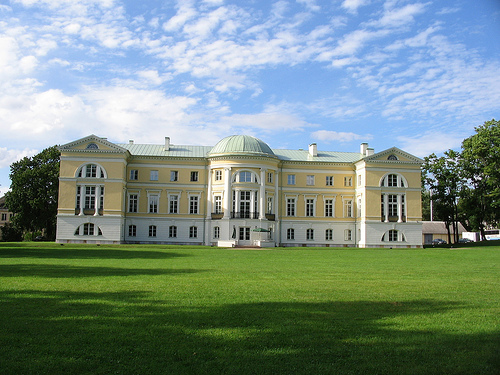
Mežotne Palace is a prominent manor house situated in the Mežotne Parish of Bauska Municipality, in the Semigallia (Zemgale) region of Latvia. Overlooking the right bank of the Lielupe River, it stands as one of the most outstanding examples of Neoclassical architecture in the country. The site has deep historical roots, originally serving as a stronghold for ancient Semigallians from the 9th to 13th centuries, with the nearby Mežotne hillfort being one of the largest such fortifications in the area. However, the manor's documented history begins in the 17th century during the era of Duke Jacob of Courland, when it functioned as a modest estate with early industrial elements like a weaving town and manufacture. The palace itself emerged in the late 18th century as a grand residence tied to Russian imperial favor.
Origins and Early History
The area's ancient significance is tied
to the Semigallians, a Baltic tribe that inhabited the region. The
Mežotne hillfort, located on the opposite (left) bank of the Lielupe
River and connected by a seasonal pedestrian bridge, was a major
defensive center in Upmale county during the medieval period.
Archaeological evidence suggests it was fortified with ramparts and
served as a key settlement until the 13th century.
By the 17th
century, under the Duchy of Courland and Semigallia, Mežotne evolved
into a manor estate. In the 1640s, during Duke Jacob's reign, a
manufacture was established, and a town of weavers developed around it,
marking early industrial activity. The estate was rented for decades by
Johann Friedrich von Medem, whose daughter Anna Charlotte Dorothea von
Medem was born there in 1761; she later became the Duchess of Courland
through marriage to Duke Peter Biron.
The pivotal moment came in 1795
when Russian Empress Catherine II granted lifetime rights to the Mežotne
estate to Charlotte Margarete von Lieven (1742–1828), a Baltic German
noblewoman who served as governess and educator to Catherine's
grandchildren, including future emperors Alexander I and Nicholas I.
This was a reward for her loyal service at the Russian court. In 1797,
Emperor Paul I (Catherine's successor) formalized it as a hereditary
estate for the Lieven family, elevating Charlotte to countess in 1799
and princess in 1826 by Nicholas I.
Construction and
Architectural Design
Construction of the palace commenced in 1797 (or
1798, per some sources) and was completed in 1802, with interior
decorations extending until 1817. The design was primarily by Italian
architect Giacomo Quarenghi, famous for his work in St. Petersburg, who
based it on his earlier Eleja Palace blueprint. German architect Johann
Georg Adam Berlitz supervised the project on-site, adding modifications
such as side avant-corps (protruding wings) to enhance the structure's
symmetry and grandeur. Berlitz was also known for designing other
Latvian manors like Durbe and Kazdanga.
The palace embodies pure
Classicism (Neoclassicism), drawing inspiration from ancient Roman
architecture. Key features include:
Exterior: A four-column
portico on the courtyard façade and a semi-rotunda on the park side,
aligning with Quarenghi's vision. The building is two stories high, with
a bel étage (piano nobile) on the first floor for state rooms.
Interiors: The centerpiece is the domed Main Hall, spanning two stories
and modeled after the Roman Pantheon, complete with an oculus and
intricate stucco work. Flanking it are enfilades of salons and a dining
room. The second floor housed living quarters and guest rooms, once
filled with paintings, sculptures, porcelain, and luxurious furniture
reflecting the Lievens' aristocratic status. A grand staircase was added
in the mid-19th century.
Park and Outbuildings: Concurrently, a
10-hectare English-style landscape park was developed, descending to the
Lielupe River with manicured lawns (maintained by grazing sheep).
Subsidiary structures included a dairy, stables, distillery, and a
renovated older manor house as the caretaker's residence, making the
estate self-sufficient.
Owners and Historical Timeline
Charlotte von Lieven, based in St. Petersburg, visited Mežotne only once
in 1818, accompanying Empress Maria Feodorovna on a trip; they stayed
just one day before departing. Upon her death in 1828, the estate passed
to her son Johann Georg von Lieven (1775–1848), who completed the
interiors after returning from Russian military service in 1817. His son
Paul Hermann von Lieven (1821–1881) inherited it next, serving as a
court official and expanding the holdings by acquiring nearby properties
like Bauska Manor (with its castle ruins), Derpele, and Krimulda. He
also finalized the farm complex.
In 1881, Paul's son Anatol Leonid
von Lieven (1873–1937) took over. Anatol began his career in St.
Petersburg's Guards Cavalry but retired in 1908 to manage Mežotne
full-time. The Lievens owned it until Latvia's independence.
Significant Events and Challenges
The palace faced turmoil in the
20th century. In 1919, during the Latvian War of Independence, it was
looted and damaged by troops under Pavel Bermondt-Avalov, a pro-German
warlord. The 1920 agrarian reform under the new Latvian Republic
dispossessed Anatol Lieven of most properties, leaving him only the
smaller Mazmežotne estate across the river until 1939.
From 1921 to
1944, it housed an agricultural school. In September 1944, during World
War II, Soviet artillery shelling partially destroyed it. Post-war, in
1946, it was repurposed by the Latvian Agricultural Experiment Station.
Restorations and Preservation
Restoration began in 1958 (or 1959)
under the Experiment Station and continued until 1989. In 1996,
ownership transferred to the State Real Estate Agency. Major
reconstruction in 2001, including hotel additions on the second floor,
saved it from ruin. These efforts preserved the Neoclassical interiors
and park, making it one of Latvia's best-maintained landscape parks.
Current Status and Use
As of 2026, Mežotne Palace operates as a
luxury hotel, hosting conferences, weddings, and cultural events. The
grounds remain open for tours, emphasizing its historical and
architectural value. It stands as a testament to Latvia's aristocratic
past and Neoclassical heritage, with ongoing preservation ensuring its
legacy.
Mežotne Palace, located in the Bauska Municipality of Latvia on the
right bank of the Lielupe River, stands as one of the most exemplary
instances of Neoclassical architecture in the country. Constructed
between 1798 and 1802, it embodies the clarity, symmetry, and elegant
simplicity characteristic of Classicism, further enhanced by its
integration with an English-style landscape park and surrounding
subsidiary structures. The palace forms a harmonious ensemble that
reflects the aristocratic ambitions of its original owners, the Lieven
family, and serves as a testament to the influence of Russian imperial
patronage on Baltic architecture. Today, it functions as a hotel and
museum, preserving its historical integrity after restorations in the
20th and early 21st centuries.
Historical Context and
Construction
The palace's origins trace back to 1795, when Russian
Empress Catherine the Great granted Mežotne Manor to Charlotte Margarete
von Lieven as recognition for her role in educating the empress's
grandchildren. In 1797, Emperor Paul I elevated it to a family estate,
prompting Charlotte to commission a new residence. Construction
commenced in 1798 under the supervision of German architect Johann Georg
Adam Berlitz, who adapted the design of Eleja Palace by renowned Italian
architect Giacomo Quarenghi. Berlitz incorporated modifications, such as
adding side transepts (also referred to as risalites or avant-corps), to
suit the site. The structural work concluded in 1802, though interior
decorations—including intricate stucco work and paintings—extended until
1817. The palace remained in the Lieven family's possession until the
1920 agrarian reform in independent Latvia, after which it endured
damage during World War II and subsequent restorations from 1959 to
1989, with further reconstructions in 2001 to accommodate modern hotel
facilities. This history underscores its role as a bridge between
18th-century Russian court influences and Latvian architectural
heritage.
Exterior Architecture
The palace is a three-story
rectangular structure, emphasizing Neoclassical principles of
proportion, symmetry, and restraint. The courtyard-facing façade is
dominated by a central portico featuring four Doric columns supporting a
triangular pediment, creating a grand entrance that evokes ancient Greek
temples while providing a sense of monumental welcome. This element
aligns directly with Quarenghi's original design inspirations. In
contrast, the park-facing façade incorporates a semi-circular
half-rotunda (or semi-rotunda protrusion), which softens the building's
lines and integrates it visually with the surrounding landscape. The
side elevations include the added transepts by Berlitz, which project
slightly forward, adding depth and rhythm to the otherwise planar form.
The façade is adorned with subtle decorative elements such as cornices,
pediments, and Doric capitals, maintaining a minimalist aesthetic
typical of early 19th-century Classicism. The building's pale exterior
walls, likely rendered in stucco or light plaster, enhance its luminous
presence against the verdant backdrop, making it a focal point in the
Semigallian landscape.
Interior Architecture
Internally, the
palace is organized around a central axis, with the first floor
dedicated to state rooms arranged in an enfilade—a sequence of
interconnected spaces that promotes flow and grandeur. The centerpiece
is the domed Main Hall, spanning two stories and modeled after the Roman
Pantheon, complete with a circular oculus or similar dome feature that
allows natural light to flood the space. This hall, considered the most
significant Classical interior in Latvia, features ornate stucco
moldings, possibly including friezes and pilasters, and serves as a hub
from which salons and the dining room radiate symmetrically on either
side. The dome's height and proportions create a dramatic vertical
emphasis, contrasting with the horizontal layout of the enfilade. The
second floor houses more private living quarters and guest rooms,
originally furnished with luxurious artworks and period furniture to
reflect the Lievens' status. Basement or ground levels likely
accommodated service areas. Decorative elements throughout include
painted motifs, gilded accents, and marble or faux-marble finishes,
though much was restored post-war to recapture the original 19th-century
elegance. The interiors blend functionality with opulence, embodying
Neoclassical ideals of harmony and rationality.
Park and
Surrounding Ensemble
Complementing the palace is a 10-hectare
English-style landscape park, developed concurrently with the building
and renowned as one of Latvia's best-designed and maintained examples.
The park features winding paths, manicured lawns, and strategic
plantings that frame views of the palace and the Lielupe River, creating
a seamless transition between architecture and nature. Subsidiary
structures, including a dairy, stables, distillery, and caretaker's
house (repurposed from an earlier manor), form a self-sufficient complex
that enhances the estate's functionality and aesthetic unity. These
outbuildings, often in complementary Neoclassical styles, contribute to
the overall ensemble, making Mežotne a holistic example of estate
planning in the Baltic region.
Significance and Legacy
Mežotne
Palace's architecture not only exemplifies Neoclassical purity but also
illustrates cross-cultural influences, from Italian design principles to
German execution, within a Latvian context. Its preservation and
adaptation as a cultural site highlight its enduring value, offering
insights into 19th-century aristocratic life and architectural
innovation. As a "miniature copy" influence on later structures like
Skrunda Manor, it holds a pivotal place in Latvia's architectural
narrative.