Location: Latgale region Map
Area: 532 km2
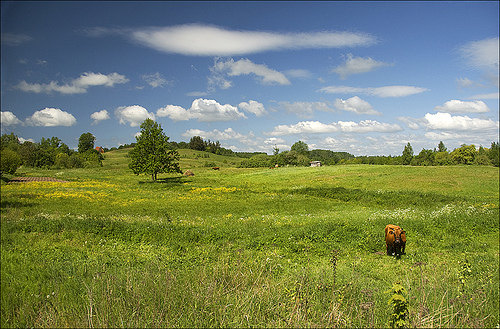
Rāzna National Park situated in the Latgale region of Latvia. It is the newest nature reserve in the country. It is a natural reserve that covers an area of 532 km2 around Lake Rāzna and adjusting wetlands as well as forests that surround it. The lake itself contains about 36 different isles that are inhabited by numerous species of birds. One of the most famous sites within borders of the natural park is a medieval Volkenberg’s Stone Castle that was constructed by the Livonian Order in the 13th century.
Geological and Prehistoric Origins
Rāzna National
Park, located in the Latgale Highlands of eastern Latvia, owes its
formation to glacial processes dating back approximately 16,000 years to
the end of the last Ice Age. During this period, retreating glaciers
shaped the region's rolling hills, moraine ridges, and numerous lakes
through erosion and deposition. The park's centerpiece, Lake Rāzna (also
known as Rāznas ezers or the "Latgale Sea"), is a prime example: it is
Latvia's second-largest lake by surface area (57.81 km²) and the largest
by water volume (0.405 km³), with a maximum depth of 17 meters. Formed
in a glacial basin, the lake features 10 islands totaling 24.6 hectares
and serves as the headwaters for the Rēzekne River. Surrounding it are
over 20 other lakes, including Lake Ežezers with its 26-36 islands (many
reedy and rushy), contributing to Latgale's nickname as the "Land of
Blue Lakes." The landscape includes diverse habitats like mixed
deciduous and coniferous forests, wetlands, grasslands, and agricultural
lands, all embedded in a hilly terrain with elevations such as Lielais
Liepukalns (289 meters, Latvia's third-highest hill) and Mākoņkalns (248
meters).
Archaeological evidence indicates human presence in the
broader Latgale region as early as the Mesolithic era, with the first
settlements appearing along lake coasts such as Lubāns, Dviete, and
Lielā Ludza. These early inhabitants were proto-Baltic peoples,
ancestors of modern Latvians and Lithuanians, who have occupied the
eastern Baltic coast for around 5,000 years. By the 7th to 9th centuries
AD, the Latgalians—a Baltic tribe—began settling and cultivating the
territory, establishing hillfort kingdoms and developing a distinct
cultural identity influenced by neighboring Slavic and Finno-Ugric
groups. Latgale's multiethnic character emerged early, with influences
from Poles, Russians, and Jews (the latter prominent due to the region's
inclusion in the Pale of Settlement during Russian rule). The area's
abundance of lakes and forests supported fishing, hunting, and
agriculture, fostering kraal-style villages that persist in some forms
today.
Medieval and Early Modern History
The medieval period
brought significant changes to the region around Lake Rāzna. In 1263,
the Livonian Order—part of the Teutonic Knights' crusade in the
Baltics—constructed Wolkenburg Castle (also known as Volkenberg’s Stone
Castle) on Mākoņkalns hill near the lake as a convent seat and defensive
stronghold. This marked the integration of Latgale into the Livonian
Confederation, a patchwork of ecclesiastical states. The castle's ruins,
now a protected historical site within the park, symbolize the era's
conflicts and Christianization efforts. Latgale remained distinct from
the rest of Latvia due to its eastern location, experiencing
Polish-Lithuanian rule after the Livonian War (1558–1583) and later
incorporation into the Russian Empire as part of the Polotsk and Vitebsk
guberniyas. This history fostered a unique cultural blend: predominantly
Catholic (unlike Protestant western Latvia), with strong traditions in
pottery, folk music, and multilingualism (Latgalian dialect, Russian,
Polish). The region's lakes, including Rāzna, supported local economies
through fishing and trade, while forests provided timber and game.
Through the 18th and 19th centuries, Latgale's rural character persisted
under Russian imperial administration. Jewish communities thrived until
World War II, when many were lost in the Holocaust, and most survivors
emigrated postwar. The area's isolation preserved traditional
lifestyles, including religious devotion—evident in sites like Aglona
Basilica, near the park, which drew massive pilgrimages (e.g., 300,000
for Pope John Paul II's 1993 visit). By the early 20th century,
following Latvia's independence in 1918, Latgale integrated into the new
republic but retained its ethnic diversity and economic reliance on
agriculture and natural resources.
Modern Environmental Concerns
and Park Establishment
The Soviet era (1940–1991) brought
industrialization and collectivization, impacting Lake Rāzna's ecology.
Intensive agriculture and pollution led to noticeable degradation by the
late 1980s. Between 1989 and 1991, Latvia's Environmental Protection
Committee first highlighted the lake's deteriorating condition compared
to the 1950s and 1960s, noting eutrophication and biodiversity loss.
This sparked initial conservation efforts amid Latvia's push for
independence.
Post-independence, momentum built for protection:
1995: Latvia adopted the National Environmental Policy Plan,
emphasizing sustainable development and unique ecosystems—a pioneering
document in the region.
1997: Daugavpils University proposed
functional zoning for the Rāzna Lake catchment to balance conservation
and use.
1999: The Latvian Nature Protection Fund funded a Daugavpils
University project to establish Rāzna Nature Park, focusing on the
lake's biodiversity (over 340 bird species, mammals like beavers,
otters, and wolves) and 14 EU-protected habitats.
2001: Eight local
parishes (Andrupene, Andzeļi, Ezernieki, Čornaja, Kaunata, Mākoņkalns,
Lūznava, and Rundēni) signed a letter of intent supporting the park's
creation, reflecting grassroots involvement.
2004: The Cabinet of
Ministers approved the Rāzna Nature Park. Concurrently, the EU-funded
LIFE Nature project "Protection of Species and Habitats in the Nature
Park Rāzna" launched to develop management strategies.
2005: Work
began on a nature protection plan under the LIFE project.
2007: On
January 1, the Rāzna National Park Law took effect, upgrading the area
to national park status. Covering 59,615 hectares (making it Latvia's
second-largest and youngest national park), it spans parts of Rēzekne,
Dagda, and Ludza municipalities. Designated a Natura 2000 site (code
LV0303400), it protects not only natural features but also Latgale's
cultural landscape, including traditional meadows, forests, and
historical sites.
The park's establishment aligned with EU
accession requirements, emphasizing biodiversity and sustainable
tourism. Management zones include a strict nature reserve (6% of the
area), a national park zone for low-intensity activities, a landscape
protection zone for traditional land use, and a neutral zone for natural
evolution.
Post-Establishment Developments and Challenges
Since 2007, the park has focused on reconciling conservation with local
needs. Home to about 5,000 residents (mostly on private land), it has
faced challenges like landowner concerns over permits for mowing,
burning, or forestry, leading to misconceptions about restrictions. This
reflects tensions between top-down EU policies (e.g., Natura 2000) and
rural traditions, compounded by historical mistrust of state
institutions. In response, the Nature Conservation Agency has extended
the management plan to 2024, initiated volunteer ranger programs, and
held outreach meetings to foster dialogue.
The park promotes
eco-tourism, highlighting its trails, birdwatching, and cultural
heritage—like the Volkenburg ruins and Latgalian folklore. It supports
fish stocks in Lake Rāzna for recreational and industrial fishing, while
preserving semi-natural habitats. As a symbol of Latgale's identity,
Rāzna National Park encapsulates the region's resilient history: from
glacial birth to Baltic tribal roots, medieval fortifications, and
modern environmental stewardship.
Rāzna National Park is the youngest national park in
Latvia, established on January 1, 2007, to protect the natural values of
Lake Rāzna and its surrounding landscapes, including a characteristic
cultural and landscape environment of the Latgale region. It is also a
designated Natura 2000 territory, emphasizing its role in preserving
biodiversity and habitats of European importance. As the second-largest
national park in the country, it serves as a key conservation area in
eastern Latvia, balancing natural protection with recreational
opportunities.
Location and Size
The park is situated in the
Latgale Highlands of eastern Latvia, spanning parts of the Rezekne,
Ludza, and Krāslava districts. It covers the Kaunata, Mākoņkalns,
Čornajas, and Lūznavas parishes in Rezekne Municipality; Andzeļi,
Andrupene, and Ezernieki parishes in Dagda Municipality; and Rundēnu
parish in Ludza Municipality. Geographically centered around coordinates
56°16′N 27°30′E, the park occupies a total area of 59,615 hectares
(approximately 596 km²), making it a vast protected zone in the "land of
the blue lakes" – a nickname for the lake-rich Latgale region. This
expansive territory integrates rolling highlands with a mosaic of
natural and agricultural features, reflecting the broader physiographic
division of Latvia's eastern uplands.
Topography and Relief
The topography of Rāzna National Park is predominantly shaped by glacial
processes from the last Ice Age, approximately 16,000 years ago,
resulting in a hilly landscape characterized by moraine ridges, rolling
hills, and undulating terrain. This glacial legacy creates a varied
relief that includes eskers, drumlins, and other post-glacial landforms
typical of the Baltic region. The park's elevation varies, with the
highest point being Lielais Liepukalns hill at 289 meters above sea
level – the tallest hill in Latgale and the third highest in all of
Latvia. Other notable elevations include Mākoņkalns hill, which offers
panoramic views over Lake Rāzna and exemplifies the park's
hillock-dominated scenery. The overall relief contributes to a diverse
microclimate and habitat distribution, with slopes supporting varied
vegetation and valleys often hosting wetlands or streams. Ancient castle
mounds, remnants of historical human interaction with the landscape, dot
the hilly areas, adding a cultural dimension to the physical geography.
Hydrography
Water bodies are a defining feature of the park's
geography, with eutrophic lakes covering about 14% of its territory and
forming a complex hydrographic network. At the heart is Lake Rāzna,
Latvia's second-largest lake by surface area (57.6 km²) and the largest
by volume (0.405 km³), often called the "Sea of Latgale" due to its
expansive sandy beaches, fish-rich waters, and recreational appeal. This
lake serves as the headwaters for the Rēzekne River and is fed by
surrounding streams and smaller lakes, creating an interconnected
catchment system. The park encompasses over 20 additional lakes, varying
in size and character: from the small Lake Asariņš to the island-rich
Lake Ežezers (with 26 islands, the most of any Latvian lake, covered in
deciduous and spruce forests with mineral-rich springs). Other notable
lakes include the clear Lake Olovecs and various ponds and streams that
enhance the wetland mosaic. This abundance of water features, including
springs and minor rivers, supports diverse aquatic ecosystems and
contributes to the park's lakeland identity.
Vegetation and
Habitats
The park's vegetation forms a heterogeneous mosaic
influenced by its glacial topography and hydrology, including mixed
deciduous and coniferous forests, wetlands, grasslands, and agricultural
lands. Boreal forests dominate in upland areas, while oak forests and
mineral-rich springs are preserved on islands and slopes. Meadows
exhibit relatively high diversity, with four types recognized as
habitats of European importance under the EU Habitats Directive,
alongside a total of 14 Annex I habitats. Wetlands and grasslands
interspersed with forests create transitional zones that enhance
ecological connectivity. Agricultural lands, though present, are
integrated into the landscape, often bordering natural areas. Soils are
not extensively detailed in sources, but the glacial moraines suggest
podzolic and gleyic soils typical of post-glacial Baltic regions,
supporting this vegetation diversity. Climate information is limited,
but the park's location in eastern Latvia implies a continental climate
with cold winters (average January temperatures around -5°C to -7°C) and
mild summers (July around 17°C), moderated by the numerous lakes which
influence local humidity and frost patterns.
Biodiversity as Part
of Geography
Biodiversity is intrinsically linked to the park's
geographical features, with the varied topography and hydrography
fostering habitats for over 340 bird species, including the great
bittern and various grebes, making it an EU-designated Important Bird
Area. Mammals such as the Eurasian beaver, Eurasian otter, and grey wolf
thrive in the wetland-forest mosaic, while rare plants like Geum rivale
and Euphrasia stricta are found in specific meadow and block sites.
Islands in lakes like Ežezers support woodpecker nesting and
EU-protected species such as the green dicotyledonous and yellow cuckoo.
This richness underscores the park's role in conserving Latvia's
glacial-influenced ecosystems, with diverse flora and fauna adapted to
the hilly, lake-dotted terrain.
Rāzna National Park, established in 2007 in Latvia's Latgale region,
spans approximately 532 square kilometers and protects a diverse mosaic
of ecosystems shaped by glacial activity. These include over 20 lakes
(with Lake Rāzna as the centerpiece), rolling hills, mixed forests,
wetlands, grasslands, and agricultural lands. The park is a Natura 2000
site and an EU-designated Important Bird Area, safeguarding 16 habitats
and 71 species of European and international importance, including rare
and endangered flora and fauna. This biodiversity is influenced by the
park's eutrophic lakes, boreal forests, raised bogs, and mineral-rich
springs, which support a rich interplay of plant and animal life.
Conservation efforts, such as habitat restoration and species
reintroduction, have enhanced its ecological value.
Flora:
Vegetation Types and Key Species
The park's flora reflects its varied
habitats, from nutrient-rich lake edges to acidic bogs and ancient
forests. Approximately 14% of the area is covered by water bodies,
fostering aquatic and wetland plants, while forests dominate the islands
and hillsides. Deciduous and coniferous woodlands intermingle, creating
biodiverse understories, and raised bogs host specialized,
low-nutrient-adapted species. The park protects several EU-priority
habitats, including natural deciduous forests on Lake Ežezers' 26
islands, boreal forests, oak woodlands, and unimproved grasslands.
Key vegetation types and notable species include:
Deciduous
Forests: Dominant on islands and hills, featuring broadleaf trees such
as oak (Quercus robur), linden (Tilia cordata), birch (Betula pendula),
aspen, elm, maple, alder (Alnus glutinosa), rowan (Sorbus aucuparia),
bird cherry (Prunus padus), and fly honeysuckle (Lonicera oblongifolia).
Undergrowth includes hazel (Corylus avellana), with ground layers of
purple dragon (Lamium maculatum), bitter pea-vine (Lathyrus vernus),
white sanicle (Ageratina altissima), greater stitchwort (Stellaria
holostea), liverleaf (Hepatica nobilis), lily of the valley (Convallaria
majalis), blueberry (Vaccinium myrtillus), bracken (Pteridium sp.),
yellow anemone (Anemone ranunculoides), dog violet (Viola riviniana),
and white anemone (Anemone nemorosa).
Coniferous and Mixed Forests:
Spruce (Picea abies), pine (Pinus), and larch (Larix decidua) mix with
deciduous elements. Rare forms like silver lime (Picea abies 'Virgata')
and thuja (Thuja occidentalis) appear in managed areas like Luznava
Manor Park, which hosts over 40 tree and shrub species.
Wetlands and
Bogs: Raised bogs, such as Andrupene Mire, support acid-loving plants
like sphagnum moss (Sphagnum fuscum, S. magellanicum), hare's-tail
cottongrass (Eriophorum vaginatum), cranberries (Vaccinium oxycoccos),
bog rosemary (Andromeda polifolia), heather, crowberries, round-leaved
sundew, Labrador tea (Ledum palustre), and leatherleaf (Chamaedaphne
calyculata). Herbaceous layers include raspberry (Rubus idaeus) and wild
strawberry (Fragaria vesca).
Meadows and Grasslands: Unimproved
grasslands feature cowslip (Primula veris), quaking grass (Briza media),
marsh geranium (Geranium palustre), yellow archangel (Galeobdolon
luteum), asarabacca (Asarum europaeum), male fern (Dryopteris
filix-mas), stone bramble (Rubus saxatilis), and riverside avens (Geum
rivale). Four types of EU-important meadow habitats are present.
Aquatic and Riparian Plants: Eutrophic lakes support free-floating
vegetation (Magnopotamion or Hydrocharition-type) and benthic
charophytes (Chara spp.). Protected species include green clubmoss
(possibly "green dicotyledonous" referring to a mistranslation), yellow
rattle ("yellow cuckoo"), black cotoneaster (Cotoneaster niger), lady's
slipper orchid (Cypripedium calceolus), foxglove (Digitalis
grandiflora), clubmoss (Lycopodium annotinum), and eyebright (Euphrasia
stricta). Rare mosses like Dicranum viride, Ulota crispa, Neckera
pennata, and blunt feathermoss (Homalia trichomanoides), along with
lichens (Collema sp.), highlight the park's cryptogam diversity.
These plants face threats from forestry and agriculture, but strict
protections in nature reserve zones (6% of the park) preserve rare
biotopes.
Fauna: Animal Diversity and Key Species
The park's
fauna thrives in its interconnected habitats, with lakes serving as
breeding and feeding grounds, forests providing shelter, and wetlands
attracting migrants. It hosts over 30,000 species across Latvia's
protected areas, but Rāzna stands out for its mammalian predators, avian
richness, and aquatic life. Conservation includes reintroduction
programs and anti-poaching measures.
Mammals
Large carnivores
and herbivores are prominent, including grey wolf (Canis lupus),
Eurasian lynx (Felis lynx), brown bear (Ursus arctos) (though few), red
fox (Vulpes vulpes), red deer (Cervus elaphus), moose (Alces alces),
wild boar (Sus scrofa), Eurasian beaver (Castor fiber), Eurasian otter
(Lutra lutra), and pine marten (Martes martes). Bats (Vespertilionidae
family) roost in forests.
Birds
As an Important Bird Area, the
park supports over 340 species, many protected. Notable residents and
migrants include great bittern (Botaurus stellaris), grebes (e.g., great
crested grebe Podiceps cristatus), red-breasted flycatcher (Ficedula
parva), black woodpecker (Dryocopus martius), osprey (Pandion
haliaetus), white-tailed eagle (Haliaeetus albicilla), mute swan (Cygnus
olor), black stork (Ciconia nigra), corncrake (Crex crex), lesser
spotted eagle (Aquila pomarina), white-backed woodpecker (Dendrocopos
leucotos), Eurasian golden oriole (Oriolus oriolus), great cormorant
(Phalacrocorax carbo), white stork (Ciconia ciconia), common crane (Grus
grus), grey heron (Ardea cinerea), and pied flycatcher (Ficedula
hypoleuca). Woodpeckers favor island forests, while wetlands attract
waders and raptors.
Fish and Aquatic Life
Lake Rāzna and
others harbor 90% of Latvia's freshwater fish species, including vendace
(Coregonus albula), European whitefish (Coregonus lavaretus), and three
EU-endangered species (unspecified, but likely including asp or others).
Aquatic invertebrates include pond snails (Lymnaea sp.), freshwater
clams (Bivalvia sp.), and stoneworts (Charales sp.).
Amphibians,
Reptiles, and Invertebrates
The European fire-bellied toad (Bombina
bombina) was reintroduced to restored wetlands. Other amphibians are
present, along with non-marine molluscs like Ena obscura, Clausilia
cruciata, Macrogastra plicatula, and Clausilia dubia. Insects include
the beetle Peltis grossa.
At the lakes
(mainly Rāzna and Ežezers lakes): boat trips, fishing, water sports,
relaxation on the beaches, picnics, traditional saunas.
In the
rivers: canoeing, fishing, traditional sauna.
Forests: hiking
(some marked paths)
Meadows: horse-drawn sleigh rides.
5
routes for cyclists
Tourist accommodation in the park has a
capacity of 578 beds.