Location: 75 km (47 mi) South of Riga
Info: pagasta eka, 6376 3472
www.tervetesnov.lv
Anna Brigadere Museum
Spridisi Tel. 2653 2691
Open: May- Oct: 10am- 5pm Wed- Sun
Tervete History Museum
Jerumi
Tel. 2989 6804
Open: May- Sep: 10am- 5pm Tue- Sun
Tervete Nature Park is situated 75 km (47 mi) South of Riga in Latvia. It only takes about one hour to get from the Latvian capital. The paths are well marked and easy to follow. Most of the Tervete Nature Park lies in the pine forests. Some of the trees are over 300 years old. Additionally to clean and healthy air the forest might be interesting to the kids. The natural park contains several playgrounds with fairly tale houses and sculptures. Additionally you can find historic medieval ruins of the Dobele Castle as well as ancient castle mounds. Another popular destination in the Tervete Nature park is a Swans Lake. Boats are available for rent if you feel like exploring the quiet banks of the lake. Additionally you can spend the whole day fishing, bird watching or swimming. Most of the tourists try to make here during Zemgalians Festival and Craftsmen Fair that are held here annually.
Ancient Origins and Semigallian Heritage
The history of
Tērvete Nature Park in Latvia is deeply rooted in the ancient
Semigallian culture, dating back to the Iron Age and the first
millennium BC. Tērvete was a prominent Semigallian center, serving
as a powerful political and residential hub for kings such as
Viestards, Namejs (also known as Nameisis or Nameiķis), and possibly
Šābis during the 13th century. This era marked a period of fierce
resistance against invading forces, particularly the German
(Livonian) Order, as the Semigallians fought to maintain their
political and economic independence until the late 13th century.
The Tērvete Archaeological Complex, which forms a key part of the
park's historical landscape, includes several significant sites
shaped primarily between the 11th and 13th centuries. These
encompass the Tērvete Hillfort with its two castle-fronts, the
hillock Svētais Kalns (Holy Hill) with an additional castle-front,
an ancient town settlement, hillocks like Putnu Kalns (Bird Hill)
and Klosterkalns (Monastery Hill), and the ruins of the Livonian
Order Castle. The hillfort, one of the largest in the Baltic region,
featured a Semigallian wooden castle with protective ramparts,
residential and farm buildings, and craft workshops. Its steep
slopes and massive rampart have been preserved, highlighting the
defensive engineering of the time. Archaeological finds from the
site include unique artifacts, such as a piece of clay plaster
depicting a piper—the only one of its kind in Latvia.
In the
medieval period, following battles with the Livonian Order, the
original Semigallian wooden castle on the Tērvete Castle Mound was
abandoned. The Order later constructed a brick bastion over the site
in the 1300s, whose impressive ruins still stand today as a
testament to this turbulent history. To preserve and showcase this
heritage, a reconstruction of the 12th-century Semigallian wooden
castle began based on archaeological research, with the eastern part
already completed. The site's exposition details Semigallian history
during the Iron Age, featuring Latvia's richest collection of
replicas of iron decorations, weapons, household items, and garment
reconstructions. Highlights include a wax statue of Governor
Viestards and the country's largest sword exhibition. This
reconstruction not only educates visitors about ancient Semigallia
but also symbolizes the enduring Latvian spirit of resilience.
The park itself protects three ancient mounds, including the Tērvete
Castle Mound, integrating these historical elements into its natural
setting. Nearby, the Pokaiņi Forest adds an layer of mystery: in the
mid-1990s, a local historian discovered stone cairns arranged by
humans throughout the area, sparking ongoing debates about their
origins and purpose—one of Latvia's biggest unsolved historical
enigmas.
Transition to Modern Recreation and Park
Establishment
While Tērvete's ancient roots provide a heroic and
mystical backdrop, the modern Tērvete Nature Park—officially the
Latvia's State Forests (LVM) Nature Park in Tērvete—emerged in the
20th century as a recreational haven. Its origins trace back to
1958, when the first walking trails were established in what is now
the Sun Mood Park, initially focusing on a smaller forested area.
The park was formally founded in 1977, expanding to incorporate
fairy-tale-themed elements and covering a third of its area with a
"Fairytale World."
A pivotal shift occurred in 2000 when
management transferred to JSC “Latvia's State Forests” (LVM),
leading to extensive infrastructure upgrades. This period
transformed the park into a family-oriented destination spanning
over 1,200 hectares, with about 400 hectares landscaped for
accessibility, including paths for pedestrians, cyclists,
wheelchairs, and prams. Key developments included the creation of
thematic zones inspired by Latvian writer Anna Brigadere's fairy
tales, such as "The Tale of Sprīdītis." The Land of Sprīdītis
features wooden sculptures of characters like Sprīdītis, the giant
Lutausis, the Forest King, Annele, and various mythical figures,
blending literature with nature.
Cultural and Recreational
Evolution
Anna Brigadere's influence is central to the park's
cultural significance, with sections like the Fairytale Forest
(featuring witches, devils, and enchanted elements), the Dwarf
Forest (with villages, towers, and yards), and the Amusement Square
(including mazes, obstacle trails, and river views) drawing directly
from her stories. These additions made the park a living tribute to
Latvian folklore, attracting families and tourists year-round
(except December 31 and January 1).
In recent decades, the park
has continued to evolve with additions like the Land of Kurbads (for
older visitors, including a 3 km skills bike park), partner
attractions such as the Tērvete Tarzan Park, Net Park, and Butterfly
Tropical House, as well as facilities like a Tourist Information
Centre, picnic areas, rentals (bicycles, Nordic walking sticks), a
Fairytale train, and horseback riding. Educational elements, such as
the Green Classroom and Old Pine Park, emphasize environmental
awareness.
The park's excellence was recognized in 2009 when it
was named Latvia's European Destination of Excellence (EDEN) in the
category of tourism and protected areas, underscoring its blend of
nature, history, and culture. Today, it remains one of Latvia's most
popular family destinations, requiring at least three hours to
explore its core areas, and serves as a bridge between the ancient
Semigallian past and contemporary sustainable tourism.
Tērvete Nature Park, also known as Latvia's State Forests Nature
Park in Tērvete, is a prominent natural and recreational area
located in the Tērvete parish of Dobele Municipality, within the
Zemgale region of Latvia. It lies approximately 70-90 km southwest
of Riga, the capital city, making it easily accessible for day
trips. The park spans over 1,200 hectares (about 2,965 acres), with
roughly one-third dedicated to themed "Fairytale World" attractions
inspired by Latvian literature, particularly the works of writer
Anna Brigadere. The majority of the territory is forested,
emphasizing conservation and outdoor activities. Established in 1958
with initial walking trails and managed by JSC “Latvia's State
Forests” since 2000, the park integrates natural beauty with
cultural elements, such as wooden sculptures and fairy-tale
characters. It features a 35-kilometer network of trails suitable
for pedestrians, cyclists, families with strollers, and individuals
with mobility impairments, covering about 400 hectares of landscaped
areas.
Topography and Terrain
The park's topography is
characterized by gently rolling terrain within the broader Zemgale
plain, a relatively flat lowland region in southern Latvia.
Elevation varies moderately, with a minimum of about 95 feet (29
meters) and a maximum of 289 feet (88 meters), resulting in an
overall elevation gain and loss of around 190 feet (58 meters)
across typical loop trails. This creates a landscape of subtle
hills, valleys, and bends, enhanced by man-made features like
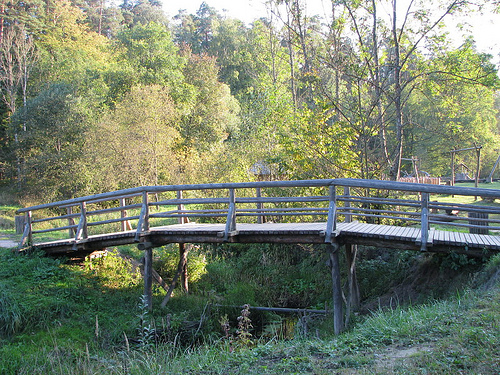
footbridges, plankways, and bridges that span depressions and water
bodies. The terrain is described as moderate in difficulty for
hiking, with winding pathways that traverse forested slopes and open
areas. A notable feature is the valley of the Tērvete River, which
adds depth and scenic variety, including stair-accessible sections
on the river's left bank near Amusement Square. The park also
includes specialized areas like the Tērvete Skills Bike Park, a
nearly 3-kilometer trail with obstacles, elevations, and turns
designed for cyclists and pedestrians. From elevated points, such as
the wooden sightseeing tower, visitors can overlook the expansive
Tērvete pine forest and the surrounding Zemgale plain, providing
panoramic views of the lowland geography.
Hydrography
The
Tērvete River is the primary water feature, winding through the park
and forming a central valley that influences much of the landscape.
This river creates natural divisions, with attractions like wooden
sculptures (e.g., characters Lutausis and Sprīdītis) positioned
along its banks. Bridges and plankways facilitate crossings,
enhancing accessibility across the valley. The park may also include
smaller wetlands, contributing to a diverse hydrological environment
that supports local ecosystems. No large lakes or major tributaries
are prominently mentioned, but the river's presence adds to the
park's humid, verdant character.
Vegetation and Forests
Forests dominate the park, covering most of its 1,200 hectares and
featuring a mix of coniferous and mixed woodlands. Key areas
include:
Old Pine Park: Located on the right bank of the
Tērvete River, this 30-hectare stand contains some of Latvia's
oldest and tallest pine trees, many approaching 300 years in age and
exceeding 40 meters (131 feet) in height. It represents mature
boreal forest ecosystems.
Dwarf Forest: Includes themed sections
like Dwarf Village, Dwarf Town “Cones,” and Dwarf Yard, with
accessible trails amid dense woodland.
Fairytale Forest: Features
pinewood areas such as the Witch's Pinewood, integrated with
sculptures.
Land of Kurbads: A developing sector with thematic
forests for older visitors.
Overall, the vegetation
emphasizes pine-dominated stands, with meadows interspersed for
biodiversity. The park's flora supports recreational trails and is
managed for sustainability, blending natural growth with landscaped
paths.
Fauna
While not extensively detailed in sources,
the park hosts a variety of wildlife typical to Latvian forests.
Mentioned species include bats and spiders in themed areas like the
Witch's Pinewood, suggesting habitats for nocturnal and invertebrate
life. A small animal garden allows interaction with domestic Latvian
animals such as goats and rabbits. Broader ecosystems likely support
birds, small mammals, and insects, given the mix of forests,
meadows, and wetlands, making it suitable for birdwatching and
nature observation.
Geological Aspects
Specific geological
details are limited, but the park lies within the Zemgale plain, a
post-glacial lowland formed during the Pleistocene era,
characterized by sedimentary deposits and moraine features. The
subtle elevations and river valley suggest glacial influences, with
sandy soils supporting pine forests. No prominent rock formations or
unique geological sites are highlighted, though the area's history
includes ancient hillforts nearby, indicating long-term human
interaction with the stable terrain.
Climate and Seasonal
Features
As part of Latvia's temperate humid continental climate,
the park experiences mild summers (average highs around
20-25°C/68-77°F) and cold winters (lows to -5°C/23°F or below), with
significant precipitation year-round (about 600-700 mm annually).
This supports lush vegetation and makes the park accessible in all
seasons, though winter may bring snow-covered trails. It is open
year-round, excluding December 31 and January 1, with varying hours
to accommodate daylight.