Skārņu iela 10
Tel. 722 78 33
Open: 11am- 5pm
Closed: Mondays
The Museum of Decorative Arts and Design is a museum in Riga, Skārņu Street 10. Its exposition reflects the work of the leading decorative art and design artists of Latvia, as well as introduces the dominant directions and styles in design and decorative art in the period from the end of the 19th century to the present day.
The Museum of Decorative Arts and Design (MDAD) in Riga, Latvia, is
uniquely situated in one of the city's most historically significant
structures: the former St. George's Church, which stands as the oldest
surviving stone building in Riga. Constructed between 1204 and 1209
using dolomite from the Daugava River, the building originally served as
a chapel for the castle of the Order of the Brothers of the Sword, a
precursor to the Livonian Order. It is first documented in the Chronicle
of Henry of Livonia in 1209, described for its laconic Romanesque
architecture featuring thick walls, narrow arched windows, and simple,
clear forms. Dedicated to Saint George, the patron saint of knights, the
chapel survived the tumultuous events of 1297, when conflicts between
Riga's citizens and the Order led to the sacking and partial destruction
of the surrounding castle.
Following the relocation of the Order's
castle, the site transitioned in the 13th century into the Convent of
the Holy Spirit, a charitable institution. In 1488, it was taken over by
a Tertiary Order (a lay branch of the Franciscans) and renamed the
Church of the Holy Spirit, incorporating an almshouse in the 16th
century to provide care for the needy. The Reformation in the 1520s
brought significant changes, shifting the building away from its
religious functions. By 1554, its bell had been removed, and the prayer
hall was repurposed by the city council as rental warehouses, divided
internally with walls and intermediate floors to maximize storage space.
In the mid-17th century, the structure evolved into a commercial hub,
storing goods such as hemp, flax, and mast pines, capitalizing on its
proximity to the harbor and market square. It earned the nickname "dove
warehouses" (including the Blue, White, and Brown Dove) due to dove
symbols adorning its facade. This utilitarian phase lasted for
centuries, embedding the building deeply into Riga's economic history.
The entire 800-year narrative of Riga—from medieval conquests to trade
dominance—is metaphorically encapsulated within its white dolomite
walls. The building, now part of the Convent Court (Konventa sēta) in
Vecrīga (Old Riga) along Skārņu iela, remains an architectural monument
of national importance, with preserved elements like 17th-century wooden
posts, exposed Romanesque walls, windows, and a triumphal arch revealing
the original apse.
The transformation into a museum space began in
the late 20th century. Between 1986 and 1989, a Polish monument
restoration company undertook extensive renovations to adapt the
historic structure for cultural use, carefully integrating modern
exhibition needs with the building's ancient features.
Establishment and Early Development of the Museum
The Museum of
Decorative Arts and Design traces its roots to collections that began
forming in the 1920s, initially as part of broader efforts to preserve
Latvian cultural heritage within institutions like the Riga City Art
Museum (established in 1905) and later the State Art Museum. These early
acquisitions focused on decorative and applied arts, reflecting Latvia's
burgeoning national identity amid post-World War I independence. The
museum itself was formally established on January 1, 1989, as the Museum
of Decorative and Applied Arts, a pivotal moment in Latvia's cultural
landscape following the loosening of Soviet-era restrictions and the
push toward national revival. It opened its doors to the public on July
6, 1989, marking the beginning of its role as a dedicated space for
showcasing Latvian craftsmanship.
Initially part of the Latvian Art
Museums' Association, the museum gained independent legal status as a
state institution under the Ministry of Culture of the Republic of
Latvia on January 1, 2000. This autonomy allowed for greater flexibility
in operations and exhibitions. A significant rebranding occurred in
2005, when it was renamed the Museum of Decorative Arts and Design to
better reflect its expanding scope, which now explicitly included
contemporary design alongside traditional applied arts. The design
collection was formally launched in 2005, with acquisitions beginning in
earnest by 2006, broadening the museum's focus to encompass modern and
innovative works.
On January 1, 2010, the MDAD was incorporated as a
branch of the Latvian National Museum of Art (LNMM), aligning it with a
larger network of national cultural institutions while maintaining its
specialized identity. This integration has facilitated collaborations,
resource sharing, and enhanced visibility.
Collection Development
and Focus
The museum's collection, now exceeding 11,928 items, has
been meticulously built to represent the evolution of professional
Latvian decorative applied arts and design from the late 19th century to
the present day. Divided into seven key areas—textile art, ceramics and
porcelain, metal art, leather art, decorative woodworking, glass art,
and design—the holdings emphasize works by leading Latvian artists and
designers. Foreign artworks are primarily acquired through donations,
keeping the core focus on Latvian contributions.
Early development
drew from folk craft traditions and ethnographic heritage, particularly
during Latvia's first national awakening in the late 19th and early 20th
centuries. Prominent figures like Jūlijs Madernieks (1870–1955), Jūlijs
Straume (1874–1970), Ansis Cīrulis (1883–1942), Jēkabs Bīne (1895–1955),
and Arvīds Dzērvītis (1847–1942) played crucial roles in forging a
national style. The collection boasts the largest holdings of works from
the Baltars porcelain painting workshop, a cornerstone of Latvian
modernism founded in the 1920s. Artists such as Romans Suta (1896–1944),
Aleksandra Beļcova (1892–1981), and Sigismunds Vidbergs (1890–1970)
infused their pieces with abstract geometrical forms inspired by Cubism,
Futurism, and Art Deco, blending graphic subtlety with vibrant colors.
Several objects are inscribed in Latvia's Canon of Art and Design, and
many have garnered international recognition. Around 500 items are
typically on display in the exhibition halls, with the permanent
exhibition "Classical Values" on the second floor narrating the
trajectory of Latvian decorative arts from the end of the 19th century
onward.
Mission, Exhibitions, and Contemporary Role
The MDAD's
mission is to survey, preserve, study, and popularize Latvian decorative
art and design achievements, serving as a dynamic platform for creative
exchange between designers, artists, and the public. It regularly
organizes exhibitions drawing from its own holdings and those of partner
institutions, exploring the past, present, and future of the field.
Notable projects include interdisciplinary collaborations with
international partners, such as the 2016 exhibition "Journey to the
Nowhere" featuring kinetic design pioneer Arturs Riņķis and photographer
Iveta Vaivode, and the 2022 "Hand-crafts" exhibition examining Latvian
textile heritage through a 21st-century lens.
Online initiatives,
such as "From the Church to the Museum" (detailing the building's
transformation), "The Ornamental Universe of Jūlijs Madernieks," and
"Porcelain Collection of Romans Suta," have expanded accessibility. The
museum continues to reflect current trends in art, fashion, and design
through experimental projects, fostering synergy across disciplines.
The Museum of Decorative Arts and Design (MDAD) in Riga, Latvia, is a
premier institution dedicated to preserving and showcasing professional
Latvian decorative applied arts and design from the late 19th century to
the present day. Housed in the historic former St. George's Church at 10
Skārņu iela in Riga's Old Town—the oldest surviving stone building in
the city, dating back to 1204—the museum opened to the public in 1989,
though its collection began forming in the 1920s. As part of the Latvian
National Museum of Art network, MDAD holds the largest collection of its
kind in Latvia, totaling over 11,928 items, with around 500–522
typically on display. Several pieces are enshrined in Latvia's Canon of
Art and Design and have garnered international acclaim. The collection
primarily features works by Latvian artists, with foreign pieces mostly
acquired through donations. It emphasizes artistic styles, technological
innovations, and creative processes across various mediums.
The
museum's permanent exhibitions include "Classical Values" on the second
floor, which traces Latvian decorative applied arts from the late 19th
century to the 1960s, and "Design Process" on the third floor (updated
in 2022), which explores Latvian design from the 1960s onward through
seven thematic stations: Nature, Environment, Human, Modern City, Public
Space, Form and Material, and Open Borders. An interactive exhibit,
"Rīgas audums," showcases hundreds of printed fabric patterns reflecting
historical fashion, art styles, and textile creativity. MDAD also hosts
temporary exhibitions, workshops (e.g., woodblock and screen printing),
and the Design Studio for Children, an engaging space for hands-on
activities like material exploration, poster creation with wooden
puzzles, kinetic experiments with colors and patterns, ceramic shaping,
and weaving simulations. The museum collaborates with initiatives like
the Riga International Textile and Fibre Art Triennial and maintains
digital access via Google Arts & Culture for selected works and stories.
The collection is organized into seven specialized sub-collections, each
highlighting distinct materials and techniques while reflecting broader
trends in Latvian art, from National Romanticism and Art Nouveau
influences to modernist experiments, Soviet-era stylistics, and
contemporary innovations.
Ceramics Collection
This is the
museum's largest sub-collection, with about 5,000 artworks spanning from
the late 19th century to today. It illustrates the evolution of ceramics
through architectural elements, garden ceramics, porcelain ware,
decorative groups, and figurines. Early pieces embody National
Romanticism and Art Nouveau styles, including works by Jēkabs Dranda,
Pēteris Šteinbergs, and Ansis Cīrulis. The foundation was bolstered by
the 1924 establishment of the Ceramics Department at the Art Academy of
Latvia under Professor Rūdolfs Pelše, making ceramics the only
decorative art discipline taught professionally at the time.
A
standout feature is the porcelain from the Baltars studio (1924–1928),
founded by Romans Suta, Aleksandra Beļcova, and Sigismunds Vidbergs,
which earned gold and bronze medals at the 1925 International Exhibition
of Art and Industry in Paris. The collection also includes items from
the Burtnieks and L'Ripor studios, where Vidbergs and Niklāvs Strunke
worked in the 1930s. Post-war pieces from the 1940s to 1980s feature
extensive ware designs like services and vases, alongside decorative
compositions; garden ceramics emerged as a new field in the late 1960s.
Contemporary works are associative, employing complex technologies in
porcelain, clay, stoneware, and combinations with metal or
unconventional materials.
Design Collection
Initiated in 2006,
this collection prioritizes industrial design objects created by or
involving Latvian designers in innovative ideas or technical execution,
alongside high-standard unique designs and select foreign pieces. It
contains over 100 objects, including industrial items from key
20th-century Latvian factories. Notable artists include Māra Skujeniece,
Juris Mednis, Valters Kiršteins, and Laima Kaugure (Studio NATURALS). A
highlight is the complete overview of BLUE microphones, a globally
acclaimed brand by Latvian designer Mārtiņš Saulespurēns, which has won
multiple prestigious awards.
The collection is continually updated
with new acquisitions, focusing on design award winners, competitions,
and professional milestones from past decades to the present. It
underscores collaborations, such as with the Design Information Centre,
and participation in events like the annual Days of Design in Latvia.
Textile Art Collection
Encompassing all forms of Latvian textile
art from the early 20th century to today, this collection highlights
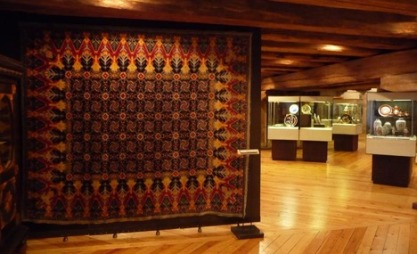
high-artistic-quality pieces from the 1920s and 1930s, such as rugs
woven in Persian technique based on sketches by Jūlijs Madernieks, Ansis
Cīrulis, and Jūlius Straume. A unique early example is an altar-frontal
embroidered around 1910 from painter Janis Rozentāls' sketch.
Systematic acquisitions ramped up in the 1960s, aligning with the rise
of professional textile art, featuring early and mid-generation artists
like Ella Ūdre-Dviele, Vera Viduka, Erna Ošele, and Milda Klēbaha. The
late 1960s introduced innovative voices such as Aija Baumane, Ērika
Iltnere, Lilita Postaža, and Ruta Bogustova. The bulk of holdings date
from the 1970s and 1980s, including works by Rūdolfs Heimrāts (founder
of the Latvian textile art school) and Georgs Barkāns, plus nearly all
major textiles by Edīte Pauls-Vīgnere, known for emotional intensity.
Beyond classical Gobelin tapestries, it includes spatial textiles
popular in those decades. Recent additions emphasize fiber art,
reflecting contemporary diversity and creative liberty.
Glass Art
Collection
With around 200 artworks, this collection covers stained
glass panels, ware, vases, and decorative objects from the early 20th
century onward. The oldest piece is Kārlis Brencēns' classical-style
stained glass "Rooster" (1905). The 1930s–1940s feature singular panels
by Jēkabs Šķērstēns and Sigismunds Vidbergs. From the 1960s to 1980s,
stained glass by Ģirts Vilks, Tenis Grass (senior), and Ludvigs Bērziņš
dominate.
Arnlds Vilbergs, founder of contemporary Latvian glass art,
is represented by etched and gilded ware and vases from the 1960s. The
1980s–1990s include philosophically charged works by Dainis Gudovskis
and Juris Dunovskis. Younger artists like Inguna Audere, Marta Ģibiete,
Inita Ēmane, Anda Munkevica, and Ilze Dūdiņa experiment with
technologies and material fusions. Other key figures include Ārija
Ēmane, Skaidrīte Rikša, and Sandra Bērziņa-Skrauce for ware and
decorative objects.
Decorative Woodworking Art Collection
This
sub-collection holds about 500 artworks, including furniture, floor and
wall decorations, multifunctional ware, boxes, candlesticks, figurines,
and wattle-work. It mirrors 1930s interior fashions and national style
efforts, with furniture sets from sketches by Ansis Cīrulis, Jūlijs
Madernieks, Arvīds Dzērvītis, and Jēkabs Bīne. Smaller objects by Hugo
Mercs, Augusts Lauris, Emīls Balodis, Ēriks Rubenis, and Jānis Laduzāns
include candlesticks and souvenirs. Wattle-work from spruce and pine
roots by Otīlija Kaža and Emma Priedīte features ware and baskets.
The 1960s highlight humorous or ironic figurines by Līze Dzeguze,
Krišjānis Kugra, Eduards Sidrabs, and Arnolds Roga, emphasizing material
properties alongside works by Rūdolfs Mākulēns, Uldis Salaks, Reinis
Ritums, and Dionīsijs Pauģis. The 1970s–1980s tie woodworking to
architecture, with interior pieces by Jānis Poļaks, Dzintars Spalle,
Guntars Zvaigzne, Andris Melders, and Oļģerts Keterliņš. Contemporary
examples by Jānis Straupe prioritize material properties over utility to
convey artistic ideas.
Leather Art Collection
Comprising
roughly 900 artworks from the 1920s to now, this collection includes
book-bindings, albums, folders, decorative boxes, leather ornaments,
wall decorations, and large interior objects. Book-bindings form the
oldest and largest segment, with laconic, modernist-influenced works by
pioneers Andrejs Purmalis and Margita Melnalksne, who gained
international recognition.
Post-WWII (1950s) pieces by Vladimirs
Lācis and Jānis Ozoliņš feature ornate patterns and Soviet symbols.
Later artists like Helēna Lauva, Tija Krūmiņa, and Modests Trepšs
explored leather's natural possibilities through abstract compositions.
Vera Cepurīte introduced new technologies emphasizing leather's beauty,
echoed in the 1970s–1980s by Valda Āboliņa, Velta Baltoka, and Andris
Štrauhs.
Graduates from the Art Institute of Estonia, such as Ilda
Sīlis, Ingrīda Preisa, Leo Preiss, Astrīda Siltuma, and Anda Līce,
brought painterly qualities, associative imagery, and techniques like
appliqué and embroidery. Traditional refinements appear in bindings and
boxes by Anatolijs Vanags and Ēriks Priedkalns. The 1990s emphasize
creative freedom in non-utilitarian objects by Biruta Auna and Inga
Kalniņa.
Metal Art Collection
This collection, with about
1,000 objects, spans ware, vases, sports awards, candlesticks,
decorative compositions, design objects, and jewellery from the 1920s to
today. Post-war works by Arnolds Naika, Džems Bodnieks, and Visvaldis
Pelcis draw from folk art with stylized forms; Naika's document case
exemplifies Soviet stylistics. The 1960s shifted to enamel experiments
on copper ware by Eižens Auniņš and Otto Ozols.
The late 1970s–1980s
feature architecture-related pieces by Riga Applied Art School graduates
like Raimonds Rinkevičs, Jānis Martinsons, Zigfrīds Rozenbergs, Ināra
Gulbe, Vilnis Zibens, and Miervaldis Zibens. Estonian-influenced artists
such as Juris Gagainis, Vilma Zariņa, Maija Sniedzīte, Ināra Jansone,
and Uldis Sokolovskis incorporate Scandinavian and global styles,
transferring fine art to objects and jewellery. Gundars Pekelis and
Indulis Urbāns add decorative compositions and enamels.
Contemporary
trends break boundaries, with lighting and furniture by Gagainis, Arvīds
Endziņš, and Māris Gailis; enamels by Dina Dubiņa; metal pictures by
Māris Šustiņš; and sculptural forms by Armands Vecvanags. Jewellery
highlights include 1920s silver fibulae by Arvīds Dzērvītis; 1950s amber
ornaments by Mirdza Burve, Oļģerts Keterliņš, Helēna Keterliņa,
Voldemārs Ansulis, and Ēvalds Veidemanis (with Arturs Bērnieks'
figurines); 1970s innovations using diverse materials by Ināra Neilande,
Laimdota Ence, and Andris Smilga; and recent alloys by Ainārs Sils,
Andris Lauders, Guntis Lauders, and Andris Silapēters.