Strēlnieku laukums 1
Open: 11am- 5pm May- Sept
Closed: Mon Oct- Apr, holidays
The Museum of the Occupation of Latvia, located in Riga, is a
pivotal institution dedicated to documenting and educating the
public about the 51-year period of foreign occupation that Latvia
endured in the 20th century. Established in 1993, it focuses on the
successive occupations by the Soviet Union (1940–1941 and 1944–1991)
and Nazi Germany (1941–1944/45), presenting artifacts, documents,
personal testimonies, and multimedia exhibits to highlight the
impacts on the Latvian state and its people. The museum operates as
a state-accredited private entity, managed by the Occupation Museum
Association of Latvia (LOMB), a non-profit organization reliant
primarily on donations, ticket sales, and limited government
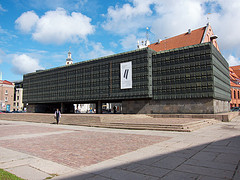
support. Housed originally in a stark, Soviet-era building from 1971
that once served as the Latvian Red Riflemen Museum, it symbolizes
the very history it critiques—a monument to Soviet propaganda
repurposed for remembrance of oppression.
The museum's mission is
threefold: to remember the crimes committed by the occupying
regimes, to commemorate the victims of repression, murder,
deportation, and exile, and to remind the world of the injustices
inflicted upon Latvia's sovereignty and population. It attracts over
100,000 visitors annually, making it one of Latvia's most visited
museums, and is often included in official diplomatic protocols for
foreign dignitaries. As of 2026, the museum is in a temporary
location at the former U.S. Embassy building on Raiņa bulvāris while
its original site undergoes renovation and expansion into the "House
of the Future" complex, which includes modern additions designed by
architect Gunnar Birkerts.
Historical Context: Latvia's Occupations (1939–1991)
To
understand the museum's focus, it's essential to grasp the broader
historical narrative of Latvia's loss of independence, which the
museum chronicles in detail through its exhibits. This period began
with the geopolitical machinations of World War II and ended with
the collapse of the Soviet Union. The following is a structured
timeline based on the museum's own historical presentation, divided
into key phases.
1939–1940: The Hitler–Stalin Pact and
Prelude to Occupation
The seeds of occupation were sown on August
23, 1939, when Nazi Germany and the Soviet Union signed the
Molotov-Ribbentrop Pact, a non-aggression treaty with a secret
protocol dividing Eastern Europe into spheres of influence, placing
Latvia under Soviet control. Latvia declared neutrality as Germany
invaded Poland on September 1, igniting WWII, but the USSR soon
followed suit by invading eastern Poland on September 17. By
September 28, a German-Soviet border treaty reaffirmed Latvia's
assignment to the Soviet sphere. On October 5, 1939, Latvia was
forced into a Mutual Assistance Pact with the USSR, allowing 25,000
Red Army troops and military bases on its soil. Ethnic Germans were
repatriated to Germany by October 30. Tensions escalated in June
1940: the Soviet Navy blockaded the Baltic States on June 12, NKVD
forces attacked Latvian border posts on June 15 (killing five and
capturing 37), and an ultimatum on June 16 demanded government
resignation and unrestricted troop entry, which Latvia accepted
without resistance.
1940–1941: The First Soviet Occupation
Soviet forces fully occupied Latvia on June 17, 1940, installing a
puppet government under Augusts Kirchenšteins on June 20. Rigged
elections on July 14–15 featured only a Communist-approved list,
leading to a new Saeima proclaiming Latvia a Soviet Socialist
Republic on July 21 and requesting USSR incorporation—achieved on
August 5. President Kārlis Ulmanis was deported. A Soviet-style
constitution was adopted on August 13, and by November 26, the
Russian SFSR Criminal Code enabled political prosecutions under
Article 58. The terror culminated in the mass deportation of June
13–14, 1941, when 15,443 Latvians (including 3,741 children) were
sent to Siberia; many adult men were imprisoned in Gulag camps. This
period saw the destruction of Latvia's independent institutions,
nationalization of property, and suppression of dissent.
1941–1944/45: The Nazi German Occupation
Germany's invasion of
the USSR on June 22, 1941, brought war to Latvia. Riga fell on July
1, and the entire country by July 7. Incorporated into the
Reichskommissariat Ostland on July 16, Latvia faced immediate Nazi
atrocities: Jewish extermination campaigns began on July 4 in major
cities, escalating to the Riga ghetto massacres starting November
30, resulting in over 70,000 Latvian Jews killed in the Holocaust
(though about 577 were saved by locals). A puppet Latvian
Self-Government was established on May 9, 1942. In February 1943,
Hitler ordered the formation of the Latvian SS Volunteer Legion,
largely through conscription. Resistance emerged with the Central
Council of Latvia (CCL) on August 13, 1943, which adopted a
memorandum for independence restoration on March 17, 1944, signed by
188 prominent figures. As the Red Army re-entered Latvia on July 18,
1944, a Latvian military unit cooperated with the CCL but was
suppressed by Germans. The Yalta Conference in February 1945
solidified Soviet hegemony over the Baltics.
1944/45–1953:
The Second Soviet Occupation and Stalinist Terror
With WWII's end
on May 8, 1945, Latvia transitioned directly into renewed Soviet
control. Partisan resistance began, with early battles like the NKVD
attack on a partisan camp on March 2, 1945. Borders shifted as the
Abrene region was annexed to Russia on October 6, 1945.
Collectivization intensified, and a second mass deportation on March
25, 1949, exiled 42,125 Latvians (including 10,987 children).
Intellectuals faced arrests, such as the "French Group" in 1951.
Stalin's death on March 5, 1953, marked the end of this brutal
phase.
1953–1985: Soviet Colonization and Stagnation
Under
Khrushchev (from September 12, 1953), partial de-Stalinization
occurred: amnesties in 1955 allowed some deportees to return, and
Khrushchev condemned Stalin's cult in 1956. However, suppressions
continued, including the Hungarian uprising (1956) and purges of
Latvian National Communists in 1959. Brezhnev's era (from 1964)
brought stagnation, with events like the Prague Spring invasion
(1968), Afghan invasion (1979), and environmental damages from
projects like the Pļaviņas hydroelectric plant (1965). Russian
colonization increased, altering demographics.
1985–1991:
Gorbachev's Reforms and Path to Independence
Mikhail Gorbachev's
leadership from 1985 sparked perestroika and glasnost, enabling
dissent. Key events included the Baltic Tribunal in Copenhagen
(1985), the Helsinki-86 group (1986), environmental protests
(1986–1987), and commemorations of deportations (1987). The Latvian
Popular Front formed in 1988, leading to the Baltic Way human chain
on August 23, 1989. Elections in 1990 gave pro-independence forces
control, culminating in the May 4, 1990, declaration of intent to
restore independence. Barricades in January 1991 defended against
Soviet crackdowns, and a failed Moscow coup on August 19, 1991,
paved the way for full independence on August 21.
This timeline
underscores the museum's narrative that both Soviet and Nazi regimes
inflicted comparable suffering, a view that has sparked
international controversy, particularly with Russia, which rejects
the "occupation" label for Soviet rule.
Establishment and
Development of the Museum
The museum's origins trace back to
February 1993, when Latvian-American historian Paulis Lazda proposed
its creation to Latvia's Ministry of Culture, insisting it rely on
voluntary donations to avoid straining the post-independence budget.
In May 1993, 11 founders (including Lazda, Rūsiņš Albertiņš, Andris
Kolbergs, and others) registered the Occupation Museum Foundation
(OMF, later LOMB in 2006) to oversee it. The first exhibition opened
on July 1, 1993, in the former Latvian Red Riflemen Museum building,
focusing solely on the initial Soviet occupation from June 17, 1940.
Anna Zoldnere served as the inaugural director.
Expansion was
rapid: In 1994, President Guntis Ulmanis inaugurated the Nazi
occupation section on June 14, including Holocaust coverage; visitor
numbers reached 3,039 in three months. Despite challenges like a
1995 water pipe burst, the Stalin-era exhibit (1945–1953) opened
that year. By 1996, commemorations for the 1941 deportations
featured a reconstructed railway car, and the exhibit extended to
1954–1964. Newsletters and an audiovisual archive began, with
visitor counts rising to 7,122.
In 1997, the Brezhnev stagnation
period (1964–1984) was added, and staff grew; the first government
grant arrived. The final segment opened in 1998, completing the full
timeline, with attendance doubling to 24,687. Threats of demolition
in 1999 were averted through public protests. The 2000s saw
publications like yearbooks, traveling exhibitions, and
accreditation in 2002, enabling state funding (about 12% of the
budget by 2022). Directors included Gundega Feldmane-Zāns (acting,
1999) and Gundega Michele (2002 onward).
Educational initiatives
expanded: teacher seminars, public discussions, and traveling
exhibits (e.g., on Soviet aviation or Latvia's return to Europe)
reached schools and international audiences. Research programs, led
by historians like Heinrihs Strods and Valters Nollendorfs, produced
studies and commissions on occupation history.
The Museum of the Occupation of Latvia (Latvijas Okupācijas muzejs),
located in Riga, is dedicated to documenting and educating the
public about the periods of Soviet and Nazi German occupations of
Latvia from 1940 to 1991. Established in 1993, the museum serves as
a repository for historical evidence of the impacts of these
totalitarian regimes on the Latvian state, its land, and its people.
Its collection forms the core of this mission, preserving artifacts,
documents, and personal testimonies that illustrate the human cost
of occupation, including themes of repression, resistance,
deportation, and survival.
History and Formation of the
Collection
The museum's collection was initiated in 1993,
concurrent with the establishment of the institution itself. It
began as a grassroots effort to gather materials that would prevent
the erasure of memories from the occupation eras. Early acquisitions
focused on items related to the initial Soviet occupation
(1940-1941), but the scope quickly expanded to encompass the Nazi
German occupation (1941-1944) and the subsequent Soviet
re-occupation (1944-1991). The collection has grown steadily through
public contributions, reflecting a collective desire among
Latvians—both at home and in the diaspora—to document and
commemorate this dark chapter. Museum specialists have played an
active role in expanding the holdings, including through fieldwork
and international expeditions to record oral histories. By early
2023, the collection had surpassed 75,000 registered items, making
it a significant resource for researchers, educators, and the
public. This figure represents an increase from earlier estimates of
around 60,000 items in 2017, highlighting ongoing growth.
The
collection's formation emphasizes ethical and community-driven
practices. Most items are acquired via donations from individuals,
families, and organizations who wish to preserve personal or
familial histories tied to the occupations. These contributions
often include stories of survival, loss, and resilience,
transforming abstract historical events into tangible,
human-centered narratives. The museum also solicits materials
through public calls and targeted outreach, such as expeditions to
countries like the United States, Canada, Germany, Great Britain,
and Russia (e.g., Krasnoyarsk Oblast) to capture testimonies from
exiles and survivors. Additionally, the collection integrates
pre-occupation and post-occupation materials to provide context on
the lead-up to and consequences of these regimes.
Types of
Items in the Collection
The museum's holdings encompass a wide
array of materials, each contributing to a layered understanding of
the occupation periods:
Artifacts and Keepsakes: These
include tangible objects donated by survivors or their families,
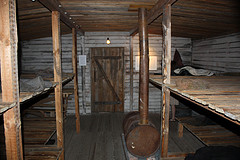
such as clothing, jewelry, household items, and tools from Gulag
camps or Nazi labor sites. They often carry personal significance,
symbolizing endurance or loss—for instance, items smuggled out of
deportation trains or hidden during house searches by secret police.
Artifacts also feature propaganda posters, military insignia, and
everyday ephemera that highlight the regimes' control over society.
Documents and Written Materials: A cornerstone of the collection,
these include historical records like arrest warrants, deportation
lists, court documents from show trials, and personal
correspondence. They document policies such as the Soviet mass
deportations of 1941 and 1949, Nazi genocidal actions against Jews
and other groups, and post-war Sovietization efforts. Maps and
charts are used to illustrate territorial changes and population
movements.
Photographs and Visual Evidence: Thousands of images
provide visual testimony to events, ranging from formal portraits of
victims to candid shots of protests, executions, and liberation
moments. These are often integrated with reconstructions in
exhibitions to create immersive experiences.
Audiovisual Archive:
Established in 1994 by historian Andrejs Edvīns Feldmanis, this is
one of the collection's highlights and among Europe's largest
dedicated to occupation-era testimonies. It includes:
Over 2,500
video testimonies (more than 4,500 hours), recorded in multiple
languages (Latvian, Russian, German, English, and others) from
diverse ethnic groups (Latvians, Russians, Jews, Lithuanians,
Estonians, etc.).
Audio recordings of testimonies and
commemorative events.
Film materials in 16mm and 8mm formats,
capturing historical footage.
Scanned auxiliary photos from
interviewees, enhancing the narratives.
Topics covered include
the 1941 and 1949 deportations, the Holocaust in Latvia, Latvian
involvement in World War II (e.g., as soldiers in various armies),
national partisan resistance, Gulag experiences, political exile,
eyewitness accounts of key events, and even Latvian veterans of the
Soviet-Afghan War. The archive humanizes history by focusing on
individual stories of suffering, selflessness, and defiance.
Acquisition and Management
Items are primarily acquired through
donations, with the museum encouraging contributions of artifacts,
documents, photos, audiovisual materials, or arrangements for new
testimonies. Potential donors can contact the Head of Collections
(for physical items) or the Audiovisual Archive team directly. The
museum does not typically purchase items, relying instead on
bequests and gifts to maintain its independence and community ties.
All materials are cataloged, preserved, and made accessible for
research, exhibitions, and educational purposes, adhering to
international standards for archival management.
Highlights
and Specific Sections
Key highlights include:
Video
Testimonies as a Core Feature: These stand out for their emotional
depth and breadth, with segments available on the museum's YouTube
channel for public access. Documentaries produced from the archive
(at least 10 films) further disseminate these stories.
Thematic
Focus on Resistance and Resilience: Sections dedicated to national
partisans (e.g., "Forest Brothers") and cultural preservation under
repression showcase items like hidden literature or underground
publications.
Holocaust and Multi-Ethnic Perspectives: Materials
addressing the Nazi occupation include survivor accounts and
artifacts related to the extermination of Latvia's Jewish community,
emphasizing inclusive narratives.
Integration with Exhibitions:
The collection informs the museum's permanent exhibition, which
chronologically guides visitors through the occupations using
artifacts, documents, and multimedia for an immersive experience. A
2022 renovation expanded the display, incorporating modern
interactive elements while retaining the collection's somber tone.
Ongoing Projects and Future Directions
The museum continues
to expand the collection through active recording of testimonies,
ensuring new generations' stories are captured before they are lost.
Expeditions for international testimonies remain a priority, as does
digitization for broader accessibility. Public engagement
initiatives, such as calls for donations and educational programs,
sustain growth. The collection not only preserves history but also
fosters remembrance, research, and dialogue about totalitarianism's
legacies, making it a vital resource in Latvia's cultural landscape.