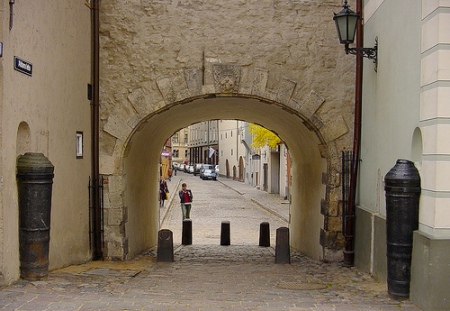
Trokšnu Aldaru ielas
The Swedish Gate, known locally as Zviedru vārti, is a historic architectural landmark in Riga's Old Town, serving as the sole surviving city gate from the original eight that once punctuated the medieval fortifications of the city. Constructed in 1698 during the period of Swedish rule over Riga (1621–1710), it is located at 11 Torņa iela (Tower Street), integrated into a row of buildings that form part of the remaining fragments of the Riga City Wall. This arched passageway, often described as discreet and unassuming, symbolizes Riga's layered history as a Hanseatic trading hub and a strategically fortified Baltic city. As part of Riga's Historic Centre, a UNESCO World Heritage Site since 1997, the Swedish Gate attracts visitors for its blend of functional design, romantic legends, and connection to the city's Swedish era. It remains a free, accessible attraction, easily reached on foot from nearby landmarks like the House of the Blackheads or St. Peter's Church, and continues to be a popular photo spot and cultural touchstone as of 2025.
The Swedish Gate's origins are tied to Riga's transformation under
Swedish dominion in the 17th century, a period marked by significant
military and urban developments. Riga fell under Swedish control in 1621
following the Polish-Swedish War, becoming the largest and most
important province in the Swedish Empire. This era saw enhancements to
the city's fortifications, influenced by Dutch and French engineering
styles, as Riga evolved into a key Baltic stronghold. The gate itself
was erected in 1698 to provide a secure passage through the city wall,
connecting the inner fortified area to external military barracks (known
as the Jacob's or Yakovlev Barracks). It replaced an earlier defensive
tower on the site and was designed for controlled access—opened at
sunrise and locked at sunset with heavy deadbolts, guarded to prevent
unauthorized entry, reflecting the era's emphasis on security amid
ongoing regional conflicts.
Two primary theories explain its
creation: one practical, attributing it to city authorities establishing
a lockable pathway for residents on Torņa Street; the other more
anecdotal, suggesting a wealthy merchant at house No. 11 built it
illicitly to bypass customs duties on goods, later charging tolls for
passage. The name "Swedish Gate" derives from its construction during
the Swedish occupation and its frequent use by Swedish soldiers
stationed nearby. After Sweden's loss of Riga to Russia in 1710 during
the Great Northern War, the gate endured while much of the city wall was
dismantled in the mid-19th century to accommodate urban expansion. By
the 1920s, it had fallen into disrepair, but in 1926, the Latvian
Society of Architects acquired and restored the adjoining building (No.
11), preserving it as a cultural monument. This restoration, led by
architect A.I. Trofimov, aligned the structure with baroque aesthetics
true to its historical period. The gate's survival through wars,
plagues, and regime changes underscores Riga's resilient fortification
history, with the broader 17th-century system evolving from Old Dutch
designs in the 1630s–1650s to a French-Dutch hybrid in the 1680s–1690s
under engineer Erik Dahlbergh.
Architecturally, the Swedish Gate exemplifies late-17th-century
functional fortification design, characterized by its simplicity and
integration into the urban fabric. It consists of a narrow, arched
passageway approximately 3–4 meters wide, carved through the thick stone
and brick city wall, with the archway framed by sturdy masonry that
blends seamlessly into the facades of adjacent residential buildings
(Nos. 11, 13, and 15 on Torņa Street). The structure's discreet
appearance—tucked between houses—gives it a hidden, almost secretive
quality, contrasting with more ostentatious gates elsewhere in Europe.
Built from local brick and stone, it features a barrel-vaulted ceiling
and robust iron fittings for the original deadbolts, emphasizing
durability and defense. The adjoining building at No. 11, restored in
the 1920s, incorporates baroque elements such as ornate tile stoves from
the 17th–18th centuries, wooden beams, and period-appropriate interiors
that evoke the Swedish era's architectural style.
The gate is part of
a small preserved section of the Riga Wall, which once encircled the
city with ramparts, bastions, and moats. Its design reflects the
practical needs of the time: efficient access for troops while
maintaining fortification integrity. Though not grand in scale, its
proportions and materials align with the eclectic influences on Riga's
architecture, including Nordic restraint from the Swedish period. In
modern restorations, efforts have focused on authenticity, preserving
exposed brickwork and historical details without over-modernization.
Visitors often note its atmospheric charm, with the narrow passage
creating an intimate, time-warp experience as one steps from the
bustling street into the echoey archway.
As of 2025, the Swedish Gate functions primarily as a pedestrian
passageway and a key tourist attraction within Riga's vibrant Old Town,
drawing visitors interested in history, architecture, and folklore. It
is open 24/7 with no admission fee, allowing free passage for locals and
tourists alike, and serves as a shortcut between Torņa Street and the
surrounding alleys. The site houses the Latvian Union of Architects in
the adjacent building (No. 11), which includes a specialized library on
Latvian history, culture, and architecture—open to the public for
research or browsing. This institutional presence ensures ongoing
maintenance and cultural programming, such as occasional exhibitions or
guided tours highlighting Riga's fortifications.
Notable features
include its rich tapestry of legends, which add a mystical allure. One
popular tale recounts a Latvian girl forbidden from loving a Swedish
soldier; upon discovery, she was bricked alive into the wall, her
midnight cries of "I still love him!" audible to those with pure hearts.
Variations involve a plague-era quarantine violation or a Swedish
officer's illicit marriage, with couples today testing their love by
listening at midnight for affirming whispers. Another story claims an
executioner resided above, placing a red rose in the window to signal
impending beheadings. These myths, while unverified, enhance its
romantic and eerie reputation, even inspiring literary references like
in Henning Mankell's The Dogs of Riga. Recent mentions in 2025 highlight
its enduring symbolic role in Latvia-Sweden ties, amid discussions of
historical alliances.
The gate's significance lies in its
representation of Riga's multicultural past, offering a tangible link to
the Swedish era amid the city's Art Nouveau and medieval splendor. It
features in walking tours focused on medieval history and architecture,
often paired with nearby sites like the Powder Tower or Riga Castle.
While no major changes have occurred by August 2025, its UNESCO status
ensures preservation, making it a "must-see" for an authentic glimpse
into Riga's fortified heritage—quiet yet profound, evoking centuries of
intrigue and resilience.