Location: Arraiolos, Évora District Map
Constructed: 13th century
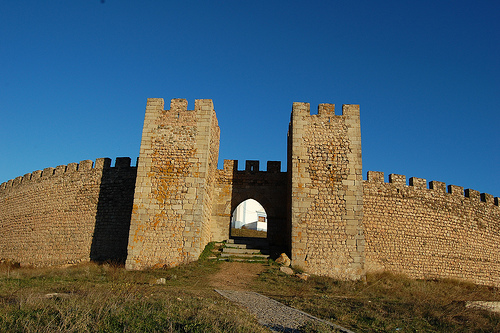
Arraiolos Castle is a round medieval citadel in a city of Arraiolos, Évora District in Portugal. First human settlements on a site of Arraiolos Castle started in prehistoric times. Modern circle castle date back to the 13th century. Portuguese king Alfonso II in 1217 allowed Soeiro, bishop of Evora, to construct military fortifications on top of the hill. Around the 14th century fortifications were largely abandoned. Few people wanted to live on top of the windy and unwelcome hill. It still was inhabited until Earthquake of 1755 did not destroy its dilapidated walls and towers. Then cholera stroke local population in 1833 castle grounds were used as a huge cemetery for its victims. Only in 1910 Arraiolos Castle got designation of a National Monument and in 1959- 63 it was restored.
Arraiolos Castle, known locally as Castelo de Arraiolos or Paço
dos Alcaides, is a medieval fortress located in the town of
Arraiolos in the Alentejo Central region of Portugal. Perched atop
Monte de São Pedro, a conical hill overlooking the surrounding
landscape, the castle is renowned for its unusual elliptical or
circular design, making it one of the few such fortifications in
Portugal and among the rarest in the world. This Romano-Gothic
structure exemplifies early 14th-century military architecture and
has played a significant role in the region's defense and settlement
history. The castle's walls enclose an area that includes historical
ruins, a central keep, and the ancient Igreja Matriz do Salvador
(Church of the Savior), blending military and religious elements.
Prehistoric and Early History
The site's history predates the
castle by millennia. Archaeological evidence indicates human
occupation on Monte de São Pedro dating back to prehistoric times,
including the Neolithic or Chalcolithic periods around the 4th
millennium BC. Artifacts such as quartz hammers, a copper axe, and
other tools have been discovered within the citadel, suggesting
early settlement and tool-making activities. The village of
Arraiolos itself is believed to have formed around 300 BC, with
influences from various ancient peoples who left their marks on the
area.
By the medieval period, the region gained prominence under
Portuguese monarchy. In 1217, King Afonso II (r. 1211–1223) donated
the Arraiolos estate to D. Soeiro, the Bishop of Évora, and the
cathedral chapter, granting permission to fortify the site with a
castle. However, no construction occurred at that time, as the
settlement was still developing. This donation marked the beginning
of ecclesiastical influence in the area, setting the stage for
future fortifications as the population grew and the need for
defense increased.
Medieval Construction and Development
The castle's construction was initiated under King Dinis I (r.
1279–1325), also known as Denis of Portugal, who granted Arraiolos
its first charter in 1290, formalizing the town's status. In 1305,
King Dinis ordered the building of the castle to bolster regional
defenses, signing a contract on December 26 of that year with the
Council of Arraiolos, represented by João Anes and Martim Fernandes.
The project was overseen by D. João Simão, with a budget of 2,000
pounds provided by the king. Work began in 1306 and was completed by
1310, using stone and lime to create a robust structure. Some
sources suggest minor extensions continued until around 1315.
The
fortifications included 207 fathoms (approximately 370 meters) of
wall, three fathoms high (about 5.5 meters) and one fathom wide
(about 1.8 meters), with two gateways and square towers. King Dinis
himself resided in the castle for periods, underscoring its
importance as a royal stronghold. In 1310, upon completion, the king
confirmed the town's charter, integrating the castle into the
fortified settlement.
Key Figures and Events
The castle
became associated with prominent figures in Portuguese history. From
1387 until his death, it served as the residence of D. Nuno Álvares
Pereira, the 2nd Count of Arraiolos and Constable of the Kingdom.
Pereira, a key military leader in the 1383–1385 Portuguese
Interregnum and the Battle of Aljubarrota (1385), used the castle as
a base before retiring to the Convent of Carmo in Lisbon. During his
tenure, the castle was a launch point for military expeditions
against Castile between 1385 and 1390, highlighting its strategic
role in border conflicts.
In 1511, King Manuel I (r. 1495–1521)
issued a new charter to Arraiolos, which may have included
enhancements to the castle, such as adding a spire to the Clock
Tower. The castle's design incorporated both defensive and
residential elements, reflecting its dual purpose.
Decline
and Abandonment
Despite its initial prominence, the castle began
to decline in the second half of the 14th century. Its exposed,
windy, and cold location on the hilltop made it uncomfortable for
inhabitants, leading to gradual abandonment. In 1371, King Ferdinand
I (r. 1367–1383) attempted to reverse this by granting special
privileges, such as restricting sacraments to the castle's church
and mandating nightly gate closures to encourage residency. These
measures failed, and depopulation continued.
By the end of the
16th century, the castle still had some residents, with gates
closing nightly as late as 1599. However, in the early 17th century,
it fell into disuse, becoming unguarded and serving as a stone
quarry for locals. By 1613, the City Council reported it in an
advanced state of ruin, with the Patio de Armas (parade ground)
repurposed as a corral.
Later History and Restoration
During the Portuguese Restoration War following independence in 1640
under King João IV (r. 1640–1656), the castle underwent remodeling
for strategic purposes. By 1655, however, it was again in ruins,
with the barbican collapsed, the keep cracked, and the Mayor's
Palace uninhabitable. The devastating 1755 Lisbon earthquake caused
further damage to the already weakened structure.
In the 19th
century, the Patio de Armas was used as a cemetery for cholera
victims in 1833. Administrative changes affected the region,
including boundary definitions in 1736, incorporation into the Évora
district in 1835, and temporary annexations of nearby parishes like
Vimieiro (1855) and Mora (1895–1898).
The 20th century brought
preservation efforts. On June 23, 1910, Arraiolos Castle was
classified as a National Monument. Partial restorations of the walls
and structures were carried out between 1959 and 1963 by the General
Directorate of National Buildings and Monuments (DGEMN). Recent
studies have examined the castle's walls, noting the presence of
renders (plaster coatings) and minimal modern interventions,
preserving its medieval authenticity.
Arraiolos Castle (Castelo de Arraiolos) is a medieval fortress
located in the town of Arraiolos, in Portugal's Alentejo region,
approximately 120 kilometers east of Lisbon. Perched atop Monte de São
Pedro, a hill rising about 400 meters above sea level, the castle
overlooks the surrounding plains and the whitewashed village below,
offering panoramic views of the Alentejo landscape. Construction began
in 1305 under the orders of King Denis I (D. Dinis) of Portugal, who
mandated the fortification to protect the growing settlement. The main
building phase occurred between 1306 and 1310, making it a prime example
of Romano-Gothic military architecture from the early 14th century. Its
design reflects the defensive needs of the Reconquista period, when
Portugal was consolidating its borders against potential Moorish
incursions and internal threats.
The castle fell into disuse by the
mid-14th century due to its exposed, windy location, which made
habitation uncomfortable. By the early 17th century, it had been
partially dismantled for building materials and was in ruins. It saw
minor restoration after Portugal's 1640 independence from Spain but
suffered further damage from the 1755 Lisbon earthquake. Today, it is a
national monument, preserved as a historical site with elements restored
for tourism, though much remains in a ruined state.
Overall
Layout and Unique Features
One of the castle's most distinctive
architectural traits is its circular (or slightly elliptical) plan, a
rarity among medieval fortifications worldwide—most castles followed
rectangular or polygonal designs for easier defense and construction.
This circular layout, enclosing an area of about 1.5 hectares, likely
drew inspiration from earlier Moorish or Roman influences, providing a
360-degree defensive perimeter without weak corners. The walls form a
continuous curtain around the hilltop, adapting to the natural terrain
for enhanced stability and visibility. This design not only maximized
defensive efficiency but also symbolized royal authority over the
landscape. The enclosure includes two main gates: a primary south gate
leading to the inner structures and a secondary one for access.
Inside the walls, the layout is compact and functional, centered around
a central keep and religious buildings. The castle's elevated, isolated
position contributed to its abandonment, as constant winds and cold made
it impractical for long-term residence, but it enhances its dramatic
silhouette today.
Walls and Defensive Elements
The curtain
walls are the castle's defining feature, constructed from rough, locally
quarried granite and schist stone, giving them a rugged, weathered
appearance that blends with the hill's natural rock. These walls stand
approximately 8-10 meters high and 2-3 meters thick, reinforced with
battlements (merlons and crenels) for archers and defenders. The
elliptical shape measures roughly 150 meters in diameter, with the walls
following the hill's contours to minimize vulnerabilities. Unlike many
contemporary castles, Arraiolos has only two projecting towers or
bastions integrated into the walls, emphasizing the circular design over
multiple angular projections.
The south gate is the most fortified
entry, flanked by the inner castle structures for added protection.
Materials like mortar and stone were sourced nearby, contributing to the
walls' earthy tones—patches of lichen, erosion, and repairs add textural
depth, revealing centuries of exposure to the elements. The
Romano-Gothic style is evident in the simple, austere lines, with
minimal ornamentation focused on functionality rather than aesthetics.
Inner Structures and Buildings
Within the enclosure, the layout
divides into defensive and communal areas. The most prominent inner
building is the Paço dos Alcaides (Governor's Palace or inner castle), a
square-plan structure adjacent to the south gate. This compact
fortress-within-a-fortress incorporates part of the curtain wall and
features a slender, tall keep (torre de menagem) rising about 20 meters
high. The keep, built in the same granite stone, served as the last line
of defense and residence for the alcaide (governor). Its design includes
narrow windows for archery and a flat roof for surveillance.
At the
center of the walled area stands the Igreja do Salvador (Church of the
Savior), a 16th-century addition in Manueline style—a Portuguese late
Gothic variant blending Gothic, Renaissance, and maritime motifs. The
church features a simple rectangular plan with whitewashed walls, a
tiled roof, and an interior adorned with azulejo tiles and frescoes
depicting religious scenes. Adjacent is the clock tower, also in
Manueline style, with ornate stonework including twisted ropes and
armillary spheres symbolizing Portugal's Age of Discoveries. These later
additions contrast with the castle's original austere military design,
reflecting evolving uses from fortress to symbolic and religious site.
Other remnants include ruined barracks, cisterns for water storage
(essential in the arid Alentejo), and pathways winding through the
enclosure. The interior space, now partly open and grassy, was once more
densely built but has been cleared for preservation.
Materials,
Style, and Preservation
The predominant materials are local stone
(granite and schist) bound with lime mortar, chosen for durability
against sieges and the region's seismic activity. The Romano-Gothic
style dominates the original construction, characterized by pointed
arches (if present in gates), ribbed vaults in the keep, and a focus on
verticality for intimidation. Manueline elements in later additions
introduce more decorative flair, such as carved portals and symbolic
motifs.
Preservation efforts in the 20th and 21st centuries have
stabilized the walls and restored the church, but the site retains an
authentic ruined charm. Visitors can walk the battlements, explore the
keep, and attend occasional cultural events in the church. The castle's
architecture not only highlights medieval engineering but also its
adaptation to Portugal's historical shifts from warfare to peace.