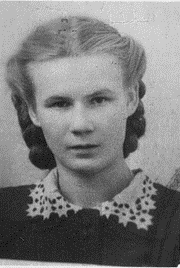
Lyudmila Alexandrovna Dubinina (Людмила Дубинина) was one of the nine hikers who perished in the Dyatlov Pass Incident in February 1959, a tragic and enigmatic event in the Ural Mountains of the Soviet Union that remains one of history’s most perplexing mysteries. As one of two women in Igor Dyatlov’s expedition team, Lyudmila, often called “Lyuda,” was known for her determination, resilience, and spirited personality.
Background and Early Life
Lyudmila Dubinina was born on May 12, 1938, in Sverdlovsk (now
Yekaterinburg), Sverdlovsk Oblast, Soviet Union. Growing up in an
industrial city during the post-World War II era, she was part of a
generation shaped by Soviet values of collective effort, education, and
physical fitness. Little is documented about her family, but her urban
upbringing in a working-class or middle-class household likely fostered
a practical and determined outlook. Her resilience was evident early on,
as she survived a snakebite during a previous hiking trip, an incident
that highlighted her toughness.
Dubinina enrolled at the Ural
Polytechnical Institute in Sverdlovsk, where she studied economics, a
field that required analytical skills and adaptability. By 1959, she was
a 20-year-old student, likely in her third or fourth year, and an active
member of the institute’s hiking and skiing club. Her passion for
outdoor activities was unusual for women at the time, reflecting her
bold and adventurous spirit. She participated in several treks in the
Ural Mountains, gaining experience in navigating harsh winter
conditions, which qualified her for the challenging Category III
expedition to Otorten Mountain in January–February 1959.
/10-1958-vost-sayany.jpg)
Personality and Relationships
Lyudmila Dubinina was described by friends and fellow hikers as
spirited, determined, and fiercely independent. She had a lively
personality, often engaging in playful banter and contributing to
the group’s high morale. Expedition diaries and accounts highlight
her tenacity, as she refused to be limited by gender stereotypes in
the male-dominated world of mountaineering. Her nickname, “Lyuda,”
was used affectionately, reflecting the warmth she inspired among
her teammates.
Physically, Dubinina was fit and capable, able
to endure the grueling demands of skiing through deep snow and
carrying heavy loads. Photos from the expedition show her smiling
and active, often bundled in winter gear but radiating energy. Her
resilience was a defining trait, as seen in her ability to keep pace
with the men and her recovery from past hardships like the
snakebite.
Dubinina had close relationships with several
group members, particularly Zinaida Kolmogorova, the other woman in
the group. Their friendship was a source of mutual support, as they
navigated the challenges of being female hikers. She was also
friendly with Igor Dyatlov, Yuri Doroshenko, and the other men,
sharing in the group’s camaraderie. Her interactions with Semyon
Zolotaryov, the oldest member, were cordial, though his outsider
status may have made their bond less personal. Dubinina’s ability to
connect with diverse personalities made her an integral part of the
team’s dynamic.
Role in the 1959 Expedition
Dubinina was one of ten members of the Dyatlov group’s expedition,
which began on January 25, 1959, with the goal of skiing
approximately 300 kilometers (186 miles) to Otorten Mountain in the
northern Ural Mountains. The team included eight men (Igor Dyatlov,
Yuri Yudin, Yuri Doroshenko, Alexander Kolevatov, Georgy
Krivonischenko, Rustem Slobodin, Nicolai Thibeaux-Brignolle, and
Semyon Zolotaryov) and two women (Zinaida Kolmogorova and Lyudmila
Dubinina). Yuri Yudin turned back on January 28 due to illness,
leaving nine hikers to continue.
As a skilled hiker, Dubinina
contributed to practical tasks such as setting up camp, cooking, and
maintaining equipment. Her economics background may have helped with
logistical planning, such as managing supplies, though no specific
evidence confirms this. Diaries and photos show her actively
participating, often skiing alongside her teammates and engaging in
group activities like singing and storytelling. Her presence,
alongside Kolmogorova, added a vital female perspective to the
expedition, challenging gender norms and inspiring the team.
On February 1, 1959, the group pitched their tent on the slopes of
Kholat Syakhl (“Dead Mountain”), a location exposed to harsh winds
and potential snow hazards. Dubinina, with her experience, likely
assisted in securing the tent, a task the group performed with
precision, as evidenced by its condition when found by rescuers.
That night, an unknown catastrophe struck, leading to the deaths of
all nine hikers.
Circumstances of Her Death
When the group failed to return as scheduled, a search and rescue
operation began in mid-February 1959. On February 26, rescuers found
the tent, cut open from the inside, with most belongings, including
shoes and warm clothing, left behind. Footprints led 1.5 kilometers
to a cedar tree, where Yuri Doroshenko and Georgy Krivonischenko
were found, partially clothed, near a small fire. Other bodies were
discovered over the following weeks, revealing a grim and puzzling
scene.
Lyudmila Dubinina’s body was found on May 4, 1959, in
a ravine 75 meters from the cedar tree, alongside Alexander
Kolevatov, Nicolai Thibeaux-Brignolle, and Semyon Zolotaryov,
collectively known as the “ravine group.” She died of massive
internal hemorrhaging caused by multiple rib fractures (six on the
left side, four on the right), which crushed her chest and heart.
The injuries were described as consistent with a high-impact force,
such as a car accident, yet there were no external wounds or
bruising on her chest. Most strikingly, her tongue, eyes, and part
of her upper lip were missing, and her orbital bones were fractured.
These findings have fueled intense speculation, though
decomposition, predation, or water exposure in the ravine’s stream
are likely explanations.
Dubinina was dressed in a jacket, a
sweater, and pants, some of which belonged to Krivonischenko,
including a pair of pants that showed trace radiation. She was found
kneeling against a rock, facing the ravine’s stream, suggesting she
may have been conscious longer than some of her companions. Her
severe injuries and the missing body parts have made her death one
of the most discussed aspects of the incident.
The official
Soviet investigation concluded that the hikers died due to a
“compelling natural force,” but the vague explanation left many
questions unanswered. Dubinina’s injuries, particularly the rib
fractures and missing tongue, have been central to theories about
the incident. A 2021 study supporting the avalanche theory suggests
a small slab avalanche caused the group to flee, with the ravine
group falling into the ravine, leading to their traumatic injuries.
However, the absence of avalanche debris in 1959, the slope’s low
angle (15–20 degrees), and the precision of the injuries keep
alternative theories alive.
Theories and Speculation
Dubinina’s death, with its severe injuries and missing body parts,
is a focal point for theories about the Dyatlov Pass Incident. Key
hypotheses include:
Avalanche: The 2020 Russian investigation
and 2021 studies propose a slab avalanche prompted the group to cut
open the tent and flee. Dubinina’s rib fractures could have resulted
from falling into the ravine or being crushed by snow. The missing
tongue and eyes are attributed to decomposition or predation, as her
body was partially submerged in water. Critics argue the slope’s
angle and lack of debris make an avalanche unlikely.
Military
Involvement: The precision of Dubinina’s rib fractures, akin to
blast injuries, and the radiation on Krivonischenko’s pants fuel
theories of a military test, such as a low-yield explosion or
chemical exposure. Her missing tongue has been sensationalized as
evidence of torture or a cover-up, though no documents support this.
Infrasound or Panic: Infrasound from wind patterns may have caused
disorientation, leading to a chaotic escape. Dubinina’s injuries
could have occurred during a fall into the ravine, but this theory
struggles to explain the trauma’s severity.
Foul Play: Theories
of an attack by locals, escaped prisoners, or Soviet agents cite
Dubinina’s injuries and missing body parts as evidence of violence.
The absence of outsider footprints or weapons undermines these
claims.
Paranormal or Extraterrestrial: Speculative theories link
Dubinina’s condition to UFOs or supernatural forces, often citing
reports of lights in the sky and her missing tongue. These lack
credible evidence, with natural processes like decomposition more
likely.
Dubinina’s missing tongue and eyes, initially shocking,
are now widely attributed to natural post-mortem processes, as her
body was exposed to water and scavengers for months. The radiation
traces, while intriguing, may relate to Krivonischenko’s nuclear
work or environmental factors in the Urals. Her kneeling position
suggests she fought to survive, making her a symbol of resilience.
Legacy and Impact
Lyudmila Dubinina is remembered as a bold, resilient, and spirited
young woman whose life was tragically cut short in the Dyatlov Pass
Incident. Her role as one of two women in the expedition, alongside
Zinaida Kolmogorova, highlights her pioneering spirit in a
male-dominated field. Her severe injuries and the mystery of her
missing body parts have made her a central figure in the narrative,
often sensationalized but deeply humanized by her courage and
camaraderie.
Photos of Dubinina, preserved by the Dyatlov
Foundation, show her smiling and skiing, capturing the group’s
optimism before the tragedy. Her diaries, though less quoted than
others, reflect her lively spirit and dedication to the expedition.
The foundation, established by survivors’ families and the Ural
Polytechnical Institute, maintains her memory through archives and
research support. The 2013 film Devil’s Pass, while fictional, draws
loosely on the incident, with characters inspired by hikers like
Dubinina.
Dubinina’s injuries continue to be studied,
contributing to theories about avalanches, military tests, or
natural phenomena. The 2019 Russian reopening of the case,
concluding in 2020 with an avalanche explanation, has not fully
resolved questions about her death, particularly the rib fractures
and radiation. Her story resonates in books, documentaries, and
podcasts, emphasizing the human cost of the tragedy and the enduring
quest for answers.
Dubinina’s legacy is tied to her strength
as a female hiker and her tragic role in the ravine group. The
Dyatlov Pass, named after the group’s leader, serves as a memorial
to her and her companions, and her memory inspires ongoing research
into one of history’s greatest mysteries.
Personal Details and Anecdotes
Resilience: Dubinina’s survival of a snakebite on a prior trek
underscored her toughness, a trait that likely helped her endure the
expedition’s challenges until the final night.
Friendship with
Kolmogorova: Her bond with Zinaida Kolmogorova was a source of
strength, as seen in photos of them laughing together, supporting
each other as women in mountaineering.
Spirited Nature:
Expedition accounts describe Dubinina engaging in playful debates
and singing, reflecting her role in maintaining group morale.
Kneeling Position: Her final posture, kneeling against a rock,
suggests a defiant struggle to survive, adding a poignant layer to
her story.