Radiograms, or radio telegrams, were the primary means of
communication for the Soviet search parties during the 1959
investigation, as the remote Ural Mountains terrain made
physical delivery impractical. These messages were formal, coded
transmissions sent via radio from search teams to headquarters
in Ivdel or Sverdlovsk, often detailing discoveries, logistics,
and urgent updates. They form a critical part of the official
case files, preserved in archives like the State Archive of the
Sverdlovsk Region (SASO) and the Center for Documentation of
Public Organizations of the Sverdlovsk Region (TsDOOSO). Many
were exchanged between February 20 and May 5, 1959, when the
last bodies were recovered.
Key examples include:
Discovery of the Tent (February 26-27, 1959): Searcher Boris
Slobtsov radioed a report after spotting the tent on the slope
of Kholat Syakhl: "Piece of broken ski was found 20m from the
tent." This was followed by an update from Egor Semyonovich
Nevolin, the radioman: "We managed to identify footprints of
eight or nine people starting from the tent and going about 1 km
down the slope, and then they were lost." These confirmed the
hikers' hasty exit and initiated the full mobilization of
rescuers.
Body Recoveries and Logistics (March-April 1959):
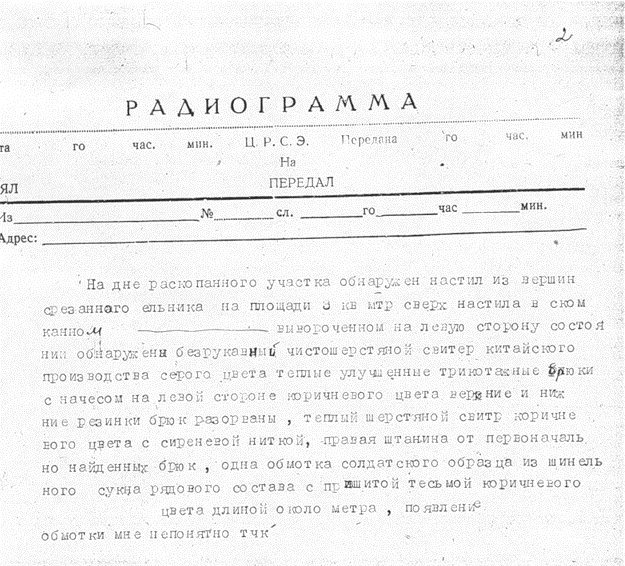
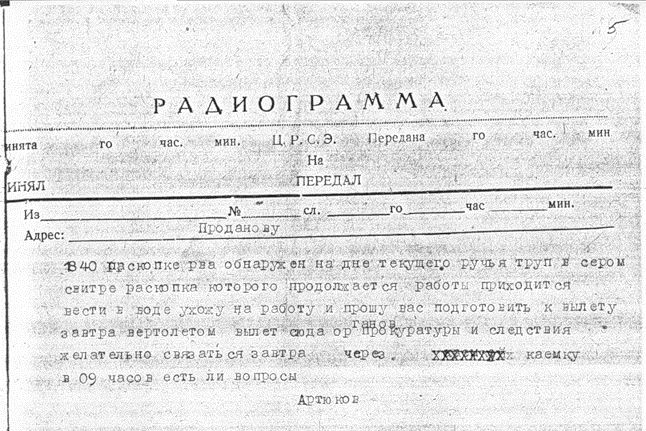
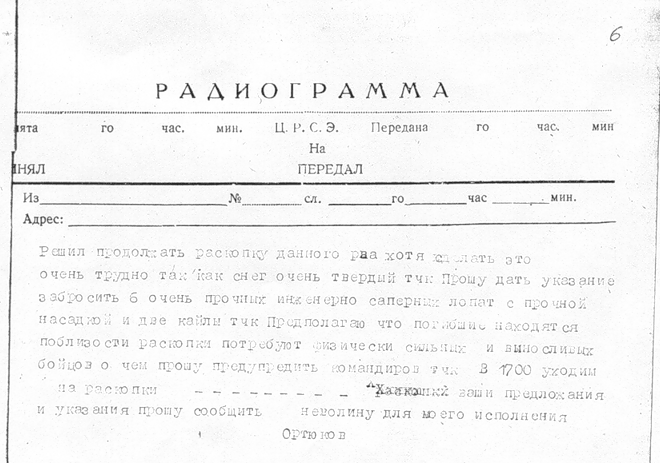
Radiograms documented the exhumations and transport. For
instance, one from search leader Georgy Ortyukov described
moving bodies: "The bodies are being lifted to the landing
site," noting three bodies (Dyatlov, Kolmogorova, and Slobodin)
being transported via helicopter. Another expressed frustration:
"This is a scandal!" when pilots refused to airlift bodies due
to concerns over radioactivity (though unconfirmed at the time).
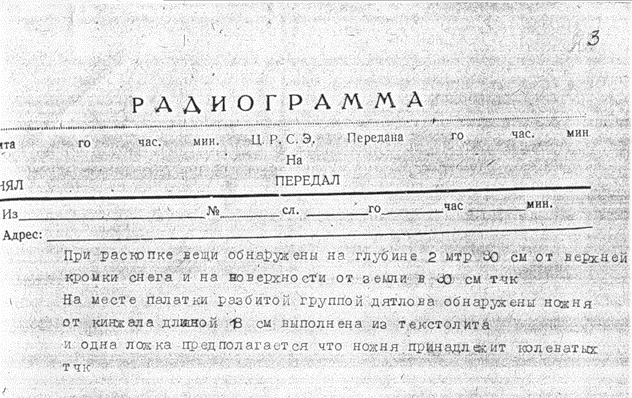
May 1959 Excavations: As snow melted, deeper searches in the
ravine yielded more evidence. Radiogram No. 4 from May 5
reported: "During excavation, items were found at a depth of 2 m
30 cm from the top of the snow cover and 30 cm above the ground
stop In place of Dyatlov group tent is found the sheath from a
dagger 18 cm long made of textolite and one spoon the sheath
assumed to belong to Kolevatov stop." Another to Prodanov
detailed coffin dimensions for the final burials: "The
dimensions of the coffins are 180 cm, the remaining dimensions
are of the actual height." These were part of a series (pp. 2-12
in TsDOOSO Fund 191) that included search plans and CPSU
oversight reports.
These radiograms reveal the
operation's urgency and bureaucratic layers, with some exchanges
lacking paper trails, leading to gaps in the record. They were
later transcribed and included in the 2013 Dyatlov Foundation
publication of the case files.
Key Documents from the Investigation
The official investigation, led by prosecutors like Tempalov and Lev
Ivanov, produced a two-volume criminal case file (dismissed on May 28,
1959, as an "overwhelming force"), obtained by the Dyatlov Foundation in
2012 from ГАСО. These documents include inventories, forensic reports,
witness testimonies, diaries, and analyses, totaling hundreds of pages.
They emphasize the group's orderly abandonment of the tent but struggle
to explain the cause of death (six from hypothermia, three from trauma).
Notable documents:
Tent Inventory and Inspection Act (Act #199,
February 27-28, 1959): Prosecutor Tempalov's initial report listed
contents: three cameras (Zolotaryov's, Krivonischenko's, Slobodin's),
group diaries, alcohol, a satirical leaflet ("Evening Otorten"),
clothing, food (oatmeal, canned meat), and gear like an ice axe and
skis. It noted cuts: "The nature and form of these lesions suggests that
they were formed from the contact with the blade of a weapon (knife) on
the inside surface of the fabric of the tent." Footprints were described
as "eight or nine pairs" leading downhill, deformed by weather but
indicating no external intruders.
Diaries and Personal Records:
Multiple diaries were recovered, including Zoya Kolmogorova's (noted as
potentially authored by an unknown person due to handwriting
discrepancies), Yuri Yudin's, and Igor Dyatlov's last entry (January 31:
"Tired and exhausted we started to prepare the platform for the tent...
It is hard to imagine such a comfort somewhere on the ridge, with a
piercing wind"). A third unidentified diary was listed, while Alexander
Kolevatov's was lost or stolen.
Forensic and Medical Reports:
Autopsies detailed injuries (e.g., Slobodin's minor skull fracture,
chest trauma on Dubinina and Zolotaryov). A radiological analysis
(March-April 1959), ordered by Ivanov, found beta radiation on clothing
(200-300 counts per minute above background) from Krivonischenko and
others, linked to his nuclear plant work but fueling conspiracy
theories. Ivanov's 1990 article admitted no rational explanation,
mentioning suppressed reports of "flying spheres."
Radiological
Certificate (Case Files pp. 371-377): Conducted by radiologist Levashov,
it measured contamination on numbered items (e.g., №1-4 clothes),
confirming spots up to 9900 cpm but dismissing gamma/alpha emissions.
Oversight and CPSU Reports: Volume 2 includes supervision notes from
Ivanov's superiors, like Evgeniy Okishev, ordering the case closed as an
accident despite anomalies.
These files, quoted in 1990s books by
Matveeva and Rakitin, were fully published in 2013, highlighting
inconsistencies like missing negatives from Krivonishenko's camera (held
privately until 1997).
Photos of the Tent
Photographs of the tent, taken by searchers and preserved in Ivanov's
archive (16 films total), are among the most analyzed evidence, showing
a partially snow-covered structure on a 15-20° slope, contradicting
avalanche theories due to its visibility and upright skis/ice axe. The
tent, a custom 5x2 meter model sewn from two standard ones (built by
Slobtsov in 1956), was pitched ~1 km from the forest edge.
Key
photos and descriptions:
Hikers' Own Photos (February 1, 1959): From
an unidentified camera (Film №5, 24 frames) and others, the last images
show setup around 5 p.m.: Frame depicts snow excavation for the tent
base (shutter 1/25 sec, aperture 5.6, GOST 65), with hikers like Dyatlov
digging a hollow perpendicular to the slope. Another shows the group
posing near the finished tent, skis vertical, in fading light—indicating
calm conditions before dinner (6-7 p.m.).
Search Party Photos
(February 27, 1959): First post-discovery shots by Vladimir Brusnitsyn
and others: The tent appears collapsed inward from snow weight, with a
large rear cut (knife-made from inside, ~2m long) and smaller front
slit. Skis protrude from snow nearby; an ice axe lies at the entrance
beside Dyatlov's jacket (containing a penknife and Kolmogorova's photo).
Footprints trail downhill in soft boots or bare feet, merging after
50-60m. One photo (1S-09) shows searcher Koptelov pointing to the site.
Later Analysis Photos (March-May 1959): Grigoriev's images (e.g.,
2S-03A) show the outlier rock near the tent and exhumation sites. May
photos reveal the dagger sheath and spoon buried 2.3m deep nearby.
Colorized versions highlight the tent's orange fabric against white
snow, with broken branches nearby suggesting no massive slide.
These photos, developed from films like Krivonischenko's (70 frames) and
loose shots (12), fueled debates—e.g., "Yeti" frame (Frame 33, a blurred
figure) debunked as Thibeaux-Brignolle. Modern 3D models (by Vasilii
Zyadik) reconstruct the slope at 23-30° steepness, supporting slab
avalanche hypotheses but not explaining the cuts.
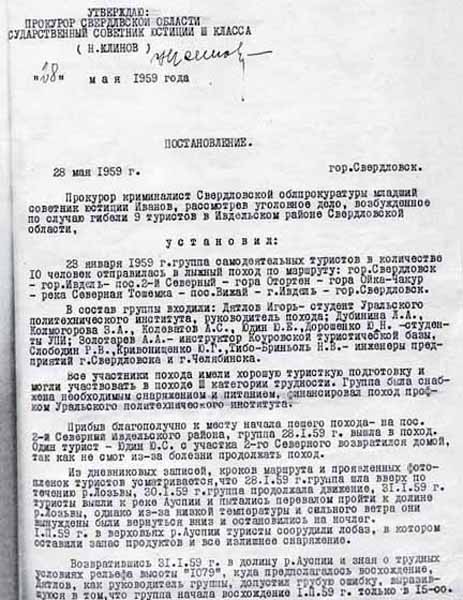
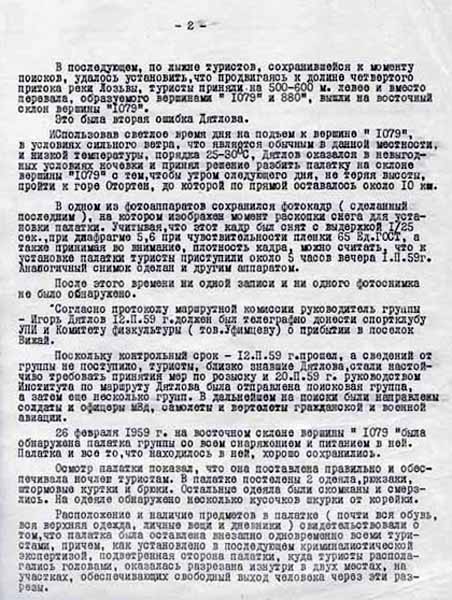
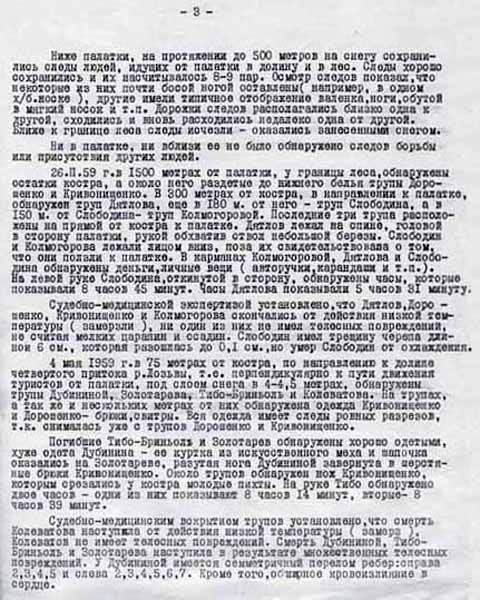
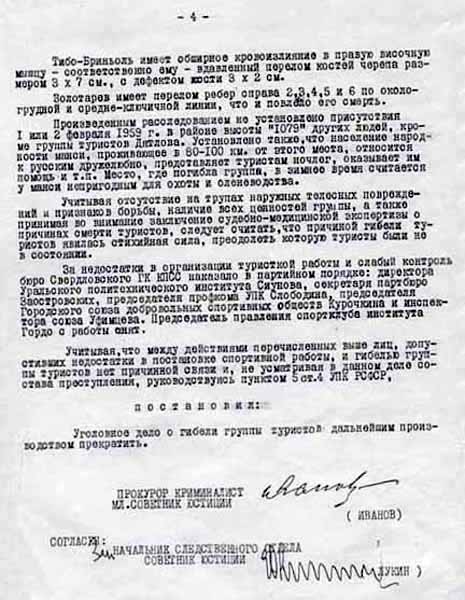
Prosecutor Ivanov closes the case of Dyatlov group
Radiograms that were sent by the search parties from Dyatlov Pass
/New%20folder/Dyatloff_group_56[1].jpg)
Personal Resume of Semen Zolatarev (not Alexander)
/0_4ca1f_e7fcb15d_XXL[1].jpg)
Analysis of the cuts made to Dyatlov group tent
/0_4714b_5afcf7b1_orig.gif)
/0_4714a_942366a3_orig.gif)
/0_4714d_225f77e7_orig.gif)
/0_4714e_1c3d8748_orig.gif)
/0_4714f_9cf3c2f_orig.gif)
/0_47150_a1e1f05_orig.gif)
/0_47151_65b17170_orig.gif)
/0_47152_a9b273c8_orig.gif)
/0_47154_adbae65e_orig.gif)
/0_47155_a76c4d0c_orig.gif)
/0_47156_b64d31ff_orig.gif)