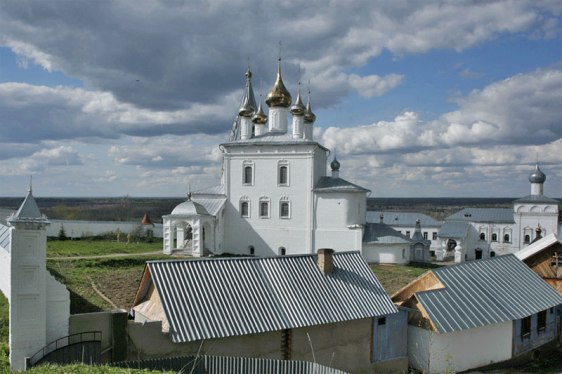
Trinity Monastery of Saint Nicholas
The Troitsko-Nikolsky Monastery, also known as the Holy Trinity-St. Nicholas Monastery or simply the Nikolsky Monastery, is a prominent Russian Orthodox monastery situated in the historic town of Gorokhovets in Vladimir Oblast, Russia. Perched atop Nikolskaya Hill (alternatively called Puzhalova Mountain), it dominates the skyline and is visible from much of the surrounding area, offering breathtaking panoramic views of the Klyazma River, the town below, and distant landmarks such as the golden domes of the Annunciation Cathedral and the silver domes of the Znamensky Nunnery across the river. This elevated position not only enhances its visual prominence but also ties into its historical role as a site of defense and spiritual refuge, contributing to Gorokhovets' reputation as a "town-museum" preserving the essence of ancient Russian spirit. The monastery is one of three active monastic ensembles in the town, alongside the Sretensky and Znamensky monasteries, all of which reflect the architectural and cultural flourishing of the 17th and 18th centuries funded by wealthy local merchants.
The monastery's origins are deeply rooted in Gorokhovets' medieval
past. The hilltop site originally hosted a wooden fortress dating back
to the town's founding around 1168, serving as a defensive outpost
against invasions. Historical records suggest spiritual activity as
early as 1365, when a small monastery may have been established by the
revered Monk Sergius of Radonezh, a key figure in Russian Orthodox
history known for founding numerous monastic communities. By 1584, a St.
Nicholas Church is explicitly mentioned on the site, indicating an
established religious presence.
The monastery was formally founded in
the first half of the 17th century during Gorokhovets' "golden age" as a
major trade hub for the region encompassing modern Vladimir and Ivanovo
oblasts. This period saw affluent merchants commissioning grand stone
structures, shifting the town from a fortified outpost to a cultural and
commercial center. Stone construction was blessed in 1686, with the main
Trinity Cathedral erected between 1681 and 1689. Additional buildings
followed, including the St. John Climacus Church in 1716 and stone
enclosure walls with the Intercession Gate-Church in the 18th century.
The 20th century brought hardship under Soviet rule. In the 1920s, the
monastery was closed, its buildings repurposed as communal housing, and
significant portions—including parts of the walls and the Intercession
Gate-Church—were demolished. It endured neglect and damage until 1993,
when it was returned to the Russian Orthodox Church amid post-Soviet
religious revival. Extensive restoration efforts followed, reviving it
as an active monastic community and a symbol of resilience.
The Troitsko-Nikolsky Monastery exemplifies 17th-century Russian
ecclesiastical architecture, characterized by its harmonious blend of
functionality, symbolism, and aesthetic grandeur. Art critic Igor Grabar
once lauded it as a "miracle," stating that it outshone even the
renowned architecture of Murom and the works of Theophanes the Greek,
describing Gorokhovets as a hidden "Kitezh" (a legendary submerged city
in Russian folklore). The ensemble's belfries are especially noteworthy
for their intricate design, typical of the era's merchant-funded
constructions.
At the heart is the Trinity Cathedral (also called the
Holy Life-Giving Trinity Church), a grand structure with golden domes
that gleam against the sky, serving as the monastery's primary landmark.
Adjoining it is the smaller St. John Climacus Church, adding to the
complex's layered silhouette. The red-brick All Saints Church, Holy
Gate, and remnants of the 18th-century stone walls enclose the grounds,
which include an ancient cemetery with weathered gravestones evoking
centuries of history. Exteriors are well-preserved, though some interior
paintings show signs of wear from restoration using modest materials. At
the hill's base, two wooden chapels enhance the site: one houses a holy
spring believed to have spiritual properties, while the other features a
large baptismal font divided for men and women. The overall design
reflects a transition from wooden to stone architecture, with elements
like low fences and manicured gardens creating an open, inviting space
rather than a fortified enclosure.
As of 2025, the monastery functions as an active male monastery under the Russian Orthodox Church, hosting daily services, monastic life, and pilgrimages. The grounds are impeccably maintained, adorned with flower beds and mowed lawns, fostering an atmosphere of profound peace and tranquility—often described by visitors as a place where one can "feel the goodness" and step back in time. Monks are rarely visible, contributing to the serene, unhurried ambiance. It attracts a modest number of tourists and pilgrims, avoiding overcrowding and preserving its authentic, "untrampled" feel.
The monastery holds immense cultural, historical, and spiritual importance, embodying Gorokhovets' preservation of 17th-century merchant chambers, churches, and monastic ensembles—earning the town a spot on UNESCO's World Heritage Tentative List. It stands as a testament to Russia's architectural heritage and the revival of Orthodox traditions after decades of suppression, often hailed as a "miracle of religious renaissance." Its location and views make it a focal point for understanding the town's layered history, from medieval fortifications to merchant prosperity.
Located at 12 Ulitsa Proletarskaya, the monastery is best accessed by car due to the steep ascent; walking from the town center via Sovetskaya Street is possible but challenging. Free parking is available near the Holy Gate. For optimal views, visitors recommend walking to the hill's edge via a small gate beside a wooden hut, especially in good weather like early May. Entry is free, and it's suitable for couples, families, or groups seeking a peaceful historical experience—ideally with a local guide for deeper insights. The site ranks highly among Gorokhovets attractions for its combination of architecture, history, and natural beauty.