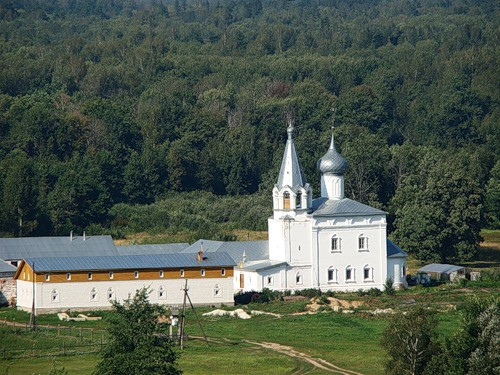
Znamensky Krasnogrivsky Monastery (Знаменский Красногривский
монастырь), also known as the Sign of the Theotokos (Znamensky)
Convent, is a Russian Orthodox women's monastery located on the left
bank of the Klyazma River in Gorokhovets, Vladimir Oblast, Russia.
It sits on a small elevation called the "Red Griva" (Красная Грива),
which protects it from spring floods—hence the name "Krasnogrivsky."
It is the oldest monastery in Gorokhovets and lies outside the
historic city limits, opposite the main settlement, offering scenic
views of the town and surrounding forests and lakes.
Founding and Early History (Late 16th–17th Centuries)
The
monastery was founded in 1598 during the reign of Boris Godunov as a
male monastery. The initial wooden structures were built on donations
from the Gorokhovets merchant Pyotr Lopukhin on land belonging to the
town's taxable population (tyaglye lyudi).
It never formed part of
the urban area of Gorokhovets; documents from 1725 describe its location
as "the village of Znamenka near Gorokhovets."
In the late 17th
century, the monastery benefited from significant patronage by local
merchants. A key benefactor was the merchant Semyon Nikiforovich Ershov
(sometimes dated around 1679 in sources). On October 5, 1669, Patriarch
Joasaph granted permission for the construction of the first stone
church in the Gorokhovets district—the Church of the Sign of the
Theotokos (Znamenia Bogoroditsy). This became the monastery's main
temple and one of the earliest stone ecclesiastical buildings in the
area.
The church exemplifies early Gorokhovets architectural style: a
cubic form with three-part apses, decorative kokoshniks, ornamental
belts, and large windows with figured platbands. A chapel dedicated to
St. John the Theologian with a refectory adjoined it from the north.
By the end of the 17th century or shortly after, the monastery had
acquired lands, meadows, peasants, and traditions like beekeeping
(wild-honey farming) through Ershov's contributions.
18th
Century: Attachment and Architectural Development
In 1723, by decree
of Peter the Great, the monastery—due to its small number of monks
(fewer than 30)—was attached as a podvorye (subordinate embassy or
courtyard) to the larger Florishcheva Hermitage (Uspenskaya Florishcheva
Pustyn) in nearby Nizhny Novgorod lands. It lost independence but
continued functioning.
During the 18th century, the ensemble
expanded:
A tented bell tower (octagon on quadrangle) was added
around 1753.
A warm church dedicated to St. John the Theologian was
attached.
A stone wall with corner towers enclosed the entire
complex.
By the late 18th century, the monastery's appearance was
largely complete, with no major new monumental constructions thereafter.
19th–Early 20th Centuries
The monastery operated as a podvorye of
the Florishcheva Hermitage. It remained a modest but stable religious
site, benefiting from its scenic location and historical significance.
Soviet Period: Closure and Destruction (1920s–1980s)
In May 1923, the
podvorye was liquidated along with the parent hermitage. Property was
confiscated, and buildings were transferred to the provincial museum
(Gubmuzey), which rented them out. In the 1920s, the church housed a
paper mill and straw warehouse.
The greatest damage occurred in the
1960s, when state farm facilities used the site: the stone wall was
demolished, the Church of St. John the Theologian was destroyed, and the
main Znamensky Church served as stables, a creamery, a barnyard, and
warehouses.
In 1983, the territory and church were used for filming
battle scenes in Yuri Ozerov's epic film The Battle for Moscow.
Revival (1990s–Present)
Restoration began in the 1990s:
On June
24, 1994, the buildings were returned to the Russian Orthodox Church and
initially transferred to the Trinity-Nikolsky (Troitse-Nikolsky) Men's
Monastery in Gorokhovets as a skete.
Repair and restoration works
started in 1995. On October 6, 1995, the altar of the small Church of
St. John the Theologian was consecrated.
On May 28, 1999, by decree
of Archbishop Evlogy, the skete became an independent Znamensky Women's
Diocesan Monastery. It regained autonomy as a convent.
Abbess
(Igumenia) Raissa (Shibeko) was appointed in 2000 and elevated to abbess
in 2006. She continues to lead the community.
Today, the monastery is
fully restored. Nuns maintain active monastic life, including services,
agriculture (cattle yard, calf barn, farming), and charity. It serves
under the Murom Diocese of the Russian Orthodox Church.
Patronal
feasts include:
May 21 and October 9 (St. John the Theologian).
December 10 (Icon of the Theotokos "Znamenie").
Main Church: Church of the Sign of the Theotokos (Znamenia
Bogoroditsy)
The central structure is the stone Church of the Sign of
the Theotokos, built around 1670 (or 1679 according to some sources)
with funds from merchant Semyon Ershov. It was the first stone church in
Gorokhovets.
Key architectural features include:
Cubic (chetverik)
form for the main volume — a classic Russian design.
Three-part apses
extending to the middle of the quadrangle (main body), creating a
compact, harmonious altar area.
Decorative kokoshniks (curved,
keel-shaped arches) in rows under the cornice, supported by an
ornamental belt. These add rhythmic visual interest and are typical of
pre-Petrine Russian architecture.
Large two-light windows (in two
tiers) on the quadrangle and apses, framed by elaborate figured
platbands ( наличники) featuring column-like elements and triangular
pediments (ochel'ya). These provide ample light and showcase detailed
stone carving.
A chapel dedicated to St. John the Theologian
(Apostle John) with a refectory adjoins the church on the north side.
This addition, along with a warm (heated) church element, enhanced
functionality for year-round use.
Bell Tower
Around 1753, a
tent-roofed (shatrovaya) bell tower was attached directly to the church,
creating a distinctive "attached" or integrated appearance.
Its
design features:
Octagonal upper section (vos'merik) atop a
quadrangular base.
Low square first tier.
Traditional tent roof
(shater), which was a popular Russian form for vertical emphasis and
acoustics.
This structure embodies the mature Gorokhovets
architectural "handwriting," with proportional harmony and integration
with the main church.
The close attachment of the bell tower to
the church is noted as quite original and visually striking.
Other Buildings and Ensemble
Holy Gates (Svyatye Vorota): Built in
1720 on the western side of the enclosure. They feature four powerful
round pillars on rectangular bases with a wide arched passageway,
providing a grand yet fortified entrance typical of monastic complexes.
Monastic Cells (Keleiny Korpus): A two-story building with a stone lower
floor (1720) and wooden upper floor (second half of the 18th century).
This mix reflects evolving construction practices and resource
availability.
Stone Enclosure Wall: Erected in the 18th century, it
surrounded the entire complex with corner towers for defense and
definition. Much of it was destroyed in the Soviet era (especially
1960s), but the overall layout remains perceptible.
The ensemble
achieved its near-modern form by the late 18th century, with no major
new monumental constructions afterward. It functions as a podvorye
(dependency) of the Florishcheva Hermitage from 1723 onward due to a
small number of monks.