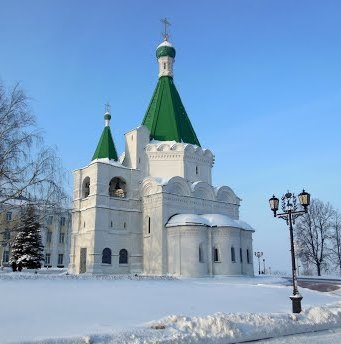
The Archangel Michael Cathedral, also known as the Cathedral of St. Michael the Archangel, is a historic Orthodox church located within the walls of the Nizhny Novgorod Kremlin in Nizhny Novgorod, Russia. Situated at 2A The Kremlin, it stands as one of the oldest surviving structures in the city and the Kremlin complex, serving as a key monument of Russian religious architecture. This small yet symbolically significant cathedral is dedicated to St. Michael the Archangel, the patron saint of soldiers, and commemorates pivotal events in Russian history, particularly the victory of the people's militia during the Time of Troubles in the early 17th century. It is the only remaining religious building from the many that once existed in the Kremlin and functions as both an active place of worship and a major tourist attraction.
The site's religious history dates back to the founding of Nizhny
Novgorod in 1221, when a wooden church dedicated to St. Michael the
Archangel was first constructed. This was soon replaced by a stone
building between 1227 and 1229, featuring intricate white-stone
decorations with animal- and human-like motifs. By 1359, the cathedral
had been rebuilt to serve as the church for the grand prince's palace
and became a burial site for grand princes and their families.
Archaeological excavations in 1960 uncovered fragments from the 13th or
14th centuries, including the original floor plan, wall configurations,
and foundations that align with the current structure.
The cathedral
suffered significant damage over the centuries. It was looted and
partially destroyed by Tatar forces in 1377 and 1378, leaving it in
ruins for extended periods. By the early 17th century, it was described
in historical records as an old, ruined stone structure where services
had long ceased. Major reconstruction occurred between 1628 and 1631
under the patronage of Patriarch Philaret and funded by the state
treasury, led by stonemasons Lavrenty Vozoulin and his stepson Antipa
Konstantinovich. This rebuild adhered closely to the original plan but
incorporated changes to honor the 1612 victory of the people's militia,
led by Kuzma Minin and Prince Dmitry Pozharsky, against Polish invaders
during the Time of Troubles.
Subsequent events included fires in 1704
and 1715, which destroyed the ancient iconostasis, leading to periods of
abandonment. Repairs were carried out in 1732, 1795, 1845, and
1909–1910. A significant restoration in 1962–1963 included transferring
the ashes of Kuzma Minin to a tomb inside the cathedral. In 1828, an
obelisk dedicated to Minin and Pozharsky was erected in front of the
cathedral by architects Abraham Melnikov and Ivan Martos. More recently,
the cathedral has been visited by prominent religious figures, including
Patriarch Alexius II in 2005 and Patriarch Kirill I in 2009, who donated
icons and conducted services. In 2009, nine bells were donated by the
Nizhny Novgorod Region Legislative Assembly, with the largest,
"Zakonnik," weighing 530 kg.
The cathedral exemplifies tent-roofed architecture, a distinctive
style in Russian Orthodox design characterized by a soaring,
pyramid-like roof. Its plan is archaic and rectangular, featuring three
church porches at the cardinal points and a three-part altar. The
structure has a two-tent asymmetric composition, with the prayer room
and bell tower sharing a unified space. The back porch is shifted
northward, displacing the main portal from the central axis, while the
northern porch has a trapezoid plan to accommodate the bell-tower
superstructure.
The original 13th-14th century church was lower, with
a single spire supported by four square pillars, whose foundations are
still visible inside. During the 17th-century reconstruction, the tented
roof was extended over the united space, and the old rubble masonry was
preserved by covering it with new brickwork. A side altar added in 1672
was later removed to restore the original composition. The exterior
features a white-stone façade with austere lines and soaring domes,
reflecting traditional Russian design. The bell tower is integrated over
the south entrance.
The interior is relatively simple, maintaining an atmosphere of
antiquity with archaeological elements on display. Visible foundations
of the original four pillars and sections of the 14th-century floor
level highlight its historical layers. The floor is paved with unique
square ceramic tiles adorned with six-pointed stars in white plaster on
a red terracotta background, a design unparalleled in Russian or
medieval architecture.
Burial sites are prominent: The western
arcosoliums (niches) mark the graves of grand princes such as Vasily
Kirdyapa (d. 1404), Ivan (d. 1416), and Vasily (d. 1450), along with
family members, indicated by inscriptions. Kuzma Minin's ashes lie under
a modest tombstone in the north-western corner, shaded by replicas of
the militia banners. A surviving 18th-century tombstone of a governor's
child is located by the southern wall.
As a spiritual and historical landmark, the cathedral symbolizes resilience and national unity, particularly through its association with the 1612 liberation of Moscow from foreign occupation. It honors the militia's victory and houses Minin's tomb, making it a site of pilgrimage for those interested in Russian history. The adjacent obelisk and nearby memorials, such as the Eternal Flame and World War II military equipment display, enhance its role in the Kremlin's patriotic narrative.
Today, the cathedral remains an active Orthodox church while attracting tourists as part of the Nizhny Novgorod Kremlin ensemble. It is open to visitors, though services may limit access at times. Contact information includes phone +7 831 439-10-94. The Kremlin underwent major restorations in 2021 for the city's 800th anniversary, preserving the cathedral's integrity. Visitors often praise its serene atmosphere and historical depth, making it a must-see for exploring Nizhny Novgorod's rich past.
The cathedral has long served as a burial place for the Nizhny
Novgorod princes and their families. The following are buried here:
Prince Vasily Semyonovich Kirdyapa (d. 1404);
Prince Ivan
Vasilyevich (d. 1416);
The last Grand Duke of Nizhny Novgorod, Vasily
Yuryevich (d. 1450);
Members of their families.
The burial
sites are not precisely known, but are marked by inscriptions in the
arcosolia of the western wall. Some remains were found during
excavations in the 1960s under the cathedral's floor.
Since 1962, the
cathedral has housed the remains of Kuzma Minin, a hero of the Nizhny
Novgorod militia of 1612. He was originally buried in the
Transfiguration Cathedral, but was moved here after its destruction. The
burials emphasize the cathedral's connection to Russian history and
military glory.
The Archangel Michael Cathedral is a symbol of the founding of Nizhny
Novgorod and its military history. It is associated with national heroes
such as Kuzma Minin and is considered the first monument to the Nizhny
Novgorod militia. As part of the Kremlin, the cathedral is listed as a
cultural heritage site of Russia and attracts tourists and pilgrims.
Today, the cathedral is active: the altar is consecrated in honor of
the Archangel Michael and other Bodiless Powers of Heaven (feast day:
November 21). Services are held regularly. Address: Nizhny Novgorod,
Kremlin. Visiting the cathedral is free, but it is recommended to
observe the rules of conduct in an active church.