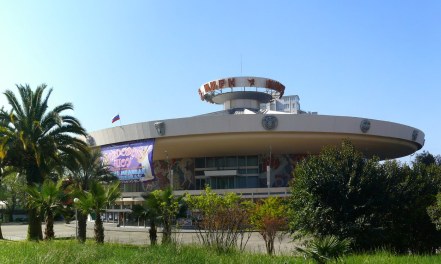
Location: Ulica Deputatskaya 8, East of Town Centre
Tel. 8622 920 375
Open: 9am- 6pm
Entrance Fee: R150- R300
The Sochi State Circus, also known as the Sochi Circus (Russian: Со́чинский госуда́рственный цирк), is a longstanding entertainment venue in the resort city of Sochi, Russia. It serves as a hub for traditional circus performances, blending elements of acrobatics, animal acts, humor, and choreography. As part of the Russian State Circus system (Rosgostsirk), it reflects the Soviet-era tradition of circus arts, which emphasized narrative-driven shows with a focus on skill, spectacle, and cultural themes. The circus is a popular attraction for families and tourists, ranked among the top things to do in Sochi, with an average rating of around 4.2 out of 5 from visitor reviews. It accommodates up to 2,000 spectators and continues to host shows year-round, though it has faced criticism over animal welfare and production quality in recent years.
Situated in the heart of Sochi's central district, the circus is located at Deputatskaya Street, 8, Sochi 354002, Krasnodar Krai, in the Southern Federal District of Russia. It sits at the intersection of Pushkin and Kurortny avenues, adjacent to the renowned Sochi Arboretum (Dendrarium), a lush botanical garden that's a major draw for visitors. The venue is conveniently close to the Black Sea promenade and beach, making it easy to combine a visit with seaside activities—it's just a short walk from the shore, where families often enjoy skateboarding or relaxing in the nearby grounds. Nearby attractions include Sochi National Park (0.2 miles away), Riviera Park (about 2 miles), and dining options like Trattoria Fettuccine or Restaurant Baran Rapan (both within 0.5 miles). Accessibility is straightforward via public transport, taxis, or on foot from central Sochi, and its proximity to Olympic-era infrastructure enhances its appeal as part of the city's post-2014 tourism boom.
The Sochi State Circus has roots in the broader tradition of Russian circuses, which flourished during the Soviet era as state-sponsored entertainment emphasizing athleticism, artistry, and public pride. Construction began in the late 1960s and was completed in 1971, aligning with the development of Sochi as a premier Soviet resort city. It was part of a wave of permanent circus buildings erected across the USSR, moving away from traveling tents to stationary venues that could host year-round performances. The circus operated continuously until the early 2010s, when it was closed for modernization ahead of the 2014 Winter Olympics in Sochi. It reopened in 2014 after renovations, incorporating updates while preserving its original Soviet aesthetic. In recent years, it has been integrated into broader cultural initiatives, such as affiliations with international circus communities through nearby Sochi Park, an amusement complex that joined global circus networks in 2024. However, the venue gained international attention in 2023 due to an incident where a lion attacked its trainer during a performance, sparking renewed debates on animal acts in circuses—an event that resurfaced in social media discussions as late as September 2025.
Designed by architect Yulian Lvovich Shvartsbreim (in collaboration with M. Korobkow), the building exemplifies late Soviet modernism and was awarded the USSR State Prize for its innovative design. The structure is a circular arena with a capacity of 2,000 seats, featuring a classic dome-like roof typical of Soviet circus architecture, which allowed for optimal acoustics and visibility during performances. One of its most distinctive elements is the ornate interior decorations, including mosaic inlays and marble accents in the vestibules, foyer, and gallery, which add a touch of grandeur and reflect the era's emphasis on public art and durability. Externally, the building has a functional yet elegant facade, blending into Sochi's subtropical landscape with clean lines and minimal ornamentation. While not drastically altered since its opening, the 2014 renovations focused on technical upgrades like lighting and seating without compromising the historical integrity. This design draws from the evolution of European circus buildings, transitioning from temporary structures to permanent ones that could adapt to modern needs, though questions remain about how well such venues have evolved in the 21st century.
The Sochi State Circus hosts a variety of traditional Russian circus
acts, rooted in Soviet styles that prioritize acrobatics, juggling,
contortion, and trained animals over Western-style narratives. Shows
typically last 1.5 to 3 hours, featuring breathtaking aerial feats,
colorful costumes, synchronized choreography, and humorous interludes
suitable for all ages—even non-Russian speakers can enjoy the visual
spectacle. Animal acts, such as those with white lions or birds, are
common, though they've drawn controversy for perceived animal distress
(e.g., uncooperative lions or shows criticized for promoting suffering).
Notable past productions include "Bird Heat," which incorporated dance
but was panned for its disjointed plot, lack of real clowns, and
excessive loud music, and lion-focused shows praised for acrobatic
elements but criticized for animal welfare.
As of late 2025, the
circus continues to offer rotating programs, with schedules available
through ticket platforms like Biletprivet and Trip.com, featuring events
into 2026. Specific 2025 shows may include seasonal themes or touring
acts, but exact lineups vary; visitors are advised to check platforms
for updates, as performances often run on weekends and holidays. Ticket
prices typically range from affordable family options (around 500-2,000
RUB, or $5-20 USD, depending on seating), with online booking
recommended. Opening hours are generally tied to showtimes, with
matinees and evening slots; the venue operates year-round but may close
for maintenance.
Reviews highlight the circus as a fun, family-oriented spot, with
pros including its entertaining acrobats, vibrant atmosphere, and value
as a permanent venue compared to temporary setups. Many appreciate the
humor and accessibility for international visitors. However, cons
include hot conditions inside, overly loud audio that can frighten
children, perceived low production quality in some shows, and ethical
concerns over animal treatment—exemplified by the 2023 lion attack
incident, which has been widely shared online as a cautionary tale about
circus practices. Overall, it's recommended for those seeking a slice of
Russian cultural entertainment, but animal lovers may prefer
alternatives like nearby Sochi Park's non-animal shows.
The Sochi
State Circus remains a symbol of Sochi's blend of Soviet heritage and
modern tourism, offering a unique window into Russia's enduring love for
the circus arts.