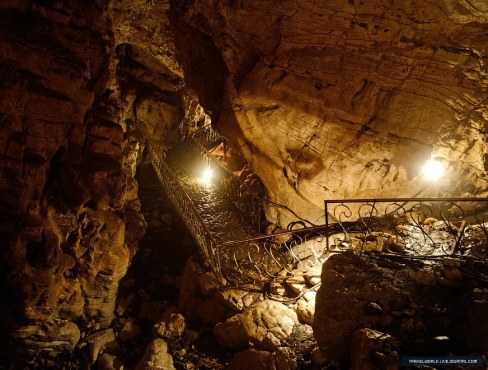
Vorontsovskaya Cave, also known as part of the Vorontsovskaya Cave System or Vorontsovka Caves, is a extensive network of underground passages located in the Khosta and Adler districts of Sochi, Russia. This system lies within the Greater Caucasus mountain range and is situated along the slopes of the Kudepsta River valley. It forms part of a broader belt of Mesozoic limestones that stretches parallel to the Black Sea coast for approximately 400 kilometers. The cave system is renowned for its interconnected chambers, archaeological significance, and accessibility as a tourist site, though it requires caution due to its natural hazards.
The caves are primarily formed in Mesozoic-era limestone, shaped over millions of years through corrosion-erosion processes involving water dissolution and mechanical erosion. This has resulted in a complex network of passages, sumps (water-filled siphons), and vertical shafts. The surrounding terrain features vertical limestone cliffs, with the cave entrances scattered across elevations ranging from 419 meters to 720 meters above sea level. Some chambers within the system are positioned up to 240 meters higher than others, creating a multi-level structure that highlights the karst topography of the region. The area's geology is characterized by numerous cave entrances riddling the landscape, contributing to the system's overall interconnectivity. The constant temperature inside is around 12°C, making it a stable subterranean environment.
The cave derives its name from the nearby settlement of Vorontsovka,
which itself was named after Illarion Vorontsov-Dashkov, a 19th-century
landowner who once controlled the region. Nearby villages like
Illarionovka and Dashkivka also bear his influence. The site has been
known to humans for millennia, with evidence of use by early prehistoric
people and cave bears. Bones from these ancient inhabitants have been
discovered within the passages, underscoring its long history as a
shelter.
Modern exploration began with the surveying of the main
Vorontsovskaya Cave. In the late 20th century, speleologists made
significant breakthroughs by connecting it to adjacent caves: the
Labyrinth Cave, Kabany Proval (Wild Boar Sinkhole), and Dolgaya Cave
(Long Cave) through a series of sumps. This unification renamed the
entire network as the Vorontsovskaya Cave System. The system has been
mapped to a total length of about 12 kilometers, making it the longest
cave in Krasnodar Krai and the sixth longest in Russia. The individual
Vorontsovskaya Cave spans around 4,000 meters. Exploration efforts have
revealed over a dozen entrances, allowing access from various points on
the valley slopes.
The cave system boasts a variety of geological formations, though it
is noted for having fewer prominent stalactites and stalagmites compared
to some other famous caves. Instead, its allure lies in imaginative rock
shapes that resemble animals and objects, such as "elephants,"
"crocodiles," and a "chandelier"—features that guides often highlight to
spark visitors' imaginations. The Prometheus Grotto (or Prometheus
Passage) is the most developed section, extending over 120 meters and
equipped for public access. This area includes somewhat outdated
installations, like wrought iron railings, which add a quirky,
historical charm but may feel rudimentary.
Deeper parts of the system
include narrow passages, vertical drops, and water features like sumps
that connect the various caves. The multi-level layout, with significant
elevation differences, creates dramatic descents and ascents for
explorers. The cave's interior is dim and humid, with slippery stone
floors that demand careful navigation.
Archaeological findings in Vorontsovskaya Cave include skeletal remains of cave bears (Ursus spelaeus) and early humans, indicating habitation during the Paleolithic era. These discoveries suggest the cave served as a refuge for prehistoric hunters and animals alike, providing insights into ancient ecosystems and human migration in the Caucasus region. Biologically, the cave supports typical karst fauna adapted to dark, moist environments, though no unique endemic species are prominently documented in public sources.
Vorontsovskaya Cave is a popular tourist attraction in Sochi,
particularly the Prometheus Grotto, which offers guided tours lasting
30-45 minutes. These tours focus on the cave's formations and history,
with guides explaining features in an engaging, if sometimes unclear,
manner. Visitors appreciate the imaginative interpretations of rock
shapes, but some find the experience underwhelming due to limited
natural speleothems and safety concerns like incomplete railings and
slippery paths.
Practical details include an environmental fee
(around 250 rubles) and cave entry (about 500 rubles), plus minor costs
like 50 rubles for toilets. The site is accessible via a hike or drive
to the Kudepsta River valley area, though exact opening hours vary
seasonally—it's best to check locally or through tour operators. Tips
from visitors: Wear sturdy, non-slip footwear; bring a flashlight if
allowed; and manage expectations if you've visited more elaborate caves.
The tour is moderately difficult, suitable for most but not ideal for
those with mobility issues. Overall, it's rated around 4 out of 5 by
reviewers, praised for its natural intrigue but criticized for
maintenance and value.