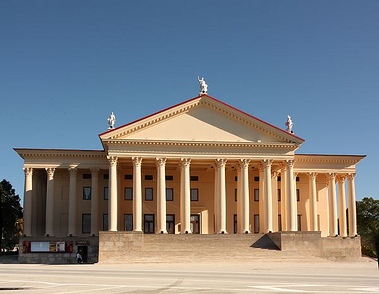
Ulitsa Teatralnaya 2, Central District
The Winter Theatre (Зимний театр in Russian) is a prominent cultural landmark in Sochi, Russia, renowned for its neoclassical architecture and role as a hub for performing arts in this Black Sea resort city. Situated in the heart of Sochi's central district, near the Black Sea coastline, it stands as a testament to the Soviet-era push to develop the city into a premier vacation and cultural destination during the 1930s.
The Winter Theatre in Sochi, Russia, represents a key milestone in
the city's transformation from a modest Black Sea outpost into a premier
Soviet resort destination during the 1930s. As part of Joseph Stalin's
ambitious program to develop Sochi as a subtropical health and leisure
hub for the Soviet elite and workers, the theatre symbolized the era's
emphasis on cultural enrichment alongside physical recreation. This
initiative followed a 1926 government decree that elevated
Sochi-Matsientinsky Resort to national importance, leading to widespread
construction of sanatoriums, infrastructure, and cultural venues. The
theatre's establishment aligned with broader efforts to create ensemble
architectural landscapes that blended neoclassical grandeur with Soviet
ideals, prioritizing public access to arts in a region known for its
mild climate and natural therapies.
Planning and Construction
(1930s)
The Winter Theatre's construction was conceived amid Stalin's
push to modernize Sochi, which included nationalizing pre-revolutionary
estates and building new facilities for rest and culture. Work on the
theatre began in September 1934 and concluded in November 1937, under
the supervision of architect Konstantin Nikolaevich Chernopyatov
(sometimes referred to as K.N. Chernopyatova in sources). This period
coincided with the height of Stalinist architecture, characterized by
monumental neoclassicism that evoked imperial Russian opulence while
serving proletarian purposes. The building's design featured a majestic
imperial style with a colonnaded facade, including 88 Corinthian
columns, pediments, and sculptural elements symbolizing the arts. It was
positioned in central Sochi near the Black Sea, integrating with the
subtropical landscape and nearby developments like sanatoriums and the
Sochi Port (built later in 1955). Although architects like Miron
Merzhanov shaped much of Sochi's resort architecture—designing
sanatoriums such as the RKKA (Red Army) facility with avant-garde
elements—the Winter Theatre was distinctly Chernopyatov's project,
emphasizing symmetry and grandeur over the minimalist forms seen in some
sanatoria.
The theatre's name reflects its role as an indoor venue
for year-round performances, contrasting with outdoor summer events in
Sochi's warm climate. Its auditorium, seating around 970, was designed
in a horseshoe layout with tiers of boxes, an orchestra pit, and ornate
interiors featuring plasterwork, chandeliers, and frescoes blending
classical mythology and Soviet themes.
Opening and Early Years
(1937–1940s)
The Winter Theatre officially opened on November 11,
1937, though some accounts note performances beginning in 1938. It
quickly became a cultural cornerstone, hosting opera, ballet, drama, and
concerts, and has been recognized as a federal cultural heritage site in
Russia since its early days. In its inaugural years, it embodied the
Soviet commitment to accessible arts, drawing comparisons to iconic
venues like Moscow's Bolshoi Theatre or St. Petersburg's Mariinsky due
to its architectural splendor. The theatre served the growing resort
population, including vacationers at nearby sanatoriums, and aligned
with Bolshevik propaganda promoting health and culture for the "new
Soviet man."
During World War II (1941–1945), Sochi's role shifted as
the city became a major hospital base for wounded soldiers, with many
sanatoriums repurposed for medical use. While specific details on the
Winter Theatre's wartime function are scarce, it likely hosted
morale-boosting performances or was temporarily adapted, surviving the
conflict intact amid the region's relative distance from front lines.
Post-War Soviet Era (1950s–1980s)
In the post-war decades, the
Winter Theatre continued as a vital cultural institution under Soviet
rule. It became home to the Sochi Philharmonic and regularly featured
touring productions from major Russian companies, including classics by
Tchaikovsky, Shakespeare, and contemporary Soviet works. The venue's
location along Resort Prospect (formerly Stalin Prospect) integrated it
into Sochi's expanding urban axis, where architecture emphasized
ensembles over individual structures. During this time, it hosted
festivals and events that reinforced Soviet cultural policies, such as
youth gatherings and artistic showcases. The theatre's neoclassical
style persisted as a symbol of enduring grandeur, even as architectural
trends shifted toward classical revivals in the late Stalin era.
Post-Soviet Period and Renovations (1990s–Present)
Following the
dissolution of the USSR in 1991, the Winter Theatre adapted to Russia's
market economy while maintaining its heritage status. It continued
operations amid economic challenges, hosting a mix of traditional and
modern performances. A significant turning point came with Sochi's
selection as host for the 2014 Winter Olympics, which spurred massive
infrastructure investments. Although the Olympics focused on new venues
in the Olympic Park and Krasnaya Polyana, the theatre underwent
renovations to preserve its historical integrity while updating
technical facilities like acoustics, lighting, and seating. By 2024,
reviews noted a refreshed interior with new halls and chairs, enhancing
visitor comfort without altering the original design.
In the
post-Olympics era, the theatre has thrived as a venue for international
festivals, such as the Yuri Bashmet Winter Arts Festival (established in
the 2000s) and the KVN comedy festival, attracting global audiences. It
symbolizes Sochi's evolution from a Soviet resort to a modern tourist
and cultural hub, hosting events like philharmonic concerts, ballets,
and theatrical productions. As of 2025, it remains a federal heritage
site, located at Teatralnaya Street 2, with coordinates approximately
43°34'20"N, 39°43'50"E, and continues to draw visitors for its blend of
history and live arts.
The Winter Theatre exemplifies Stalinist neoclassical style,
characterized by its grand scale, symmetry, and ornate details that
evoke the opulence of imperial Russian architecture while aligning with
Soviet monumentalism. The exterior features a portico with 88 Corinthian
columns, drawing comparisons to iconic venues like Moscow's Bolshoi
Theatre or St. Petersburg's Mariinsky Theatre. The building's facade is
adorned with pediments, friezes, and sculptural elements, including
allegorical figures representing the arts. Its overall design emphasizes
verticality and grandeur, with a prominent central entrance flanked by
wings, creating a U-shaped structure that encloses a forecourt. The
theatre's location amid subtropical greenery enhances its majestic
presence, blending harmoniously with Sochi's coastal landscape.
Internally, the layout includes a large auditorium with seating for
approximately 970 spectators, arranged in a traditional horseshoe
configuration with multiple tiers of boxes, balconies, and an orchestra
pit. The decor features intricate plasterwork, chandeliers, and frescoes
that highlight themes of classical mythology and Soviet idealism.
Renovations over the years have preserved these elements while
modernizing technical aspects like lighting and acoustics to support
contemporary productions.
As a versatile venue, the Winter Theatre hosts a wide array of events, including ballet, opera, classical concerts, theatrical plays, and international festivals. It is home to the Sochi Philharmonic and frequently features touring companies from major Russian cities, such as performances of classics like "Jesus Christ Superstar" or works by Tchaikovsky and Shakespeare. The theatre's name—"Winter"—reflects its original purpose as an indoor counterpart to outdoor summer venues in Sochi's mild climate, allowing year-round cultural activities. It has also served as a site for conferences, film screenings, and music events, attracting both locals and tourists. Visitor reviews often praise the immersive experience, noting the elegant atmosphere and high-quality productions, though some mention variability in show quality depending on the performers.
Located at Teatralnaya Street 2 in central Sochi, the theatre is easily accessible by public transport or on foot from nearby attractions like the Sochi Arboretum or the Riviera Park. Tickets for performances can be purchased online or at the box office, with prices varying by event (typically ranging from 500 to 5,000 RUB). Guided tours are occasionally available, offering insights into its history and backstage areas. For those interested in architecture, evening visits are recommended when the building is illuminated, providing stunning views against the Black Sea backdrop. The theatre remains a must-visit for cultural enthusiasts exploring Sochi's blend of natural beauty and historical significance.