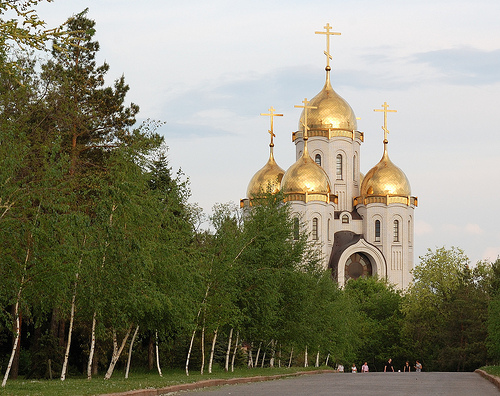
Address: Mamayev Kurgan, Volgograd
The Church of All Saints (Храм Всех Святых) is a Russian Orthodox church located on Mamayev Kurgan in Volgograd, Russia. This hill, historically known as Height 102 during the Battle of Stalingrad, is a pivotal site in World War II history and now hosts a vast memorial complex dedicated to the heroes of that battle. The church serves as a poignant addition to this ensemble, functioning as a place of worship, reflection, and commemoration for the millions who perished in the Great Patriotic War (1941-1945). Unlike the monumental sculptures and halls in the complex, such as The Motherland Calls! statue, the church adopts a more subdued presence, blending spiritual solace with the site's solemn atmosphere. It was constructed relatively recently, in the early 2000s, and stands as a symbol of reconciliation and eternal memory amid the scars of one of history's bloodiest conflicts.
The origins of the Church of All Saints trace back to 1993,
coinciding with the 50th anniversary of the Soviet victory
in the Battle of Stalingrad—a grueling 200-day siege that
turned the tide of World War II on the Eastern Front,
claiming over two million lives. The idea was to erect a
spiritual monument to honor the fallen soldiers and
civilians. In 1995, the project received the official
blessing of Patriarch Alexy II of Moscow and All Russia,
marking a significant step in post-Soviet Russia's efforts
to integrate Orthodox Christianity into public memorials.
Site selection was deliberate: the church was built near a
mass grave on Mamayev Kurgan, approximately 200 meters from
the main memorial structures. This location underscores its
role in remembering the unburied and unidentified victims of
the battle. Construction officially began in October 2000,
with the cornerstone laid on May 9, 2002—Victory Day in
Russia. The building was completed by September 2004, and it
opened to parishioners in May 2005, just in time for the
60th anniversary of the end of World War II. Father Georgy
Lazarev has served as the church's prior since its
inception, overseeing its operations and fostering a
welcoming environment for visitors and worshippers alike.
The church's establishment reflects broader trends in
Russia's cultural and historical revival, where Orthodox
structures are added to Soviet-era war memorials to
emphasize spiritual dimensions of national sacrifice.
Despite some initial controversy over altering the hill's
historical silhouette—originally a purely secular memorial
designed between 1959 and 1967—the church has been
integrated thoughtfully, complementing elements like the
Hall of Military Glory and the Eternal Flame.
Architecturally, the Church of All Saints embodies
traditional Russian Orthodox elements with a modern,
restrained twist, prioritizing harmony with its surroundings
over grandeur. Standing at a height of 33 meters (about 108
feet), the structure features pristine white walls that
contrast sharply with the golden onion domes—a hallmark of
Russian ecclesiastical design symbolizing the heavens and
divine light. These domes are visible from various points in
Volgograd, including distant neighborhoods, adding a
luminous accent to the city's skyline, especially at sunset.
The exterior is modest and unassuming, with clean lines and
minimal ornamentation to avoid overshadowing the memorial
complex's dramatic sculptures. It was positioned slightly
off the main path, about 200 meters to the left of the
central ensemble, and is partially screened by trees to
preserve the site's original aesthetic. This placement
ensures it doesn't disrupt views of key monuments like The
Motherland Calls!, but it becomes prominent when approached
from the Hall of Military Glory or higher elevations on the
hill.
Internally, the church maintains simplicity: the
decor is understated, with icons, frescoes, and altars
focused on themes of resurrection, martyrdom, and eternal
life. The masonry draws inspiration from other local
churches, such as the Church of Faith, Hope, and Love in
Volgograd, but is distinguished by its dome configuration
and integration into a memorial landscape. The overall
design evokes serenity, providing a quiet counterpoint to
the hill's vast, open spaces and the emotional weight of the
nearby ruins and statues. Some critics have noted it as a
"novodel" (new build in historical style), which slightly
alters the ensemble's mid-20th-century appearance, but many
appreciate its organic fit.
As part of the Mamayev Kurgan Memorial Complex—a
UNESCO-recognized site visited by millions annually—the
Church of All Saints holds profound symbolic value. It
transforms the hill from a mere battlefield relic into a
multifaceted space for historical remembrance, spiritual
healing, and national pride. Dedicated to all saints and the
war's victims, it offers a venue for prayer,
candle-lighting, and quiet contemplation, bridging the
secular heroism of Soviet memorials with Orthodox traditions
of honoring the dead.
The church's location on what was
once a fiercely contested high ground during the Battle of
Stalingrad amplifies its meaning. Mamayev Kurgan changed
hands multiple times in 1942-1943, with German and Soviet
forces clashing in brutal combat that left the earth scarred
and littered with remains. Today, the church stands as a
beacon of peace, hosting divine services on Sundays and
major Orthodox holidays, and attracting pilgrims, tourists,
and locals alike. It also participates in Victory Day
ceremonies, where wreaths are laid and services honor
veterans.
Recent social media posts, such as one from
August 2025 capturing the church at sunset, highlight its
enduring visual appeal and role in contemporary Russian
identity, often evoking themes of resilience and beauty amid
historical tragedy.
The church is open to the public daily, with no admission
fee (though donations are appreciated). It receives high
praise from visitors, holding a 4.5 out of 5 rating on
platforms like Tripadvisor based on dozens of reviews, and
has earned Travelers' Choice awards for its consistent
excellence. Many describe it as a "serene sanctuary" ideal
for reflection, with Father Georgy noted for his
approachable demeanor—visitors often engage in conversations
about faith and history.
Tips for visitors:
Best
Time to Visit: Weekdays to avoid crowds; evenings for
atmospheric sunsets over the domes.
Accessibility:
Located at Prospekt Imeni V.I. Lenina, Volgograd (within the
memorial complex). The site is reachable by public
transport, taxi, or guided tours. The hill involves some
walking on paths and stairs, so comfortable shoes are
recommended.
What to Do: Attend a service if timing
aligns, light a candle for the fallen, or relax on nearby
benches. Combine with exploring the full Mamayev Kurgan,
which takes 2-4 hours.
Etiquette: Dress modestly (cover
shoulders and knees), and maintain silence inside.
Photography is generally allowed but respectful.
Nearby
Attractions: The Motherland Calls statue, Eternal Flame, and
Hall of Military Glory are steps away, making it easy to
incorporate into a broader visit.
Overall, the Church
of All Saints offers a deeply moving experience, blending
architectural elegance with historical depth in one of
Russia's most iconic memorial sites.