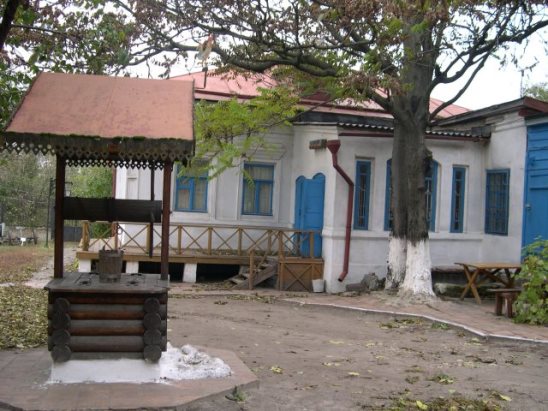
Location: Chapaev Street (Улица Чапаева) 264
Constructed: 19th century
The Aksay Post House, also referred to as the Aksay Postal Station of the 19th Century (Russian: Аксайская почтовая станция XIX века), is a preserved historical site and museum in Aksay, Rostov Oblast, Russia, situated at Budyonnovsky Spusk Street, 3. This cultural heritage object forms a key component of the broader Aksay Military-Historical Museum complex, which encompasses multiple sites dedicated to the region's past. Originally serving as a crucial relay point for mail, travelers, and carriages on major southern Russian routes, the station has been meticulously restored and opened to the public as a museum in 1992. It provides an immersive look into imperial Russia's postal system, Cossack life, archaeological discoveries, and even ties into later events like World War II, making it a multifaceted attraction for history buffs, families, and tourists interested in the Don Cossack heritage.
Early Establishment and Strategic Role (Late 18th–Early 19th
Centuries)
Postal services in Aksay trace back to at least 1792, when
archival records from the Don Cossack Host’s Civil Government document
the allocation of funds and assignment of local Cossacks to establish
and staff a post yard.
This was part of Russia’s expanding yam
(relay) postal system, originally reformed under Peter the Great and
expanded under Catherine the Great and Nicholas I. The station’s
location at the confluence of the Aksay and Don Rivers made it
exceptionally strategic: it sat at the intersection of four major postal
tracts—the Kazan route (Moscow to Kazan), Mariupol, Bakhmut, and
Zadonsky (to Stavropol)—linking central Russia to the Caucasus and Black
Sea regions.
Travelers and mail coaches arrived daily. The station
provided fresh horses (changed every 50–100 versts), lodging, meals, and
stables. Cossack yamshchiks (drivers) received modest stipends (7–30
rubles annually) and tax exemptions in exchange for service.
Early
structures were modest wooden buildings, including a supervisor’s
(postmaster’s) house, inn for travelers, coach-house with stables, a
central well, and open yards for horse relays. The station relocated
several times (notably 1805–1807) between upland and meadow sites due to
frequent Don River floods before stabilizing in the stanitsa.
In 1842
it was formalized as a temporary district postal office (kontora)
following resident petitions, handling official decrees, private
correspondence, and later registered mail and parcels.
19th-Century Operations and the Fire/Reconstruction
The wooden
building burned down in a major fire in 1837. A new stone kuren
(traditional Cossack house) was constructed in the 1840s, forming the
core of the surviving complex.
By the mid-19th century, the station
operated around the clock like a modern bus or train station, supporting
both state administration and regional trade in a frontier Cossack area.
It remained a key node until railways and telegraphy began to supplant
horse relays in the late 19th/early 20th centuries. By 1899 it had
evolved into a post-and-telegraph office while still maintaining some
relay functions into the early 1900s.
Famous Visitors
The
station’s location ensured a constant stream of prominent travelers.
Among those documented to have passed through (or stayed overnight)
were:
Alexander Pushkin (in 1820 and 1829; some local accounts claim
a third visit) — en route to the Caucasus and during southern travels.
Mikhail Lermontov
Alexander Griboyedov
Leo Tolstoy and Alexei
Tolstoy
Composers Pyotr Tchaikovsky and Mikhail Glinka
Emperors
Alexander I, Nicholas I, and Alexander II
General Nikolay Raevsky
Exiled Decembrists (post-1825)
These figures highlight the
station’s role not only in postal logistics but also in cultural and
political connectivity across the empire.
20th Century: Decline,
WWII, and Transition
The station gradually lost its original
postal-relay function with modernization. During WWII (Great Patriotic
War), the area saw heavy fighting: Aksay stanitsa was occupied twice by
German forces (November 1941 and July 1942–February 1943). In 1942, a
Soviet anti-aircraft battery from the 3rd Division of the 485th
Artillery Regiment covered the civilian evacuation across the Don River.
In 1985, the “Pereprava” (River Crossing) monument was erected near the
station entrance: a GAZ-MM military truck and anti-aircraft guns mounted
on an inclined pedestal commemorate these events.
Museumification
and Modern Era (1980s–Present)
Local efforts to preserve the site
began in the early 1980s under Vladimir Dmitrievich Gladchenko and
school-museum enthusiasts. The first Pushkin Festival occurred in 1981,
followed by a memorial plaque on the Postmaster’s House. In 1984 the
Aksay City Executive Committee transferred the “Postmaster’s House” to
the People’s Museum of Aksay’s History. Community-driven renovations
(1986–1988), including help from local residents and Bulgarian builders,
restored the courtyard and buildings. The first permanent exposition
opened in 1989.
The site officially became the Museum Complex “Postal
Station of the 19th Century” in 1992, operating as a branch of the Aksay
Military-Historical Museum. The “Hotel” building was added in 1997.
Interiors were reconstructed to reflect 19th-century authenticity.
Today the complex at 3 Budyonnogo Street (Budyonnovsky Spusk) includes:
The Postmaster’s House (stone kuren)
The Hotel building
Carriage shed with 19th–early 20th-century horse-drawn vehicles
(phaetons, britzkas, sleighs, buggies — including one from the film The
Elusive Avengers)
Well, gazebo, and courtyard
Exhibits on postal
history, road life artifacts, postcards, maps, Cossack domestic
traditions (“Cossack House”), and archaeology/paleontology from the
Aksay River basin (Stone Age to Middle Ages).
Annual events
include the Pushkin Festival (first Saturday in June), with historical
reenactments, costumes, and carriages. A bust of Pushkin and a versta
milestone stand at the entrance. The museum remains open to visitors
daily, offering guided tours, lectures, and a living glimpse into
imperial Russia’s postal and Cossack heritage.
Designed for functionality in a rural Cossack context, the Postal
Station exemplifies modest 19th-century Russian architecture with
practical, unadorned structures built from brick and wood, featuring
low-sloped roofs and efficient layouts to support rapid coach
turnarounds. The complex recreates a typical postal yard of the era and
includes several key elements:
Postmaster's House: The central
administrative building where the station keeper oversaw operations,
including horse relays, mail handling, and traveler registrations. It
bears a memorial plaque for Pushkin's visits and has been restored to
reflect its original role.
Hotel Building: A two-story lodging
facility for overnight guests, now housing exhibitions on both floors.
It was the last structure transferred to the museum in 1997 and features
period-appropriate interiors.
Carriage Shed: A storage area for
vehicles, now displaying historical transport artifacts in an open
courtyard setting.
Small Wing: Originally a utility space (later used
for archaeology storage), it complements the yard and was among the
first areas renovated in 1987–1988.
Well and Gazebo: Essential for
watering horses and providing shaded rest for passengers, these add to
the authentic ambiance.
Courtyard: Spanning about 480 square meters,
this outdoor space was revitalized in 1988 with tree planting, weeding,
and painting, serving as a venue for events like the annual Pushkin
Festival.
The overall layout prioritizes efficiency, with
buildings arranged around a central yard for easy access, evoking the
everyday operations of a busy imperial outpost.
Thanks to its position on key travel routes, the station hosted a
remarkable roster of Russia's elite, many of whom documented their
experiences in writings that enrich its legacy. Notable figures include:
Literary icons: Alexander Pushkin (who visited in 1820 and 1829
during his Caucasus travels), Mikhail Lermontov (inspired by the region
for works like A Hero of Our Time), Alexander Griboyedov, Leo Tolstoy,
Alexei Tolstoy.
Composers: Pyotr Tchaikovsky and Mikhail Glinka (the
"father of Russian classical music").
Military and political leaders:
General Nikolai Raevsky, exiled Decembrists (from the 1825 revolt), and
members of the imperial family, including Emperors Alexander I,
Alexander II, and Nicholas I.
Others: Baron Rosen and various heirs
to the throne.
These stops underscore the station's role in
cultural exchange, with Pushkin's visits particularly celebrated through
annual festivals featuring period reenactments, costumes, carriages, and
actors to transport visitors back in time.
Since its 1992 opening, the Postal Station has evolved into an
educational hub with permanent and rotating exhibitions that blend
postal history, Cossack culture, and archaeology. Key highlights
include:
"Mail in Aksay" Exhibition: Focuses on 19th-century
Cossack postal services, with artifacts like scales, inkstands, stamps,
and documents. It extends outdoors to the courtyard and carriage shed,
showcasing a unique collection of late 19th–early 20th-century
horse-drawn vehicles, such as droshkies (light open carriages), sleighs,
phaetons (four-wheeled open carriages), britchkas (light wagons), and
other carts that illustrate transportation evolution.
"Cossack House"
Exhibition: Recreates a typical Cossack dwelling with authentic period
items, including wooden furniture, religious icons, household utensils,
dishes, textiles, tools, and labor instruments, offering insights into
daily life.
Rotating and Thematic Displays: Housed in the Hotel
building, these have included "Money of Russia" (1998), "World of Stone"
(temporary), "I Was Among the Don Cossacks" (for Pushkin's 200th
anniversary in 1999), and exhibits on Aksay's ancient history, featuring
fossils, Stone Age tools, Bronze and Iron Age pottery, Sarmatian
weapons, Polovtsian artifacts, Tatar relics, and early Rus settlements
from the Aksay River basin.
WWII-Related Elements: Displays and
artifacts tied to the Don River crossings, including maps, photographs,
and survivor accounts from the 1940s evacuations and battles.
The
museum emphasizes hands-on learning, with immersive setups suitable for
all ages, and its collections contribute to the larger Aksay
Military-Historical Museum's holdings of over 69,000 items.
As a relic of Russia's imperial postal network—analogous to ancient systems in Persia or China but scaled to the empire's expanse—the Aksay Postal Station highlights themes of connectivity, exploration, and regional identity in the Don Cossack lands. Its integration into Aksay's tourism scene, alongside nearby sites like the Customs Outpost, underground bunkers, and ancient hillforts, draws visitors to Rostov Oblast for a comprehensive historical experience. The annual Pushkin Festival, held on the first Saturday in June since 1987, features lively reenactments and cultural programs, making it a highlight. The museum operates daily from 9:00 AM to 5:00 PM without breaks. Admission fees are not specified in available sources, so visitors should check the official website (www.aksay-museum.ru) or contact +7 (86350) 5-28-13 for current pricing, guided tours, or group bookings. The site is ranked highly among Aksay attractions (e.g., #2 on Tripadvisor with a 4.6/5 rating from limited reviews) and is accessible, though advance planning is recommended for festivals or peak seasons.