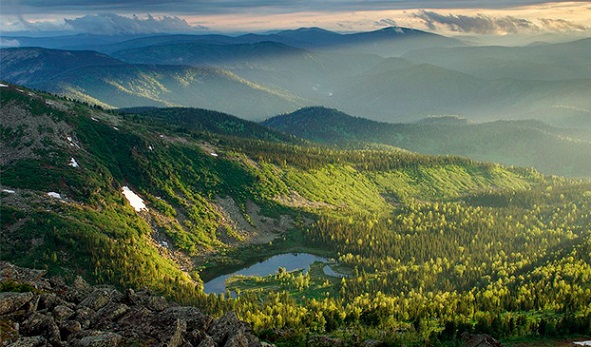
Kuznetsky Alatau Nature Reserve (Russian: Кузнецкий Алатау заповедник, also known as Kuznetsk Alatau Zapovednik) is a strict nature reserve (zapovednik) in Kemerovo Oblast (Kuzbass), southwestern Siberia, Russia. It protects high-mountain ecosystems in the Kuznetsk Alatau mountain range, part of the Altai-Sayan system.
Key Features and Attractions
The reserve features varied
topography with three main elevation zones:
Alpine zone (higher
elevations): Glacial cirques, small glaciers, tundra, dwarf shrubs, and
rocky landscapes. Highest peaks reach around 1,873–2,217 m.
Subalpine/mid-level: Flattened areas with tundra, bogs, and scattered
rocks.
Lower slopes/taiga: Dense coniferous forests (fir, spruce,
cedar/pine), river valleys, and limestone outcrops.
Highlights
include:
Scenic mountains like Mount Chemodan and Mount Bobrovaya.
Lakes such as Lake Rybnoe (Fish Lake), Lake Srednetersinskoe, and Lake
Panfilovskoe.
Krestovskie wetlands.
Glaciers and blooming alpine
meadows (especially striking in summer).
Wildlife: Moose, roe deer,
maral (Siberian red deer), boars, beavers (reintroduced), bears, and
many birds (including rare species; it's an Important Bird Area).
An ecological center (near Myski) offers an open-air complex where
visitors can observe ungulates in semi-natural conditions.
Permits and Access Rules
As a strict nature reserve, entry requires
advance permission. Individual or spontaneous visits are prohibited—only
scientists, educational groups, or approved ecotourism participants are
allowed.
Apply via the official website (kuz-alatau.ru) or
contact the administration in advance.
Main office: Mezhdurechensk,
Prospekt Shakhterov 33.
Visitor center: Myski, Karchitskaya 76.
Phones: +7 905 900 70-50, +7 (38475) 3-19-05, or others listed on the
site.
Provide details on group size, purpose, itinerary, and dates.
Approvals focus on minimizing environmental impact.
Ecotourism
options (guided only):
River rafting on three designated routes
(e.g., Kiya, Usa, Verkhnyaya Ters rivers) — summer (July–October).
Hiking tours (e.g., to Kanym Mountain).
Snowmobile routes (e.g.,
"Taskyl-Tour", "Reserved Distances", "Winter Safari").
Stays at
cabins (e.g., near Fish Lake) or tents.
Best Time to Visit
June–September: Prime season for hiking, rafting, and viewing
meadows/glaciers. July is warmest (~16.6°C average).
Winter
(December–March): Snowmobiling and winter activities; very cold and
snowy.
Hiking season is shortest in higher areas (typically
July–August) due to snow and weather. Early summer can still have
lingering snow and wet trails.
Climate note: Subarctic (Dfc) with
high precipitation (1,200–1,500 mm/year). Expect changeable mountain
weather—rain, fog, and sudden temperature drops are common. Summers are
mild but short; winters are harsh.
How to Get There
Gateway
towns:
Mezhdurechensk — Main administrative hub and starting point
for many routes.
Novokuznetsk, Kemerovo, Myski, or Abakan (nearby in
Khakassia).
Transportation:
Fly or take the train to
Novokuznetsk or Kemerovo from Moscow or other major cities.
The
Novokuznetsk–Abakan railway passes through the southern part (via
Mezhdurechensk).
From gateways: Primarily by car/4x4 (main method).
Helicopter for remote areas.
Organized tours usually handle
transfers.
Independent travel is difficult due to permit
requirements and rugged terrain.
Activities and Experiences
Rafting: Guided trips on rivers through taiga and mountain scenery.
Hiking/Trekking: Varying difficulty trails to mountains, lakes, and
valleys (e.g., Golden Valley area). Some routes involve bushwhacking or
crossing snowfields early in season.
Wildlife viewing and
photography: Especially at the ecological center or guided eco-routes.
Snowmobiling: Popular in winter.
Educational programs: At the visitor
center or ecological center (thematic presentations, observation of
animals).
Other: Limited trail rides, summer skiing on snowfields.
Multi-day trips with cabin/tent stays are common.
Practical
Visiting Tips
Preparation: Join an organized tour or apply for a
group permit well in advance (weeks/months). Solo travel is not
feasible.
Gear: Layered clothing for variable weather, sturdy
waterproof hiking boots, rain gear, insect repellent (taiga has
mosquitoes), sun protection, and a good sleeping bag. Bear safety
awareness is essential—make noise on trails.
Physical fitness: Trails
can be demanding with elevation gain, wet/muddy conditions, and boulder
fields (kurumnik).
Health and Safety: Remote area with limited
medical access. Inform someone of your itinerary. Hypothermia risk due
to rain/cold. Wildlife (bears) requires caution.
Costs: Reasonable
for guided packages (contact reserve for details); include transport,
permits, guides, and accommodation.
Respect rules: No littering, no
off-trail movement, follow "leave no trace." Strict anti-poaching
enforcement.
Language: Russian is primary; English may be limited
outside major tours.
Nearby: Combine with Podnebesnye Zubya
("Celestial Teeth") area near Mezhdurechensk for additional hiking if
reserve access is restricted.
Name and Geographical Context
"Alatau" comes from Turkic languages
meaning "motley" or "variegated mountains," reflecting the colorful
landscape of subalpine meadows, snowfields, stone fields, and forests.
The reserve lies on the western slopes of the range, spanning Tisulsky,
Novokuznetsky, and Mezhdurechensky districts. It covers approximately
412,900 hectares (about 4,129 km²), with a buffer zone of around
223,000–330,000 hectares.
The area serves as a critical watershed for
the Tom River (a major Ob tributary) and its headwaters (Upper, Middle,
and Lower Ters, Usa, etc.), supplying clean water to the industrialized
Kuzbass region. Glaciers and snowfields exist at unusually low altitudes
(1,200–1,500 m) for this latitude, feeding rivers and lakes.
Pre-Establishment History and Background (Pre-1989)
The broader
Kuznetsk Alatau range has long featured in indigenous histories,
including Shor and other Turkic peoples, with traditional uses for
hunting, gathering, and herding. Scientific interest grew in the Soviet
era due to its unique ecology, biodiversity, and role as a water source
amid growing industrial pressures in nearby coal-mining and
metallurgical areas (Kuzbass Coal Basin).
In the 1980s, proposals for
protection intensified. In 1983–1984, expeditions led by Professor T.N.
Gagina from Kemerovo State University (KemGU) explored the area. The
primary motivation was protecting clean water resources—preserving
headwaters, high bogs, and mountain-taiga forests threatened by logging,
pollution, and development. The reserve aimed to safeguard pristine
ecosystems and unique flora/fauna in a heavily industrialized region.
Before 1989, local people hunted species like sable, red squirrel,
beaver, moose, and wapiti. Industrial pollution (especially acid rain
from metallurgical plants) already affected the mountains.
Establishment and Early Years (1989–1990s)
The reserve was officially
established on December 27, 1989, by Decree No. 385 of the Government of
the RSFSR (Russian Soviet Federative Socialist Republic). Initial area
plans reached up to ~455,500 ha, but it was formalized around
401,812–412,900 ha.
Key early milestones:
1993 (September 28):
Boundaries approved by the Kemerovo Oblast Council (Decision No. 213),
along with a protected buffer zone.
1995: Buffer zone extended into
Khakassia Republic (8,000 ha).
1996: A.A. Vasilchenko appointed
director.
As a zapovednik, it follows strict protection rules with
minimal human intervention, focusing on scientific research, monitoring,
and anti-poaching. It forms part of the Altai-Sayan ecological network.
Post-Soviet Challenges and Development (2000s–2010s)
After the
Soviet collapse, the reserve faced ongoing pressures:
Industrial
pollution: Acid rain from dozens of factories in the Kuzbass lowlands
continued to threaten ecosystems, though high-altitude sphagnum bogs
filtered much of it.
Resource extraction: In the early 2000s, the
Ministry of Natural Resources pushed for geological surveys for gold and
other minerals. Poaching and illegal fishing persisted due to
underfunding of rangers.
Conservation efforts included wildlife
monitoring (e.g., northern reindeer, an isolated population of ~120–250
individuals), botanical studies, and ecotourism development in the
buffer zone (e.g., rafting on the Usa River) to generate funds.
Research documented biodiversity: ~578–618 vascular plants, 273 bird
species, 65 mammals (including brown bear, sable, musk deer, and rare
black stork), plus rare endemics like Rhodiola rosea. Glaciers, studied
since the late 20th century (first discovered in 1967), showed decline.
Modern Era and UNESCO Recognition (2020s)
In 2021, the reserve
gained UNESCO Biosphere Reserve status as the Kuznetsky Alatau Biosphere
Reserve, highlighting its global importance for biodiversity and
sustainable development. This elevated its profile for research and
limited eco-tourism.
Ongoing priorities include climate change
monitoring (glacier retreat of 50–75% since the 1980s), anti-poaching,
water quality protection, and balancing conservation with regional needs
in one of Siberia’s most urbanized industrial areas. Indigenous Shor
concerns about broader threats to the biosphere reserve have been noted
in recent years.
Topography and Landforms
The reserve features a complex, dissected
mountain terrain formed by glacial, volcanic, and tectonic processes.
The Kuznetsk Alatau consists of several parallel medium-height ridges
separated by river valleys. The mountains have relatively smooth
outlines, with steeper western slopes and gentler eastern ones.
The
terrain ascends in a series of three relatively flat levels cut by deep
river valleys. Key elevation zones include:
Alpine zone (highest
elevations, ~5–8% of the reserve): Features glacial-origin landforms
such as trough valleys, cirques, and cirque lakes. The highest peak in
the reserve is Great Kanym (or similar summits around 1,870–1,873 m).
Other notable peaks include Lesser Kanym, Zubets, and Drakon (ancient
volcanic cones).
Subalpine/mid-mountain zone (roughly 1,250–1,600 m):
Flattened areas with scattered igneous rock blocks, mountain tundra,
dwarf shrubs (willows, birches), sedges, mosses, lichens, and bogs.
Lower forested zones (down to ~800–1,000 m): Coniferous dark taiga and
cedar forests, transitioning to pine-fir in the northwest. River valleys
cut through limestone and schist layers with rocky outcrops. Slopes
often have clay soils without limestone.
Boulder fields are common,
with crooked birch and juniper formations. Karst features (caves, lakes)
and permafrost (above the tree line, up to 100–150 m thick in places)
also occur.
Hydrology: Rivers, Lakes, and Glaciers
The reserve
serves as a vital "water tower" for the region, accumulating and
purifying precipitation that feeds major rivers. It supplies 70–80% of
the inflow to the upper and middle Tom River.
Major rivers
(fast-flowing mountain streams, mostly snowmelt-fed, >2/3 of flow from
snow):
Upper, Middle, and Lower Ters (tributaries of the Tom).
Kiya River (flows into the Chulym, then Ob).
Others: Us, Taidon, etc.
Rivers are crystal-clear, with rocky beds, rapids, and winter ice
cover on smaller streams by late October. They support diverse fish,
including taimen, grayling, lenok, and others.
Lakes: Numerous
glacial and cirque lakes, often deep (up to 80 m). Notable examples
include Lake Rybnoe (largest, ~1 km long, 500 m wide), Lake
Srednetersinskoe, Lake Panfilovskoe, and others. Many are transparent
and glacier-fed.
Glaciers and snowfields: A unique feature is the
presence of small glaciers, glacierets (~78 glaciers + 57 glacierets
totaling ~3.1 km² in the broader range), and permanent snowfields at
unusually low altitudes (1,200–1,500 m) for these latitudes—rare in the
Northern Hemisphere at middle latitudes. They feed rivers and lakes but
have declined significantly (50–75% since the 1980s) due to warming.
Deep snow accumulation (3–5 m average, up to 10–15 m in depressions)
lasts 6–9 months, supporting snowfields and avalanche activity.
Climate
The climate is continental subarctic (Dfc), with high
precipitation due to orographic effects. It is one of the wettest areas
in Kemerovo Oblast, with up to 1,200–3,000 mm annually (highest in the
central watershed and western macro-slope).
Winter: Cold and
snowy; January average ~ -15.5°C. Southwestern winds pile snow on north-
and east-facing slopes.
Summer: Mild and short; July average ~
+16–16.6°C. Only 1–3 months above 10°C.
High humidity, long snow
cover, and orographic lift support glaciers at low elevations and
diverse vegetation.
Vegetation and Landscape Mosaic
The name
"Alatau" (Turkic for "motley/mottled mountains") reflects the colorful
mosaic: subalpine meadows, blue skies, rocky "loaches" (goltsy), stone
fields, and white snow.
~85% forest cover, dominated by Siberian fir,
spruce, Siberian pine (cedar), with some pine and broadleaf (birch,
poplar) in lower/disturbed areas.
Subalpine meadows with bright
flowers (e.g., Asian trollflower, martagon lily, columbine).
Alpine
tundra, mountain swamps, and bogs.
Over 578–625 vascular plant
species, plus many mosses, lichens, and endemics (e.g., Rhodiola rosea).
The reserve protects a transition between Siberian taiga to the
north and more southern steppe influences, creating high biodiversity
across elevation gradients.
Flora
The vegetation shows pronounced altitudinal zoning and
reflects the humid, mountainous conditions. Forests cover ~85% of the
reserve, primarily dark coniferous taiga.
Alpine/high-mountain
zone (above ~1,600 m): 235 species (103 characteristic). Features
tundra-like communities with sedges (Carex altaica, C. aterrima), dwarf
willows and birches, mosses, lichens, and mountain bogs. Summer blooms
include columbine (Aquilegia glandulosa), doronicum (Doronicum
altaicum), crowfoot (Ranunculus altaicus), bilberries (Vaccinium
myrtillus), persicaria (Polygonum bistorta), and bergenia (Bergenia
crassifolia). Purple carpets of flowers often ring glacier-fed lakes.
Subalpine/mid-elevation taiga (roughly 1,250–1,600 m): Siberian fir
(Abies sibirica) dominates, mixed with Siberian pine/cedar (Pinus
sibirica) on well-drained slopes and Siberian spruce (Picea obovata) in
valleys. Understory includes honeysuckle (Lonicera pallasii) and
spiraea. Sparse woodlands near timberline help regulate snowmelt runoff.
Lower forest belt and black taiga (chern) zones: Includes fir-spruce
forests transitioning to pine-larch on eastern slopes. Broadleaf
elements like birch (Betula) and aspen (Populus) appear in disturbed or
lower areas. Black taiga features rich herbaceous layers.
Other
habitats: Rocky steppe patches on lower slopes (154 species), mountain
swamps and bogs (with birch thickets, cranberries, and various Carex and
Eriophorum species), river valleys, and floodplains.
Overall
vascular plant diversity: 578–625 recorded species (from ~80 families,
~275 genera), with projections up to 943. This represents about 25% of
the Altai-Sayan region's flora. Additional non-vascular plants include
323 moss species and various lichens/fungi (still understudied).
Notable and rare plants: Many species are rare or threatened, including:
Rhodiola rosea (rose-root or golden root)
Paeonia anomala (peony)
Leuzea carthamoides (maral root)
Paeonia anomala
Orchids like
Cypripedium (lady's slipper)
Endemics such as Aconitum pascoi
(wolfsbane) and Brunnera sibirica.
Thirty or more species are
regionally threatened or Red Book-listed. The flora mixes taiga,
mountain, and some steppe elements, with high endemism due to the
isolated mountain setting.
Fauna
The fauna is primarily boreal
taiga with mountain and some steppe influences. It includes a mix of
native species plus a few reintroduced or introduced ones (e.g., beaver,
muskrat, American mink).
Mammals (58–65 species)
Insectivores:
11 species (e.g., shrews).
Bats: 9 species.
Rodents: 18–24
species, the most common group — including red squirrel (Sciurus
vulgaris), Siberian chipmunk (Tamias sibiricus), various voles, pikas
(Ochotona alpina), and beavers (Castor fiber, reintroduced and now
widespread with 200–250 individuals).
Lagomorphs: Hares.
Carnivores: 13 species, including sable (Martes zibellina tomensis,
numerous and stable at thousands), brown bear (~240–300 individuals, the
largest predator), wolf, Eurasian lynx, wolverine, otter, badger, and
smaller mustelids.
Ungulates: 5 species — moose (Alces alces),
Siberian roe deer (Capreolus pygargus), Siberian wapiti/maral (Cervus
elaphus sibiricus), wild boar, and a small isolated population of forest
reindeer (~120 individuals, a conservation concern due to inbreeding).
Brown bears are particularly notable, moving to tundra in summer for
berries. Sable is a flagship species with high densities in cedar-fir
forests.
Birds (273–281 species)
About 70% of Kemerovo
Oblast's birds nest here. Roughly 239 are breeding species; many are
migratory. The reserve is an Important Bird Area.
Common in lower
slopes/taiga: Yellowhammer, crossbills, rosefinch, chaffinch, tits,
fieldfare, hazel grouse, corvids.
High-mountain tundra: Water pipit,
reed bunting, twite, solitary snipe, rock ptarmigan.
Rare/Red Book
species: Black stork (6–8 pairs), golden eagle, peregrine falcon, saker
falcon, gyrfalcon, osprey, imperial eagle, and others (about 13
rare/endangered species total).
Six Altai-Sayan endemics occur
here, such as Siberian finch and Godlewski's bunting.
Other
Vertebrates
Fish: 13–14 species in rivers and lakes, including taimen
(Hucho taimen), Siberian grayling (Thymallus arcticus), lenok, and
others. The reserve protects important headwaters and spawning grounds.
Amphibians: 2 species (common toad, moor frog).
Reptiles: 2 species
(viviparous lizard, common viper).
Insects are diverse (hundreds
of species recorded), including Red Book butterflies like Apollo
(Parnassius apollo).