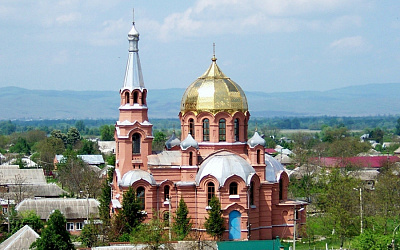
Ardon (Osset. Yrydon) is a city in the Republic of North Ossetia - Alania. The administrative center of the Ardon region.
Travelers who are going on vacation to Ardon or another city in North
Ossetia should visit a unique natural landmark - a huge oak tree, whose
venerable age is at least five centuries old. This tree, as the
old-timers of Ardon say, was dedicated to the ancient deity Alarda,
whose cult has long been widespread in many Ossetian villages. Citizens
respect the relic tree and even believe that it is time to give it the
official status of a natural monument of regional significance.
The
Orthodox Cathedral of the Holy Great Martyr George the Victorious in the
city center, as well as the chapel of the Holy Healer Panteleimon in the
courtyard of the hospital. A few years ago, the rector of the temple
decided to establish a worship cross in the city in memory of the laity
and members of the clergy, whose graves were lost during the years of
Soviet power. The worship cross in Ardon became the first such monument
in the Vladikavkaz and Alanian diocese.
Among the sights of Ardon, it
is worth highlighting the places that keep the memory of the tragic
events of the Great Patriotic War: - the mass grave of soldiers who fell
on the battlefields in 1942; a memorial monument to the Ardonians who
died in battle, erected in 1972; a monument to the soldiers of the 319th
Rifle Division, located in the vicinity of the city, whose dramatic
history is known to every city dweller;
Ardon Museum of the
history of the city, culture, and education,
House-Museum of Nikolai
Salamov,
The Podvig Museum, founded in 1987 on the basis of
vocational school No. 15, is also dedicated to the soldiers of the 319th
division.
Bulvarnaya Street Sovetov (local Arbat),
Central park of
recreation and culture.
Triangle Park,
Square with a fountain, a
summer scene,
Monuments: Lenin, Stalin,
Worship cross at the
entrance from Vladikavkaz,
Monument to V.V. Chumakov,
Monument to
Kosta Khetagurov
Memorial to Veterans of WWII
Monument to G.T.
Botoev,
Monument to K.T.Toguzov,
Monument to Ts.V. Ambalov,
Memorial "Eternal Flame"
brotherly grave,
Memorial to H. Ramonov,
also to S. Khoranov, I. Dzhikaev, Margelov, G. Botoev, a monument to the
Dzugaev brothers.
Church of the Holy Great Martyr George the Victorious.
Chapel of
the Holy Healer Panteleimon (at the hospital) was founded in 2008.
The Theological Seminary, the cultural center of Ossetia, was founded at
the end of the 19th century.
city natives
Ardon is a town situated in the Republic of North Ossetia–Alania, a
federal subject of Russia located in the North Caucasus region of
Eastern Europe. It serves as the administrative center of Ardonsky
District and is positioned centrally within the republic.
Geographically, Ardon lies at coordinates 43°11′N 44°19′E, approximately
39 kilometers (24 miles) northwest of the republic's capital,
Vladikavkaz. The town is built on the west bank of the Ardon River at an
elevation of about 420 meters (1,380 feet) above sea level. Ardonsky
District, which encompasses the town, spans 377.08 square kilometers
(145.7 square miles) and is uniquely the only district in the republic
that is entirely internal, surrounded by other districts without
external borders. It shares boundaries with Prigorodny District to the
southeast, Pravoberezhny District to the east, Kirovsky District to the
northwest, Digorsky District to the west, and Alagirsky District to the
south, with its northern edge influenced by the proximity to the Terek
River valley.
Topography and Terrain
The geography of Ardon
and its surrounding district is characterized by its position on the
Ossetian inclined plain, which extends from the foothills of the Greater
Caucasus Mountains' Forest Ridge in the south to the Elhotovo Gates of
the Sunzha Ridge in the north. The terrain generally descends from south
to north, creating a transitional landscape that shifts from hilly and
mountainous zones in the southern parts to flatter valleys and lowlands
in the north. Elevations within the district range from around 400
meters in the northern valleys to approximately 600 meters in the
southern foothills, reflecting this gradual incline.
Broader regional
context places Ardon in the central part of North Ossetia–Alania, where
the northern areas lie within the Stavropol Plain, a relatively flat
expanse, while the southern portions approach the rugged northern slopes
of the Greater Caucasus Mountain Range. This mountain system dominates
the republic's southern boundary, with prominent peaks including Mount
Kazbek at 5,033 meters (the highest point in North Ossetia–Alania) and
Mount Jimara at 4,780 meters. The landscape around Ardon features
dramatic mountain vistas, deep valleys, and proximity to natural
reserves, offering opportunities for outdoor activities amid the
Caucasus' rugged beauty. Approximately 22% of the republic's territory,
including parts near Ardon, is covered by forests, contributing to a mix
of wooded hills and open plains.
Hydrography
The Ardon River
is the defining hydrological feature of the area, with the town itself
located on its west bank. This river, a major left tributary of the
Terek River, originates from glaciers in the Caucasus Mountains and
flows northward through the district for about 50 kilometers within its
boundaries. Overall, the Ardon River stretches 101 kilometers in length
and plays a crucial role in local irrigation, agriculture, and defining
some district boundaries. The river's valley, including the Ardon
Valley, has historical significance as part of ancient trade routes like
the Silk Road and modern pathways such as the Ossetian Military Highway
connecting Russia and Georgia.
In the wider central region, rivers
primarily drain into the Terek River basin, which includes other notable
waterways such as the Urukh River (104 km), Kambileyevka River (99 km),
Gizeldon River (81 km), Fiagdon River (75 km), and Sunzha River (278
km). These rivers carve through the landscape, creating fertile valleys
and gorges that enhance the area's scenic appeal.
Climate
Ardon experiences a moderately continental climate, typical of the North
Caucasus foothills. Average temperatures in January hover around -5°C
(23°F), while July averages +24°C (75°F), indicating warm summers and
cold, snowy winters. Precipitation varies by elevation: the plains
around Ardon receive 400–700 millimeters annually, while higher
mountainous areas to the south can exceed 1,000 millimeters. This
climate supports diverse vegetation, from steppe-like grasslands in the
north to denser forests in the foothills.
Natural Features and
Resources
The region's natural features include a blend of
mountainous terrain, river valleys, and forested areas, with Ardon's
proximity to the Caucasus Mountains providing access to high peaks,
clear rivers, and outdoor recreation spots. Notable resources in the
central republic area encompass minerals like copper, silver, and zinc;
timber from the forested zones; mineral waters; and hydroelectric
potential from rivers such as the Ardon. Untapped oil and gas reserves
also exist, adding to the area's economic potential. The landscape's
diversity, from inclined plains to mountain ridges, fosters rich
biodiversity and scenic beauty, though it is also prone to natural
hazards like flooding along rivers and seismic activity due to the
tectonic setting of the Caucasus.
Etymology
The name of the city comes from the Ardon River. Hydronym is translated from the Ossetian language as - "mad river", where arra - "6shenaya", don - "river".
Ancient and Medieval Periods
The history of Ardon, a town in the
Republic of North Ossetia-Alania, Russia, is deeply rooted in the
broader historical context of the North Caucasus region. The territory
around Ardon, situated in the fertile Ardon River valley, was inhabited
by proto-Ossetian communities—descendants of the ancient Sarmatian
nomads—during the Iron Age in the 1st millennium BCE. These early
settlers engaged in agriculture, herding, and riverine trade in the
northern foothills of the Caucasus Mountains, establishing a cultural
foundation tied to both steppe and mountainous economies. Archaeological
evidence from the region indicates sedentary lifestyles with fortified
settlements, reflecting the transition from nomadic to more stable
communities.
During the medieval era, the Ardon valley formed an
integral part of the Kingdom of Alania, a powerful North Iranian polity
that flourished from the 8th to the 13th centuries. Alania controlled
strategic mountain passes and fertile lowlands, serving as a key node on
trade routes connecting the Silk Roads to the Black Sea and the South
Caucasus. The Alans, ancestors of the modern Ossetians, adopted
Christianity in the 10th century, which influenced local architecture,
society, and cultural practices. The kingdom facilitated the exchange of
goods such as metals, furs, and ceramics, and maintained ties with
neighboring Georgian kingdoms. However, the Mongol invasions in the
1230s devastated the region, scattering Alan populations and dismantling
the kingdom's centralized authority, leading to a period of
fragmentation and external influences.
Incorporation into the
Russian Empire (18th–19th Centuries)
The modern settlement of Ardon
emerged during Russia's expansion into the Caucasus. Ossetia's gradual
incorporation into the Russian Empire began in the mid-18th century
through diplomatic alliances, culminating in 1774 following Russia's
victory in the Russo-Turkish War and the Treaty of Küçük Kaynarca. This
allowed Ossetians to affiliate voluntarily with Russia for protection
against Ottoman and Persian threats, enabling Russian administrative
control, including the resettlement of highland populations to the
plains and the establishment of military outposts.
In February 1816,
General Delpotso (also referred to as General Ivan Abkhazov in some
regional histories) selected a site on the southern bank of the Ardon
River for a fortified settlement to secure the Caucasus frontier. By
1823–1824, this military outpost was officially named Ardon, in honor of
the nearby Ardon River (whose name derives from the Ossetian word "don,"
meaning "water" or "river"). The relocation of the road between the
Elizabethan and Konstantinovsky military settlements to the left bank of
the Terek River in 1824 prompted the construction of new fortifications,
including Ardon, to protect the route.
In 1825, a Cossack village was
founded adjacent to the military fortification, populated initially by
mountaineers from the nearby Alagir Gorge. By 1838, the village of
Ardonskaya was established nearby, with part of the Vladikavkaz Cossack
regiment relocated there. The Russian government supported settlement by
allocating 10,000 rubles for tools and 60 pairs of bulls with carts for
timber transport, aiding the Cossacks in building dwellings. In 1870,
the Ossetian village of Kadygaron was incorporated into Ardonskaya,
blending Cossack and Ossetian communities. Toward the end of the 19th
century, Ardon became a cultural hub with the founding of a Theological
Seminary, which served as a center for Ossetian education and
intellectual life. The town's strategic location made it an important
road junction, facilitating trade and military movements between
Vladikavkaz (39 km southeast) and other parts of the Caucasus.
Soviet Era (20th Century)
Following the Russian Revolution, Ardon
became part of the North Ossetian Autonomous Soviet Socialist Republic
(ASSR), established on April 20, 1924, as part of the Soviet Union's
administrative divisions to promote collectivization and regional
autonomy. The 1930s saw industrialization, including collective farms
for agriculture, small factories for food processing, and mining
operations in the nearby Sadon lead-zinc complex, boosting economic
output amid political repressions.
During World War II (the Great
Patriotic War in Russian historiography), Ardon experienced significant
hardships. In 1942, fierce battles occurred in the region as Nazi forces
advanced into the North Caucasus. The town honors these events with
memorials, including a mass grave for soldiers who fell in battle, a
1972 monument to Ardon residents who died in the war, and a monument to
the 319th Rifle Division near the town. The 319th Division's tragic
history—marked by heavy losses during defensive operations—is
commemorated locally, with every resident familiar with its story.
Post-war reconstruction accelerated growth through agricultural
collectivization and infrastructure development, such as rail links
branching to Alagir, transforming Ardon into a key transportation hub.
In the 1960s, Ardon underwent rapid expansion, evolving into an
industrial-agricultural center. Facilities included a cannery, hemp
processing factory, and other food and agricultural processing plants.
This growth culminated in Ardon receiving town status in 1964, marking
its transition from a village to an urban settlement. Population figures
reflect this development: the 1979 census recorded 12,857 residents,
rising to 13,536 in 1989.
Post-Soviet Period (Late 20th–21st
Centuries)
After the dissolution of the Soviet Union in 1991, Ardon
and the surrounding Ardonsky District adapted to Russia's federal
structure. In 1994, North Ossetia adopted its current name, Republic of
North Ossetia-Alania, emphasizing its Alanian heritage. Administrative
reforms, including Law No. 12-RZ of March 5, 2005, formalized Ardonsky
District's municipal borders and status within the republic. The town's
economy continued to focus on agriculture and industry, with its
position as a road and rail junction supporting regional connectivity.
The region faced challenges from ethnic tensions in the North Caucasus,
including the 1992 Ossetian-Ingush conflict over nearby territories and
the 2004 Beslan school siege in the adjacent Pravoberezhny District,
which heightened security concerns and socioeconomic strains. Despite
this, Ardon's population grew steadily: 17,521 in 2002, 18,774 in 2010,
and an estimated 18,915 in 2023 (a 0.8% increase).
Cultural
preservation efforts include the Ardon Museum of the History of the
City, Culture, and Education, and the Podvig Museum (founded in 1987 at
Vocational School No. 15), dedicated to the 319th Rifle Division. In
recent years, a worship cross was erected to commemorate lost graves
from the Soviet era, marking the first such monument in the Vladikavkaz
and Alanian diocese. Today, Ardon remains a vital administrative and
economic center in North Ossetia-Alania, blending its ancient Alanian
roots with modern Russian influences.
6 preschool institutions
4 secondary educational institutions
Ardon Agricultural Technology College,
Sports complex,
Palace of
Culture,
School of Music,
Sunday School
Museum of Culture and
Education,
Library,
Leisure and culture park (opened in 2017).
Church of the Holy Great Martyr George the
Victorious.
The chapel of the holy healer Panteleimon (at the
hospital) was founded in 2008.
Theological seminary, the cultural
center of Ossetia, was founded at the end of the 19th century.
Artists
Ambalov, Tsotsko Bitsoevich (1871-1937) - ethnographer,
writer, well-known collector of Ossetian folklore.
Dzutsev, Soslan
Khasanovich - musician, arranger, harmonist, performer of folk songs.
Laureate of Russian and International competitions. People's Artist of
North Ossetia-Alania and Honored Artist of South Ossetia.
Epkhiev,
Tatari Aslanbekovich - playwright, poet.
Ilas Arnigon is an Ossetian
poet.
Salamov, Nikolai Mikhailovich - theater and film actor.
People's Artist of the USSR (1984).
Tlatov, Elmarza Danilovich -
Ossetian writer.
Tkhapsaev, Vladimir Vasilyevich - theater and film
actor. People's Artist of the USSR (1960).
Military
Terentiev,
Vasily Grigorievich (1899-1957) - Soviet military leader, lieutenant
general (1944)
Toguzov, Kaurbek Tembolatovich (1919-2009) - Hero of
the Soviet Union (1943)
Athletes
Zangiev, Dzantemir
Georgievich (1936) - Honored coach of the RSFSR in freestyle wrestling
(1980), two-time champion of the RSFSR (1966, 1969), Honorary Master of
Sports of the USSR.
Koroev, Alan Vitalievich (1998) Russian football
player.
Kulaev, Boris Khadzhumarovich (1929-2008) - multiple champion
of the USSR, Honored Master of Sports of the USSR (1957).
Makiev,
Alan Vladimirovich (1991) Russian basketball player.
Mistulov, Alan
Olegovich (1997) Russian footballer.