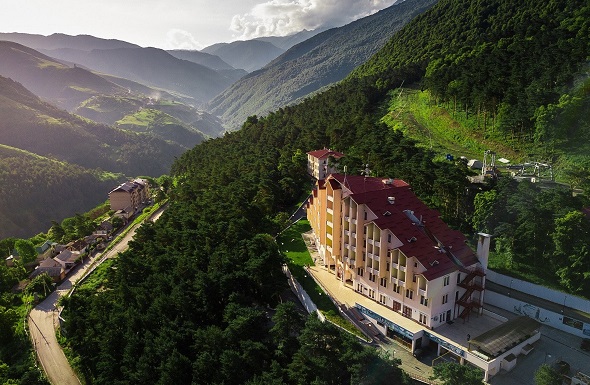
Armkhi (Ingush. Mokhtӏe) is a village in the Dzheyrakhsky region
of Ingushetia. The developing tourism center and all-season resort
of Armkhi. It is part of the Dzheyrakh rural settlement. Located on
the left bank of the Armkhi River.
The nearest settlements
with permanent population: in the north - the village of Beini, in
the west - the regional center Dzheyrakh, in the east - the village
of Lyazhgi.
Тhe resort of the same name is located near the
village.
Best Time to Visit
Summer (June–September): Prime season for
hiking, sightseeing tower complexes, and outdoor activities. Warm
days (often 15–25°C/59–77°F in valleys, cooler at altitude),
wildflowers, and clear mountain views. Long daylight hours suit
exploration.
Winter (December–March): Popular for skiing and snow
activities at the Armkhi ski area. Expect cold temperatures and
snow; facilities cater to winter sports.
Shoulder seasons
(spring/fall): Fewer crowds but possible rain or variable weather.
Check forecasts, as mountain conditions change quickly.
General
tip: July–August offers the most reliable weather for first-timers,
but book ahead for peak summer.
How to Get There
Armkhi
lies in a border zone near Georgia, so access involves specific
requirements, especially for foreigners.
By Air: Fly into
Magas Airport (IGT) in Ingushetia or Beslan Airport (OGZ) in nearby
North Ossetia (Vladikavkaz area, ~45–60 minutes away by car/taxi).
Grozny Airport (GRV) in Chechnya is another option (~1.5–2 hours).
From airports, arrange a taxi or transfer to Armkhi (around 1–1.5
hours depending on starting point).
By Road: Drive or take a
taxi/bus from Nazran/Magas (main hubs) or Vladikavkaz. The route
through the mountains is scenic but involves checkpoints.
Public
Transport: Buses or shared taxis (marshrutkas) connect regional
cities, but private transfer or rental car is more convenient for
the final leg to Armkhi.
Important: Border Zone Permit
Foreigners (and sometimes Russian citizens for certain areas) need a
special FSB (Federal Security Service) border zone permit to visit
mountainous parts like Armkhi and tower complexes. Apply in advance
(ideally 30–45+ days) via the FSB office in Nazran or online through
official channels. Local tour operators or hotels like Armkhi Resort
can often assist. Without it, access is restricted at checkpoints.
Russian citizens may need only a passport in some cases. Always
verify current rules, as they can change.
Safety Note: While the
North Caucasus has improved significantly, many governments advise
caution or against travel to Ingushetia due to regional risks.
Research current advisories, consider traveling with a local guide
or reputable tour, and stay informed. The area around Armkhi is
generally geared toward tourism but remains conservative.
Where to Stay
The main accommodation is Armkhi Resort (Sanatorium
Armkhi), a 3-star (or 2/3-star) complex with various room categories
(standards, comfort, suites), some with mountain views and
balconies. Facilities typically include:
Indoor and outdoor
pools (seasonal)
Sauna, SPA, massage, gym, and wellness programs
Restaurant serving local and Russian cuisine
Wi-Fi, parking,
kids’ areas, sports facilities (e.g., badminton, yoga)
Options
for larger groups like cottages/houses
Reviews praise the
stunning location and helpful staff, though some note dated
Soviet-era elements in parts of the facility. It’s ideal for a
relaxing stay with on-site activities.
Alternatives in the
broader area include guesthouses or hostels like Legendi Gor for a
more budget/local experience. Book via major platforms or directly.
Things to Do and Attractions
Skiing and Winter Sports: Armkhi
has ski lifts, slopes, and related infrastructure—suitable for
beginners and intermediates. Rentals and instruction available
seasonally.
Hiking and Nature: Explore trails around the resort,
pine forests, and gorges. Great for day hikes with panoramic views.
Ancient Tower Complexes: Visit nearby Ingush architectural gems like
Erzi, Vovnushki, Targim, and others in the Dzheyrakh-Assa Reserve.
These medieval stone towers (battle, residential, signaling) are
UNESCO-level heritage and highlight Ingush history. Guided tours
recommended.
Cultural Experiences: Learn about Ingush traditions,
visit museums or open-air sites, and observe local hospitality.
Nearby Tkhaba-Yerdy Church is an ancient Christian site.
Resort
Activities: Swimming, horseback riding, ATV tours, wellness
treatments, and excursions organized by the resort.
Day Trips:
Combine with other Ingushetia highlights or cross into neighboring
areas if permits allow.
Practical Visiting Tips
Health and
Wellness Focus: As a sanatorium, Armkhi emphasizes clean mountain
air, mineral waters, and treatments. Bring any personal medications;
consult doctors on-site for programs.
What to Pack: Layered
clothing for variable mountain weather (warm days, cold nights),
sturdy hiking shoes, rain jacket, sunscreen, hat, insect repellent
(summer), and modest attire (conservative region—cover
shoulders/knees, especially for women at cultural sites). Power
adapter for Russian sockets.
Food and Drink: Resort restaurant
offers meals; try local Ingush specialties like chapilgush
(cheese-filled flatbread), hingalsh (pumpkin version), lamb
shashlik, and boiled meats. Fresh, hearty Caucasian cuisine. Bottled
water recommended over tap. Alcohol availability may be limited due
to cultural norms.
Money and Connectivity: Rubles are king; ATMs
in larger towns (Nazran/Magas). Wi-Fi at the resort, but signal can
be spotty in remote mountains. Bring a local SIM if needed (rules
for foreigners may apply).
Language: Russian is widely spoken;
English is limited. Basic phrases help, or hire a guide. Locals are
often hospitable.
Transportation On-Site: Resort may offer
shuttles or tours. Taxis for short trips; roads can be winding—drive
cautiously.
Cultural Respect: Ingushetia is predominantly Muslim
and conservative. Respect local customs, dress modestly, avoid
public displays of affection, and be mindful of interactions (e.g.,
limited contact with unfamiliar women). Photography of sensitive
sites/checkpoints may be restricted.
Health/Safety: Altitude
awareness (acclimatize), no tap water, standard travel insurance
(medical/evacuation). Follow local advice on trails/weather. Petty
crime is low but stay vigilant.
Sustainability: Support local
guides and minimize impact in this sensitive mountain ecosystem.
The history of the Armkhi resort began at a time when the Ingush
still wore a Circassian coat, the center of Ingushetia was Vladikavkaz,
and Idris Zyazikov headed the Ingush Autonomous Region.
Both the
Ingush people and the Soviet Union needed a resort: there was a lack of
medical institutions in Ingushetia, and there were no year-round resorts
at an altitude of more than 1000 meters throughout the USSR.
The
Dzheirakh Gorge has long attracted attention with its beautiful
location, pine forests on the slopes of the mountains, murmuring
streams, springs, waterfalls and, of course, clean air. Thanks to the
efforts of the head of the health department of Ingushetia, Abdul-Khamid
Tangiev, the authorities drew the attention of the authorities to the
Sunny Valley of Armkhi, which is ideal for a resort.
In 1925, at
the direction of the People's Commissar of Health of the RSFSR Nikolai
Semashko, an expedition arrived in the village of Armkhi, which was
called Mokhkate, and Achaluki. The commission included: professors of
medicine, physics, climatologists, the head of the North Caucasian
Resort Administration and doctors. The regional expedition spent several
days on the spot, checked and inspected the surroundings, and after a
comprehensive examination, confirmed the value of the Dzheyrakh Gorge
for organizing a high-altitude climatic station, where it would be
possible to treat pulmonary, bone and childhood tuberculosis.
The
conclusion of the regional expedition marked the beginning of the
development of resorts in Armkhi and Achaluki.
Abdul-Khamid
Tangiev, 22, worked hard to get money to build a resort in Armkhi. To do
this, he had to overcome the doubts of both Ingush officials and members
of the country's government.
In 1926, a train arrived in
Ingushetia with members of the All-Russian Central Executive Committee
of the USSR. Mikoyan, Rykov, Chicherin and other members of the
government were received at the Didigovs' house. After receiving the
guests, Abdul-Khamid Tangiev showed People's Commissar for Foreign
Affairs Georgy Chicherin to Table Mountain and said that mountainous
Ingushetia begins behind it, where it is planned to build "Russian
Switzerland". Chicherin assured Tangiev that the Council of People's
Commissars would support the idea and invited him to Moscow.
The
Council of People's Commissars really supported the idea of creating a
Russian Switzerland. Tangiev had a meeting with the People's Commissar
of Health of the RSFSR Nikolai Semashko, where he was handed a banknote
sheet for 100,000 rubles. Ingushetia has also been given detachments of
medical workers, medical equipment and medicines, and the salaries of
doctors working in mountain villages have been increased.
In
Armkhi, the construction of a resort began: the work was supervised by
the contractor Amirkhan Lyanov, who won the auction. The project was
made by engineer Ibragim Bazorkin. There was a lot of work: to build a 7
km long mountain road, breaking it through the rocks; construct a
one-story building of the sanatorium and all household services; lay
plumbing; improve the pine forest in the construction zone. The
sanatorium was built from local pine, but some materials and products
were brought from Vladikavkaz on pack horses and donkeys.
The
road and bridges were built day and night, the rocky ground exploded,
there was a continuous rumble.
By the end of 1926, the road was
already completed. And in early 1927, the sanatorium was ready. It
consisted of four buildings, next to which was the building-cottage of
M. Kalinin, resembling a tower. It was in this building that Idris
Bazorkin wrote his famous novel From the Darkness of Ages.
A
reinforced concrete arch bridge was built across the Terek River, and
two wooden bridges across the Armkhi River.
On June 15, 1928, the
Armkhi resort was officially opened. It became the first Ingush mountain
climatic station. For the Ingush, this day was a national holiday,
people on horseback and carts from all over Ingushetia came to the
event. The opening was attended by guests from Georgia, Azerbaijan,
Chechnya, Dagestan and Ossetia.
Speaking at the grand opening, a
well-known doctor and poet from Ossetia, U. Shanaev, read out his poems,
which he dedicated to the resort. Here is its beginning:
Did you
dream, dashing Ingush,
Someday see here
Between marvelous pines,
apple trees, pears,
What grows wild here
Home for suffering
people...
During the first season, there were 30 patients and 123
vacationers at Armkhi.
By 1928, Abdul-Khamid Tangiev achieved the
construction of a resort in Armkhi, a hospital and a mineral water plant
in Achaluki. After that, he went to study at the Leningrad Institute of
Civil Engineers, and the Armkhi resort was headed by I. Malsagov.
After the deportation of the Ingush in 1944, the Armkhi resort was
transferred to the Georgian ASSR, and the doctor Georgy Bachiashvili
became the head. The resort was renamed "Daryal". It became a recreation
area and continued to operate, hosting over 600 people per season.
In 1957, the Ingush began to return from deportation. According to
witnesses, the director of the resort Bachiashvili and the Georgians,
who at that time lived in the village of Armkhi, helped the Ingush who
returned to their native village with housing and livestock.
In
1958, the resort was transferred to the Ministry of Health of the
CHIASSR. The former name "Armkhi" was returned to him.
Life in
exile had a detrimental effect on the health of the Ingush and Chechens.
There were a lot of people suffering from respiratory diseases. In this
regard, the resort "Armkhi" began to work as a republican
anti-tuberculosis sanatorium. The director was radiologist S. Dobriev.
After "Armkhi" was under the jurisdiction of the CHIASSR, they
stopped allocating money for the development of the resort, and it fell
into decay.
In 1980, the resort was transferred to the Urengoygaz
enterprise, after which it began to be destroyed.
The revival of
"Armkhi" began after almost 20 years. On the site of the destroyed
resort in 1998, the government of Ingushetia decided to create a
health-improving complex with the name "Jeirakh". The seven-story
building of the hotel complex, which was built by the Turkish company
Summa, organically fit into the mountainside covered with pine forest.
The new building has the attributes of a modern hotel: a conference
room, a fitness room, a spa and a swimming pool. In 1999, the recreation
center "Jeyrakh" received the first vacationers.
In 2008, the old
name "Armkhi" was returned to the resort "Jeyrah".
In 2011,
Ingushetia was included in the federal project for the development of
resorts in the North Caucasus. From that moment a new history of
"Armkhi" began. In 2012, as part of the project to create a tourism
cluster, a ski resort was built in Armkhi. A 1200-meter ski slope, a
600-meter cable car and an open-air swimming pool appeared next to the
health-improving complex.
Today "Armkhi" is an all-season resort
that welcomes vacationers, athletes and those who wish to improve their
health.
Location and Coordinates
Coordinates: Approximately 42°48′43″N
44°42′28″E (or 42.81194°N, 44.70778°E).
It lies on the left bank
(embankment) of the Armkhi River (also known as Kistinka or
Kistetistskali in Georgian sources), a tributary of the Terek River
system.
The village is about 5 km upstream from the district center
of Dzheyrakh. Nearby settlements include Beini (northeast), Lyazhgi and
Olgeti (east).
Topography and Terrain
Armkhi occupies a
rugged, high-mountain position typical of the northern slopes of the
Greater Caucasus (Bolshoy Kavkaz). Key features include:
Elevation: The resort area is around 1,200–1,520 meters (about
3,900–5,000 feet) above sea level. Ski slopes reach relevant heights
with vertical drops up to 250 m. Surrounding peaks rise much higher.
Surrounding mountains:
South: Snowy Black Mountains ridge
(ӏаьржа-лоам / Black Mountains).
North: Prominent Table Mountain
(Столовая гора / Maet-Loam).
It lies on the slope of Okhkar-Loam
(Охкар-Лоам / Okkharay loam, elevation ~3,334 m).
The terrain
features steep slopes, deep gorges (canyons), valleys, and forested
plateaus. The village and resort sit in a relatively sheltered "Sunny
Valley" (Solnechnaya Dolina) within the gorge, offering protection while
providing dramatic panoramic views.
The landscape includes pine
forests on slopes, subalpine and alpine meadows, rocky outcrops, and
river terraces. It forms part of a protected/natural reserve area with
rich biodiversity.
This is classic highland Caucasus topography:
narrow river valleys carved by erosion, flanked by steep ridges that are
part of the Greater Caucasus system (stretching ~150 km across
Ingushetia, with peaks exceeding 3,000–4,000+ m in the broader region,
e.g., Shan Mountain at 4,451 m).
Hydrology
Armkhi River
(Kistinka): The central feature. It is a fast-flowing mountain river
with clear, cold water (spring water from the mountains flows from taps
in the area). It contributes to the Terek River basin.
The gorge
features streams, springs, and waterfalls, enhancing the scenic and
recreational value. The river has historically been linked to Kist (an
old Ingush ethnonym) references in maps and texts dating back centuries.
Climate
Armkhi has a moderate continental to highland/mountain
climate, varying significantly with elevation (a hallmark of
Ingushetia). Key characteristics:
Milder summers and cooler
winters than lowlands, with significant diurnal and seasonal shifts.
High sunshine hours (often described as a "Sunny Valley"), supporting
its resort status.
Clean, pure mountain air ideal for health
treatments (historically for tuberculosis and respiratory issues).
Precipitation: More in winter (snow for skiing) and influenced by
orographic effects from the Caucasus.
Winter: Cold with snow cover
supporting skiing; January averages around -0.8°C or lower at higher
elevations.
Summer: Warm but comfortable (July ~+23°C regionally),
with cooler nights.
The climate supports pine forests, diverse
vegetation (broad-leaved forests transitioning to alpine meadows), and
year-round tourism.
Vegetation and Environment
Forests:
Pine-dominated on slopes, with wild apple, pear, and other trees. The
resort integrates into a pine forest setting.
Meadows: Subalpine and
alpine zones with herbs used for local teas and traditional medicine.
Biodiversity: Part of protected mountainous Ingushetia, with
opportunities for wildlife viewing. The area is known for its pristine
nature, mineral-rich springs, and ecological value.
Broader
Context in Ingushetia and the Caucasus
Ingushetia lies on the
northern slopes of the Greater Caucasus, bordering Georgia (south),
Chechnya (east), and North Ossetia-Alania (west/north). The republic is
predominantly mountainous in its southern half (where Armkhi is
located), contrasting with northern plains/steppes. Armkhi serves as a
"gateway" to high-mountain Ingushetia, near historic tower complexes,
gorges, and cultural sites.
Its geography—combining river valley
accessibility, high elevation for climate therapy, forested slopes for
recreation, and dramatic peaks—makes it uniquely suited for tourism,
skiing, hiking, and sanatorium activities since the Soviet era
(established 1928).