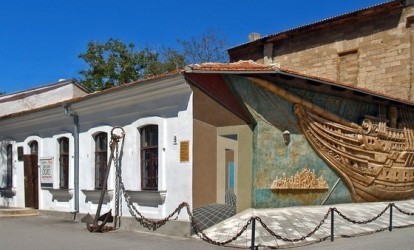
Location: Feodosiya
The Museum of Alexander Grin (often transliterated as Alexander Green in some sources, but correctly Aleksandr Stepanovich Grin) in Feodosiya, Crimea, is a literary-memorial institution dedicated to the life and works of the renowned Russian romantic writer, best known for his fantastical tales of adventure, the sea, and unyielding dreams, such as Scarlet Sails and She Who Runs on the Waves. Situated in a modest one-story house near the Black Sea coast at Galereynaya Street 10, the museum preserves the space where Grin resided and created some of his most iconic literature, offering visitors an immersive journey into his imaginative world. Grin himself affectionately referred to Feodosiya as "the city of tender watercolors," a nod to its serene coastal beauty that inspired much of his writing.
Grin moved to Feodosiya in 1924, seeking a quieter life after years
of hardship, including imprisonment and exile under the tsarist regime
for his revolutionary activities. The period from 1924 to 1929, spent in
this house, is often described as his happiest and most fruitful, during
which he penned major novels like She Who Runs on the Waves (1928), The
Golden Chain (1925), The Road to Nowhere (1929), and Jessie and Morgiana
(1929), along with numerous short stories. The house itself, built in
the late 19th century, became a symbol of his creative sanctuary until
financial difficulties forced him to relocate to Staryi Krym in 1930,
where he passed away in 1932.
The museum was officially established
as a memorial site and opened to the public on July 9, 1970, under the
initiative of local cultural authorities and Grin's widow, Nina Grin,
who played a key role in preserving his legacy. It operates as a
municipal non-profit cultural and scientific organization, focusing on
literary preservation and education. Today, it attracts around 35,800
visitors annually and employs 23 staff members, including seven curators
dedicated to research and exhibitions. This Feodosiya location is one of
four Grin museums worldwide, with others in Staryi Krym (his final
home), Vyatka (his birthplace), and a smaller site nearby, but the
Feodosiya museum stands out for its direct connection to his prime
creative years.
The museum's exterior is unassuming—a simple, light-colored one-story
building typical of early 20th-century Crimean architecture, with a
small adjacent museum park spanning 0.1 hectares that provides a
peaceful outdoor space for reflection. However, the interior is where
the magic unfolds. Designed by the artist and architect Savva G. Brodsky
(a friend of Grin and illustrator of his works), the space has been
ingeniously transformed into a symbolic sailing ship, evoking the
romantic maritime themes central to Grin's literature. This thematic
approach goes beyond a mere biographical display; it immerses visitors
in the "world of Grin's characters," with rooms styled as ship cabins
featuring austere dark wood paneling, portholes, and nautical motifs
that blend memorial authenticity with artistic fantasy.
The total
exhibition space spans 293.3 square meters for permanent displays and
107.3 square meters for temporary ones, plus a 95-square-meter museum
store and a scientific library. The design emphasizes creativity and
inspiration, hosting live music, modern art, graphics, and photography
to align with Grin's visionary outlook, making it a hub for artists,
writers, musicians, and actors.
With a collection of over 17,000 items (including 9,592 rare
artifacts), the museum's exhibits vividly reconstruct Grin's life,
influences, and literary universe. Key highlights include:
Memorial Study Room: The only fully preserved memorial space, this room
recreates Grin's workspace with meticulous detail. It features a green
baize-covered table where he wrote, shelves lined with his modest
collection of Russian and foreign prose, reproductions of antique
engravings depicting seascapes, a chest for storing manuscripts, two
bentwood chairs, a stiff couch, a lounge chair, a copper porthole, an
English telescope, a barometer, and a star globe. This room offers a
poignant glimpse into his daily routine and the introspective
environment that fueled his romanticism.
Cabin of Travel: A literary
exposition room dedicated to Grin's early life, covering his childhood
in Vyatka Province and adolescent years marked by wanderlust, odd jobs
(including as a sailor), and formative experiences that shaped his
seafaring tales.
Nautical and Literary Artifacts: Throughout the
"ship," visitors encounter models of sailing ships, age-old nautical
devices (like compasses and sextants), antique maps, a ship bell, ocean
shells, and personal items such as photographs, original manuscripts,
and first-edition books. Illustrations by Savva Brodsky, who captured
the ethereal quality of Grin's stories, are prominently displayed,
alongside rotating exhibits of contemporary art inspired by his works.
The museum also functions as a cultural center, regularly organizing
themed exhibitions, literary readings, and meetings with writers,
artists, and musicians to keep Grin's spirit of imagination alive.
Open from 10 a.m. to 6 p.m. (closed Mondays and Tuesdays), with box
office hours from 9:00 a.m. to 12:30 p.m. and 2:00 p.m. to 4:30 p.m.,
admission is affordable at around 15 UAH (Ukrainian hryvnia, though
prices may vary with local currency fluctuations). Reviews from visitors
often highlight its intimate, dreamy atmosphere, though some note it
feels "old and forgotten," suggesting a need for modernization while
praising its unique tribute to Grin's romanticism. Guided tours are
available, enhancing the experience by delving into Grin's biography and
the symbolism of the exhibits.
In the broader context of Feodosiya—a
historic city with over 2,500 years of history, featuring landmarks like
the Genoese Fortress and the Aivazovsky Art Gallery—the Grin Museum
stands as a beacon of literary heritage, inviting dreamers to sail into
the realms of fantasy amid Crimea's scenic backdrop.